Does a Sole Proprietor Need an EIN Number

No, a sole proprietor EIN number is not required unless the business hires employees, files excise returns or opens a Keogh plan. Otherwise the Internal Revenue Service (IRS) lets the owner file under a Social Security number (SSN). The Employer Identification Number (EIN) stays optional, and the IRS issues it free.
Key Takeaways
- A sole proprietor EIN number is required for employees, excise returns, alcohol, tobacco and firearms returns, retirement plans, withholding and gambling payouts.
- A sole proprietor with no trigger can file Schedule C and issue Forms 1099 under an SSN.
- A voluntary EIN keeps the SSN off client Forms W-9 and helps open a business bank account.
- One EIN covers every business and trade name a sole proprietor owns.
- A new EIN is required only after incorporating, forming a partnership or declaring bankruptcy.
What Is a Sole Proprietor EIN Number?
A sole proprietor EIN number is the nine-digit Employer Identification Number the IRS assigns to an unincorporated, one-owner business. The number is written XX-XXXXXXX and works as the business tax ID. According to IRS Publication 1635, the IRS issues the number free of charge.
A sole proprietor is one individual who runs a business without forming a corporation or a limited liability company (LLC). The owner reports profit and loss on Schedule C of Form 1040. That setup makes the sole proprietorship EIN number optional in many cases.
New owners meet this choice early. According to the Census Bureau, applicants filed about 5.6 million new business applications in 2025. The SBA Office of Advocacy counts 36.2 million small businesses in the United States. Owners comparing structure options should settle the tax ID question at the same time.
The tax ID question has a precise answer, and that answer depends on the IRS trigger list.
When Does a Sole Proprietor Need an EIN Number?
A sole proprietor needs an EIN number only when a specific IRS trigger applies. The IRS names employees, excise taxes, alcohol, tobacco and firearms taxes, and withholding on non-wage income paid to a non-resident alien. The 2025 Schedule C instructions add qualified retirement plans and gambling payouts.
The 6 triggers are listed below.
- Hiring one or more employees and filing employment tax returns.
- Filing federal excise tax returns.
- Filing alcohol, tobacco and firearms tax returns.
- Withholding tax on non-wage income paid to a non-resident alien.
- Maintaining a qualified retirement plan, including a Keogh plan.
- Paying gambling winnings.
Earning income, invoicing clients and paying contractors are not triggers by themselves. A freelance designer with no staff and no retirement plan can file under an SSN. The trigger that catches most owners is the first employee.
Does a Sole Proprietor With Employees Need an EIN?
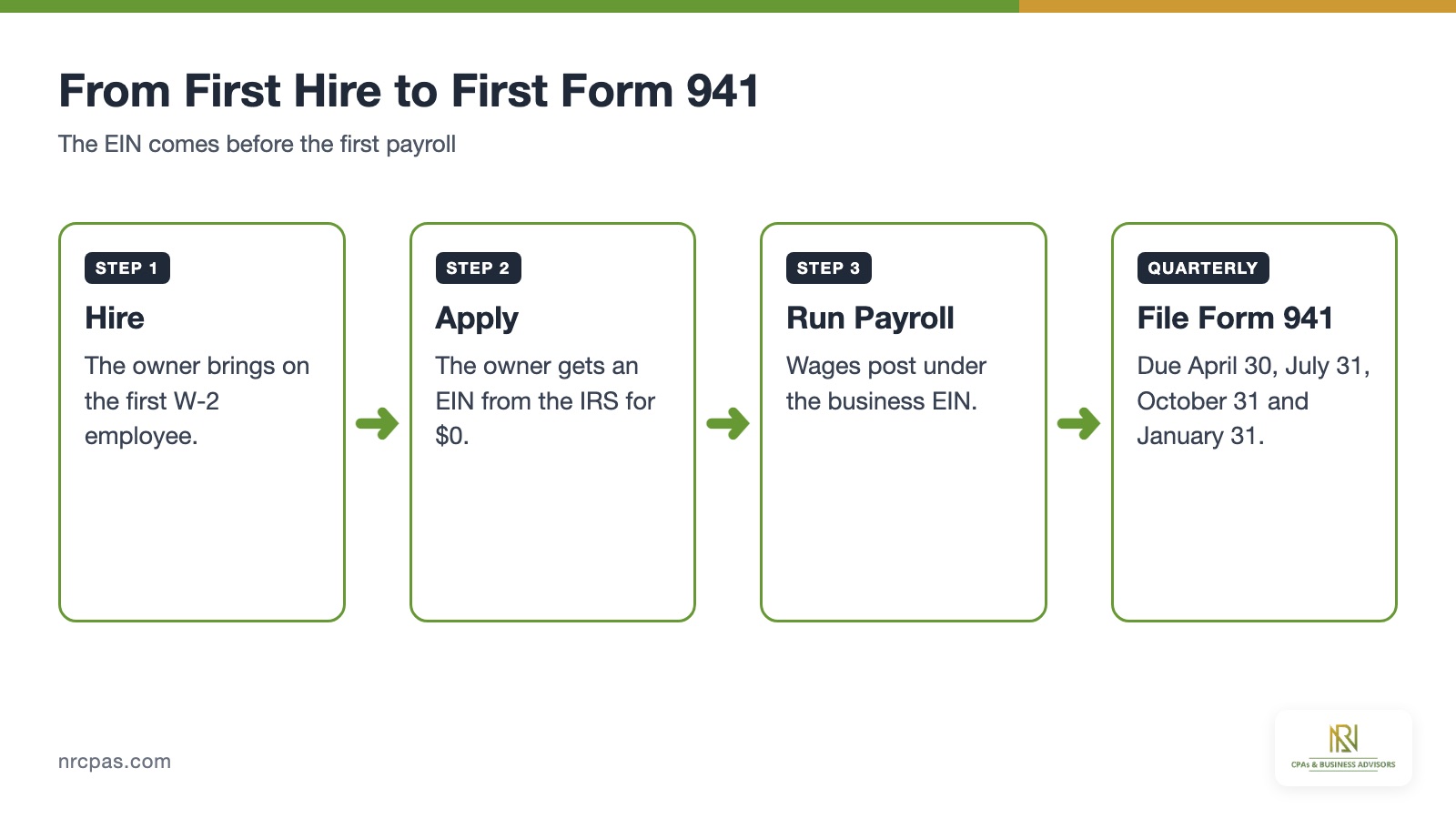
A sole proprietor with employees needs an EIN before the first payroll. The EIN goes on Form 941, the quarterly payroll return, and on every Form W-2. According to the IRS, Form 941 is due on April 30, July 31, October 31 and January 31.
A payroll provider does not change that rule. The IRS treats the owner as the employer, so the EIN must belong to the owner's business. The provider files the returns, while the liability stays with the owner.
Household employees follow the same rule. A nanny, housekeeper or caregiver who works in the owner's home triggers an EIN for household employment taxes. That trigger applies even when the business has no staff. Owners planning a first hire can add payroll tax advice before the first paycheck.
The flow graphic below traces a first hire from application to the first Form 941.
Payroll is one filing that carries an EIN. Excise returns and retirement plans are the next two.
Do Excise Taxes and Retirement Plans Require an EIN for a Sole Proprietor?
Excise tax returns and qualified retirement plans each require an EIN for a sole proprietor. Excise returns and Keogh plans both need an EIN, even for a one-person business. Federal excise taxes apply to goods such as fuel, tobacco, alcohol and firearms.
A Keogh plan is a qualified retirement plan for self-employed owners. According to the IRS, a one-participant 401(k) plan must file Form 5500-EZ once its assets reach $250,000 at year end. That filing carries the plan's EIN.
The same retirement rule covers a Solo 401(k). The IRS sets the 2026 employee deferral limit for a 401(k) at $24,500. Owners who want the retirement plan limits in numbers can compare plan sizes before applying.
Outside these triggers, the SSN still does the job. That leads to the choice between an SSN and an EIN.
Should a Sole Proprietor Use an SSN or an EIN?
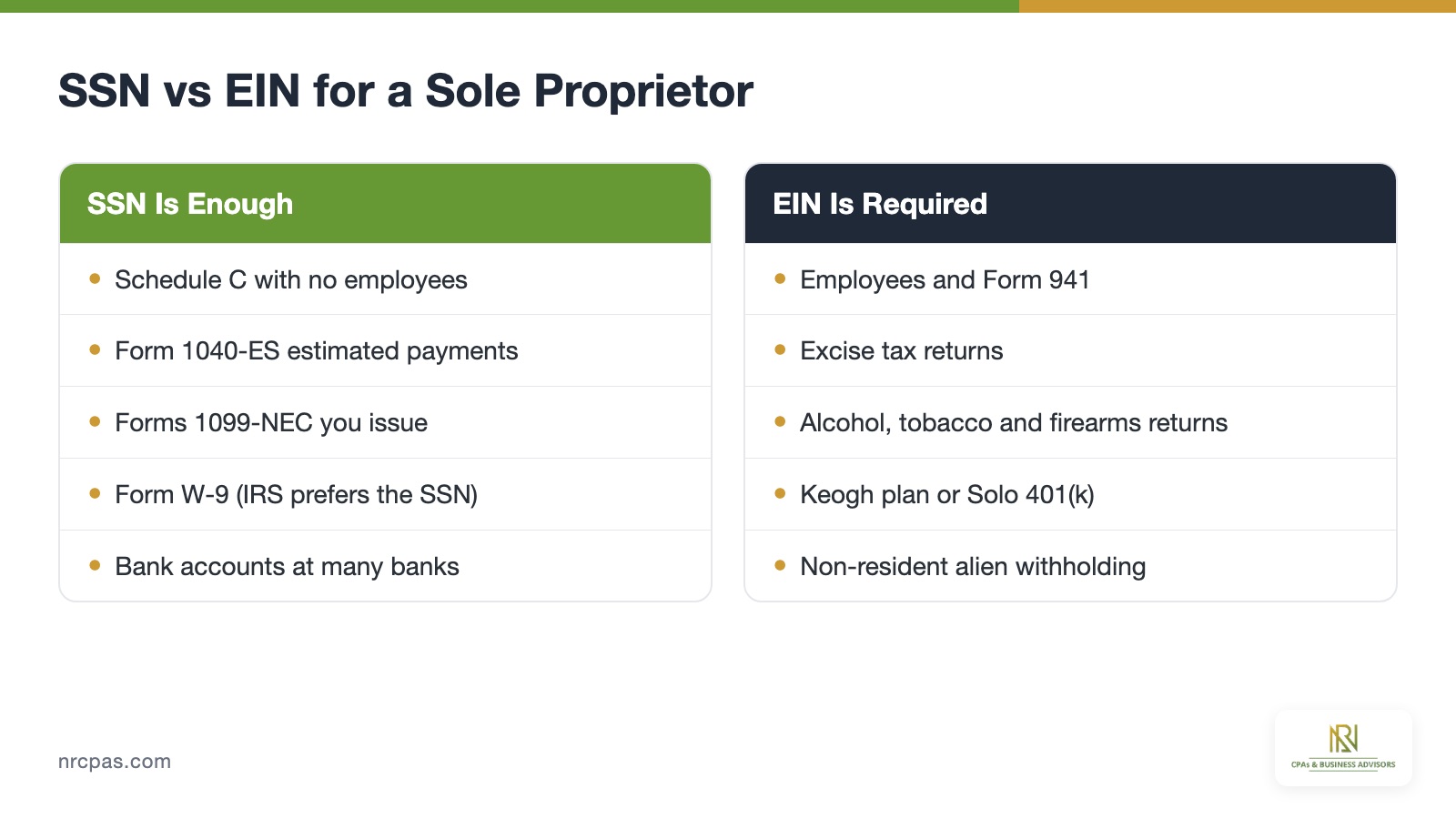
A sole proprietor can use an SSN when no IRS trigger applies. A sole proprietor SSN goes on Schedule C, on Form 1040-ES estimated payments and on Forms 1099-NEC the owner issues. According to the IRS, 1099-NEC reporting starts at $2,000 for payments made on or after January 1, 2026.
The 2025 Schedule C instructions say to leave line D blank when the owner has no EIN. The table below sorts 6 common situations by the number each one accepts.
| Situation | SSN | EIN | Decided by |
|---|---|---|---|
| Schedule C with no employees | Allowed | Optional | Owner |
| First employee on payroll | Not accepted | Required | IRS |
| Keogh plan or Solo 401(k) | Not accepted | Required | IRS |
| Excise tax return | Not accepted | Required | IRS |
| Form W-9 for a client | Allowed, IRS preferred | Allowed | Owner |
| Business bank account | Accepted at many banks | Often requested | Bank |
The rows marked Owner are the real choices. The comparison graphic below shows the same split between SSN-only and EIN-only filings.
Either number leads to the same tax result. According to the IRS, self-employment tax runs 15.3%, and Schedule SE applies once net earnings reach $400. Owners can claim half of that tax as a reduction in income through the SE tax write-off. Equal tax results leave privacy and banking as the reasons to get an EIN anyway.
Why Would a Sole Proprietor Get an EIN Anyway?
A sole proprietor gets an EIN anyway to protect the SSN, open a business bank account and look established. The main benefit of a voluntary EIN is privacy on Form W-9. Every client that issues a Form 1099 asks for that form first.
A W-9 sits in the client's vendor file for years. According to the IRS, a sole proprietor may enter an SSN or an EIN on Form W-9. The IRS prefers the SSN. The EIN still keeps the SSN out of those files.
A business bank account is the second reason. Federal customer identification rules require a bank to collect a taxpayer identification number before opening any account. A sole proprietor SSN meets that rule, but larger banks often ask for an EIN on business accounts.
Lenders ask for the number too. Owners who want EIN credit cards need the number on the application. The same number then builds a credit file separate from the owner's personal file.
Wholesale suppliers and corporate clients also request a tax ID. The next step is getting one, and the IRS process is short.
How Does a Sole Proprietor Get an EIN?
A sole proprietor gets an EIN by applying to the IRS online, by fax or by mail. The IRS charges nothing, and the online application issues the number immediately. According to the IRS, a fax reply arrives in about 4 business days, and mail takes about 4 weeks.
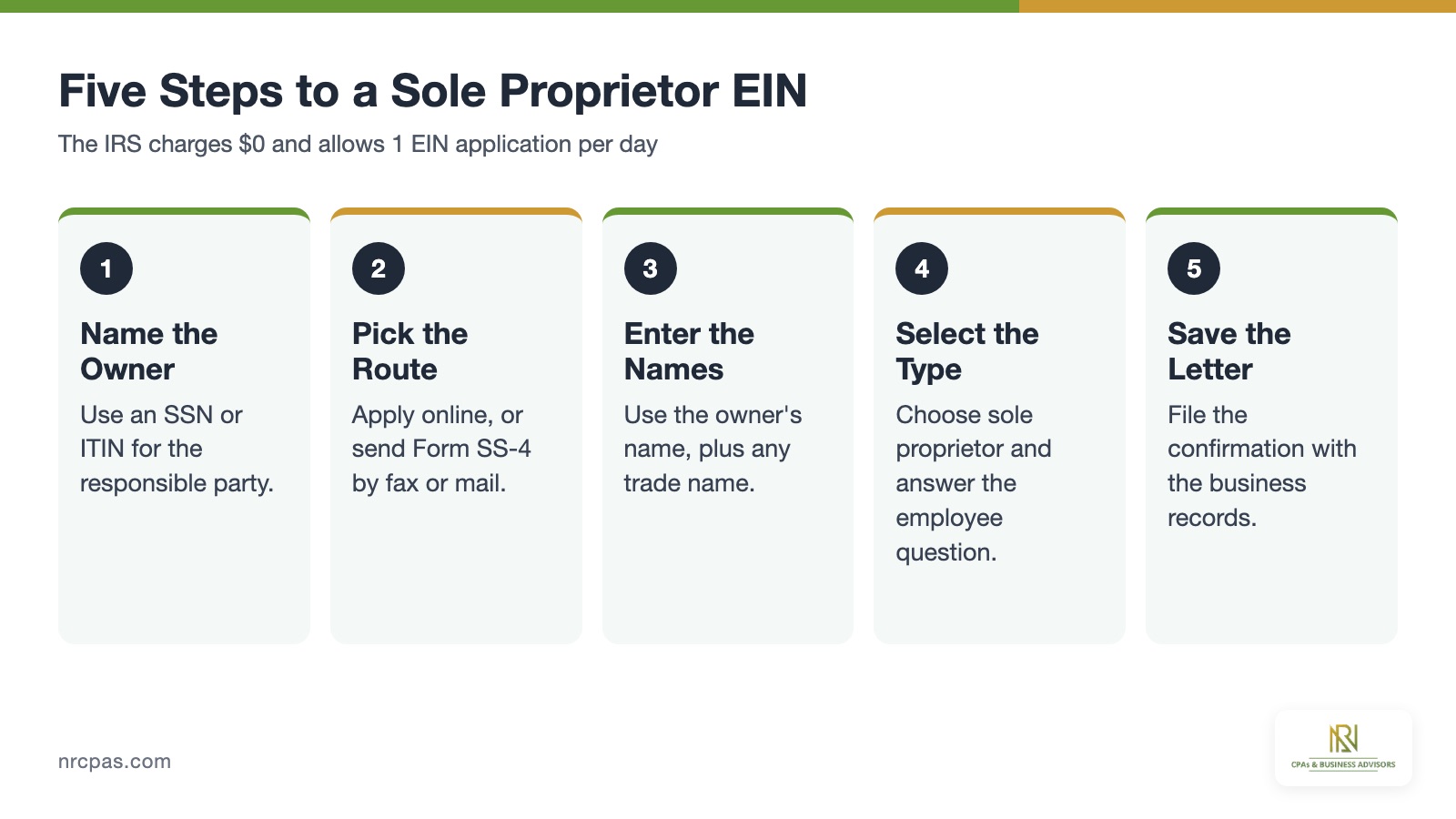
Learning how to get an EIN for a sole proprietorship takes 5 steps, listed below.
- Confirm the owner has an SSN or an Individual Taxpayer Identification Number (ITIN) to name as the responsible party.
- Open the IRS online EIN application, or download Form SS-4 for fax or mail.
- Enter the owner's individual name as the legal name and any trade name on the DBA line.
- Select sole proprietor as the entity type and answer the employee question accurately.
- Save the confirmation letter with the business records.
Form SS-4 is the paper application for any EIN number sole proprietorship owners request by fax or mail. The steps appear in the same order in the graphic below.
The IRS allows only 1 EIN application per day, whether online, by phone, by mail or by fax. Third-party sites that charge a fee add no authority, because the IRS fee is $0. A trade name on the form raises a state question, and the DBA requirements explain it.
Once the number exists, the next question is how far it stretches across several businesses.
Does a Sole Proprietor Get One EIN for Every Business?
A sole proprietor needs only one EIN, no matter how many businesses or trade names the owner runs. The IRS says owning multiple businesses does not require a new EIN. The owner is the taxpayer behind every venture.
The return still separates the ventures. The Schedule C instructions say to complete a separate Schedule C for each business. A landscaper with a web design side business therefore files 2 Schedule C forms under one number.
Each owner holds a separate number, though. Two sole proprietors cannot share one EIN, and a business with two owners is a partnership with its own EIN. The shared EIN rules cover the full comparison for LLCs and corporations.
One number lasts until the structure changes. A structure change is the next event that creates a new EIN.
When Does a Sole Proprietor Need a New EIN?
A sole proprietor needs a new EIN when the business incorporates, forms a partnership or declares bankruptcy. A name change or a move never requires a new EIN. According to the IRS, those 3 events are the ones listed for sole proprietors.
The old number cannot move to the new entity. A corporation or partnership is a separate taxpayer, so the IRS issues it a separate number. The IRS also says a buyer of an existing business must apply for its own EIN.
Owners who turn a trade name into a company face the same rule. The DBA upgrade post explains the filing order. A wrong number at that stage carries a cost, as the next section shows.
What Happens If a Sole Proprietor Uses the Wrong Number?
A sole proprietor who uses the wrong number faces backup withholding and information return penalties. A missing taxpayer identification number can trigger 24% backup withholding. According to the IRS, a payer must withhold 24% when the payee gives no taxpayer identification number.
Penalties add to the withholding. For returns due in 2026, the IRS penalty reaches $340 per return, or $680 per return for intentional disregard. A name on line 1 of Form W-9 that does not match the number causes most mismatch notices.
The IRS can waive a penalty for reasonable cause, such as a quick correction. A TIN notice response should include a corrected Form W-9. The corrected form closes the mismatch, and other questions sole proprietors ask about EINs follow from it.
What Other Questions Do Sole Proprietors Ask About EINs?
Can a Sole Proprietor Use the Same EIN for an LLC?
A sole proprietor cannot always reuse one EIN for an LLC, because LLCs with tax duties need their own. According to the IRS, a single-member LLC without employees or excise tax can use its owner's SSN or EIN. The LLC needs its own EIN once it pays wages.
Banks and many states ask for an LLC EIN anyway. Owners who review the LLC number timing before filing avoid a duplicate application.
How Does a Sole Proprietor Differ From a Single-Member LLC?
A sole proprietor differs from a single-member LLC in legal structure, not in the default federal return. Both report profit on Schedule C by default. The sole proprietor vs LLC choice changes the liability wall, because a sole proprietor has none.
A disregarded LLC owner still pays self-employment tax on net earnings. The one-member LLC rules show how the numbers compare.
Is There a Downside to Having an EIN?
The downside of having an EIN is one more number to keep consistent across forms. An EIN costs $0 and does not change the tax rate. The application asks whether the business has employees, and an honest answer prevents payroll notices.
What Happens If You Create an EIN and Never Use It?
An EIN that is never used stays assigned to the owner and costs nothing. According to the IRS, the agency cannot cancel an EIN, but it can deactivate one. The owner keeps the confirmation letter for the day the number is needed.
How Much Must a Sole Proprietor Earn to File Taxes?
A sole proprietor must file Schedule SE once net self-employment earnings reach $400. According to the Social Security Administration (SSA), the 2026 Social Security wage base is $184,500. Net earnings above that amount still pay the 2.9% Medicare portion.
Who Can Help a Sole Proprietor With an EIN?
A CPA firm can confirm which number belongs on each form before a filing goes out. We review triggers, payroll plans and retirement plans for sole proprietors. The firm is led by founder Nischay Rawal, CPA, EA, and the office line is (305) 872-3096.
Owners who want a second opinion can talk with NR tax experts about triggers, forms and filing dates. That review lists the number each return needs. It also flags the day a hire or a plan makes the EIN mandatory.
The sole proprietor EIN number rule is simple: use the SSN until a trigger appears, then apply for the EIN. Owners who want that rule built into a sole proprietor setup can start with the structure review.