Can You Use the Same EIN Number for Multiple Businesses

No, you cannot use the same EIN number for multiple businesses when each business is a separate legal entity. The Internal Revenue Service (IRS) assigns one Employer Identification Number (EIN) per entity, so each LLC, corporation or partnership needs its own. One EIN does cover several brands, locations and ventures that sit inside a single sole proprietorship.
Key Takeaways
- One EIN identifies one taxpayer, so every separate LLC, corporation and partnership needs its own number.
- A sole proprietor keeps the same EIN for multiple businesses, trade names and locations.
- The IRS allows only 1 EIN per responsible party per day, whether you apply online, by fax or by mail.
- A new EIN is required after incorporating, forming a partnership, creating a trust or opening an estate.
- An EIN cannot be canceled, so an old number stays with its original entity.
Can You Use the Same EIN Number for Multiple Businesses?
You can use the same EIN number for multiple businesses only when those businesses belong to one taxpayer. Separate legal entities each need their own EIN, even when one person owns all of them. The IRS ties the number to the entity, not to the owner, the brand or the bank account.
Owners often ask can you use the same EIN number for multiple businesses after forming a second company. The entity rule gives three clear cases. One sole proprietor with several ventures keeps one EIN. One LLC with several trade names keeps one EIN. Two LLCs formed under state law need two EINs. Owners who plan separate entity setup should settle that count before filing anything.
According to the Census Bureau, applicants filed more than 5.6 million new business applications in 2025. Each application that creates a new entity starts a new EIN decision. The first step is knowing what the number actually identifies.
What Does an EIN Identify for the IRS?
An EIN identifies one taxpayer on every business tax filing. The IRS issues it as a nine-digit number in the format XX-XXXXXXX. The number follows the entity, not the product line, so adding a service never creates a new one.
Employers, partnerships, corporations, trusts and estates all use EINs. The IRS also states that you need one to hire employees or pay excise taxes. Sole proprietors without employees can use a Social Security number (SSN) instead, though many still apply for an EIN.
An EIN is not a substitute for an SSN on personal returns. The IRS says to use the number only for business activities. That limit explains why several ventures can share one number only when one taxpayer owns them all.
When Can One EIN Cover More Than One Business?
One EIN covers more than one business when the same legal entity owns every activity. New brands, new locations and new trade names do not change the taxpayer. The IRS lists a business name change and a location change as events that need no new EIN.
The table below sorts the common setups by whether they need a separate EIN.
| Setup | Separate EIN needed | Reason |
|---|---|---|
| Sole proprietor with 3 ventures | No | One taxpayer owns all three |
| One LLC with 2 trade names | No | A trade name is not an entity |
| Corporation with a division | No | A division is part of the corporation |
| Two separate LLCs | Yes, 2 EINs | Each LLC is its own entity |
| Corporation with a subsidiary | Yes, subsidiary gets its own | The subsidiary is a separate corporation |
The comparison graphic below shows the same split between one-EIN and many-EIN structures.
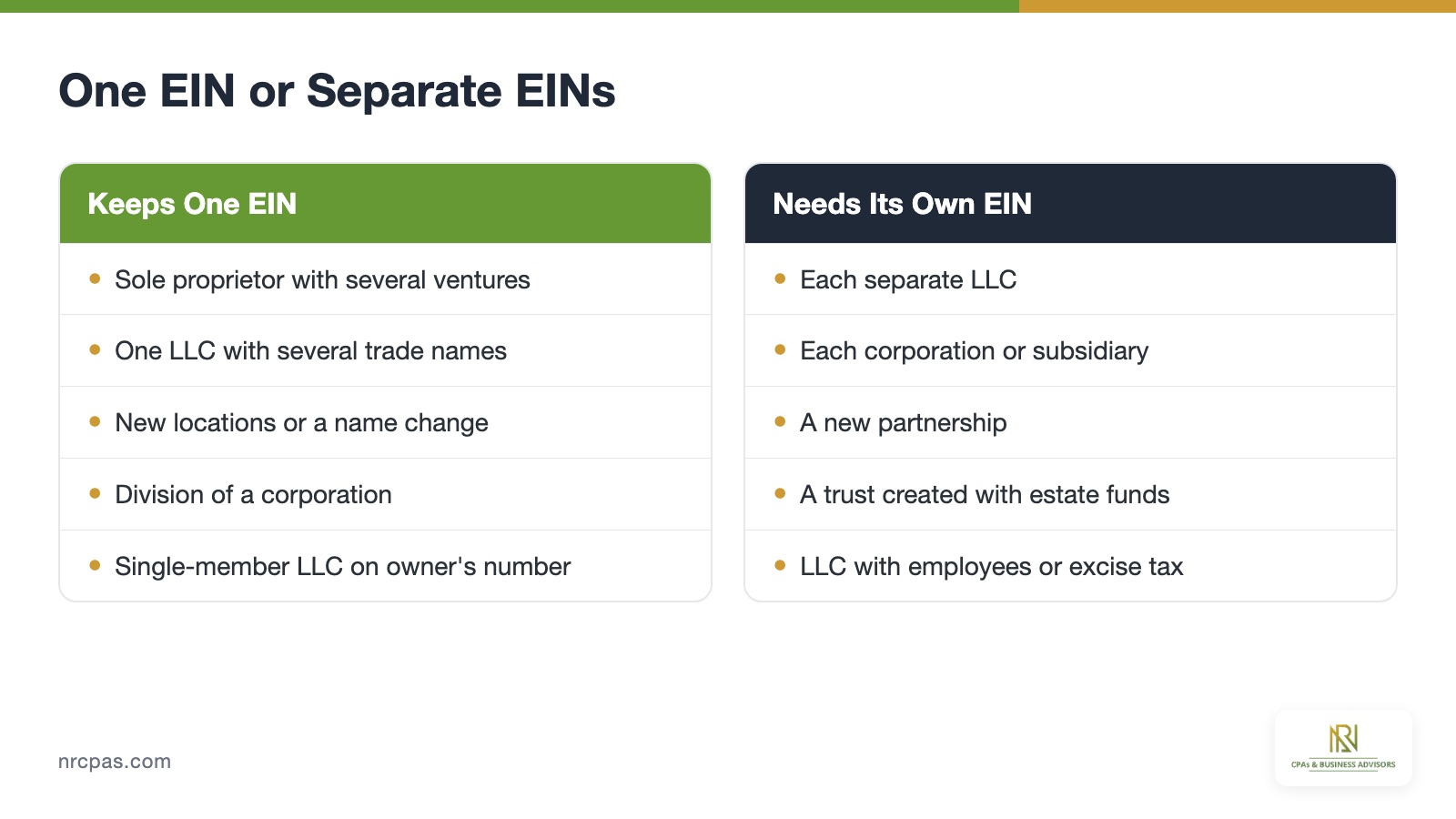
Sole proprietors fall on the one-EIN side of that split. Their tax return still has a few quirks, covered next.
Can a Sole Proprietor Use One EIN for Several Businesses?
A sole proprietor can use one EIN for several businesses. The IRS says owning multiple businesses does not require a new EIN. The sole proprietor is the taxpayer behind every venture. Pub 1635 repeats that rule for stores, plants and branches.
The return still separates the ventures. The Schedule C instructions say to file a separate Schedule C for each business you own. A landscaping company and a web design practice therefore produce 2 Schedule C forms with the same EIN or SSN.
Self-employment tax then merges the results. According to the IRS, self-employment tax runs 15.3%, which is 12.4% for Social Security plus 2.9% for Medicare. A loss in one venture lowers the combined earnings, and Schedule SE applies once net earnings reach $400. Owners comparing structures can review disregarded entity rules before choosing.
The Social Security Administration (SSA) sets the 2026 Social Security wage base at $184,500. Net earnings above that amount still pay the 2.9% Medicare portion. Shared liability is the cost of this convenience, because a sole proprietor has no legal wall between ventures. A wall appears only when an owner creates a new entity, and that step triggers new EIN rules.
When Do You Need a New EIN for a New Business?
You need a new EIN for a new business when the new business changes the entity's ownership or structure. The IRS says a new EIN is needed, in general, when ownership or structure changes. The IRS also lists specific events for each entity type.
The table below summarizes the IRS list for each entity type.
| Entity | Get a new EIN if you | No new EIN if you |
|---|---|---|
| Sole proprietor | Incorporate, form a partnership or declare bankruptcy | Change name or location, or own multiple businesses |
| Corporation | Get a new charter, become a subsidiary or merge into a new corporation | Change name, declare bankruptcy or choose S status |
| Partnership | Incorporate or end it and begin a new one | Change name, location or ownership without termination |
| LLC | Form a new corporation or partnership, or owe employment or excise tax as a single member | Change name, or elect corporate or S status |
| Estate or trust | Create a trust with estate funds, or change a revocable trust to irrevocable | Change the trustee or executor address |
Every row follows one pattern. A new taxpayer gets a new number. The answer to can you use the same EIN number for multiple businesses stays no. A pass-through return planning review before the change keeps old and new EINs from overlapping on returns.
The LLC row has one special case. According to the IRS, a single-member LLC without employees or excise tax can use its owner's SSN or EIN. That LLC must use its own EIN once it pays wages. Banks and many states ask for an LLC EIN anyway, and that leads to the application steps.
How Do I Get an EIN Number for My New Business?
To get an EIN number for a new business, form the entity with the state first. Then apply to the IRS for free. The online application issues the EIN immediately after approval. The IRS warns that an application filed before the entity exists may be delayed.
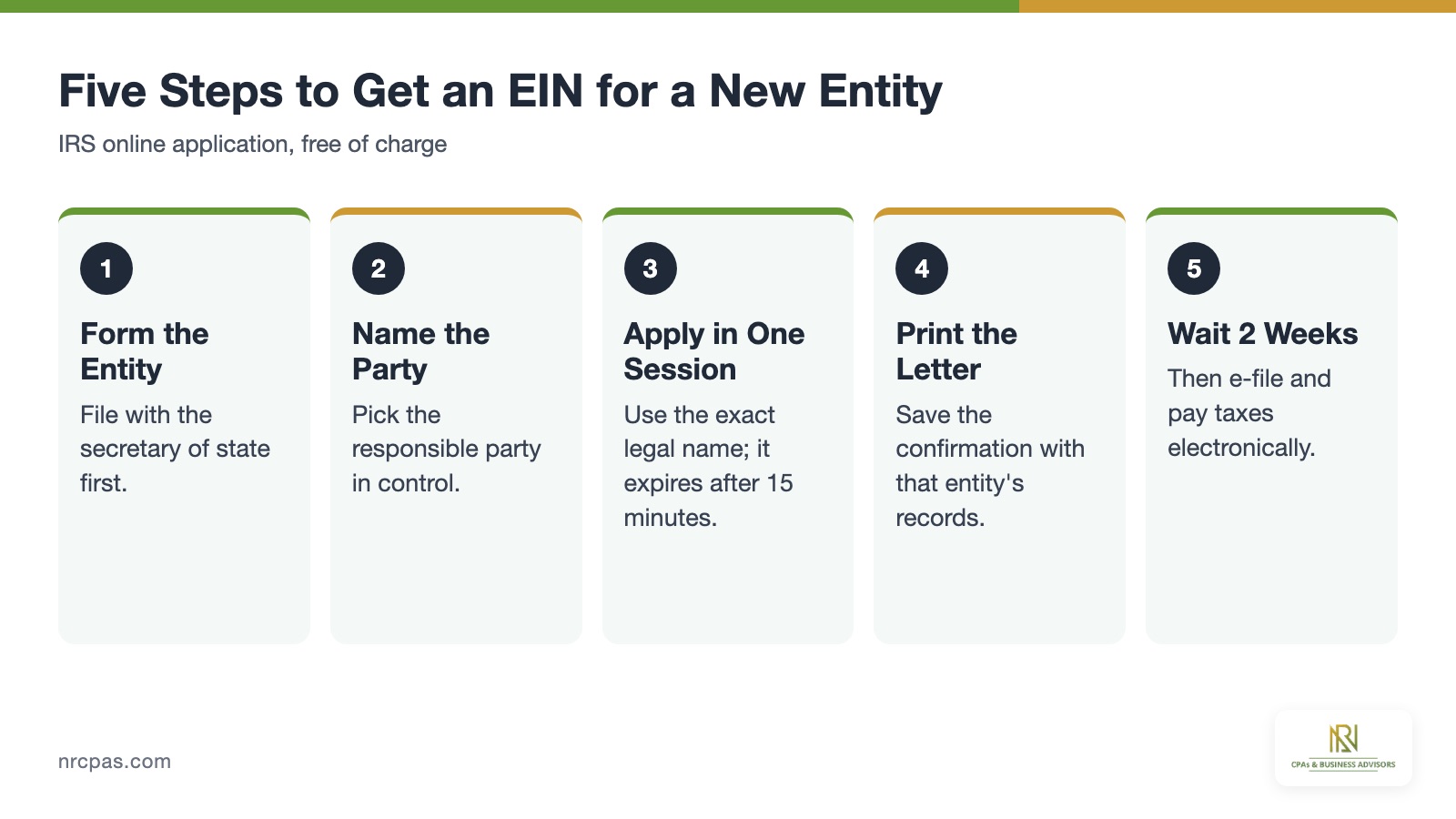
Follow these 5 steps for each new entity.
- File the articles of organization or incorporation with the secretary of state.
- Name the responsible party, meaning the person who controls the entity and its assets.
- Submit the online application in one session with the legal name exactly as formed, because it expires after 15 minutes of inactivity.
- Print the confirmation letter and save it with that entity's records.
- Wait up to 2 weeks before e-filing or paying taxes electronically with the new EIN.
The steps appear in order in the graphic below.
The IRS also lets owners apply by fax or mail. The IRS replies to a fax in about 4 business days, and mailed Form SS-4 returns an EIN in about 4 weeks. Owners who want the filing handled can use new company filing support. Owners with several entities still hit a scheduling limit, which the next section explains.
How Many EINs Can I Get Per Day?
You can get only 1 EIN per day for each responsible party. The IRS limit applies to online, phone, fax and mail requests alike. An owner forming 4 LLCs therefore needs 4 separate days.
The online tool runs Monday through Friday from 6 a.m. to 1 a.m. Eastern Time. Saturday hours end at 9 p.m., and Sunday service runs from 6 p.m. to midnight. Owners can start the next application the following day.
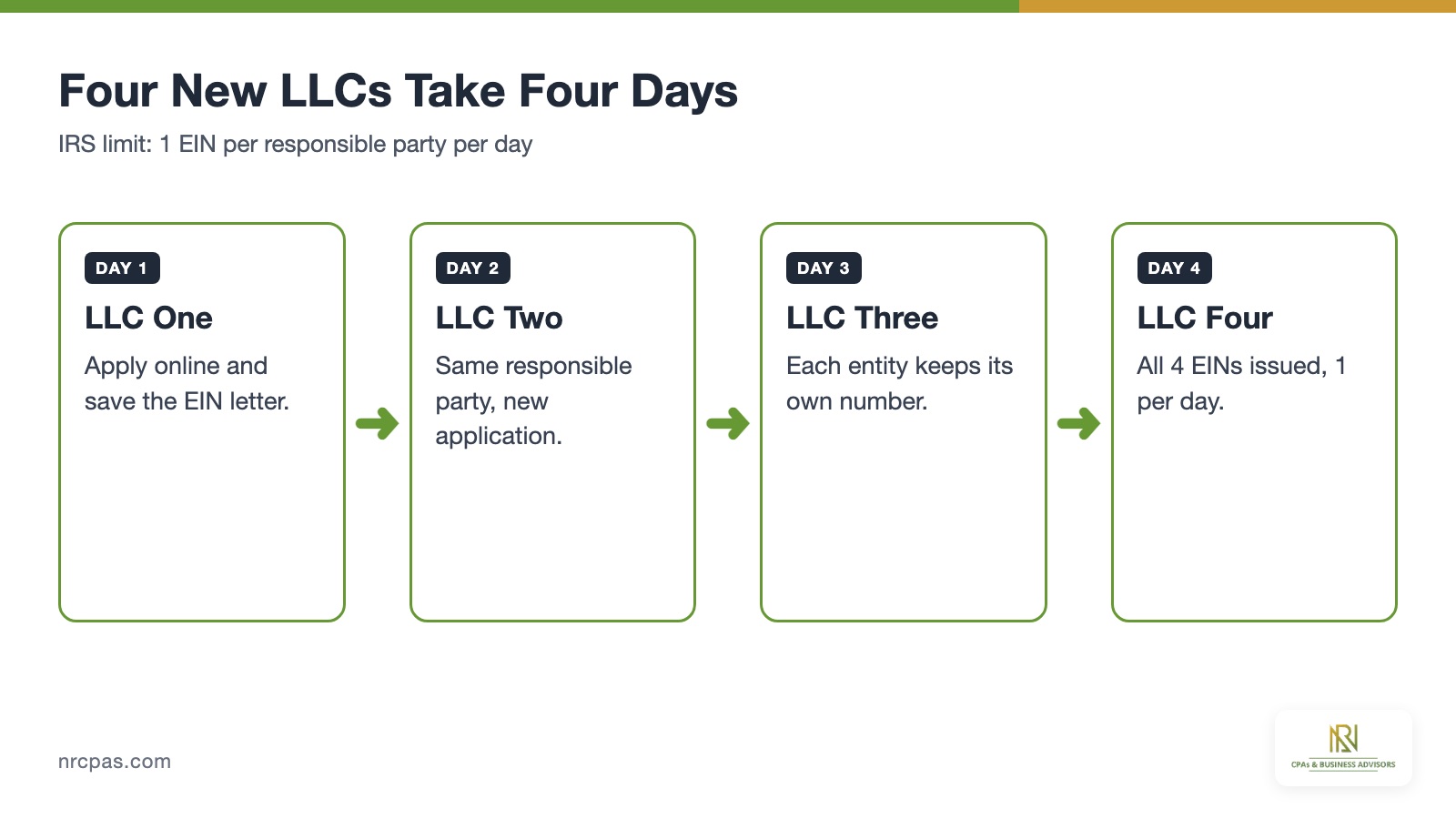
The timeline graphic above shows 4 applications across 4 days. Founders who rush the process by reusing one EIN pay for it later, as the next section shows.
What Happens If I Use the Same EIN for Two Businesses?
Using the same EIN for two separate businesses causes mismatched tax records, penalties and weaker liability protection. The IRS matches each return to the legal name tied to the number. A second entity filing under that number creates a mismatch.
The financial damage shows up in four places, listed below.
- Payroll deposits and returns post to the wrong entity's account.
- Forms 1099 and W-2 carry a name that does not match the number.
- Banks and payment processors freeze or question the mismatched accounts.
- Courts may treat the two companies as one when books and numbers blur.
According to the IRS, information return penalties for 2026 start at $340 per return and reach $680 per return for intentional disregard. Commingled records also invite a claim to pierce the corporate veil, which can make an owner personally liable. Clean entity-level financials prove that each company stands apart.
Fixing a mistake starts with a call. The IRS says a business entity should have only one EIN. Owners who hold more than one can call the Business and Specialty Tax Line at 800-829-4933. The call settles which number to keep, and many related questions follow from it.
What Other EIN Questions Do Multi-Business Owners Ask?
Can I Use My EIN Number for Another Business?
You can use your EIN number for another business only when the other business belongs to the same entity. A new LLC or corporation needs a new number even when you own both. A new brand under your current entity keeps the current number.
Owners starting a company for a new idea often wonder whether a new venture advisory review is worth it before filing. The review compares one entity against two.
Do I Need a Separate EIN for Each LLC?
You need a separate EIN for each LLC that has employees, excise taxes or a partnership or corporate tax status. Every LLC with employment or excise tax duties must use its own EIN. A single-member LLC without those duties may use its owner's number for income tax.
Most owners still apply for each LLC, since banks ask for the number. According to the SBA Office of Advocacy, the United States has 36.2 million small businesses, and Florida has 3.49 million of them. Owners with several entities appear in both counts.
Can I Get Another EIN If I Already Have One?
You can get another EIN if you already have one when you form a new entity or change your structure. The IRS blocks only a second number for the same entity. A second number for one entity creates the duplicate-number problem noted earlier.
The same rule covers a holding company that owns its subsidiaries. Each subsidiary corporation takes its own EIN, so a multi-brand planning session should map the full structure before any filing.
Can Two People Have the Same EIN Number?
Two people can share one EIN only through an entity they both belong to. A partnership has one EIN, and each partner reports income with a personal SSN. Two separate sole proprietors cannot share a number.
The IRS says nominees are not authorized to apply for an EIN. Each application names one responsible party, who must be a person in control of the entity. That person's SSN is the one the IRS counts for the daily limit.
Can I Reuse an Old EIN for a New Business?
You can reuse an old EIN only for the same entity that first received it. The IRS cannot cancel an EIN, but it can deactivate one. A closed company keeps its number for its final returns.
A new entity that replaces a closed one needs a fresh number. The IRS also says a buyer must use its own EIN for payroll and never the prior employer's. Owners who close a company should still file final returns, and unpaid balances may need notice resolution support.
How Do You Use Your Business EIN Number for Credit?
Learning how to use your business EIN number for credit starts with matching each EIN to its own accounts. Lenders build business credit files by EIN. A shared number would blend two companies into one file.
Apply for credit under the legal name on the IRS letter. The name, address and EIN must match across the application, the W-9 and the bank account. Each entity then builds its own repayment history, and clean books prove it to lenders.
Who Can Help With Multiple EINs and Business Entities?
A CPA firm can map your entities, EINs and tax filings before any application goes to the IRS. We work with owners who run several companies and need each one filed correctly. The firm is led by founder Nischay Rawal, CPA, EA, and the office line is (305) 872-3096.
Founders who want a second opinion on structure can talk with NR CPAs experts about entities, EINs and books. That review covers which companies need their own number and which can share one. It also lists the filing deadlines for every entity you own.
Choosing between a pass-through and a corporation also shapes the EIN count. The LLC-versus-S-corp comparison shows how each choice changes the tax return that carries the number.
The answer to can you use the same EIN number for multiple businesses is no across separate entities and yes within one. Owners who map their structure first can finish with entity planning built on that rule.