How to Make a Cash Flow Statement Step by Step


Learn how to make a cash flow statement from the income statement and two balance sheets, using the indirect or direct method. Seven steps turn those records into operating, investing and financing totals that sum to the change in cash. The Financial Accounting Standards Board (FASB) sets the format in ASC 230.
Key Takeaways
- A cash flow statement needs 3 source records: the income statement and two consecutive balance sheets.
- The indirect method starts at net income, while the direct method lists gross cash receipts and payments.
- Both methods report the same operating total, and the 3 sections add up to the net change in cash.
- Increases in receivables and inventory reduce operating cash, while increases in payables raise it.
- Ending cash on the statement must equal the cash line on the ending balance sheet.
How Do You Make a Cash Flow Statement Step by Step?
You make a cash flow statement step by step by gathering source records, choosing a method and totaling three sections. Then you reconcile to ending cash. The statement always closes on one equation: beginning cash plus net change in cash equals ending cash. Seven steps cover the full build.
According to the U.S. Small Business Administration (SBA) Office of Advocacy, the country has 36.2 million small businesses. Owners who ask how to prepare a cash flow statement from scratch can follow the numbered list below. The list works for a month, a quarter or a year.
- Pick the reporting period and collect the income statement, the beginning balance sheet and the ending balance sheet.
- Choose the indirect method or the direct method for operating cash flow.
- Calculate net cash from operating activities.
- Calculate net cash from investing activities.
- Calculate net cash from financing activities.
- Add the three totals to get the net change in cash, then add beginning cash.
- Match ending cash to the balance sheet and list any noncash transactions.
The graphic below shows the seven steps in the order a bookkeeper completes them.
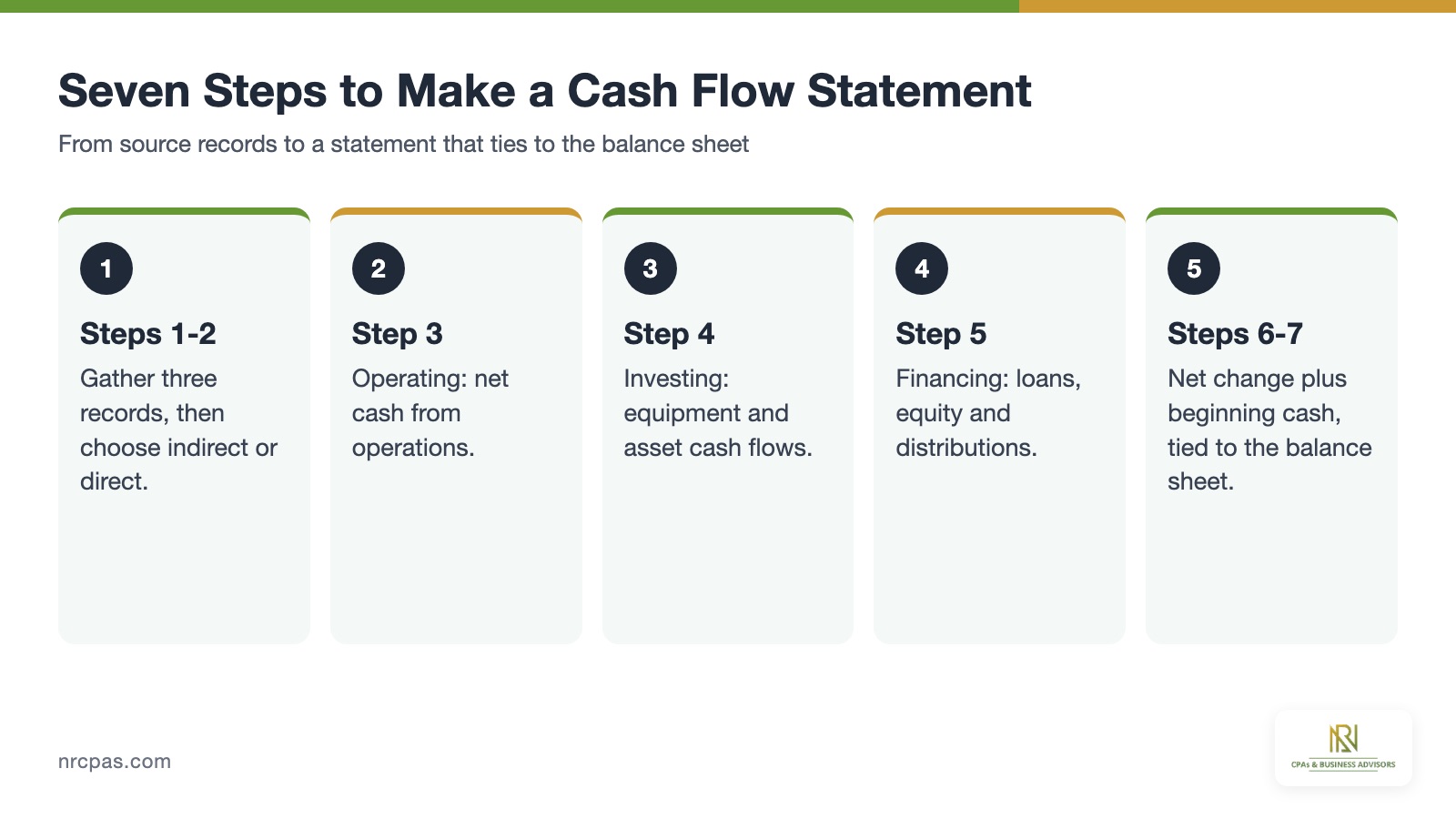
Teams that outsource statement preparation follow the same sequence every close. Step 1 depends on having the right records in hand.
What Do You Need Before You Prepare a Cash Flow Statement?
Before you prepare a cash flow statement, you need six records. They are the income statement, two balance sheets, the fixed asset ledger, loan records and bank statements. The two balance sheets must be consecutive, ending on the first and last day of the period. The table below lists each record and the section it feeds.
| Record | What it supplies | Section it feeds |
|---|---|---|
| Income statement | Net income, depreciation, gains and losses, interest expense | Operating |
| Beginning balance sheet | Opening cash and prior account balances | All sections |
| Ending balance sheet | Closing cash and new account balances | All sections |
| Fixed asset ledger | Equipment purchases, sales and depreciation | Investing |
| Loan and equity records | Borrowing, principal payments, owner draws | Financing |
| Bank statements | Proof of every cash total | Final check |
The accounting method behind the books changes how much adjusting the statement needs. According to the Internal Revenue Service (IRS), the cash method reports income when received, and the accrual method reports income when earned.
Cash-basis books carry no receivables or payables, so operating cash flow sits close to net income. Accrual books need every working capital adjustment shown later in this post. According to the IRS, the cash method is open to businesses averaging $31 million or less in receipts for 2025 tax years. That method choice belongs in cash-basis planning before year end.
With the six records in hand, the next question is what each section of the statement reports.
What Are the Three Sections of a Cash Flow Statement?
The three sections of a cash flow statement are operating, investing and financing activities. Operating activities report cash from running the business, and investing activities report cash from long-term assets. Financing activities report cash from owners and lenders.
What Goes in Operating Activities?
Operating activities include cash received from customers and cash paid to suppliers, employees, landlords and lenders for interest. Operating activities show whether the core business funds itself. Under U.S. generally accepted accounting principles (GAAP), interest paid and interest received both sit in this section.
According to the Federal Reserve Banks' Small Business Credit Survey, 51% of 7,653 small firms named uneven cash flow a financial challenge. The same survey found 56% of firms named paying operating expenses as a challenge.
The JPMorgan Chase Institute measured the cushion behind those numbers. According to that research, the median small business holds 27 cash buffer days, and 25% hold fewer than 13. The median small restaurant holds 16 days, so restaurant cash flow needs close tracking.
Cash that leaves the business for long-term assets belongs in the next section.
What Goes in Investing Activities?
Investing activities include cash paid for equipment, property and securities and cash received from selling them. The full purchase price of equipment appears as an investing outflow in the year it is paid. Loans made to others and collections on those loans also sit here.
A tax deduction does not change that cash outflow. According to the IRS, the 2025 Section 179 limit is $2,500,000, and the phase-out begins at $4,000,000 of purchases. The Section 179 limits lower taxable income, while the statement still shows the full cash paid.
Money raised to pay for those assets is reported in the third section.
What Goes in Financing Activities?
Financing activities include cash from loans and owner contributions and cash paid for loan principal and owner distributions. Loan proceeds are a financing inflow, and principal repayments are a financing outflow. Interest on the loan stays in operating activities under U.S. GAAP.
According to the SBA, 7(a) loans reach up to $5 million, and every dollar borrowed lands in this section. Dividends paid to shareholders also appear here. Owner draws and distributions follow the same rule for LLCs and partnerships.
The three sections come together in the indirect method, the format used in the worked example below.
How Do You Make a Cash Flow Statement With the Indirect Method?
You make a cash flow statement with the indirect method by starting at net income. Then you adjust for noncash items and working capital changes. The adjustments convert accrual profit into cash collected and paid. The example below shows how to make a cash flow statement for Maple Street Print Shop LLC, a fictional business.
The shop's income statement for the year ended December 31, 2025 shows $650,000 of revenue and $310,000 of cost of goods sold. Operating expenses were $237,000, depreciation $20,000 and interest expense $5,000. A $2,000 gain on a truck sale brings net income to $80,000.
The shop also bought $45,000 of equipment and sold a truck with an $8,000 book value for $10,000. It borrowed $30,000, repaid $12,000 of loan principal and paid owners $40,000. The balance sheet table below shows both year-ends.
| Account | Dec 31, 2024 | Dec 31, 2025 | Change |
|---|---|---|---|
| Cash | $40,000 | $83,000 | +$43,000 |
| Accounts receivable | $50,000 | $62,000 | +$12,000 |
| Inventory | $30,000 | $26,000 | -$4,000 |
| Equipment, net | $120,000 | $137,000 | +$17,000 |
| Accounts payable | $25,000 | $32,000 | +$7,000 |
| Accrued wages | $10,000 | $13,000 | +$3,000 |
| Bank loan | $60,000 | $78,000 | +$18,000 |
| Owner equity | $145,000 | $185,000 | +$40,000 |
Total assets rise from $240,000 to $308,000. Owner equity rises $40,000, which equals $80,000 of net income minus $40,000 of distributions. Those balance changes drive every adjustment in the next section.
How to Prepare Cash Flow Statement From Balance Sheet Changes?
Learning how to prepare cash flow statement from balance sheet changes takes two sign rules. Asset increases use cash, and liability increases supply cash. Four rules cover every working capital line. The list below applies them.
- An increase in receivables or inventory is subtracted from net income.
- A decrease in receivables or inventory is added to net income.
- An increase in payables or accrued expenses is added to net income.
- A decrease in payables or accrued expenses is subtracted from net income.
Depreciation is added back, because it reduced net income without any cash leaving. The $2,000 truck gain is subtracted, because the $10,000 of sale proceeds belongs in investing and would otherwise be counted twice. The statement table below applies every rule.
| Line item | Source | Amount |
|---|---|---|
| Net income | Income statement | $80,000 |
| Add depreciation | Income statement | $20,000 |
| Subtract gain on truck sale | Income statement | ($2,000) |
| Increase in accounts receivable | Balance sheets | ($12,000) |
| Decrease in inventory | Balance sheets | $4,000 |
| Increase in accounts payable | Balance sheets | $7,000 |
| Increase in accrued wages | Balance sheets | $3,000 |
| Net cash from operating activities | Total of the lines above | $100,000 |
| Purchase of equipment | Fixed asset ledger | ($45,000) |
| Proceeds from truck sale | Fixed asset ledger | $10,000 |
| Net cash used in investing activities | Total of the lines above | ($35,000) |
| Proceeds from bank loan | Loan records | $30,000 |
| Repayment of loan principal | Loan records | ($12,000) |
| Owner distributions | Equity records | ($40,000) |
| Net cash used in financing activities | Total of the lines above | ($22,000) |
| Net increase in cash | Sum of three sections | $43,000 |
| Cash at January 1, 2025 | Beginning balance sheet | $40,000 |
| Cash at December 31, 2025 | Ending balance sheet | $83,000 |
The three sections combine into a $43,000 increase in cash, as the graphic below shows.
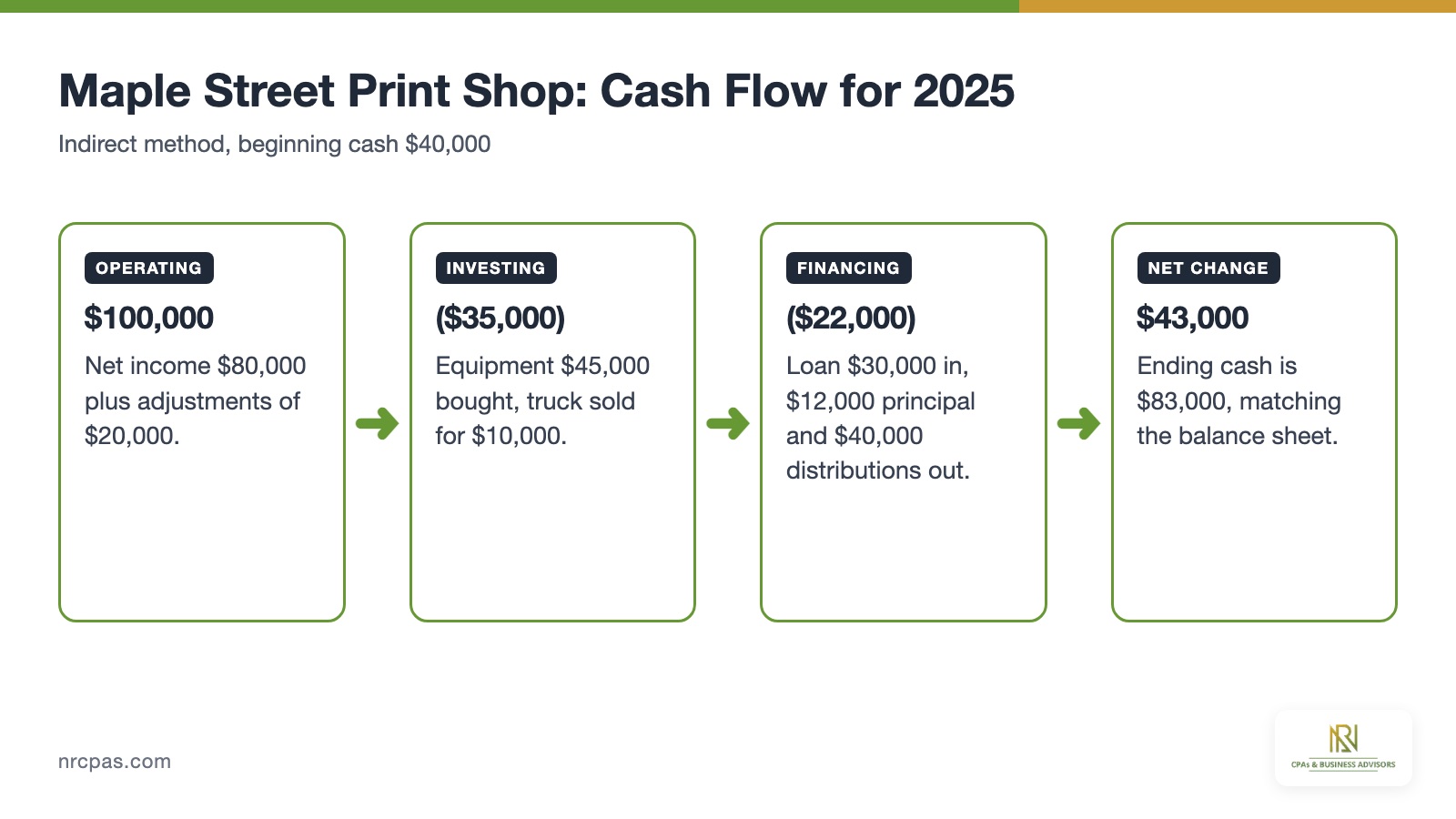
The $83,000 ending cash matches the balance sheet table, so the statement ties. Bookkeepers who keep clean ledgers produce cash flow statements that tie on the first pass. The other presentation, the direct method, reaches the same $100,000 by a different route.
How Do You Make a Cash Flow Statement With the Direct Method?
You make a cash flow statement with the direct method by listing cash received from customers. Then you list cash paid to suppliers, employees and lenders. The direct method reports the same $100,000 of operating cash flow as the indirect method. Only the operating section changes.
Each direct line starts from an income statement figure and adjusts it with a balance sheet change. The table below converts the same Maple Street numbers.
| Line item | Calculation | Amount |
|---|---|---|
| Cash received from customers | $650,000 revenue minus $12,000 receivable increase | $638,000 |
| Cash paid to suppliers | $310,000 cost of goods sold minus $4,000 inventory decrease minus $7,000 payables increase | ($299,000) |
| Cash paid for operating expenses | $237,000 expenses minus $3,000 accrued wages increase | ($234,000) |
| Interest paid | $5,000 interest expense, paid in full | ($5,000) |
| Net cash from operating activities | $638,000 minus $299,000 minus $234,000 minus $5,000 | $100,000 |
The investing and financing sections stay identical under both methods. According to FASB, ASC 230 encourages entities to report gross cash receipts and payments, which is the direct method. A reconciliation of net income to operating cash flow is still required with it.
A writer who learns how to write a cash flow statement can start with the indirect method. A direct schedule then serves readers who want gross receipts. The comparison graphic below lines up both methods.
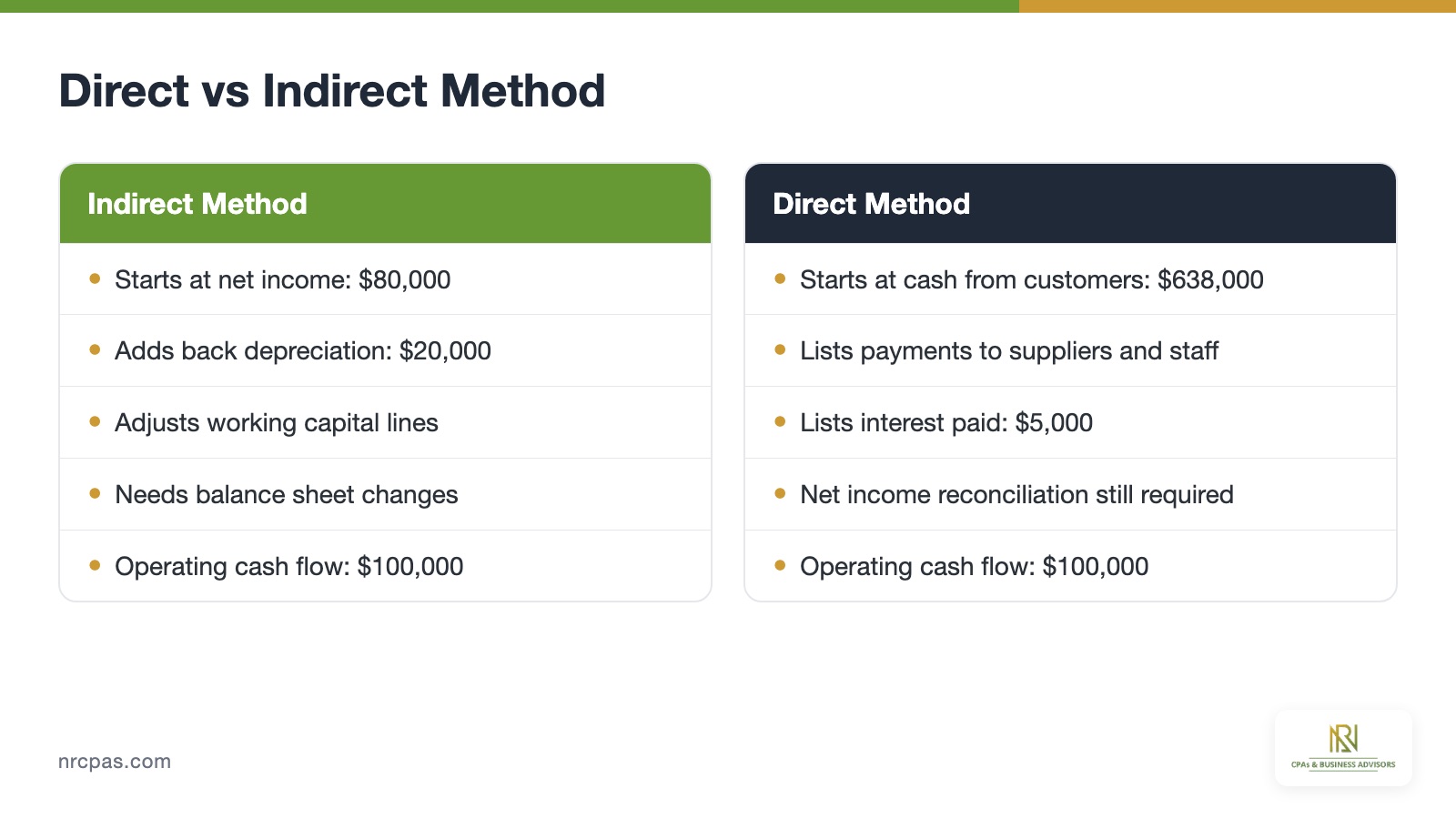
FASB sets the rules behind both presentations.
What Does ASC 230 Require on a Cash Flow Statement?
ASC 230 requires a statement of cash flows whenever a business presents a full set of financial statements under U.S. GAAP. ASC 230 is the FASB standard that defines the statement of cash flows. Teams studying how to prepare a statement of cash flow under GAAP begin with this standard.
The standard sets four core rules. Cash equivalents are short-term investments with an original maturity of three months or less. Restricted cash joins cash in the beginning and ending totals under ASU 2016-18. Cash flows fall into operating, investing and financing classes. Noncash investing and financing deals, such as equipment bought with a seller note, are disclosed separately.
ASC 230 also fixes where common cash items land. The list below shows five placements for U.S. GAAP.
- Interest paid sits in operating activities.
- Interest received sits in operating activities.
- Dividends received sit in operating activities.
- Income taxes paid sit in operating activities.
- Dividends paid sit in financing activities.
According to FASB, ASU 2016-15 and ASU 2016-18 took effect for public business entities in fiscal years beginning after December 15, 2017. The International Accounting Standards Board's IAS 7 differs, because it lets companies place interest paid in operating or financing activities.
A statement that follows ASC 230 still needs a final proof before it goes to a lender.
How Do You Check a Cash Flow Statement for Errors?
You check a cash flow statement for errors by tying ending cash to the balance sheet. Then you test the sign of each adjustment. A statement is correct only when beginning cash plus the net change equals the ending balance sheet cash. Five mistakes cause most failed tie-outs.
- Subtracting depreciation instead of adding it back.
- Leaving a gain or loss on an asset sale in operating activities without removing it.
- Counting loan principal as an operating payment.
- Reporting a financed equipment purchase as cash paid.
- Using balance sheets that do not cover the same period.
Outside review catches those slips early. Cash flow consulting adds a second pair of eyes before lenders see the numbers. The IRS says records generally stay useful for 3 years, so the bank statements behind each total should be kept that long.
Accurate statements matter because survival is not automatic. According to the Bureau of Labor Statistics (BLS), 79.6% of establishments born in 2013 survived one year. Another 50.6% survived five years, and 34.7% survived ten. A correct statement is the first tool for planning past each of those marks.
What Else Should You Know Before You Make a Cash Flow Statement?
Four side topics sit around the build: forecasting, Excel, AI tools and timing. The short answers below cover each topic and the help available.
How to Forecast Cash Flow Statement Figures for Next Year?
To forecast cash flow statement figures, project net income, working capital balances and capital spending, then run the same seven steps. A forecast replaces actual balances with projected balances and keeps every sign rule. Receivable days, inventory days and payable days drive the projected working capital lines.
Planners pair the forecast with budget forecasting so equipment purchases and loan draws match expected cash.
A forecast shows the months where cash runs short, and the lowest month sets how much cushion the business needs. A plan for improving cash flow targets the weakest section.
How Do You Create a Cash Flow Statement in Excel?
You create a cash flow statement in Excel with one tab per balance sheet and one for the income statement. A final tab holds the statement. Learning how to do a cash flow statement in Excel comes down to formulas that subtract beginning balances from ending balances.
A check cell that compares computed ending cash to balance sheet cash catches most formula errors. Lock the sign rules into the formulas once, and every later period reuses them.
Can ChatGPT or Another AI Tool Make a Cash Flow Statement?
An AI tool can arrange a cash flow statement from figures pasted into it, but the figures must come from your ledger. An AI tool cannot see your bank feed, so it cannot verify ending cash. Every output still needs the tie-out check from the section above.
How Often Should a Business Prepare a Cash Flow Statement?
A business should prepare a cash flow statement at least once a year, and monthly statements give earlier warning of shortfalls. Learning how to make a statement of cash flow for one month works the same as for a year.
Founders watching a short runway can read startup cash burn straight from the monthly operating line. Lenders can ask for annual statements plus a recent interim period.
Who Can Help a Small Business Make a Cash Flow Statement?
An accounting firm can help a small business make a cash flow statement by posting the ledger and tying the balance sheets. The firm then builds the three sections each month. We work from the books to the statement so owners see cash movement without spreadsheet work.
Owners who want to know how to make a cash flow statement can hand the job to the NR CPAs bookkeepers. The firm is led by founder Nischay Rawal, CPA, EA. Call (305) 872-3096.
Monthly cash tracking makes year-end work lighter. The records stay current, the balance sheets stay consecutive and the cash line stays proven against the bank. The full set of year-end statements then ties out at once.