Can You Turn a DBA Into an LLC and Keep the Business Name


No, a DBA cannot be turned into an LLC directly, because a DBA is only a registered name. The owner files Articles of Organization with the state and registers the same name under the LLC. A new EIN is needed only when the IRS rules require one. The owner keeps the business name and gains liability protection.
Key Takeaways
- A DBA is a trade name, so the LLC must be formed as a new entity.
- The LLC can keep the old business name when the name is open in the state records.
- A single-member LLC with no employees can keep the owner's EIN, according to the IRS.
- Employees, a partner or an S corporation election require a new EIN.
- Bank accounts, contracts, licenses and assets must be moved to the LLC to earn the liability shield.
Can I Turn My DBA Into an LLC?
You can turn a DBA into an LLC only by forming a new LLC and attaching the old name to it. A DBA is a name on file, so nothing exists to convert. A sole proprietor files Articles of Organization, and the state creates the LLC as a separate legal person.
According to the U.S. Small Business Administration (SBA), registering a DBA name does not provide legal protection by itself. The SBA also states that a sole proprietorship does not produce a separate business entity. Owners remain personally liable for business debts under a DBA.
That liability gap reaches a large pool of owners. According to the SBA Office of Advocacy, the country has 36.2 million small businesses. According to the Census Bureau, 29.8 million U.S. businesses had no paid employees in 2022.
The state creates the LLC itself, and the LLC registration becomes effective only after the filing is accepted. The reasons for filing at all come next.
Why Would a Sole Proprietor Turn a DBA Into an LLC?
A sole proprietor turns a DBA into an LLC to separate personal assets from business debts. The LLC, not the name, is what builds the wall between the owner and the business. According to the SBA, LLCs protect owners from personal liability in most instances.
Owners who ask can I turn my DBA into an LLC usually name three goals. Searches for how to turn my DBA into an LLC reflect those same goals. Those goals are liability protection, a cleaner banking record and room to add partners or tax elections later.
The SBA adds that the protection has limits. Insurance still fills coverage gaps, and mixing personal and business funds can weaken the shield.
Taxes do not shrink on day one. A single-member LLC pays SE tax rules exactly like a sole proprietor, because the IRS treats the LLC as a disregarded entity. The filings follow a fixed step order, and the next section lists it.
How Do You Turn a DBA Into an LLC Step by Step?
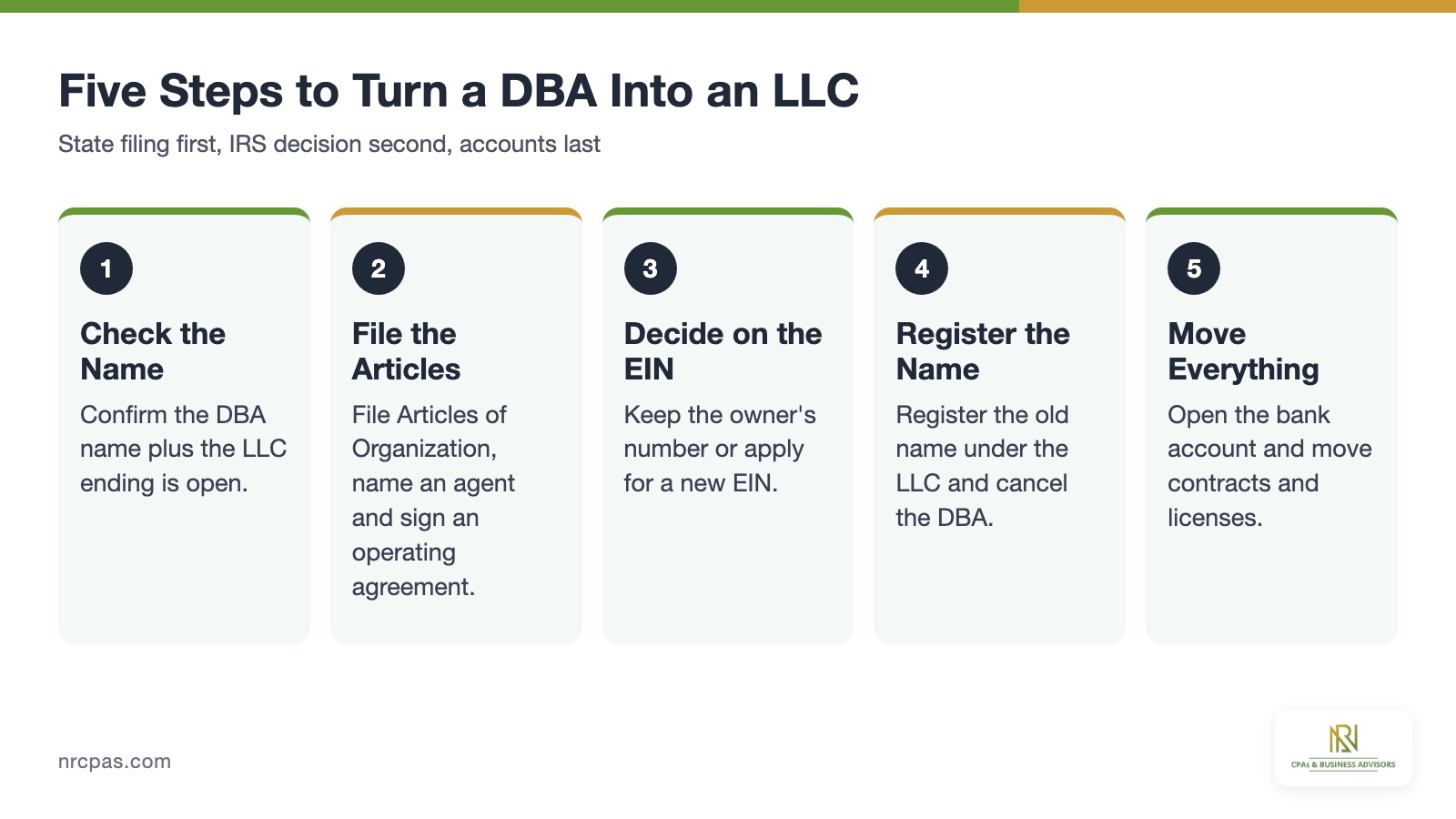
You turn a DBA into an LLC in five steps, and the state filing comes before the IRS filing. The order is name check, state filing, EIN decision, name registration and account transfers. The numbered list below shows that order.
- Search the Secretary of State records to confirm the DBA name, plus the LLC ending, is open.
- File the Articles of Organization, name a registered agent and sign an operating agreement.
- Decide whether the LLC needs a new EIN under the IRS rules.
- Register the old trade name under the LLC and cancel the sole proprietor filing.
- Open a business bank account and move contracts, licenses and assets to the LLC.
The graphic below lays out the same five steps in sequence.
Each state names the first filing differently. Florida, Texas and California call it Articles of Organization or Certificate of Formation. A new owner advisory review before filing catches name conflicts early. The EIN decision in step three needs a closer look.
Do You Need a New EIN When a DBA Becomes an LLC?
A DBA that becomes an LLC needs a new EIN only when the IRS rules say so. A single-member LLC with no employees and no excise tax can keep the owner's SSN or existing EIN. According to the IRS, a new EIN is required when a sole proprietor incorporates or forms a partnership.
The IRS lists a name change and a new location as events that do not require a new EIN. A single-member LLC needs its own EIN when it has any employees or files certain excise tax returns. The IRS also says wages paid after January 1, 2009 must be reported under the LLC's name and EIN.
The table below sorts the common starting points by the EIN result.
| Starting point | New EIN needed | Reason |
|---|---|---|
| One owner, no employees, no election | No | The LLC is disregarded for income tax |
| One owner with employees | Yes | The LLC is a separate employer |
| One owner who elects S corporation status | Yes | The LLC is taxed as a corporation |
| Two or more owners | Yes | The LLC is taxed as a partnership |
Owners who want a number anyway can apply for one. According to the IRS, the online EIN tool is free and issues the number immediately when the application is approved. The IRS limits each responsible party to 1 EIN per day, so the application should use the LLC's exact legal name.
A bank may ask for an EIN even when the IRS does not. A later S corp choice decides whether the number stays or changes. The EIN settles the number, and the name decision follows.
How Do You Keep the Business Name When You Form the LLC?
You keep the business name by filing the LLC under that exact name plus an LLC ending. Sunrise Cleaning becomes Sunrise Cleaning LLC, and the old name needs no second filing in that form. The name must be open in the state business records before the filing is accepted.
Owners who want the name without the ending on signs register it as a fictitious name under the LLC. The old DBA stays attached to the sole proprietor until it is canceled, so the owner must retire it. Each state sets its own filing office, fee and clock.
The state examples below show how three states handle the name and the formation fee.
| State | LLC formation | Name filing | Extra cost or clock |
|---|---|---|---|
| Florida | $100 articles plus $25 agent filing | $50 fictitious name, 5-year term | Cancel old name in 30 days |
| Texas | Certificate of Formation | $25 assumed name certificate | $10 to abandon old certificate |
| California | Articles of Organization | County fictitious business name | $800 annual LLC tax |
Florida shows the cleanest path. According to Florida Statutes section 605.0213, filing Articles of Organization costs $100, and designating a registered agent costs $25. According to Florida Statutes section 865.09, a fictitious name registration costs $50 and runs through December 31 of the fifth calendar year.
The same Florida statute requires a registrant who stops using a name to cancel within 30 days. A new person may re-register the name when the cancellation is filed. A Florida LLC also files an annual report between January 1 and May 1, starting the year after formation.
Texas works differently. According to the Texas Secretary of State, the assumed name certificate costs $25 and lasts up to 10 years. The abandonment statement for the old certificate costs $10.
California adds a tax. According to the California Franchise Tax Board, every LLC organized in the state owes an $800 annual tax until it cancels. Name rules settle the paperwork, but the assets still sit in the owner's name.
How Do You Move Assets, Contracts and Bank Accounts Into the LLC?
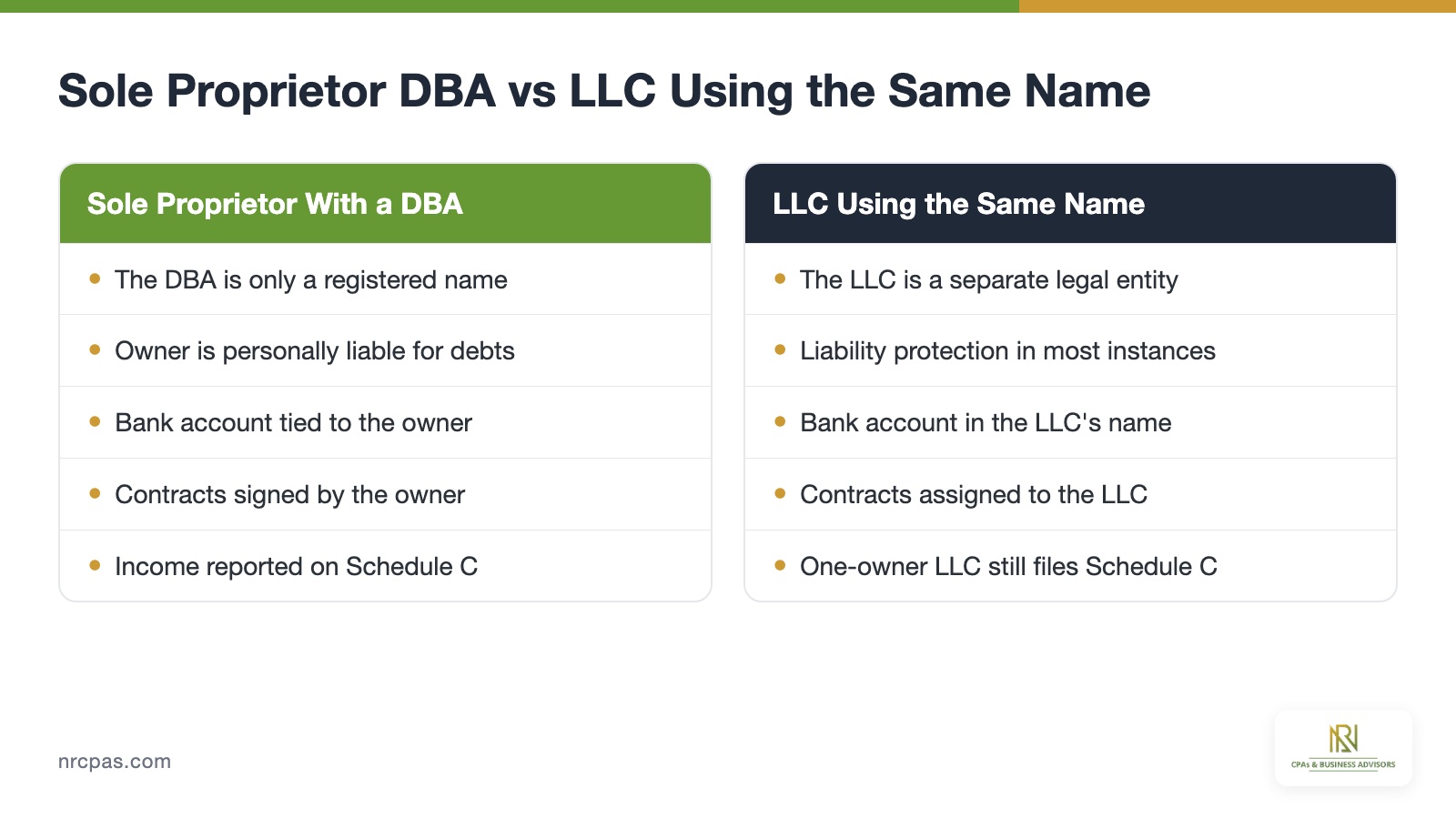
You move assets and contracts into the LLC by assigning each one in writing, then open accounts in the LLC's name. The liability shield covers only what the LLC owns and signs. Anything left in the owner's name stays outside the shield.
The bulleted list below covers what a sole proprietor usually moves.
- A new business bank account opened with the formation papers and the operating agreement.
- Customer contracts, assigned to the LLC or re-signed at renewal.
- Equipment, tools and inventory, listed in a short bill of sale to the LLC.
- Business licenses, permits and sales tax registrations, reissued in the LLC's name.
- Insurance policies, with the LLC added as the named insured.
- Payment processors, invoices and websites, updated to show the LLC.
The comparison graphic below shows how the same business looks before and after the move.
Some contracts bar assignment without consent. The owner can ask the client for consent or wait for the renewal date. Vehicles need a new title when the LLC owns them.
New books should start on the formation date, with an opening balance sheet that lists each asset moved. A clean opening balance sheet proves the LLC owns what it uses. Taxes change next, though the income tax return changes little.
What Happens to Taxes After a Sole Proprietor Becomes an LLC?
A sole proprietor who becomes an LLC keeps filing Schedule C unless the LLC elects another tax status. A one-owner LLC is a disregarded entity, so the income tax return barely changes. According to the IRS, the owner still pays self-employment tax like a sole proprietor.
The IRS sets the self-employment tax rate at 15.3%, made of 12.4% for Social Security and 2.9% for Medicare. According to the IRS, net earnings of $400 or more trigger the tax. According to the Social Security Administration (SSA), the 2026 Social Security wage base is $184,500.
The graphic below pulls those tax figures into one view.

A different tax status requires a filing. According to the IRS, an LLC files Form 8832 to elect corporate treatment. That election can take effect up to 75 days before filing. An S corporation election adds payroll duties for the owner.
The IRS requires a responsible party change on an EIN record to be reported within 60 days on Form 8822-B. Owners who miss a payroll or excise return after the switch may face IRS penalty relief requests. Mistakes are avoidable when the common errors are known.
What Mistakes Should You Avoid When You Turn a DBA Into an LLC?
The mistakes to avoid are filing the EIN first, skipping the operating agreement and leaving accounts in the owner's name. Each mistake leaves the owner personally exposed even after the LLC exists. The bulleted list below names six errors.
- Applying for an EIN before the state approves the LLC.
- Getting a second EIN that leaves two numbers on one business.
- Keeping the old bank account for deposits after the LLC opens.
- Signing new contracts in the owner's personal name.
- Letting the old DBA registration run beside the LLC name.
- Missing the first annual report, which Florida requires between January 1 and May 1.
Cash timing causes a quiet mistake of its own. A late client payment can hit the old account, so cash flow timing needs a deposit plan during the first quarter. The remaining questions fit under one wider question.
What Else Should Sole Proprietors Know Before Forming an LLC?
Sole proprietors also need answers on DBA cancellation, cost, timing, S corporation status and legal entity rules. The short sections below cover each side topic.
Do You Have to Cancel the Old DBA After Forming an LLC?
You have to cancel the old DBA when the sole proprietor stops using the name. A leftover DBA keeps the name tied to the owner personally. In Florida the cancellation is due within 30 days after the owner stops using the name.
Is a DBA Cheaper Than an LLC?
A DBA is cheaper than an LLC to file and to maintain. In Florida the fictitious name fee is $50, while the LLC filings start at $125 for the articles and the agent designation. The LLC costs more up front because it buys liability protection.
Can I Turn My DBA Into an LLC Without Closing the Business?
You can turn your DBA into an LLC without closing the business, because the same operations continue under the new owner. The sole proprietor stops using the name, and the LLC starts. Customers see the same name with an LLC ending.
Can You Turn a DBA Into an LLC Later?
Yes, you can turn a DBA into an LLC later, because no deadline forces the move. Owners can run under a DBA for years and form the LLC when risk or revenue grows. Waiting leaves personal assets exposed in the meantime.
Should the New LLC Elect S Corporation Status?
The new LLC should elect S corporation status only when profits justify the added payroll work. The election needs Form 8832 or Form 2553 and a new EIN. A tax review of conversion tax planning shows the break-even point.
Is a DBA a Legal Entity?
A DBA is not a legal entity, because a DBA is only a name registered by an owner. The LLC is the legal entity. Contracts and debts belong to whichever person or entity signs them.
How Long Should Records From the Old DBA Be Kept?
Records from the old DBA should be kept for at least 3 years from the filing date, according to the IRS. The IRS extends the period to 7 years for a bad debt deduction claim. The sole proprietor files keep their value after the LLC starts.
Who Can Help Turn a DBA Into an LLC?
A CPA firm can help turn a DBA into an LLC by checking the EIN rules, state filings and tax effects. We review each step with owners before the filing is made. The team at NR CPAs counsel is led by founder Nischay Rawal, CPA, EA, and the office number is (305) 872-3096.
Owners who want the state filings and the account transfers handled in order can start with LLC conversion.