Business Plan for Small Business and What It Should Include


A business plan for small business is a written document that sets goals, strategies and the steps to reach them. Most plans hold 9 sections, from the executive summary to the appendix. A lean plan fits on 1 page, while a traditional plan can run dozens of pages. Lenders and investors usually ask for the traditional version.
Key Takeaways
- A small business plan has 9 standard sections, beginning with the executive summary and ending with an appendix.
- The lean format takes as little as 1 hour, and the traditional format can run dozens of pages.
- BLS data shows 34.7% of establishments born in 2013 were still open in 2023.
- SBA guidance calls for financial projections that cover the next 5 years.
- Restaurants, nonprofits and startups add their own sections to the standard plan.
What Is a Business Plan for Small Business?
A business plan for small business is a written roadmap that links goals to the steps, people and money required. The plan answers what the business sells, who buys it and how it earns a profit. The U.S. Small Business Administration (SBA) says a plan guides each stage of starting and managing a company.
Plans also help owners win funding and bring on partners. Small firms rely on that roadmap every day. According to the SBA Office of Advocacy, the country has 36.2 million small businesses.
Those small businesses employ almost 46% of private-sector workers, per the same SBA Office of Advocacy data. A written plan turns a first idea into a strategic roadmap that a lender can read in minutes.
Many of those firms do not last, which is why planning matters.
Why Does a Small Business Need a Business Plan?
A small business needs a business plan because survival rates fall every year after opening. According to the Bureau of Labor Statistics (BLS), 79.6% of private establishments born in 2013 were open after 1 year. The same BLS data shows 50.6% were open after 5 years and 34.7% after 10 years.
The graphic below shows those 3 BLS survival rates for establishments born in 2013.

A plan gives owners a written test of the idea before cash is spent. Owners find weak pricing, thin margins and missing customers on paper first.
Capital is the second reason. The Federal Reserve Banks surveyed 6,525 small employer firms in 2025. Of those firms, 38% applied for a loan, line of credit or merchant cash advance. Among applicants, 42% received the full amount, 36% received some or most, and 22% received none.
According to the SBA, a plan, an expense sheet and 5-year financial projections improve the chance of securing a loan. A business plan for small businesses of every size therefore starts with the reader who funds it. That reader picks the format, and the format is the next decision.
What Are the Two Formats of a Small Business Plan?
The two formats of a small business plan are the traditional plan and the lean startup plan. According to the SBA, traditional plans use a standard structure and can run dozens of pages. Lean plans summarize only the key points, take as little as 1 hour to write and typically fit on 1 page.
Lenders and investors commonly request the traditional plan. The SBA adds that some lenders and investors may ask for more information after a lean plan. The table below compares the 2 formats on length, writing time, reader and structure.
| Feature | Traditional Plan | Lean Startup Plan |
|---|---|---|
| Length | Dozens of pages | About 1 page |
| Writing time | Longer, with detailed research | As little as 1 hour |
| Typical reader | Lenders and investors | Owners and early partners |
| Structure | 9 sections, from executive summary to appendix | Chart of partners, activities, resources, value proposition, customers, channels and costs |
The traditional column carries the 9 sections that the next heading lists, and the graphic below shows the same split.

What Should a Small Business Plan Include?
A small business plan should include 9 sections, according to the SBA. The numbered list below follows the standard traditional order.
- Executive summary: the mission, the product or service, the leadership team and the location.
- Company description: the problem the business solves and the customers it serves.
- Market analysis: the industry outlook, the target market and the competitors.
- Organization and management: the legal structure and who runs each function.
- Service or product line: what the business sells and how it benefits customers.
- Marketing and sales: how the business attracts and keeps customers.
- Funding request: the amount, debt or equity, and the use of funds.
- Financial projections: forecast statements for the next 5 years.
- Appendix: licenses, permits, resumes, contracts and credit histories.
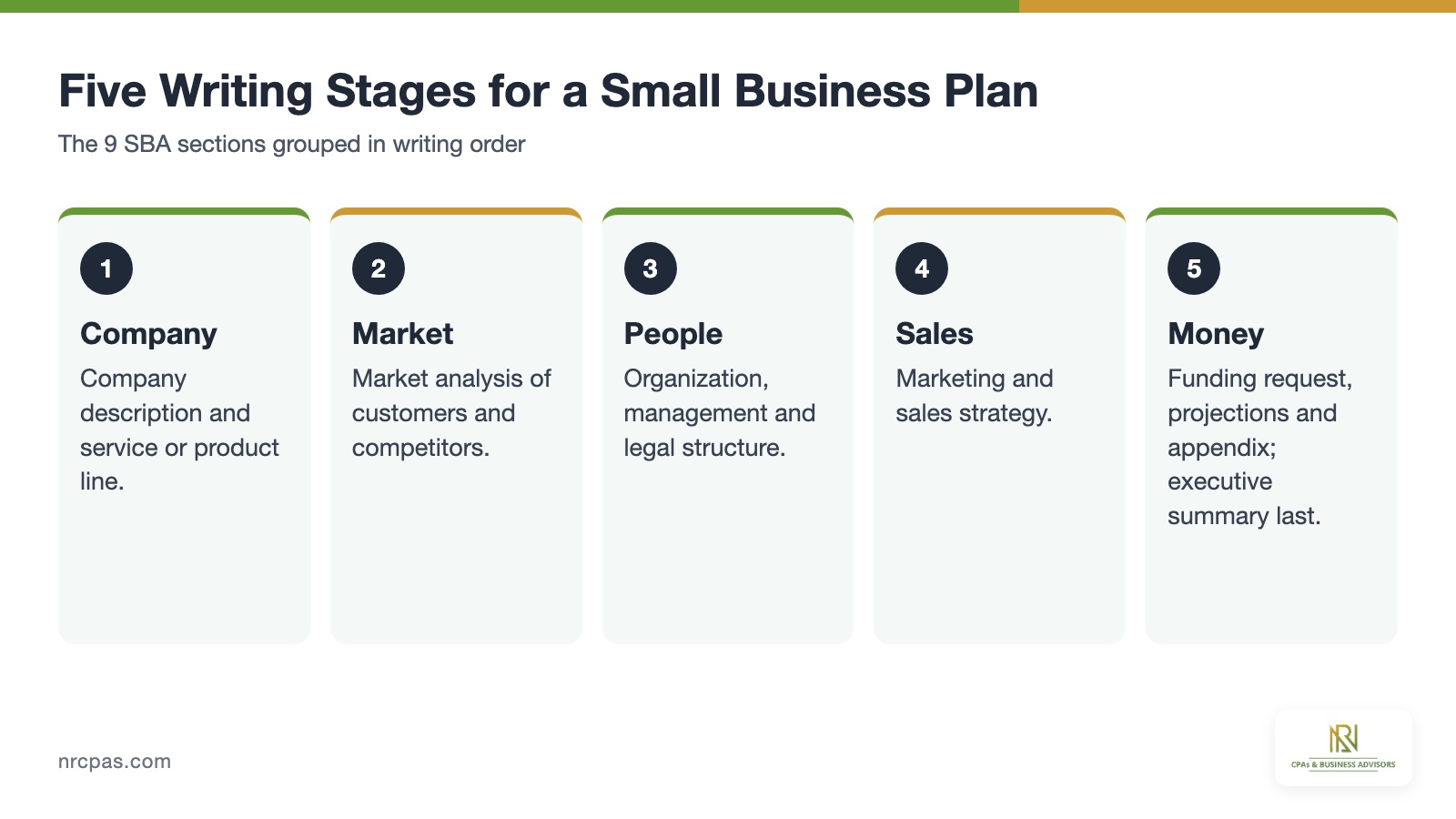
The executive summary opens the plan, yet it is easier to write last. Writing the summary last lets the other 8 sections settle first. The graphic below groups all 9 sections into 5 writing stages.
Section 8 carries the most numbers, so the financial plan earns its own heading.
How Do You Build the Financial Plan in a Small Business Plan?
Build the financial plan by pairing the funding request with projected income statements, balance sheets and cash flow statements. According to the SBA, projections should cover the next 5 years. The first year should use quarterly or even monthly figures.
Three statements carry those numbers. The income statement shows profit. The balance sheet shows what the business owns and owes, and the cash flow statement shows cash movement. Projections stay credible when linked statements reconcile, so net income flows into equity.
A complete financial plan lists 5 inputs, shown below.
- Startup expenses such as equipment, inventory, marketing and legal fees.
- Capital requirements that name the loan or investment amount sought.
- A monthly sales forecast for the first year.
- Operating costs, including payroll, rent and software.
- A cash flow forecast that shows the lowest expected cash balance.
The cash flow forecast deserves the most attention, because a profitable plan can still run out of cash. A cash flow statement built month by month exposes that gap early.
An established business adds history to the projections. According to the SBA, those owners include income statements, balance sheets and cash flow statements for the last 3 to 5 years. Lenders read projected financials beside that history, so both must use the same accounting method.
Projected profit also depends on how the business is taxed, and tax treatment depends on legal structure.
What Legal Structure Goes in a Small Business Plan?
The legal structure in a small business plan names the business type. Types include sole proprietorship, partnership, limited liability company (LLC) and corporation. According to the SBA, the organization section also states whether the business is a C corporation or an S corporation. Structure drives liability and taxes, so the plan names it early.
Formation fees belong in the budget. According to the Florida Division of Corporations, filing LLC articles of organization costs $125. An owner choosing a legal structure should price the filing, the registered agent and the annual report together.
Taxes then follow the structure. An LLC can elect S corporation status, which changes how owner pay is taxed. The tax classification choice flows into the profit projections.
The same budget holds a tax break for launch costs. According to the IRS, a new business can deduct up to $5,000 of start-up costs in the year it begins. The IRS adds a separate $5,000 for organizational costs. The deduction shrinks by the amount total costs exceed $50,000, and the remainder is amortized.
Start-up costs also raise a size question for founders, which is how much plan the business needs.
How Long Should a Business Plan Be for a Startup?
A business plan for startup ventures should run 1 page for a lean plan or dozens of pages for a traditional plan. Length follows the reader. A founder testing an idea needs the lean version, which takes as little as 1 hour.
A founder asking a bank for money needs the traditional version. The SBA 7(a) application checklist asks for a one-year projection plus a written explanation of how the business will reach it. Many founders hire plan preparation help to build that projection.
The loan size sets how much detail the lender needs. The table below lists 2 SBA programs with their maximum amounts.
| SBA Program | Maximum Amount | What the Plan Must Show |
|---|---|---|
| 7(a) loan | $5 million | Use of funds and repayment ability |
| Microloan | $50,000 | Launch costs and early cash flow |
According to the SBA, the average microloan is about $13,000. Small loans need a short plan, while a $5 million request needs the full traditional plan. Founders can pair the plan with advice for new founders for the funding strategy.
The standard plan then adapts to each industry, which the next heading covers.
What Changes in a Business Plan for Specific Small Businesses?
The 9 standard sections stay the same across industries, while the content inside each section changes. The 4 side topics below cover restaurants, nonprofits, post-launch updates and professional help.
What Goes in a Business Plan for a Restaurant?
A business plan for restaurant startups adds a concept, a menu, a location and a design plan to the standard sections. The location and menu sections drive the startup budget. Rent, equipment and food cost each need their own line.
Restaurant projections also track food cost and labor as percentages of sales. Restaurant operators who model those percentages weekly spot margin problems before the first lease payment comes due.
What Goes in a Business Plan for a Nonprofit?
A business plan for nonprofit groups replaces the profit model with a mission statement and a board of directors. A fundraising plan and an impact plan follow. A business plan for a nonprofit organization starts with the mission statement. The IRS reviews that statement when it decides on tax-exempt status.
The financial section lists 4 statements: financial position, activities, cash flows and functional expenses. According to the IRS, the user fee is $600 for Form 1023 and $275 for Form 1023-EZ. Those fees belong in the budget, and nonprofit finance reporting needs its own chart of accounts.
How Does a Small Business Plan Change After Launch?
A small business plan changes after launch because actual results replace projections. Each gap between actual and projected results updates the next forecast. Owners then revise pricing, hiring and cash targets.
Growth adds new sections, such as new locations or product lines. The scaling steps for a growing company belong in the plan before the money is spent. Plan support files should be kept for 3 years, according to the IRS, and for 7 years for bad debt claims.
Who Can Help Write a Small Business Plan?
A CPA firm can help write a small business plan by building the projections, the entity choice and the tax assumptions. We prepare plans and financial models for owners across the country. The founder of NR CPAs & Business Advisors is Nischay Rawal, CPA, EA, and the office number is (305) 872-3096.
Owners can browse guides from NR CPAs insights on planning, statements and tax rules.
Plans, statements and tax rules connect, so one reviewer should check all three before a lender sees the plan. That review catches mismatched figures between the projections and the budget. A complete business plan for small business owners comes together faster with business planning services.