Does Solo 401(k) Reduce Self-Employment Tax or Only Income Tax


No, a solo 401(k) does not reduce self-employment tax for a sole proprietor. The 15.3% tax is figured on net profit before any retirement contribution. The contribution cuts income tax instead, through a Schedule 1 deduction. S corp owners see the same result, since 401(k) deferrals taken from W-2 pay still carry payroll tax.
Key Takeaways
- Self-employment tax of 15.3% is computed on net earnings before a solo 401(k) deduction is subtracted.
- A sole proprietor deducts a solo 401(k) contribution on Schedule 1, not on Schedule C, so net profit stays the same.
- The 2026 limits are $24,500 for employee deferrals and $72,000 for the overall limit, before catch-up amounts.
- S corp owners pay payroll tax on W-2 pay that funds deferrals, while the employer contribution carries no payroll tax.
- Business expenses and a reasonable S corp salary change self-employment tax, and a retirement plan does not.
Does Solo 401(K) Reduce Self-Employment Tax for Sole Proprietors?
A solo 401(k) does not reduce self-employment tax for a sole proprietor. The contribution never lowers the net profit that the tax uses. The contribution reduces income tax only. According to the Internal Revenue Service (IRS), self-employed owners deduct plan contributions on Form 1040, Schedule 1, not Schedule C.
Schedule C is where net profit is calculated, and Schedule SE reads that net profit to compute the tax. Accurate net profit reports therefore drive the tax. The Schedule 1 deduction comes later, so Schedule SE never sees it. Owners who ask does solo 401(k) reduce self-employment tax often assume the plan works like a business expense. The form order shows why it does not.
Schedule 1 also holds the line for the deductible half of self-employment tax. Careful retirement tax planning uses that deduction and the plan deduction together, as the next section shows. The tax itself needs a definition first.
How Is Self-Employment Tax Calculated Before a Solo 401(K) Contribution?
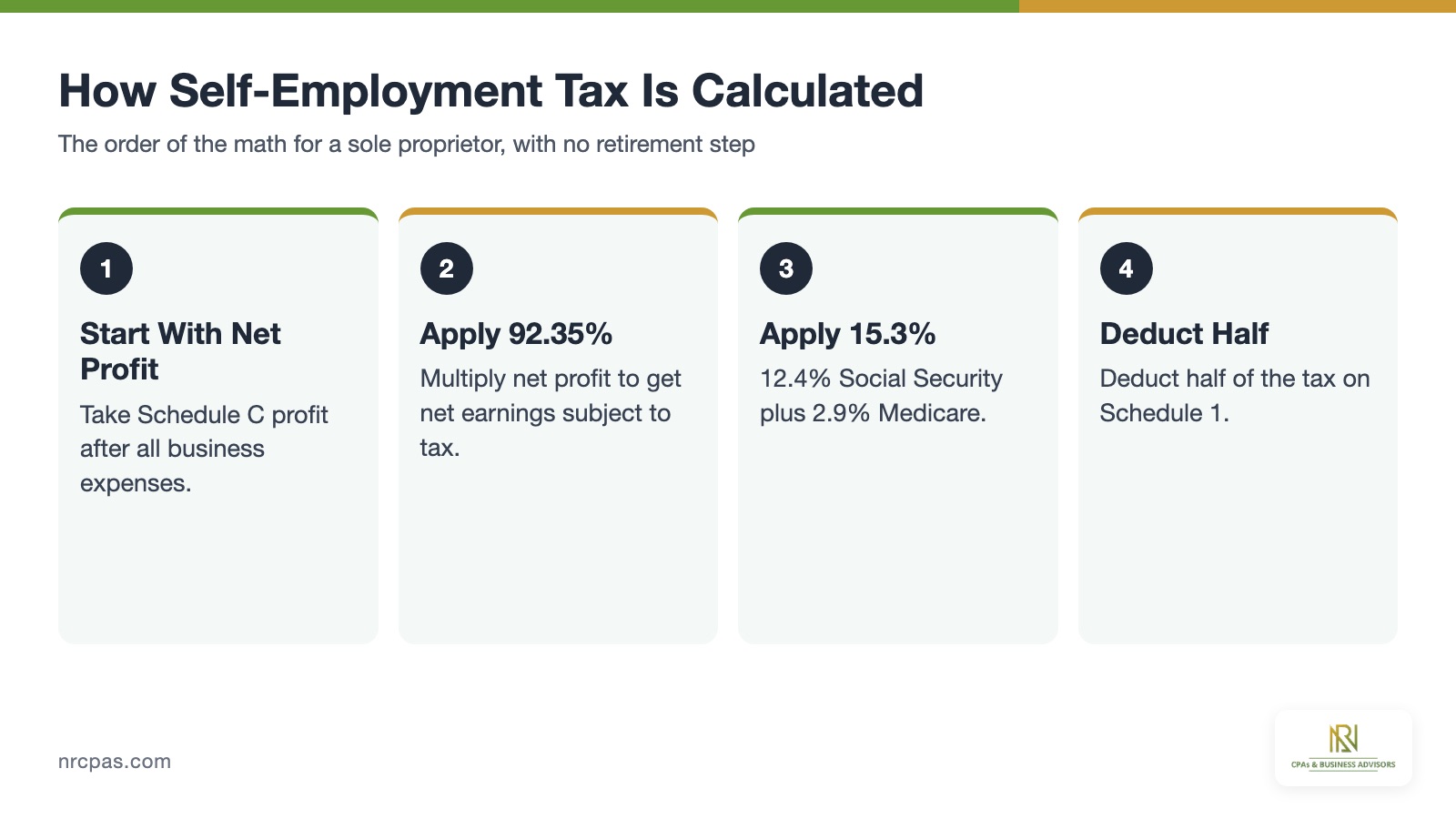
Self-employment tax is calculated on 92.35% of net earnings at a combined rate of 15.3%. According to the IRS, the 15.3% splits into 12.4% for Social Security and 2.9% for Medicare. The calculation starts and ends before any retirement deduction appears.
The IRS requires Schedule SE once net earnings from self-employment reach $400. The Social Security part stops at the annual wage base. The Social Security Administration (SSA) set it at $176,100 for 2025 and $184,500 for 2026. The 2.9% Medicare part has no cap.
The four steps below show the order of the math for a sole proprietor.
- Start with net profit from Schedule C, after all business expenses.
- Multiply net profit by 92.35% to get net earnings subject to the tax.
- Multiply that amount by 15.3%, with the 12.4% part capped at the wage base.
- Deduct half of the result on Schedule 1 when figuring adjusted gross income.
The graphic below lays out the same four steps in order, so the missing retirement step is easy to spot.
A sole proprietor with $100,000 of net profit owes $14,130 of self-employment tax, according to the IRS. Half of that, $7,065, becomes a deduction on Schedule 1. A solo 401(k) deduction lands on the same schedule, which raises the question of how the two deductions interact.
How Does a Solo 401(K) Deduction Work on a Sole Proprietor Return?
The self-employed 401(k) tax deduction works as an adjustment to income on Schedule 1. It lowers adjusted gross income but leaves Schedule C and Schedule SE alone. Owners must deduct their own contribution on Schedule 1, and a deduction taken on Schedule C needs correction. The IRS tells owners who made that mistake to amend the Form 1040 and Schedule C.
The IRS also defines plan compensation for a self-employed person as net earnings after two subtractions. One is the deductible half of self-employment tax. The other is the owner's own plan contribution, which makes the formula circular.
The IRS solves the circle with a reduced contribution rate from Publication 560. A 25% employer rate becomes 20%, because 25% divided by 125% equals 20%. Those solo 401(k) tax deduction rules produce the figures in the table below for a $100,000 profit.
| Line | No contribution | Full contribution | Change |
|---|---|---|---|
| Self-employment tax | $14,130 | $14,130 | $0 |
| Half of self-employment tax deducted | $7,065 | $7,065 | $0 |
| Solo 401(k) deduction | $0 | $43,087 | $43,087 |
| Taxable income after $16,100 standard deduction | $76,835 | $33,748 | -$43,087 |
| Federal income tax | $11,617 | $3,802 | -$7,815 |
The full contribution in the table is a $24,500 employee deferral plus a $18,587 employer contribution, which is 20% of $92,935. The 2026 brackets of 10%, 12% and 22% produce the income tax lines. They exclude the qualified business income (QBI) deduction and state tax. The graphic below contrasts the two taxes on the same $100,000 profit. The next question is how high those contributions can go.

What Are the Solo 401(K) Contribution Limits for 2025 Versus 2026?
The solo 401(k) contribution limits for 2026 are $24,500 for employee deferrals and $72,000 for total annual additions. According to the IRS, the 2025 figures were $23,500 and $70,000. A one-participant 401(k) plan follows the same limits as any other 401(k) plan.
The owner wears two hats, employee and employer, and each hat has its own cap. These solo 401(k) deduction limits apply to each person, and the IRS counts deferrals across every plan the person joins. The employee side is limited to 100% of earned income up to the deferral limit. The employer side is limited to 25% of compensation, or the reduced rate for a self-employed person.
| Limit | 2025 | 2026 | Applies to |
|---|---|---|---|
| Employee deferral | $23,500 | $24,500 | All owners |
| Catch-up, age 50 and over | $7,500 | $8,000 | Age 50 or older by year end |
| Super catch-up, ages 60 to 63 | $11,250 | $11,250 | Age 60, 61, 62 or 63 |
| Overall limit, no catch-up | $70,000 | $72,000 | Deferral plus employer |
| Overall with age 50 catch-up | $77,500 | $80,000 | Age 50 to 59 or 64 and over |
| Overall with super catch-up | $81,250 | $83,250 | Age 60 to 63 |
The IRS also caps the compensation counted toward contributions at $360,000 for 2026. The overall limit excludes catch-up amounts, which is why the last two rows add them on top. The graphic below shows the 2026 figures at a glance.
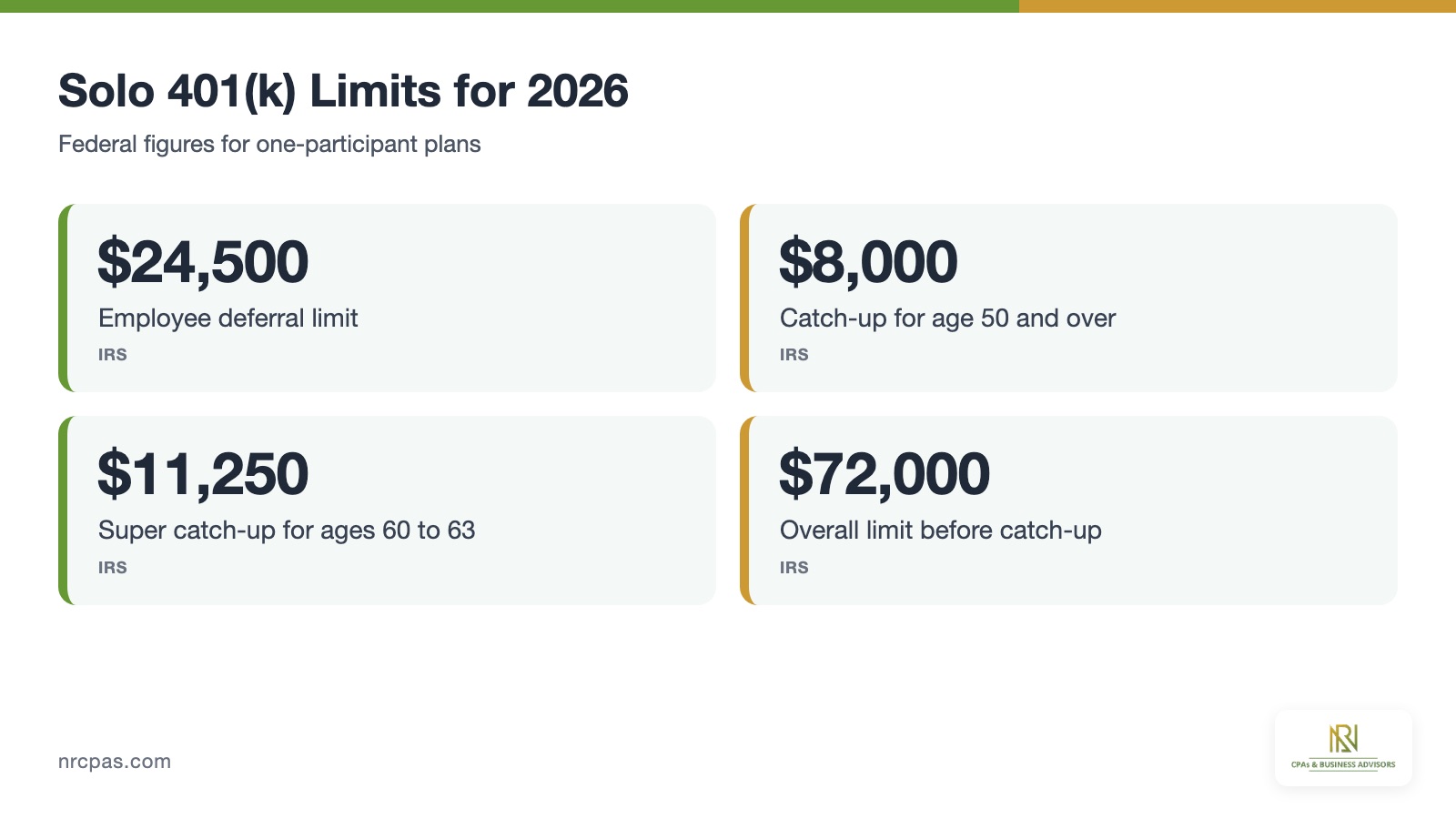
The super catch-up of $11,250 replaces the $8,000 regular catch-up for owners who are 60, 61, 62 or 63. It is not added to it. The IRS adjusts every amount for cost of living. Owners who use solo plan setup should confirm figures each January.
Does a Solo 401(K) Reduce Self-Employment Tax for S Corp Owners?
A solo 401(k) does not reduce payroll tax for S corp owners. Deferrals come out of W-2 pay already taxed under the Federal Insurance Contributions Act (FICA). Employee deferrals stay subject to Social Security and Medicare tax. According to the IRS, W-2 boxes 3 and 5 include pre-tax 401(k) deferrals.
The employer contribution works differently. It is not wages, so it carries no Social Security or Medicare tax. It also does not reduce self-employment tax, because an S corp shareholder pays none on distributions in the first place.
An S corp owner therefore faces a different trade-off. Salary sets the employer contribution cap at 25% of W-2 pay, yet each salary dollar costs 15.3% in payroll tax. S corp wages must also stay reasonable. The table below compares three salary levels for a 2026 solo 401(k).
| W-2 salary | Payroll tax at 15.3% | Employer contribution at 25% | Total with $24,500 deferral |
|---|---|---|---|
| $40,000 | $6,120 | $10,000 | $34,500 |
| $60,000 | $9,180 | $15,000 | $39,500 |
| $100,000 | $15,300 | $25,000 | $49,500 |
Each extra $10,000 of salary adds $1,530 of payroll tax and supports $2,500 more employer contribution. Owners who want a larger plan deposit pay for it in payroll tax. Owners who want lower payroll tax accept a smaller employer contribution. Both choices start with the entity, and an owner with no S election follows different rules.
Does Solo 401(K) Reduce Self-Employment Tax for Single-Member LLC Owners?
A solo 401(k) does not reduce self-employment tax for a single-member LLC owner who files as a sole proprietor. A disregarded LLC reports on Schedule C, so the sole proprietor rules apply unchanged. The same holds for working partners in a partnership.
Owners of a one-person LLC who elect S corp status switch to the payroll rules from the previous section. Only the tax classification changes the answer, and the LLC label does not. Partners in a partnership deduct their own contributions on Schedule 1 as well.
An entity switch to S status therefore deserves a full projection first. Neither entity type lets the owner's own contribution shrink the tax base.
A different group of contributions does shrink the tax base, and that group belongs to the owner's employees.
Which Strategies Actually Reduce Self-Employment Tax?
Business expenses, employee plan contributions and a reasonable S corp salary reduce self-employment tax, and an owner's own plan contribution does not. Anything that lowers Schedule C net profit lowers the tax. A $1,000 deductible expense saves $141 of self-employment tax and also lowers income tax.
Contributions for common-law employees count as a business expense. The IRS example for Joe shows his $100,000 net profit as a figure after his employees' 10% contribution. That employee cost lands on Schedule C, so it shrinks net profit and the tax.
The strategies below are listed from the narrowest to the broadest effect on self-employment tax.
- Deduct business expenses fully so net profit reflects real income.
- Fund employee plan contributions, which are a Schedule C expense.
- Elect S corp status and pay a defensible salary, with distributions above it.
- Keep income below the $184,500 wage base so the 12.4% part is capped.
The Social Security part tops out at $22,878 for 2026, which is $184,500 times 12.4%. Above that wage base only the 2.9% Medicare part applies. The IRS adds a 0.9% Additional Medicare Tax once income passes $200,000 for single filers. Those limits sit beside the plan benefits, so the remaining questions cover the plan itself.
What Other Solo 401(K) Questions Matter for Self-Employed Owners?
Does a Self-Employed Roth 401(K) Change the Tax Answer?
A self-employed Roth 401(k) contribution does not change self-employment tax, and it also gives no current income tax deduction. The IRS treats Roth deferrals as after-tax money that grows tax-free. The self-employed Roth 401(k) rules share the $24,500 deferral limit with traditional deferrals, so owners split one limit between the two.
The Roth catch-up rule applies to wages. According to the IRS, plans with Roth features require Roth catch-ups in 2026 after prior-year wages above $150,000. S corp owners paid W-2 wages above that line must follow it, while owners with no W-2 pay are generally outside it.
Does a Solo 401(K) Lower the QBI Deduction?
A solo 401(k) deduction lowers the QBI deduction slightly, because the IRS reduces qualified business income by the deductible plan contribution. The 20% deduction then applies to a smaller number. QBI calculation still leaves a net gain, since the plan deduction is worth more than the QBI it removes.
Do Solo 401(K) Contributions Affect Social Security Benefits?
Solo 401(k) contributions do not affect Social Security benefits, because the earnings record uses net earnings subject to self-employment tax. Those earnings stay unchanged, which keeps retirement wealth planning projections intact. Owners who push net profit down through business expenses do lower that record, which is a separate effect on future benefits.
What Are the Solo 401(K) Pros and Cons?
The solo 401(k) pros and cons come down to high limits against added paperwork. The advantages include deferral limits above IRA limits, a Roth option and loan features in some plans. The costs follow in the list below.
- Only owners with no employees other than a spouse qualify for the one-participant design.
- Owners must adopt written plan documents and keep a plan account in the plan's name.
- Plans reaching $250,000 in assets must file Form 5500-EZ, according to the IRS.
- Hiring eligible employees brings nondiscrimination testing and employer contributions for them.
Can a Startup Credit Offset Solo 401(K) Costs?
A startup tax credit of up to $5,000 per year for three years exists, but an owner-only plan generally does not qualify. According to the IRS, the credit requires at least one plan participant who is a non-highly compensated employee. Owners who plan to hire can revisit the credit with multi-year planning before the first hire.
Is a Solo 401(K) Right for a Founder With Variable Income?
A solo 401(k) suits a founder with variable income, because the employer contribution can be set after the year ends. Deferral decisions are flexible within the plan rules, and a $0 contribution is allowed in a slow year. Solo founders often pair the plan with a SEP IRA or a Roth IRA, which the IRS lists as alternatives.
How Do We Help Owners Plan a Solo 401(K) Around Self-Employment Tax?
We model the self-employment tax, the plan deduction and the entity choice together. Owners then see the true tax result before funding anything. The team at NR CPA planners is led by founder Nischay Rawal, CPA, EA. Reach the office at (305) 872-3096.
Owners who ask does solo 401(k) reduce self-employment tax get a clear no for their own contributions. Income tax gets a clear yes. The plan fits best inside owner retirement planning that tracks both taxes every year.