What Is Qualified Real Property for Section 179 and What Counts

Qualified real property for Section 179 is qualified improvement property plus roofs, HVAC, fire protection and alarm systems, and security systems. Each must be a nonresidential building improvement placed in service after the building was. The owner can then expense it up to the $2,560,000 limit for 2026 instead of depreciating it over 15 or 39 years.
Key Takeaways
- Qualified real property has five categories: qualified improvement property, roofs, HVAC, fire protection and alarm systems, and security systems.
- Only nonresidential buildings qualify, and each improvement must be placed in service after the building itself.
- Building enlargements, elevators, escalators, internal structural framework, land and residential rentals do not qualify.
- The 2026 Section 179 limit is $2,560,000, and the phase-out begins at $4,090,000.
- Roofs, HVAC, fire protection and security systems are 39-year property, so Section 179 is usually their only first-year write-off.
What Is Qualified Real Property for Section 179?
Qualified real property for Section 179 is the set of building improvements that the tax code lets an owner expense at once. The code names five categories. They are qualified improvement property, roofs, HVAC, fire protection and alarm systems, and security systems.
Owners ask what is qualified real property for Section 179 whenever a roof or HVAC bid arrives. Section 179 normally covers equipment, which tax law calls section 1245 property, as the deduction mechanics show. According to Internal Revenue Code (IRC) section 179(d)(1), real property joins that group only at the taxpayer's election.
The scale of that election is large. According to the U.S. Energy Information Administration (EIA), the country had 5.9 million commercial buildings in 2018. Those buildings held 96 billion square feet of floorspace. Each building needs a new roof, HVAC system and life-safety equipment eventually. Owners who use improvement tax planning can time each deduction to the year the work is finished.
The graphic below splits the five categories into interior work and building systems.
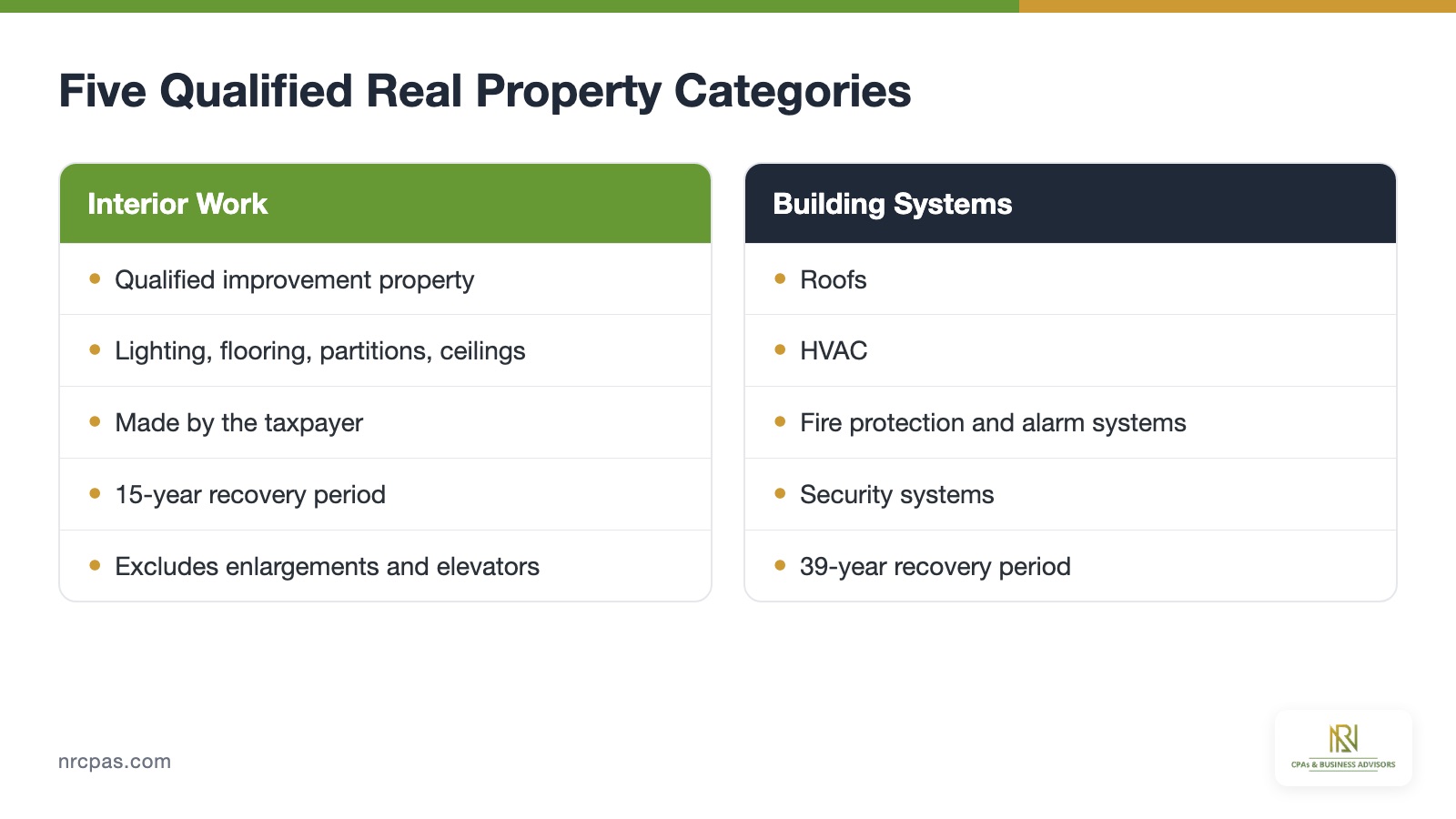
The first category, qualified improvement property, has the longest rulebook.
Which Interior Improvements Count as Qualified Improvement Property?
Qualified improvement property (QIP) is any interior improvement a taxpayer makes to a nonresidential building after its first placed-in-service date. QIP covers interior work such as new lighting, flooring, partition walls and ceilings. The four tests below must all be met.
- The work is made to an interior portion of the building.
- The building is nonresidential real property.
- The taxpayer who claims the deduction made the improvement.
- The improvement is placed in service after the building was first placed in service.
The third test matters when a building changes hands. A buyer cannot expense interior work that a previous owner finished, because the improvement was not made by the buyer.
Three kinds of cost are excluded from QIP, even when the work happens inside the walls. The list below names each one.
- The enlargement of the building, such as a new wing or an added floor.
- Any elevator or escalator, whether new or replaced.
- The internal structural framework, such as load-bearing walls and columns.
Mixed projects need a cost split, so that only the interior share is expensed. The Coronavirus Aid, Relief, and Economic Security (CARES) Act of 2020 also settled the recovery period for QIP. According to IRC section 168(e)(3)(E), QIP is 15-year property, retroactive to property placed in service after December 31, 2017.
Interior work is only part of the picture, because the building's shell and systems follow different tests.
Which Building Systems Qualify Besides Qualified Improvement Property?
The building systems that qualify besides qualified improvement property are roofs, HVAC, fire protection and alarm systems, and security systems. Each must be an improvement to nonresidential real property placed in service after the building was first placed in service. Interior location is not required, so a rooftop unit or a new roof still counts.
The Internal Revenue Service (IRS) labels all four systems, plus QIP, as qualified section 179 real property in its Form 4562 instructions. Each system has its own questions, starting with the roof.
Does a Roof Replacement Qualify for Section 179?
A roof replacement qualifies for Section 179 when the building is nonresidential and the new roof is placed in service later. A capitalized roof replacement counts, while a leak patch is a deductible repair. The deduction covers the materials and labor of the replacement.
A section 179 roof replacement on a warehouse or office building is one of the largest single deductions an owner can claim. A roof added after a storm follows the same test. The claim depends on the placed-in-service date, not on the reason for the work.
Does an HVAC System Qualify for Section 179?
An HVAC system qualifies for Section 179 when heating, ventilation or air-conditioning property is installed in a nonresidential building later. Rooftop units, central units, boilers and chillers are the usual examples.
The statute covers new installations and replacements alike. A replaced HVAC system gets its own placed-in-service date. A building with units installed in different years carries a separate date for each unit.
Do Fire Protection and Alarm Systems Qualify for Section 179?
Fire protection and alarm systems qualify for Section 179 when they are installed in a nonresidential building after its first placed-in-service date. Sprinklers, suppression equipment, smoke detection and alarm panels are the usual examples.
Code upgrades often trigger these projects, and a retrofit after a fire marshal inspection fits the test. Keep the contractor's completion letter, because that letter fixes the placed-in-service date.
Do Security Systems Qualify for Section 179?
Security systems qualify for Section 179 when they are installed in a nonresidential building after the building was first placed in service. Surveillance cameras, access control hardware and intrusion detection equipment are the usual examples.
The same four systems in an apartment building do not qualify, because the statute reaches only nonresidential real property. That limit is the first of several exclusions.
What Does Not Count as Qualified Real Property for Section 179?
Property that does not count as qualified real property for Section 179 includes residential rentals, land, enlargements and related-party purchases. The building itself is never qualified real property, only improvements made to it afterward. The table below sorts nine common projects by outcome.
| Project | Qualifies | Category | Typical recovery period |
|---|---|---|---|
| Office lighting and flooring | Yes | Qualified improvement property | 15 years |
| New warehouse roof | Yes | Roof | 39 years |
| Rooftop HVAC replacement | Yes | HVAC | 39 years |
| Sprinkler retrofit | Yes | Fire protection | 39 years |
| Cameras and access control | Yes | Security system | 39 years |
| Building addition | No | Enlargement | 39 years |
| Elevator replacement | No | Elevator | 39 years |
| Apartment building roof | No | Residential property | 27.5 years |
| Parking lot paving | No | Land improvement | 15 years |
The recovery periods come from IRC section 168(c). That section sets 39 years for nonresidential real property and 27.5 years for residential rental property. The paving row shows why owners confuse categories. Both paving and fencing carry a 15-year life, yet both fall outside qualified real property.
Four more exclusions apply to every Section 179 claim. Property acquired by gift, by inheritance or from a related person does not count as a purchase under IRC section 179(d)(2). Estates and trusts cannot claim the deduction at all.
Noncorporate lessors face a stricter test. According to IRC section 179(d)(5), a noncorporate lessor generally qualifies only when it produced the property. The other path is a lease term under 50% of the class life.
Each qualifying project still needs a formal election, and the election has its own steps.
How Do You Elect Section 179 on Qualified Real Property?
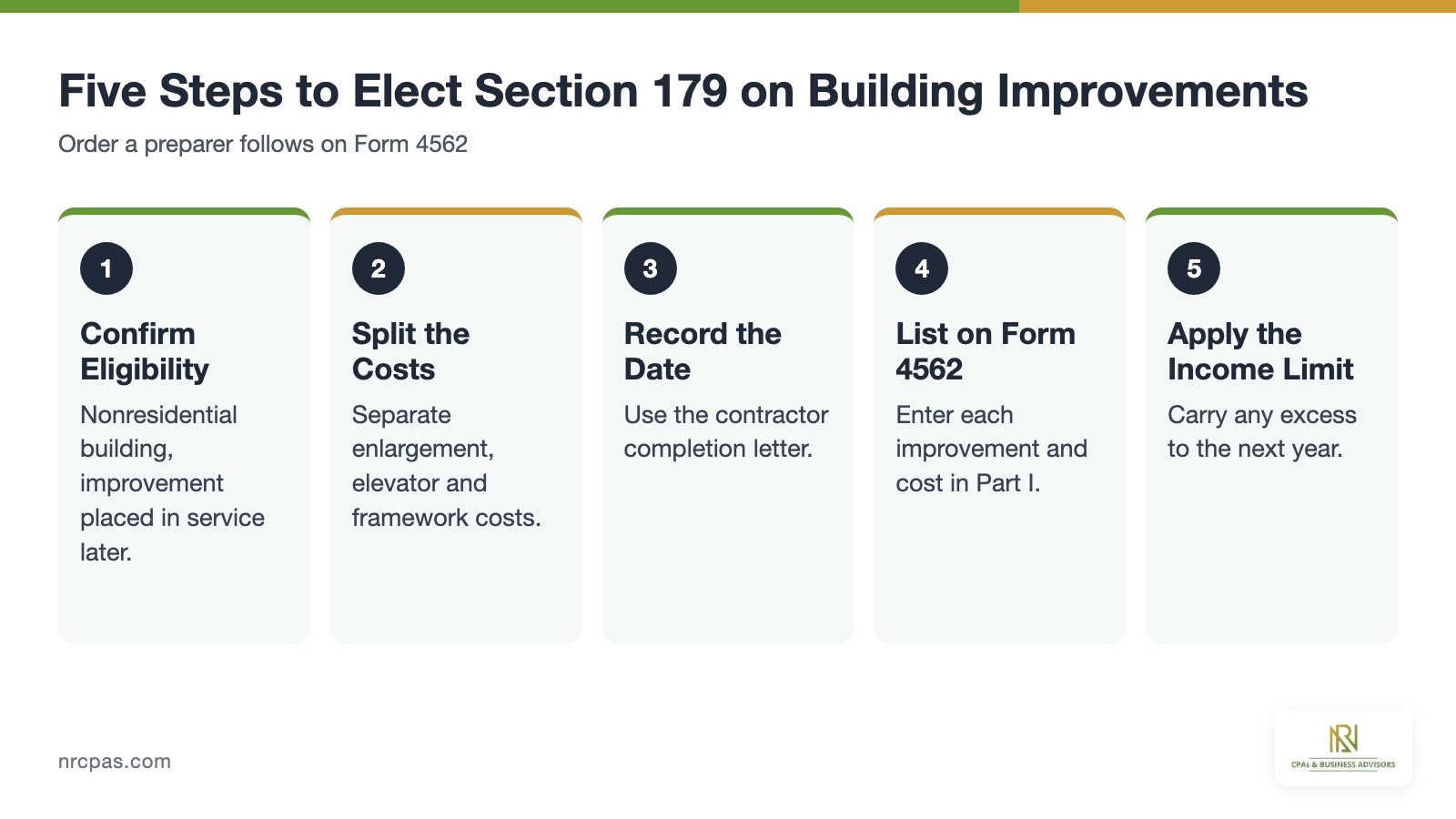
You elect Section 179 on qualified real property by listing it on Form 4562 and attaching the form to the return. Real property is not expensed automatically, so the election must be made for each improvement. The five steps below follow the order a preparer uses.
- Confirm the building is nonresidential and the improvement was placed in service after the building.
- Separate qualifying costs from enlargement, elevator and structural framework costs.
- Record the placed-in-service date from the contractor's completion letter.
- List each improvement and its cost in Part I of Form 4562.
- Apply the taxable income limitation and carry any excess to the next year.
The graphic below shows the same five steps in sequence.
An election is not permanent. According to IRC section 179(c), a taxpayer may revoke the election for any property, and the revocation is then irrevocable. The Form 4562 walkthrough therefore deserves a second review before filing.
Once the election is made, the dollar limits decide how much of the cost is deducted.
How Much Qualified Real Property Can You Expense Under the 2026 Limit?
You can expense qualified real property up to the $2,560,000 Section 179 limit for tax years beginning in 2026. The deduction phases out dollar for dollar once total qualifying property placed in service exceeds $4,090,000. The deduction reaches zero at $6,650,000.
According to IRS Publication 946, the 2025 limit was $2,500,000, with the phase-out starting at $4,000,000. The One Big Beautiful Bill Act, signed July 4, 2025, set those 2025 figures. Qualified real property shares the cap with equipment, so a large roof can crowd out a vehicle or machinery purchase. The annual limit history shows how the cap moved from year to year.
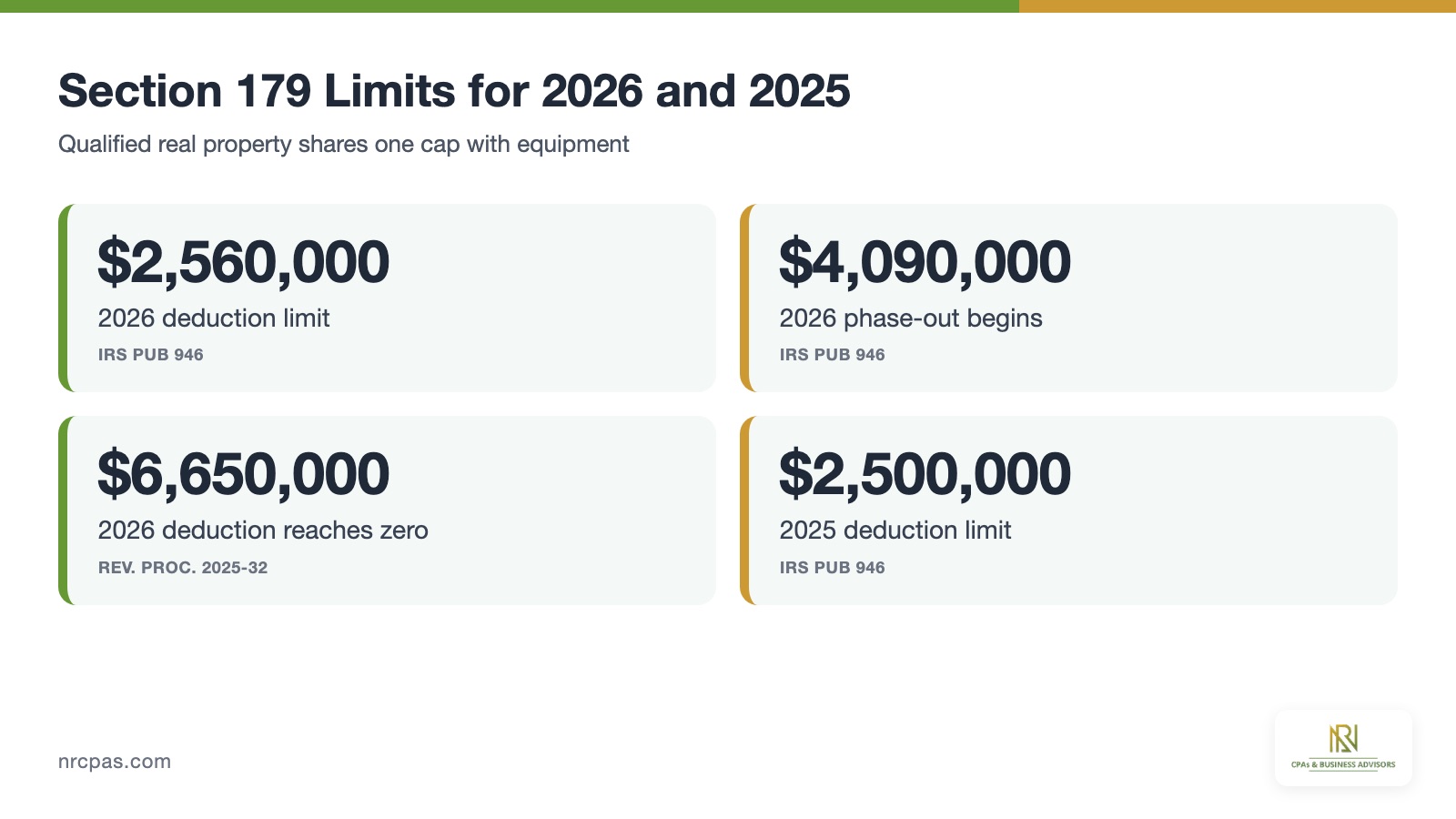
The graphic above lists the four dollar figures in one place. A second cap sits underneath them. Under IRC section 179(b)(3), the deduction cannot exceed taxable income from the taxpayer's active trades or businesses.
A business with $800,000 of taxable income and a $1,200,000 qualifying roof and HVAC project can deduct $800,000 now. The other $400,000 carries forward to a later year. The carryforward keeps the full cost deductible, but it delays the cash benefit.
That delay is where bonus depreciation enters the comparison.
Should You Choose Section 179 or Bonus Depreciation for Building Improvements?
Section 179 is the stronger choice for roofs, HVAC, fire protection and security systems, while bonus depreciation fits QIP. Bonus depreciation applies only to property with a recovery period of 20 years or less. Roofs and building systems are 39-year property, so bonus depreciation does not reach them.
QIP is 15-year property, so both provisions apply to it. According to the One Big Beautiful Bill Act, bonus depreciation is 100% for qualifying property acquired after January 19, 2025. The IRS issued interim guidance in Notice 2026-11 on January 14, 2026.
Bonus depreciation has no dollar cap and no taxable income limitation, and it can create a net operating loss. Section 179 has both limits, but it works asset by asset. A common plan expenses the roof and HVAC under Section 179 and lets bonus depreciation cover the QIP. Owners who budget for those projects through capex budgeting avoid a surprise at filing time.
The same real property rules raise several side questions about tenants, rentals, records and state returns.
What Else Should Owners Know About Qualified Real Property?
Qualified real property raises side questions about tenants, rental buildings, new factory property, recapture, records and state returns. The sections below answer each one in short form.
Can a Tenant Claim Section 179 on Qualified Real Property?
A tenant can claim Section 179 on qualified real property when the tenant made and paid for the improvement. Interior buildouts made by the tenant are the classic QIP case. Tenants who finish suites before moving in should review the tenant buildout rules for lease-specific limits.
Does Section 179 Apply to Rental Buildings?
Section 179 applies to rental buildings only when the building is nonresidential and the owner meets the lessor rules. Apartment buildings and long-term residential rentals are excluded entirely. A commercial landlord that is not a corporation must pass the class life test in IRC section 179(d)(5). The rental building deductions article covers the lessor tests in detail.
What Is Qualified Production Property?
Qualified production property is a separate provision, IRC section 168(n), that allows a 100% depreciation allowance for certain factory buildings. It is not part of Section 179 and has its own dates. According to IRS Notice 2026-16, construction must begin after January 19, 2025 and before January 1, 2029. The property must be placed in service before January 1, 2031.
What Happens When Business Use Drops Later?
Recapture applies when an improvement stops being used predominantly in a trade or business. According to IRC section 179(d)(10), the benefit of the deduction is recaptured in that case. Selling the building after expensing a roof can also turn part of the gain into ordinary income. Tracking the business-use percentage each year prevents an unplanned tax bill.
What Records Prove a Qualified Real Property Claim?
The records that prove a qualified real property claim are the invoice, the contract, the proof of payment and the placed-in-service evidence. According to the IRS, property records should be kept until the limitations period expires for the year the property is disposed of. A roof or HVAC claim therefore needs records for the full life of the building ownership. Those records also support fixed asset schedules on the balance sheet.
Do States Follow the Federal Rules?
States set their own Section 179 rules, so a federal deduction can produce a state add-back. Several states decouple from the federal limit or cap the amount. The state return should be modeled before the project is approved. Business owners who also buy secondhand machinery can compare the secondhand equipment rules in the same filing.
Who Can Help Decide What Qualifies?
A CPA can decide what qualifies by reviewing each invoice against the five categories before the return is filed. We separate qualifying roof, HVAC, fire protection and security costs from excluded costs, and we document the placed-in-service dates. Founder Nischay Rawal, CPA, EA, leads the firm at (305) 872-3096.
The team at NR tax advisors works with owners who want a plan before the work starts. Each plan starts with a review of the building, the invoices and the placed-in-service dates. The review covers every roof, HVAC unit, alarm panel and camera system installed during the year. It also flags excluded costs before filing.
Owners who ask what is qualified real property for Section 179 in their own building can begin with building tax strategy.