What Are Outstanding Checks in Bank Reconciliation


Outstanding checks in bank reconciliation are checks a business has written and recorded that the bank has not yet paid. Outstanding checks are subtracted from the bank statement balance, because the books already show the payment. A $2,550 total of uncleared checks turns an $18,400 bank balance into $15,850 before deposits in transit. No journal entry is needed, unless a check is voided.
Key Takeaways
- An outstanding check is recorded in the books but has not cleared the bank.
- Outstanding checks are subtracted on the bank side of the reconciliation.
- Deposits in transit are added on the same bank side.
- Outstanding checks need no journal entry until a check is voided or replaced.
- A check older than 6 months is stale-dated, and the bank may refuse it.
What Are Outstanding Checks in Bank Reconciliation?
Outstanding checks in bank reconciliation are issued checks that appear in the company's cash records but not on the bank statement. The question "what is outstanding checks in bank reconciliation" has a short answer. An outstanding check is a payment already recorded by the business but not yet cashed by the payee. Accountants also call these uncleared checks.
The gap exists because a check takes days to travel from the mailbox to the bank. During that gap, the books show less cash than the bank does. Neither record is wrong, since the two records simply post the same payment on different dates.
Checks remain a large payment channel. According to the Federal Reserve Payments Study, Americans paid 9.2 billion checks worth $24.45 trillion in 2024. Each of those checks was outstanding for a few days at some company, so the reconciling item is routine. Owners who want cash reconciliation help usually start with this one item.
Outstanding checks are easy to define, but the cause of the gap is worth a closer look.
Why Do Outstanding Checks Make the Bank Balance Higher Than the Books?
Outstanding checks make the bank balance higher than the books because the business subtracts a check on the day it is written. The bank subtracts the same check only when the payee deposits it. The difference is a timing difference, not an error.
The Check Clearing for the 21st Century Act took effect on October 28, 2004. That law let banks clear checks from images instead of moving paper. Faster clearing shortens the gap, but a check mailed on the 30th still clears after month-end. The graphic below traces one check from the day it is written to the day the bank debits it.
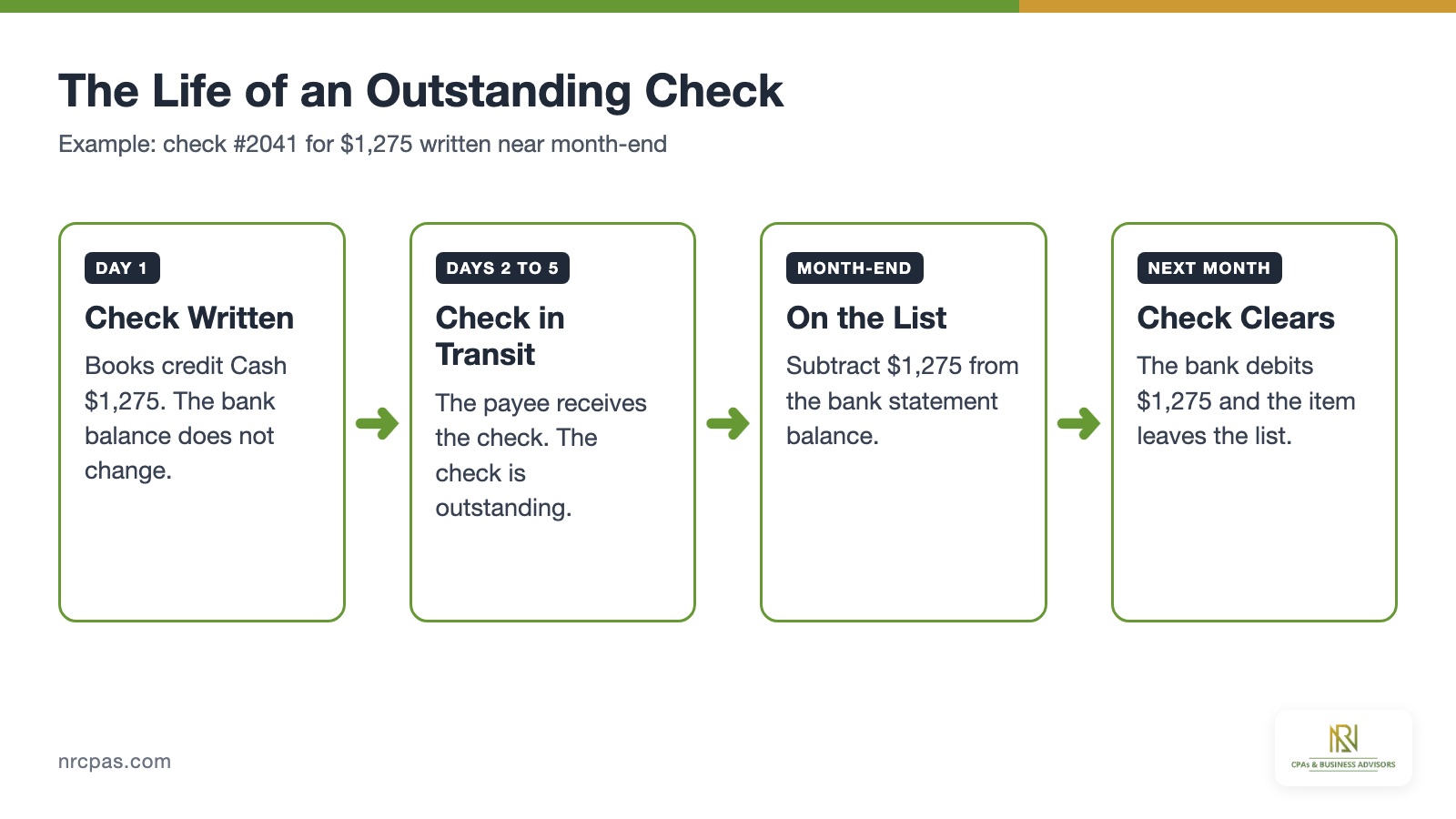
Deposit rules also stretch the gap. According to the Federal Reserve, Regulation CC makes the first $275 of a check deposit available the next business day. The payee's bank may hold the rest, and the paying bank debits the account only once the check reaches it.
Owners who spend the bank balance without subtracting uncleared checks risk overdrafts. Written cash controls prevent that mistake. Controls start with knowing which side of the reconciliation holds each item.
Where Do Outstanding Checks Go on a Bank Reconciliation?
Outstanding checks go on the bank side of a bank reconciliation, as a deduction from the bank statement ending balance. When preparing a bank reconciliation, outstanding checks should be subtracted because the books already deducted them. The subtraction lowers the bank balance to the true cash figure.
The question "where do outstanding checks go on a bank reconciliation" depends on a simple split. Bank-side items fix the bank balance, and book-side items fix the ledger balance. The table below lists 6 common reconciling items in 6 rows and 4 columns.
| Reconciling item | Side | Action | Journal entry needed |
|---|---|---|---|
| Outstanding check | Bank | Subtract | No |
| Deposit in transit | Bank | Add | No |
| Bank error | Bank | Add or subtract | No, the bank corrects it |
| Bank service fee | Book | Subtract | Yes |
| Interest earned | Book | Add | Yes |
| NSF customer check | Book | Subtract | Yes |
Only the book-side rows change the ledger, and the two bank-side timing rows never do. Knowing the side is half the work, and the other half is finding each check.
How Do You Find Outstanding Checks on a Bank Reconciliation?
How to find outstanding checks on bank reconciliation starts with matching each register check to the bank statement. Any recorded check that has not cleared is outstanding. The steps below work for a paper register or accounting software.
- Print the check register for the statement period and the prior outstanding list.
- Tick each register check that appears as cleared on the bank statement.
- List every unticked check by number, date, payee and amount.
- Add the prior month's checks that are still uncleared.
- Total the list and subtract that total from the bank statement balance.
The graphic below shows the same 5 steps in order.
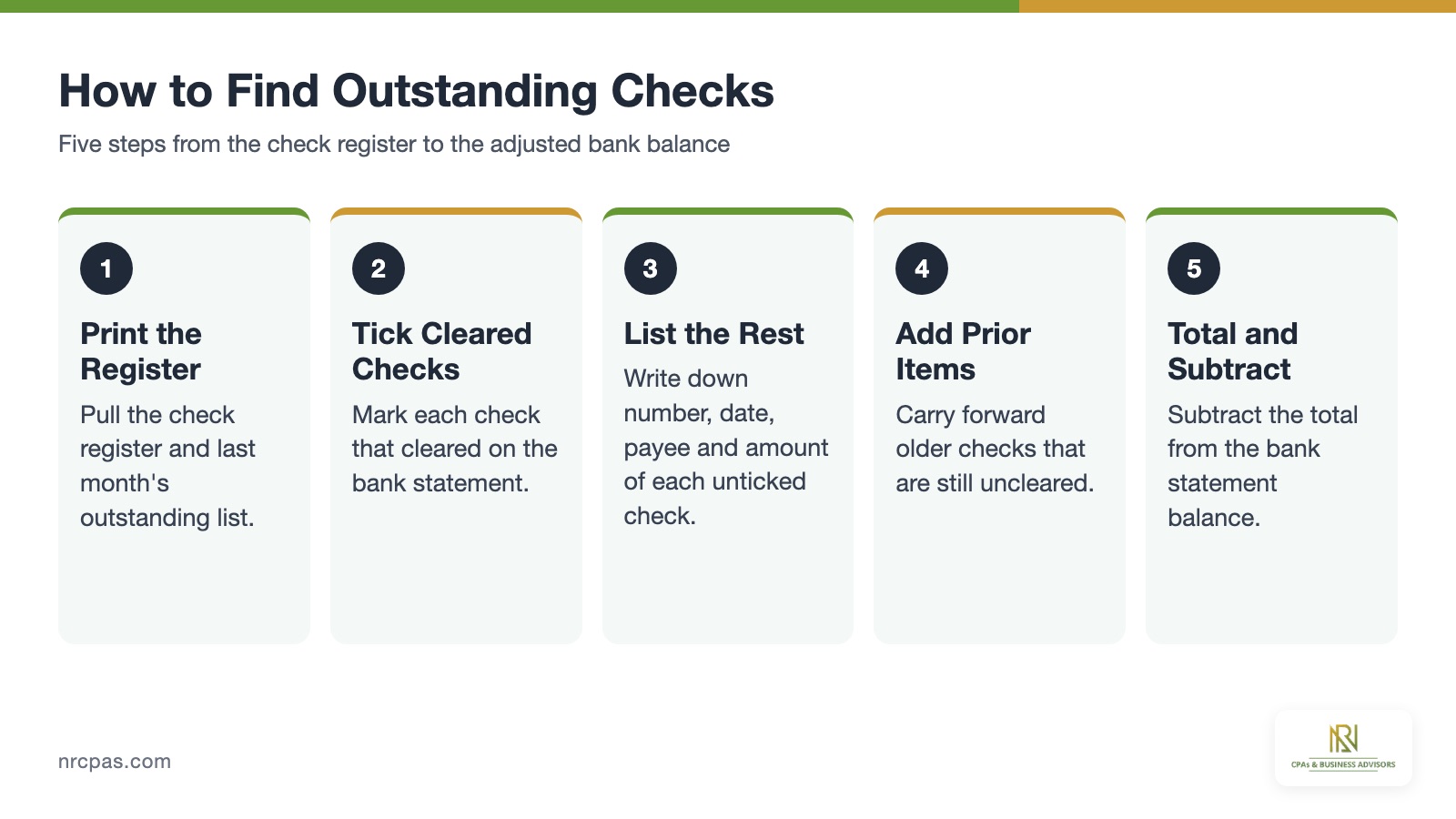
Check numbers help because gaps in the sequence reveal a missing or voided check. A prior-month check stays on the list until it clears. Once the list is totaled, the adjusted balance can be calculated.
How Do You Calculate the Adjusted Bank Balance With Outstanding Checks?
You calculate the adjusted bank balance by starting with the bank statement balance, adding deposits in transit, and subtracting outstanding checks. The adjusted bank balance must equal the adjusted book balance. The worked example below uses an $18,400 bank statement balance.
| Reconciliation line | Amount |
|---|---|
| Bank statement ending balance | $18,400 |
| Add: deposit in transit | $2,150 |
| Less: outstanding check #2041 | ($1,275) |
| Less: outstanding check #2046 | ($860) |
| Less: outstanding check #2049 | ($415) |
| Adjusted bank balance | $18,000 |
The three outstanding checks subtract $2,550 from the bank side, and the deposit in transit adds $2,150 back. On the book side, an $18,030 ledger balance gains $12 of interest and loses a $42 bank fee. The adjusted book balance is $18,000, so the two sides agree.
Agreement proves the reconciliation, and monthly reconciliations keep the proof current. The book-side entries for interest and fees are the only journal entries in this example.
Do Outstanding Checks Need a Journal Entry?
No, outstanding checks do not need a journal entry, because the check was already recorded when it was written. The only journal entry for outstanding checks appears when a check is voided, replaced or written off. The original entry debited an expense or payable and credited Cash.
A voided check reverses that original entry. The journal entry for outstanding checks that are voided debits Cash and credits the account first charged, such as Accounts Payable. The reversal returns the money to the books and removes the check from the outstanding list.
A replacement check then posts as a new payment. Skipping the reversal would count one bill twice, once on the lost check and once on the replacement. Old checks create the next question, since time changes their status.
What Happens When an Outstanding Check Goes Stale?
An outstanding check goes stale at 6 months from its date, and the bank is no longer obliged to pay it. This rule comes from Section 4-404 of the Uniform Commercial Code. A stale-dated check is not void, because the bank may still pay it in good faith.
The business should act before that point. Contact the payee, confirm the payment is still owed, and place a stop payment if a replacement will be issued. A stop payment protects the business from paying the same bill twice.
Long-unclaimed payments may also fall under state unclaimed property laws. Dormancy periods differ by state and by payment type, so the business should confirm the rule before writing off an old check. Writing off a check by crediting income too early can create a reporting problem later.
Stale checks are one risk among several, and the rest of the topic sits in the questions below.
What Else Should You Know About Outstanding Checks?
Outstanding checks also touch the balance sheet, tax timing, fraud controls and review habits. The answer to what is outstanding checks in bank reconciliation holds in each case. The sections below cover each side topic in short form.
Do Outstanding Checks Appear on the Balance Sheet?
No, outstanding checks do not appear on the balance sheet as a separate line, because the Cash account is already reduced. The reported cash figure equals the adjusted bank balance. The adjusted figure of $18,000 is the cash number reported in the example.
Cash then feeds the other statements. A reconciled cash balance opens the cash flow schedule for the period.
The same cash figure sits at the top of the assets section. Cash is listed first because it is the most liquid asset. A reader who compares the balance sheet with the income statement sees why one unreconciled check shifts both reports. The balance sheet shows the cash on hand at the reporting date, while the income statement shows the expense for the period.
What Is the Difference Between Outstanding Checks and Deposits in Transit?
Outstanding checks are payments the bank has not yet debited, while deposits in transit are receipts the bank has not yet credited. Outstanding checks are subtracted and deposits in transit are added. Both are bank-side timing items.
The comparison graphic below sets the two items side by side.
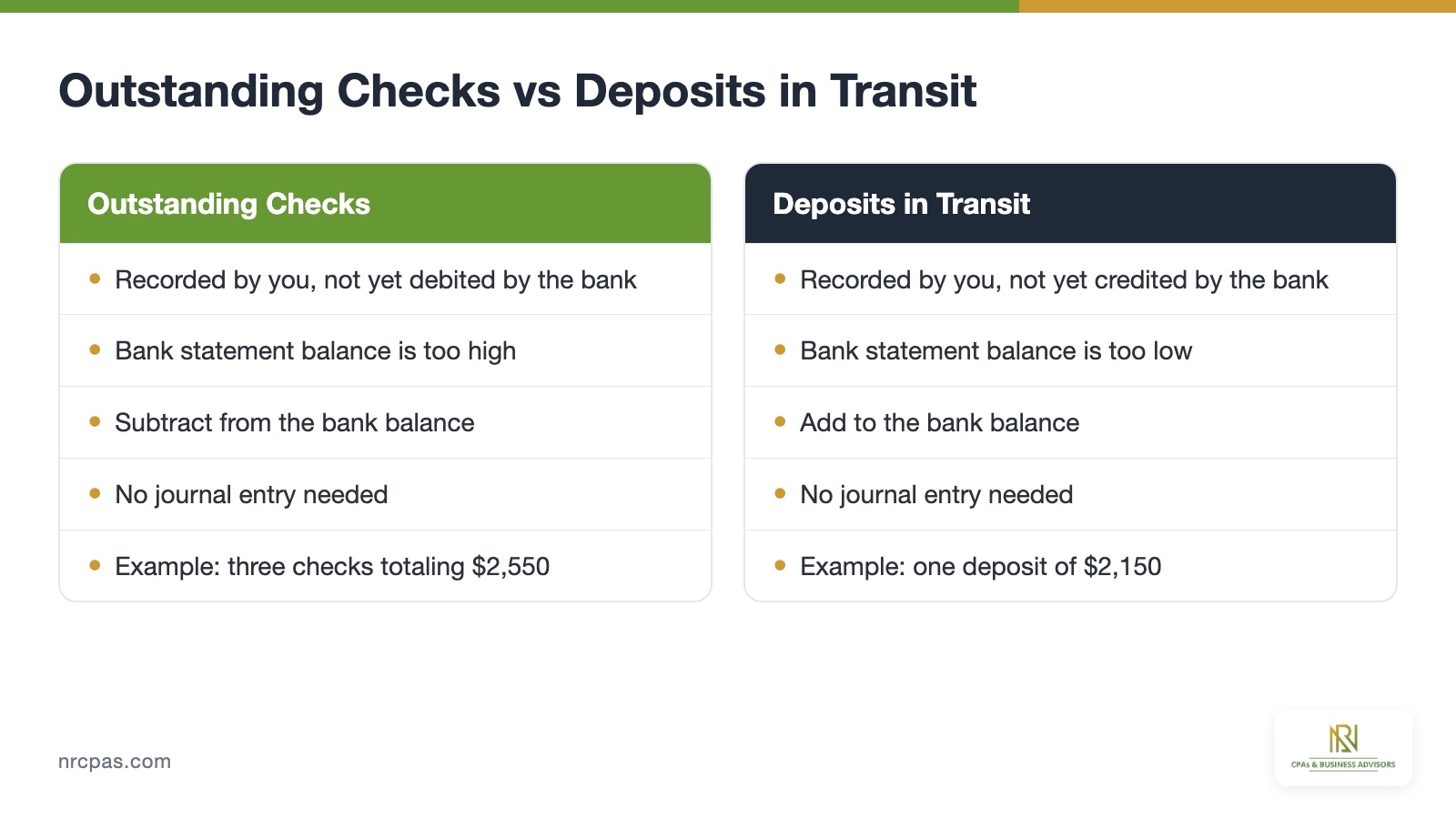
Both items clear on their own once the bank processes them. Neither one needs a journal entry, and each one leaves the list when it appears on a later statement.
Do Outstanding Checks Affect Taxes?
Outstanding checks affect taxes only through timing. According to the Internal Revenue Service (IRS), a cash-method business generally deducts an expense in the year it pays the expense. Year-end cutoff planning decides which year a late-December check belongs to.
Payment records matter for reporting as well. According to the IRS, clients file Form 1099-NEC for contractor payments of $600 or more made during 2025. The threshold is $2,000 for payments made on or after January 1, 2026.
According to the IRS, business records should be kept for at least 3 years from the filing date. The period grows to 6 years when income above 25% of gross income is left off a return. The bank reconciliation file belongs with those records.
How Do Outstanding Checks Relate to Check Fraud?
Outstanding checks relate to check fraud because an unusual old item on the list can signal a forged or altered check. According to the Association for Financial Professionals (AFP), 63% of organizations faced attempted or actual check fraud in 2024. The same survey reports 79% faced some payments fraud.
A reviewer who is not the check signer should scan the list each month. Banks also offer positive pay, which compares each presented check with an issued-check file. Better cash management pairs that service with the monthly review.
How Often Should You Review Outstanding Checks?
Outstanding checks should be reviewed at every reconciliation, and monthly is the minimum for most businesses. Companies that write many checks may review weekly. The review should flag every check that is older than 60 days.
A clean month-end list also speeds the month-end close for the whole team.
The final outstanding list usually gets a sign-off from a finance lead. The lead confirms that every old item has a note and every recent item should clear. A part-time small business CFO can fill that role without a full-time hire. Owners who have no finance lead should assign the sign-off to someone who does not sign checks.
How Can a CPA Firm Help With Bank Reconciliations?
A CPA firm can reconcile each bank account, clear old outstanding checks and tie the cash balance to the financial statements. We prepare monthly reconciliations for small businesses across the country. The firm is led by founder Nischay Rawal, CPA, EA, and the office number is (305) 872-3096.
Owners still weighing what is outstanding checks in bank reconciliation can call the team at NR CPA counsel.
The firm keeps each reconciliation in a dated workpaper. A lender or an auditor can then trace every adjustment to a bank statement line. Clean cash records also produce reconciled financial statements that lenders trust.