Balance Sheet vs Profit and Loss Statement and How They Differ


No, a balance sheet and a profit and loss statement are different reports. The balance sheet vs P&L question comes down to timing. A balance sheet lists assets, liabilities and equity on one date. A P&L lists revenue and expenses across a period and ends with net income. Net income then feeds the balance sheet through equity.
Key Takeaways
- A balance sheet is a snapshot on one date, and a P&L covers a month, quarter or year.
- The balance sheet follows Assets = Liabilities + Equity, and the P&L follows Revenue - Expenses = Net Income.
- Net income from the P&L moves into retained earnings or owner's equity on the balance sheet.
- The books produce the P&L first, and the balance sheet cannot close until net income is known.
- Profit does not equal cash, because unpaid invoices raise profit without raising the bank balance.
What Is the Difference in a Balance Sheet vs P&L?
The difference in a balance sheet vs P&L is timing and purpose. A balance sheet reports financial position on one date, while a P&L reports performance across a period. The balance sheet shows what the business owns and owes, and the P&L shows whether the business made money.
According to the U.S. Securities and Exchange Commission (SEC), a balance sheet details a company's assets, liabilities and shareholders' equity. The SEC adds that an income statement shows how much revenue a company earned over a specific time period. A P&L is the income statement under another name.
The table below lines up the two reports across 5 features. Each row names one feature and how each statement handles it.
| Feature | Balance Sheet | P&L Statement |
|---|---|---|
| Time covered | One date, such as December 31 | A period, such as a month, quarter or year |
| Main question | What does the business own and owe? | Did the business make money? |
| Core equation | Assets = Liabilities + Equity | Revenue - Expenses = Net Income |
| Other names | Statement of financial position | Income statement, statement of operations |
| Last line | Total liabilities and equity | Net income or net loss |
One report measures position, and the other measures performance. Owners who keep both current through financial statement services see each question answered on schedule. The graphic below shows the snapshot against the period.

The snapshot report deserves a closer look first, because the P&L feeds into it.
What Does a Balance Sheet Show About a Business?
A balance sheet shows what a business owns, what it owes and what remains for the owners on one date. The balance sheet always follows the equation Assets = Liabilities + Equity. The SEC states that a company's assets have to equal the sum of its liabilities and shareholders' equity.
The balance sheet has 3 sections, and each section groups accounts by type, as the list below shows.
- Assets are resources the business owns, such as cash, accounts receivable, inventory and equipment.
- Liabilities are debts the business owes, such as accounts payable, credit cards and bank loans.
- Equity is the owner's share after liabilities are subtracted from assets, including retained earnings.
Assets and liabilities are split again into current items due within 1 year and long-term items due later. Lenders read that split to judge short-term liquidity. The report stops at one date, so the activity between two dates sits on a different statement.
What Does a Profit and Loss Statement Show About a Business?
A profit and loss statement shows revenue, costs and expenses over a period and ends with net income. The P&L answers whether the business made a profit or a loss during that period. The balance sheet vs profit and loss statement contrast starts here, because the P&L has no assets or debts on it.
The P&L builds down the page in 5 steps, listed below in the order a reader sees them.
- Revenue is the income earned from the main business activity.
- Cost of goods sold or cost of services is subtracted to reach gross profit.
- Operating expenses such as rent, wages and marketing are subtracted to reach operating income.
- Interest and income taxes are subtracted next.
- The remainder is net income, also called the bottom line.
According to the Internal Revenue Service (IRS), an accrual-method business reports income in the year its right to the income is fixed. The P&L follows that timing, so earned revenue appears even when payment is pending. Casual labels such as income sheet describe the same report, so an income sheet vs balance sheet comparison is the same comparison.
The Financial Accounting Standards Board (FASB) is adding detail to the P&L as well. According to FASB, ASU 2024-03 requires public companies to disclose natural expense categories in annual periods beginning after December 15, 2026. Small businesses do not face that rule, but the same detail helps margin analysis. The bottom line of this report then becomes the first number on the other one.
Where Does Profit Go on the Balance Sheet?
Profit goes on the balance sheet in the equity section, as retained earnings or owner's equity. Net income from the P&L increases equity, and a net loss decreases it. Draws and dividends reduce equity as well.
A worked example makes the link visible. Greenline Landscaping, a sample company, earned $240,000 of revenue in the year. Cost of services was $96,000 and operating expenses were $102,000, so net income was $42,000. The owner took $20,000 in draws, and opening equity was $30,000.
The table below places the year-end figures from both statements in one view. Every line comes from the same set of books.
| Statement | Line | Amount |
|---|---|---|
| P&L | Revenue | $240,000 |
| P&L | Cost of services plus operating expenses | $198,000 |
| P&L | Net income | $42,000 |
| Balance sheet | Total assets | $92,000 |
| Balance sheet | Total liabilities | $40,000 |
| Balance sheet | Owner's equity | $52,000 |
Equity of $52,000 equals opening equity of $30,000, plus net income of $42,000, minus draws of $20,000. Liabilities of $40,000 plus equity of $52,000 equal assets of $92,000. The flow graphic below traces the $42,000 from the P&L into equity.

The same $42,000 appears twice, once as a period result and once inside a date-based total. That overlap raises the next question about whether the two reports must agree.
Should the P&L and Balance Sheet Match?
The P&L and balance sheet should not match in total, but they must agree through equity. Net income should equal the change in equity after adding back draws and subtracting owner contributions. Greenline's equity rose $22,000, and adding $20,000 of draws returns the $42,000 of net income.
A gap after those adjustments signals a posting error. Common causes include an equipment purchase booked as an expense, a missing vendor bill or an unreconciled bank account. A balance sheet that fails Assets = Liabilities + Equity points to the same kind of error.
According to the IRS, the Schedule L balance sheets on Form 1120-S should agree with the corporation's books and records. The books must also use one accounting method, according to IRS Publication 334. Agreement between the reports also depends on preparation order, which comes next.
What Comes First, the P&L or the Balance Sheet?
The P&L comes first when the books are prepared, and the balance sheet comes second. The balance sheet cannot be completed until net income is known. Published reports often list the balance sheet first, but the preparation order stays fixed.
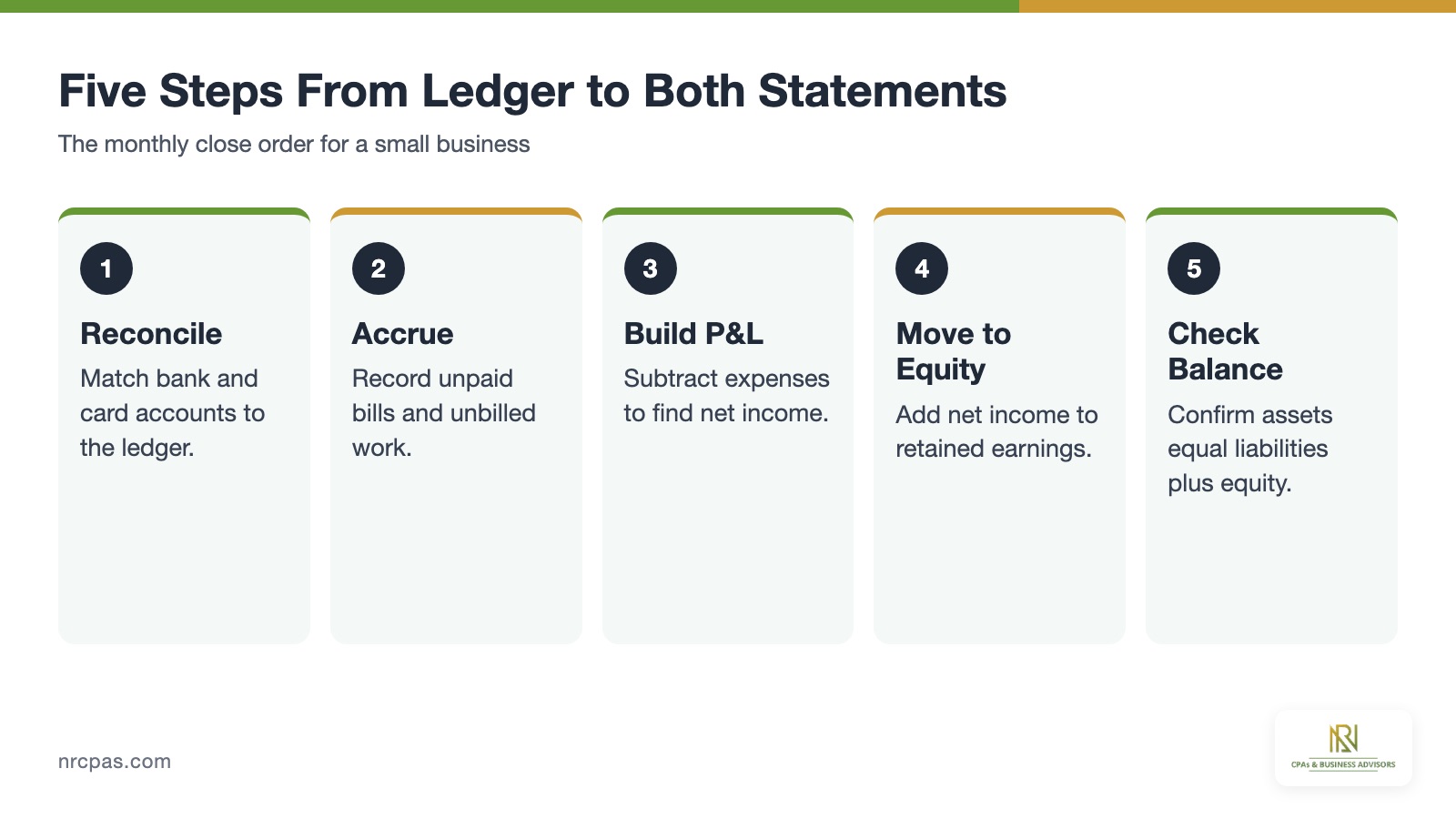
The sequence below shows how a monthly close moves from the ledger to both reports.
- Reconcile bank and credit card accounts to the ledger.
- Record accruals, such as unpaid bills and unbilled work.
- Build the P&L and calculate net income.
- Move net income into retained earnings or owner's equity.
- Finish the balance sheet and confirm Assets = Liabilities + Equity.
The steps above show why a balance sheet alone cannot give profit directly. Even so, two balance sheets can reveal profit indirectly.
Can You Tell Profit From a Balance Sheet?
You can estimate profit from two balance sheets, but a single balance sheet does not show profit. Profit equals the change in equity between two dates, plus draws and dividends, minus contributions. The P&L remains the only report that lists how profit was earned.
Profit also differs from cash. Greenline earned $42,000 but holds $38,000 of cash, because $22,000 of invoices is still unpaid. Receivables raise profit before they raise the bank balance.
According to the Federal Reserve Banks' Small Business Credit Survey, 47.3% of employer firms operated at a profit in 2024. Profit status alone does not describe liquidity, so owners also read cash flow gaps on the third core statement. Each statement also carries its own warning signs.
What Red Flags Show Up on Each Statement?
Balance sheet red flags signal weak liquidity or heavy debt. P&L red flags signal shrinking margins. Each report exposes a different kind of risk. A p&l vs balance sheet review catches both kinds, and the list below groups the warning signs by statement.
- Balance sheet: current liabilities larger than current assets.
- Balance sheet: accounts receivable growing faster than revenue.
- Balance sheet: negative equity or a loan balance that keeps rising.
- P&L: revenue rising while net income falls.
- P&L: cost of services growing faster than revenue.
- P&L: one-time gains hiding weak operating income.
Owners with a finance lead, such as a fractional CFO, review both lists each month. The accounting method behind the numbers can change what those lists show.
How Do Cash Basis and Accrual Basis Change Each Statement?
Cash basis and accrual basis change when income and expenses enter both statements. Cash basis books record items when money moves, while accrual books record items when they are earned or incurred. The cash basis vs accrual basis balance sheet difference shows up in receivables and payables.
A cash basis balance sheet carries no accounts receivable and no accounts payable, because unpaid invoices and bills are not recorded. An accrual balance sheet carries both. The cash vs accrual balance sheet gap also changes net income, so the P&L moves with it.
According to the IRS, a corporation or partnership meets the 2026 gross receipts test at $32,000,000 of 3-year average receipts. Entities under that limit can generally use the cash method. Switching later requires planning, so accounting method advice belongs in year-end decisions. The method chosen also shapes what lenders see.
Who Asks for a Balance Sheet and a P&L?
Lenders, investors, tax agencies and owners all ask for both statements, and each reader uses them differently. Lenders read the balance sheet for debt and liquidity, and they read the P&L for repayment ability. Investors compare both against other firms.
According to the U.S. Small Business Administration (SBA), a 7(a) loan has a maximum amount of $5 million. The SBA says its Working Capital Pro line suits firms that can produce timely and accurate financial statements. The Federal Reserve Banks' Small Business Credit Survey reports that 38.3% of employer firms applied for financing. The same survey shows an 80.8% approval rate.
Tax filers need the balance sheet too. According to the IRS, an S corporation skips Schedule L only when total receipts and total assets are both under $250,000. Corporations with total assets of $10 million or more file Schedule M-3 in place of Schedule M-1.
Founders preparing a first raise can lean on early-stage advisory to build both reports. The remaining questions are shorter side topics.
What Else Do Owners Ask About a Balance Sheet vs P&L?
Owners also ask about statement types, off-balance-sheet items, depreciation, retention and preparation. The sections below answer each side topic briefly.
Is a Balance Sheet the Same as a Financial Statement?
No, a balance sheet is one financial statement, and the term financial statement covers the full set. The 3 core statements are the balance sheet, the P&L and the cash flow statement. The balance sheet vs financial statement distinction is one of part versus whole.
The cash flow statement explains why cash changed between two balance sheet dates. Financial statements also include notes. Financial statements vs balance sheet confusion usually comes from treating the part as the whole set.
What Is On Balance Sheet vs Off Balance Sheet?
On balance sheet items are recorded in the ledger totals. Off balance sheet items are obligations or rights kept outside those totals. Off balance sheet items usually appear only in the notes. Examples include loan guarantees and pending lawsuits.
FASB's lease standard, ASC 842, moved most leases onto the balance sheet. Internally built brand value stays off, because it has no recorded cost.
Do Fixed Assets Show Up on a P&L?
No, fixed assets show up on the balance sheet, and only depreciation expense reaches the P&L. A $10,000 oven is an asset, and its yearly depreciation is the expense. Expensing the full price distorts both statements.
Asset cost sits on the balance sheet until depreciation moves a slice into expense each year. Owners buying vehicles or equipment can compare that treatment with tax rules before the purchase. Entity choice, such as a single-member LLC, then decides how the net income is taxed.
What Does a Balance Sheet Not Include?
A balance sheet does not include revenue, expense detail or the value of future contracts. Revenue and expenses belong on the P&L. Revenue recognition rules, such as those in service revenue accounting, decide which period earns each dollar.
What Is the Golden Rule of the Balance Sheet?
The golden rule of the balance sheet is that assets must equal liabilities plus equity. A balance sheet that does not balance contains an error. The rule holds on every date, for every business size.
How Long Should Both Statements Be Kept?
Both statements and their supporting records should be kept for at least 3 years, according to the IRS. The IRS requires 6 years when unreported income exceeds 25% of the gross income shown on the return. Bad debt claims require 7 years of records.
Who Can Prepare a Balance Sheet and a P&L for a Small Business?
A CPA or an enrolled agent can prepare both statements and tie them to the tax return. We prepare monthly P&L and balance sheet packages for small businesses and review the equity roll-forward each close. The firm is led by founder Nischay Rawal, CPA, EA, and the office line is (305) 872-3096.
Business owners can reach the team at NR advisory group to set up a monthly close. The close covers reconciliations, accruals and the equity roll-forward. Each step keeps the two reports in agreement with the bank and the ledger.
Agreed statements then support a clear forecast model for the next 12 months. Budgets start from last year's P&L and the closing balance sheet. Owners who plan hiring or equipment purchases use those two starting points.
Every balance sheet vs P&L question gets a numbers-based answer once the books tie. Lender packages built from lender statements show that tie.