Does My Vehicle Qualify for Section 179 Deduction


Yes, a vehicle qualifies for Section 179 when the business buys it and drives it over 50% for work. It must also be placed in service by December 31, 2026. Weight then settles "does my vehicle qualify for section 179 deduction" at full cost. A rating over 6,000 pounds avoids the $20,300 passenger car ceiling for 2026.
Key Takeaways
- Five tests decide qualification: purchase, new-to-you, business use above 50%, placed in service, and enough business income.
- Gross vehicle weight rating (GVWR) decides the cap, with 6,000 pounds as the first dividing line.
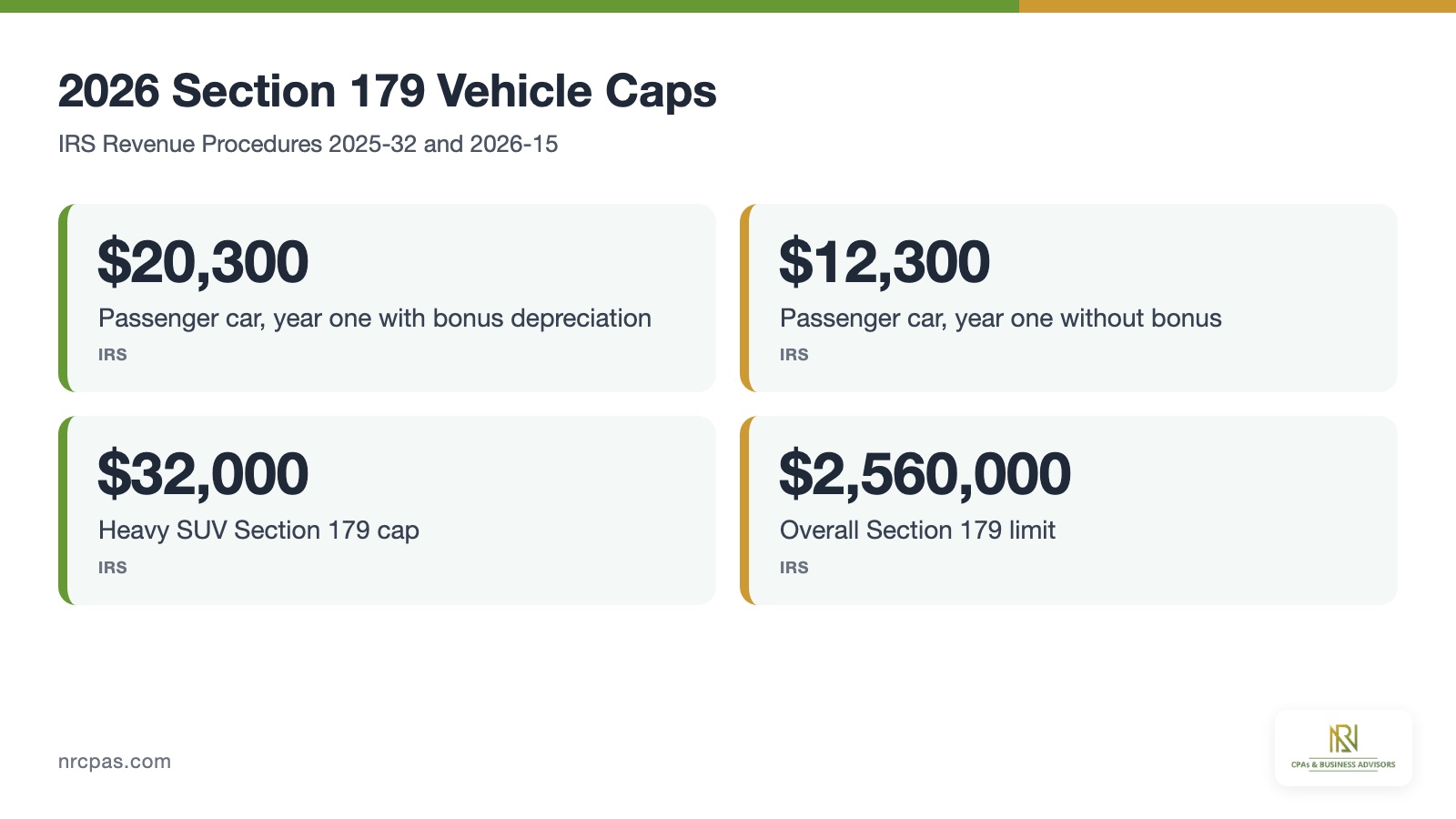
- A passenger car under 6,000 pounds is capped at $20,300 in year one for 2026, or $12,300 without bonus depreciation.
- A heavy SUV rated 6,001 to 14,000 pounds has a $32,000 Section 179 cap, and bonus depreciation covers the rest.
- Pickups with a 6-foot bed and vans with no seating behind the driver skip the SUV cap.
- A mileage log kept at the time of each trip proves the business-use percentage.
Does My Vehicle Qualify for Section 179 Deduction?
Your vehicle qualifies for the Section 179 deduction when it passes five tests. The tests are purchase, new-to-you, business use above 50%, placed in service, and enough business income. A vehicle qualifies only when all five tests are met in the same tax year. Section 179 then lets the business expense the vehicle cost in year one instead of depreciating it over five years.
The dollar ceilings are rarely the problem. According to the Internal Revenue Service (IRS), the 2026 Section 179 limit is $2,560,000. The phase-out starts at $4,090,000 of qualifying purchases. The deduction ends completely at $6,650,000.
Few vehicle buyers come near those totals, so the vehicle's own tests decide the result. A CPA who builds vehicle write-off strategy runs those tests before the purchase date. The tests run in a fixed order.
How Do I Know If I Qualify for Section 179?
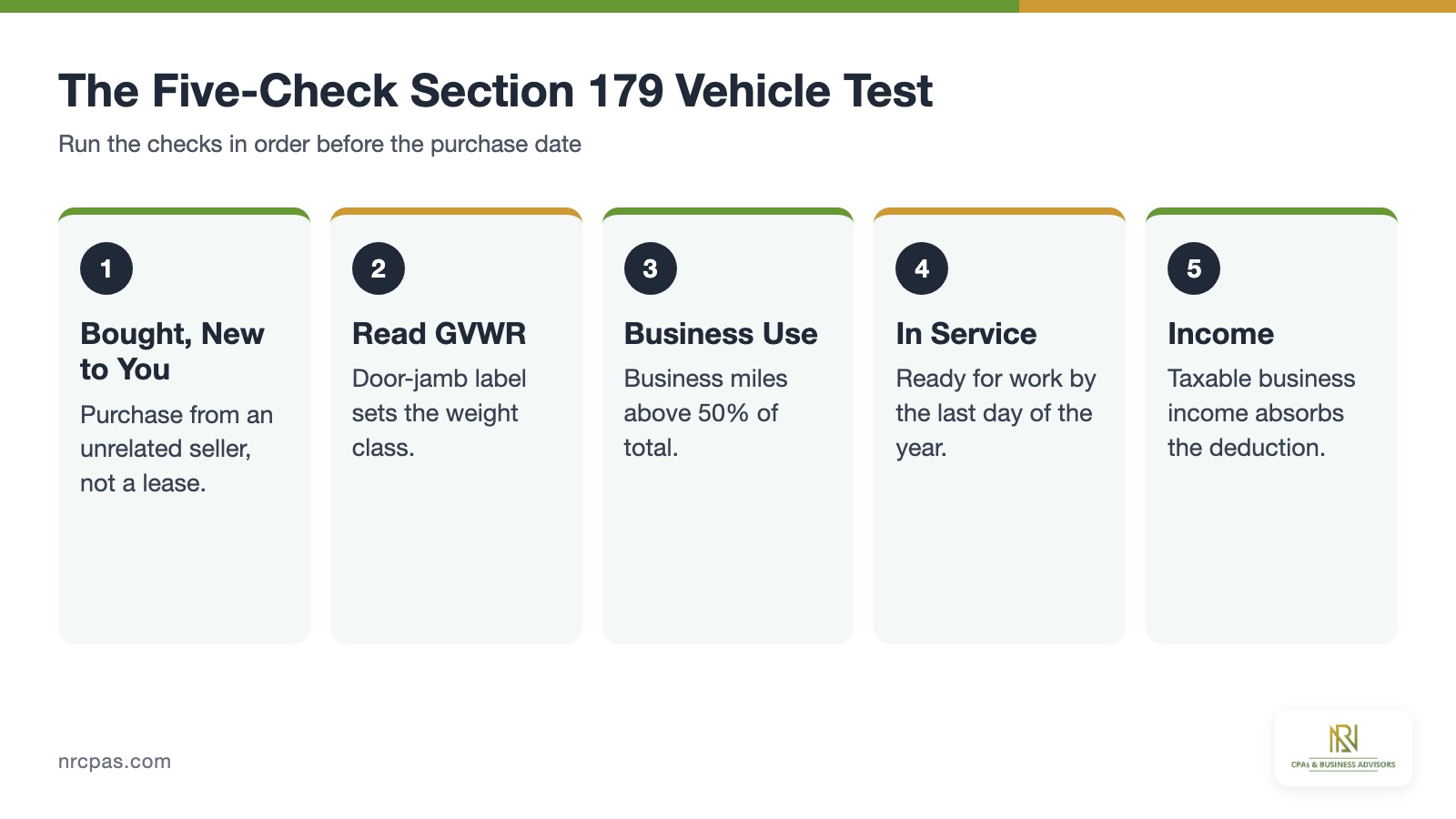
You know you qualify for Section 179 when your vehicle clears the five checks below, taken in order.
- Confirm the business bought the vehicle, new to its operations, from an unrelated seller.
- Read the GVWR on the door-jamb label to find the weight class.
- Divide business miles by total miles, and confirm the result is above 50%.
- Confirm the vehicle is ready and available for work by the last day of the tax year.
- Confirm taxable business income can absorb the deduction.
The graphic below shows the same five checks as a short route from purchase to Form 4562.
Used vehicles pass check one as easily as new ones, because "new to you" means the business never used the vehicle before. A business that is buying used trucks still has to buy from an unrelated seller. Weight then sets how much of the cost the deduction covers.
What Qualifies a Vehicle for Section 179?
A vehicle qualifies for Section 179 when it is a purchased car, SUV, truck or van. Its weight class then sets the dollar cap. The IRS sorts vehicles into three weight classes. Each class carries its own first-year ceiling for 2026, as the table below shows.
| Vehicle class | GVWR | 2026 cap | First-year result |
|---|---|---|---|
| Passenger car or light truck | 6,000 lbs or less | $12,300 without bonus | $20,300 with bonus depreciation |
| Heavy SUV | 6,001 to 14,000 lbs | $32,000 Section 179 | Full cost after bonus depreciation |
| Pickup, van or bus outside the SUV rule | Over 6,000 lbs | No SUV cap | Full cost within overall limits |
| Work vehicle over 14,000 lbs | Over 14,000 lbs | No vehicle cap | Full cost within overall limits |
The table lists four rows because the third and fourth rows both escape the SUV cap for different reasons. Every row starts with the weight rating, so that number comes first.
How Do I Find My Vehicle's GVWR?
You find your vehicle's GVWR on the certification label inside the driver's door jamb, printed in pounds. According to the National Highway Traffic Safety Administration (NHTSA), federal rules require that label to show the GVWR. GVWR is the maximum loaded weight the maker allows, not the empty weight.
The rating changes by trim, cab, drivetrain and equipment, so one model name can sit on both sides of 6,000 pounds. The table below lists published ratings for common work vehicles.
| Vehicle | Published GVWR | Above 6,000 lbs |
|---|---|---|
| Toyota Tacoma XtraCab SR5, 6-foot bed, 2WD | 5,605 lbs | No |
| Ford F-150, most cab and bed builds | 6,010 to 7,050 lbs | Yes |
| Chevrolet Tahoe, 2WD and 4WD | 7,400 and 7,600 lbs | Yes |
| Ford Transit cargo van, T-150 and T-250 | 8,800 and 9,150 lbs | Yes |
A truck such as the full-size pickup example shows how close a light build sits to the line. Read the door-jamb label when a manufacturer does not publish the rating for a trim. A rating at or below 6,000 pounds moves the vehicle into the passenger car caps.
What Is the Section 179 Limit for a Vehicle Under 6,000 Pounds?
The Section 179 limit for a vehicle under 6,000 pounds is the passenger automobile ceiling. For 2026 that ceiling is $20,300 in year one, or $12,300 without bonus depreciation. According to the IRS in Revenue Procedure 2026-15, later years allow $19,800, $11,900 and then $7,160 per year. The ceiling covers Section 179 and depreciation together.
The $20,300 figure includes an $8,000 bonus depreciation add-on. A $30,000 sedan and a $50,000 sedan therefore produce the same $20,300 at 100% business use. Business use below 100% shrinks the ceiling by the same percentage.
A $40,000 sedan used 75% for business, for example, has a first-year ceiling of $15,225. Cars are measured by unloaded weight, while trucks and vans use GVWR. A luxury crossover under the line, like the one in this luxury crossover example, follows the same ceiling. Vehicles above the line follow a different cap.
What Is the Section 179 Cap for a Heavy SUV?
The Section 179 cap for a heavy SUV is $32,000 for 2026, according to the IRS. The cap applies to a four-wheeled passenger vehicle rated over 6,000 pounds and not over 14,000 pounds. Bonus depreciation then deducts the cost above $32,000 at 100%.
A $70,000 SUV rated 7,400 pounds and used 100% for business gets $32,000 under Section 179 plus $38,000 of bonus depreciation. The first-year total equals $70,000. The 2025 cap was $31,300, so the 2026 cap rose by $700.
The callout below lists the 2026 caps used throughout this post.
A minivan or a seven-seat SUV is a heavy SUV when its rating clears 6,000 pounds. A check of the minivan rules therefore starts at the door-jamb label. Some vehicles over 6,000 pounds escape the cap entirely.
Which Pickups and Vans Skip the SUV Cap?
Pickups with a 6-foot bed and vans with no seating behind the driver skip the SUV cap. The tax code excludes them from the SUV definition. According to the IRS, three design tests remove a vehicle over 6,000 pounds from the $32,000 cap. Meeting any one of the three tests removes the cap.
- The vehicle seats more than nine people behind the driver, such as a shuttle van.
- The vehicle has a cargo area at least 6 feet long inside that is not reachable from the passenger compartment.
- The vehicle has an enclosed cab, no seating behind the driver, and no body more than 30 inches ahead of the windshield.
The second test covers the pickup with a 6-foot bed, and the third covers the cargo van with a flat cab. A conventional cargo van with a long nose usually fails the third test. A Transit-style van with a bulkhead behind the front seats needs a check of its body design.
The graphic below compares the capped SUV with the vehicles that skip the cap.
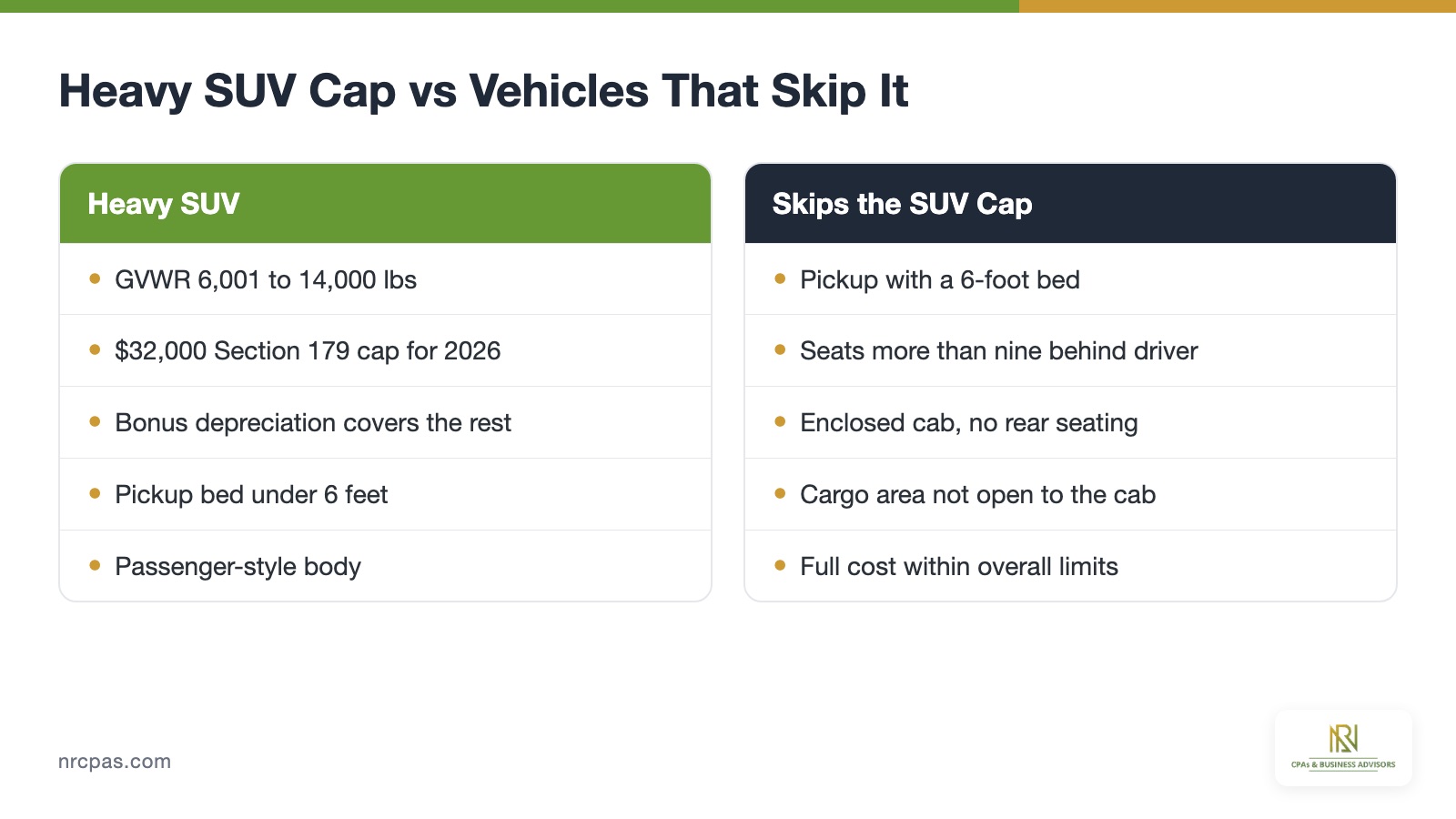
A pickup with a bed under 6 feet is treated as an SUV, so bed length matters as much as weight. Weight and bed length together answer the next question.
Can You Write Off 100% of a 6000 Lb Vehicle?
You can write off 100% of a 6000 lb vehicle in 2026 when its rating is above 6,000 pounds. Business use must also be 100%. A rating of exactly 6,000 pounds does not clear the line. Heavy SUVs reach 100% through Section 179 plus bonus depreciation, and 6-foot-bed pickups reach it through Section 179 alone.
A $68,000 pickup with a 6-foot bed, used 100% for business, produces a $68,000 deduction in year one. A $60,000 pickup of the same kind used 70% for business produces $42,000. The business-use percentage multiplies the cost before the deduction is taken.
Income still limits Section 179. A business with $50,000 of taxable income can elect $50,000 and carry the rest forward. Bonus depreciation fills that gap, as the next question explains.
What Vehicles Qualify for 100% Bonus Depreciation?
Vehicles that qualify for 100% bonus depreciation include any car, SUV, truck or van used over 50% for business. The vehicle must be acquired after January 19, 2025. According to the IRS, the One Big Beautiful Bill Act (OBBBA) made 100% bonus depreciation permanent for that property. Both new and used vehicles qualify, provided they are new to the business.
Bonus depreciation does not lift the passenger car ceiling, so a sedan still stops at $20,300. Heavy vehicles use bonus depreciation to deduct everything above the Section 179 cap.
What Is Not Eligible for Section 179?
A leased vehicle, a vehicle used 50% or less for business, and a gifted vehicle are not eligible for Section 179. Five common situations disqualify a vehicle outright. The list below names each one.
- A vehicle leased under an operating lease, because the lessor is the tax owner.
- A vehicle used for business 50% of the time or less.
- A vehicle bought from a spouse, parent, grandparent, child, grandchild or a controlled business.
- A vehicle received as a gift or inheritance, because no purchase took place.
- A vehicle used only for commuting, because commuting miles are personal miles.
A vehicle that fails one of these rules can still produce a mileage deduction at the standard rate. Vehicles that pass raise a planning choice between two first-year tools.
Is It Better to Take Section 179 or Bonus Depreciation?
Taking both is usually better, because Section 179 is taken first and bonus depreciation covers the remaining basis. According to the IRS, Section 179 cannot exceed taxable business income, while bonus depreciation has no income limit. Bonus depreciation can create a loss, and Section 179 cannot.
Section 179 gives control, because the owner picks which assets to elect and how much. Bonus depreciation applies automatically to a whole asset class unless the owner elects out. The detailed trade-offs sit in this guide to combined first-year deductions.
The right mix depends on income this year and next year. Entity type changes the mix again.
Can an LLC Write Off a Car Purchase?
An LLC can write off a car purchase when the LLC buys the car. The car must also be used over 50% for business. The entity that deducts the vehicle has to be the entity that bought it. A single-member LLC reports the deduction on Schedule C, and a multi-member LLC reports it on Form 1065.
S corporations use Form 1120-S, and the Section 179 amount passes to each owner on Schedule K-1. A sole proprietor with no LLC can claim the same deduction on Schedule C. Owners weighing election timing advice should title the vehicle in the name of the business that claims it.
After the entity is settled, the claim itself follows a short sequence.
How Do I Claim Section 179 Deduction on My Car?
You claim Section 179 deduction on your car by electing it on Form 4562 and listing the vehicle in Part V. According to the IRS, the election must be made on a timely filed return, extensions included. A return filed without Form 4562 is a return that did not elect Section 179.
The steps below run from the purchase date to the filed return.
- Buy the vehicle and record the purchase price, tax and fees as its basis.
- Place the vehicle in service and note the date.
- Track every business trip as it happens.
- Multiply the basis by the business-use percentage.
- Apply the weight-class cap, then bonus depreciation on the remainder.
- Report the vehicle on Form 4562 and file with the return.
The line-by-line placement is covered in this Form 4562 instructions walkthrough. Step three decides whether the rest of the claim survives an audit.
What Records Prove Business Use of a Vehicle?
A mileage log kept at the time of each trip proves business use of a vehicle. According to IRS Publication 463, an adequate record shows the date, destination, business purpose and miles of each trip. A log rebuilt from memory in April does not meet that standard.
Cars and SUVs are listed property, so the substantiation rules are strict. The file should hold the items below.
- The bill of sale or loan agreement, with the date the vehicle was placed in service.
- A photo of the door-jamb label showing the GVWR.
- The mileage log, with total annual miles and business miles.
- Fuel, repair and insurance receipts.
According to the IRS, records should be kept for at least 3 years from the filing date. Property records last until the limitation period ends for the sale year, so a vehicle file often outlives that default.
What Happens If Business Use Drops to 50% or Less?
Business use that drops to 50% or less triggers recapture, which adds part of the earlier deduction back to income. According to the IRS, the amount added equals the Section 179 and bonus deduction in excess of straight-line depreciation. Recapture is reported in Part IV of Form 4797.
Business use is tested every year during the 5-year recovery period for cars and light trucks. A truck deducted at 90% in year one and driven 45% for business in year three triggers recapture. Planners track the five-year holding on the calendar to avoid it.
What Other Vehicle Questions Affect Section 179?
Electric vehicles, financing, state rules and mileage choices also affect a Section 179 vehicle claim. The short answers below cover each side topic.
Do Electric Vehicles Qualify for Section 179?
Electric vehicles qualify for Section 179 under the same weight rules as gas vehicles. According to the IRS, the federal clean vehicle credits ended for vehicles acquired after September 30, 2025. A credit claimed earlier reduces the depreciable basis by the credit amount. The electric SUV rules show a Model X above the line and a Model 3 below it.
Does Financing Change Whether a Vehicle Qualifies?
Financing does not change qualification, because a financed vehicle is still a purchase. The business deducts the full cost in the year the vehicle is placed in service, while the loan payments continue for years. The title and loan should carry the name of the business.
Do State Rules Match Federal Section 179 Rules?
State rules do not always match the federal rules. According to the California Franchise Tax Board, California does not conform to federal bonus depreciation. A federal deduction taken through bonus depreciation may not reduce state tax. The 2026 limit and phase-out are explained in the 2026 limit outlook post.
Does the Standard Mileage Rate Rule Out Section 179?
Section 179 and the standard mileage rate cannot be used on the same vehicle, because the per-mile rate already includes depreciation. According to the IRS, the standard rate must be chosen in the first business year to keep that option later. Taking Section 179 in year one locks the vehicle into actual expenses.
Who Can Confirm a Vehicle Qualifies Before the Purchase?
A CPA can confirm that a vehicle qualifies before the purchase. The check covers the GVWR, the body design, the business-use plan and the income. We run that check for owners of trucks, vans and SUVs before the purchase date.
The NR accounting team is led by founder Nischay Rawal, CPA, EA. Call (305) 872-3096 to review a vehicle before it is placed in service.
The answer to does my vehicle qualify for section 179 deduction rests on five tests, a weight class and a log. A vehicle purchase review puts all three on paper.