Is Self-Employment Tax Deductible and How Much Can You Deduct


Yes, 50% of self-employment tax is deductible, as an adjustment on Schedule 1, line 15 of Form 1040. According to the Internal Revenue Service (IRS), the deduction covers the employer-equivalent half of the 15.3% tax. The deduction lowers income tax only, never the self-employment tax itself, and it needs no itemizing.
Key Takeaways
- Half of self-employment tax is deductible above the line on Schedule 1, line 15.
- Self-employment tax is 15.3% of 92.35% of net profit, with a 2026 Social Security wage base of $184,500.
- The deduction lowers income tax and never reduces the self-employment tax bill.
- The 0.9% Additional Medicare Tax has no deductible half.
- A $100,000 profit carries $14,130 of self-employment tax and a $7,065 deduction.
Is Self-Employment Tax Deductible on a Federal Return?
Self-employment tax is deductible on a federal return for the employer-equivalent half only. The deductible portion equals 50% of the self-employment tax you owe. The IRS lets owners subtract that half when figuring adjusted gross income (AGI).
Employees cannot deduct the Social Security and Medicare tax taken from a paycheck, according to the IRS. Employers deduct their matching half as a business expense. Self-employed owners play both roles, so the tax code gives them the employer half back as a deduction.
The answer to "is self-employment tax deductible" stays the same for sole proprietors, freelancers and partners. Owners who plan the deduction early can pair it with pass-through tax planning before the first estimated payment. The deduction only matters once the tax applies, so the next section sets the trigger.
Do I Owe Self-Employment Tax Before I Can Deduct It?
You owe self-employment tax when your net earnings from self-employment reach $400 or more, according to the IRS. Self-employment tax is the Social Security and Medicare tax for people who work for themselves. The rate is 15.3%, made of 12.4% for Social Security and 2.9% for Medicare.
The rule covers sole proprietors, independent contractors, partners and members of a single-member limited liability company (LLC). According to the IRS, the tax applies even when you already receive Social Security benefits. Age does not remove the tax.
Owners often ask whether a one-person LLC changes the rule. A solo LLC owner reports on Schedule C by default and pays the same 15.3%. The tax then sits next to income tax on the return, which raises a second question.
Do You Pay Self-Employment Tax and Income Tax on the Same Profit?
You pay self-employment tax and income tax on the same profit, because the two taxes use separate calculations. Self-employment tax funds Social Security and Medicare, while income tax funds general government spending. Schedule SE figures the first tax, and Form 1040 figures the second.
Both taxes start from the Schedule C net profit. The self-employment tax is a federal tax, and Schedule 2 adds it to the income tax total. The deduction then shrinks only the income tax side of that total.
That split explains why the deduction exists. A profit gets taxed twice, once for payroll programs and once for income. The deduction trims the second hit by the size of the employer half, so the math comes next.
How Do You Calculate the Self-Employment Tax Deduction?
You calculate the self-employment tax deduction by taking half of the total self-employment tax from Schedule SE. The total starts with 92.35% of net profit, the IRS factor for net earnings. That factor removes the 7.65% employer share from the base, and 100% minus 7.65% equals 92.35%.
The numbered list below shows the math for a sole proprietor with $100,000 of net profit in 2026.
- Multiply $100,000 of net profit by 92.35% to reach $92,350 of net earnings.
- Apply 12.4% Social Security to $92,350, which gives $11,451.
- Apply 2.9% Medicare to $92,350, which gives $2,678.
- Add both parts to reach $14,130 of self-employment tax.
- Divide $14,130 by 2 to reach a $7,065 deduction.
The Social Security part stops at the wage base. According to the IRS, the 2025 base is $176,100, and the 2026 base is $184,500. The maximum Social Security tax in 2026 is therefore $22,878, while Medicare has no cap.
The Additional Medicare Tax adds 0.9% above $200,000 for single filers and $250,000 for joint filers, per the IRS. That 0.9% has no employer half, so no part of it is deductible. The table below shows the deduction and the income tax saved at four profit levels.
| Net profit | Self-employment tax | Deductible half | Income tax saved |
|---|---|---|---|
| $30,000 | $4,239 | $2,120 | $212 at 10% |
| $50,000 | $7,065 | $3,532 | $424 at 12% |
| $100,000 | $14,130 | $7,065 | $1,554 at 22% |
| $150,000 | $21,194 | $10,597 | $2,543 at 24% |
The savings use the 2026 standard deduction of $16,100 and the single brackets from IRS Revenue Procedure 2025-32. The 10% bracket ends at $12,400, the 12% bracket at $50,400 and the 22% bracket at $105,700. The graphic below shows the same four key numbers.

The savings are modest because a deduction only saves the bracket rate on its amount. A $7,065 deduction in the 22% bracket saves $1,554, not $7,065. Owners then need to know where the deduction goes on the return.
Where Do You Claim the Self-Employment Tax Deduction on Form 1040?
You claim the self-employment tax deduction on Schedule 1, line 15, titled deductible part of self-employment tax. Schedule SE computes the amount, and Schedule 1 carries it to Form 1040. The IRS lists this path in Topic 554.
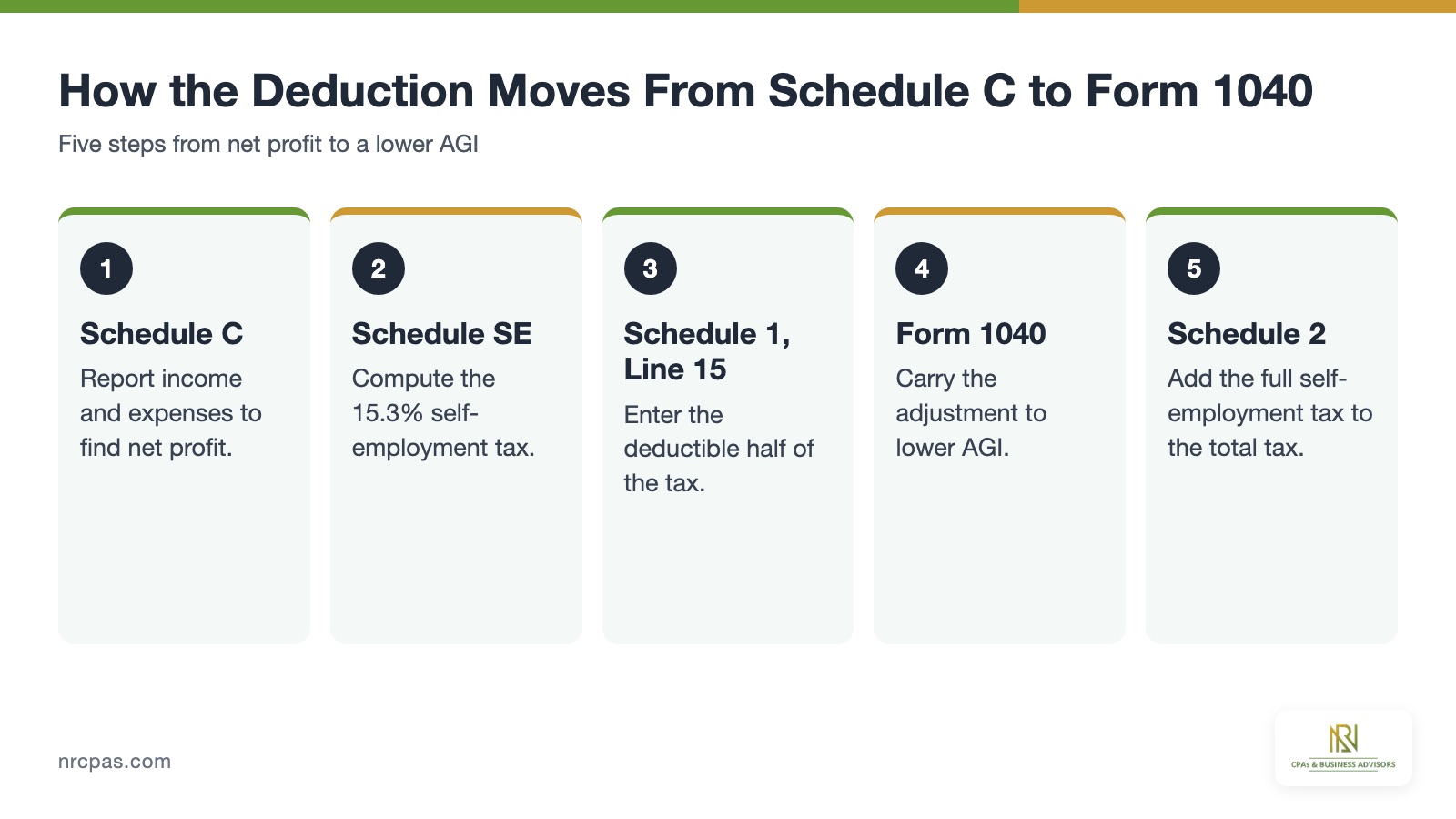
The numbered list below follows the flow of forms from profit to deduction.
- Report income and expenses on Schedule C to find net profit.
- Complete Schedule SE to compute the 15.3% self-employment tax.
- Copy the deductible half to Schedule 1, line 15.
- Carry the Schedule 1 total to Form 1040 to lower AGI.
- Carry the full self-employment tax to Schedule 2 as an added tax.
The graphic below draws the same five steps from Schedule C to Form 1040.
Tax software fills line 15 once Schedule SE is complete. Paper filers should check that line, because a missed entry raises income tax. Two filing questions come up often at this step.
Can You Write Off Self-Employment Tax Without Itemizing?
You can write off self-employment tax without itemizing, because the deduction is an adjustment to income. An above-the-line deduction reduces AGI before the standard deduction applies. Filers who take the 2026 standard deduction of $16,100 single or $32,200 joint still get the full half.
A lower AGI also helps with credits and deductions that phase out at higher AGI. The deduction therefore works twice for some owners. Owners also ask where on Schedule C the deduction belongs.
Can You Deduct Self-Employment Tax on Schedule C?
You cannot deduct self-employment tax on Schedule C, because the deduction is a personal adjustment on Schedule 1. Deducting it on Schedule C would understate net profit and shrink the tax base itself. A smaller base would produce a wrong, lower self-employment tax.
The IRS says the deduction does not affect net earnings from self-employment or the self-employment tax. Schedule C stays at full profit, and line 15 does the work. That rule leads to the next question about what the deduction cannot do.
Does the Self-Employment Tax Deduction Reduce the Self-Employment Tax Itself?
The self-employment tax deduction does not reduce the self-employment tax itself, according to the IRS. The deduction lowers income tax only. Schedule SE already finished the self-employment tax before the deduction reached Schedule 1.
A $100,000 profit shows the point. The self-employment tax stays $14,130 with or without the $7,065 deduction. Only the income tax on $100,000 falls to the tax on $92,935.
The deduction also lowers other income-based figures. Half of the self-employment tax reduces qualified business income (QBI) before the 20% deduction applies. The QBI rules explain that link in full.
Owners who want a smaller self-employment tax must shrink net profit instead. Each $1,000 of deductible business expense cuts the tax by about $141, which is $1,000 times 92.35% times 15.3%. Clean profit and loss records support those expenses. The graphic below compares what the deduction changes with what it leaves alone.

That comparison covers the core answer. Several related questions come from different kinds of earners, which the next heading groups together.
What Else Should Self-Employed Owners Know About This Deduction?
Self-employed owners also need answers on contractors, partners, rental income, state returns, S corporations and estimated payments. The sections below answer each topic in short form.
Do Independent Contractors Pay Self-Employment Tax?
Independent contractors pay self-employment tax on net earnings of $400 or more, according to the IRS. Contractors get the same deduction for half of that tax. The IRS treats an independent contractor as a sole proprietor for this rule.
Do I Have to Pay Self-Employment Tax on 1099 Income?
You have to pay self-employment tax on 1099 income when net profit from that income reaches $400. The tax applies to profit after expenses, not to the 1099 total. A contractor with a $60,000 Form 1099-NEC and $10,000 of expenses owes tax on $50,000.
Clients do not withhold the tax from 1099 pay, so contractors send it in themselves. Estimated payments handle that step, as a later section shows.
Do You Have to Pay Self-Employment Tax on a Side Gig?
You have to pay self-employment tax on a side gig when the side gig nets $400 or more. Wages from a day job do not erase the side gig tax. The Social Security part uses one combined wage base, so day job pay can cut that part.
Do Partners Pay Self-Employment Tax?
Partners pay self-employment tax on their share of partnership earnings from Schedule K-1. Limited partners include only guaranteed payments for services actually rendered. According to the IRS, whether a partner counts as limited follows section 1402(a)(13).
Every partner who pays the tax takes the same half deduction on Schedule 1.
Do You Pay Self-Employment Tax on Rental Income?
You do not pay self-employment tax on rental income from real estate, unless you are a dealer or give substantial services. Ordinary rentals go on Schedule E, which skips Schedule SE. According to the IRS, substantial services for tenants move the income to Schedule C.
Hotel-style stays with daily services fall under that rule. Passive landlords have no deduction to take because they owe no tax. Owners who buy furnishings can review rental write-offs that still apply.
Is Self-Employment Tax Federal or State?
Self-employment tax is federal, because Congress sets it as part of the Social Security and Medicare system. States do not charge a separate self-employment tax. States do tax the same profit as income.
Many states start from federal AGI, so the half deduction carries through. According to the Pennsylvania Department of Revenue, Pennsylvania does not allow it. In a state like that, the question "is self-employment tax deductible" has a federal answer only.
Does an S Corporation Owner Get the Deduction?
An S corporation owner usually gets no self-employment tax deduction, because wages carry payroll tax instead of Schedule SE tax. The company deducts the employer half of payroll tax as a wage expense. Distributions above a reasonable salary carry no Social Security or Medicare tax.
The salary must be reasonable, and the S corp salary limits are set by IRS wage reviews.
Owners who file Form 2553 should compare payroll costs with the Schedule SE tax they would save. The election works best when made before the first profitable year. Early entity choice avoids a late switch.
How Do Estimated Payments Work With the Deduction?
Estimated payments cover both income tax and self-employment tax, and the deduction lowers only the income tax part. Owners avoid the underpayment penalty by owing less than $1,000 or paying 90% of current-year tax. The IRS also accepts 100% of prior-year tax.
Late or short payments add interest. An owner who falls behind can ask about underpayment penalties before a balance grows.
Each quarterly payment covers both taxes, so owners should mark the calendar early. The due dates fall in April, June, September and January. A steady plan built on estimated payment planning keeps each quarter's payment close to the real tax.
What Is the 20% Self-Employment Deduction?
The 20% self-employment deduction is the QBI deduction, which is up to 20% of qualified business income. The QBI deduction is separate from the half self-employment tax deduction. Both lower income tax, and neither lowers the self-employment tax.
Who Can Help New Owners Plan Self-Employment Tax?
A new business owner can get help from a startup advisor and a part-time CFO before the first return. Early new business advisors map the first-year costs.
A new owner also needs clean monthly numbers, because bookkeeping drives every quarterly payment, since each estimated payment comes from year-to-date profit. Monthly profit tracking by a part-time CFO keeps each estimated payment accurate.
How Can a CPA Firm Help With Self-Employment Tax?
A CPA firm can run Schedule SE, line 15 and the estimated payments side by side for each owner. We model all three before the first quarterly payment is due.
The team at NR tax team is led by founder Nischay Rawal, CPA, EA, and the office line is (305) 872-3096. The firm helps owners answer "is self-employment tax deductible" for their own return.
Owners who want a full review can start with self-employment tax planning from the same team.