Are Funeral Expenses Tax Deductible on an Estate Return


No, funeral expenses are not tax deductible on an estate income tax return. The estate deducts them on Form 706, the federal estate tax return, under Section 2053, and only when the estate must file. According to the Internal Revenue Service (IRS), that filing threshold is $15,000,000 for 2026 deaths. Form 1041 and the final Form 1040 never allow the deduction.
Key Takeaways
- Form 1041 deducts costs that exist only because the estate exists, and funeral costs are not one of them.
- Funeral expenses are deductible only on Schedule J of Form 706 under Section 2053.
- The federal estate tax exemption is $13,990,000 for 2025 deaths and $15,000,000 for 2026 deaths.
- The same estate administration expense cannot cut both Form 1041 and Form 706 without a waiver.
- Medical bills paid within 1 year after death can go on the final Form 1040 or Form 706, never both.
What Expenses Are Deductible on an Estate Income Tax Return?
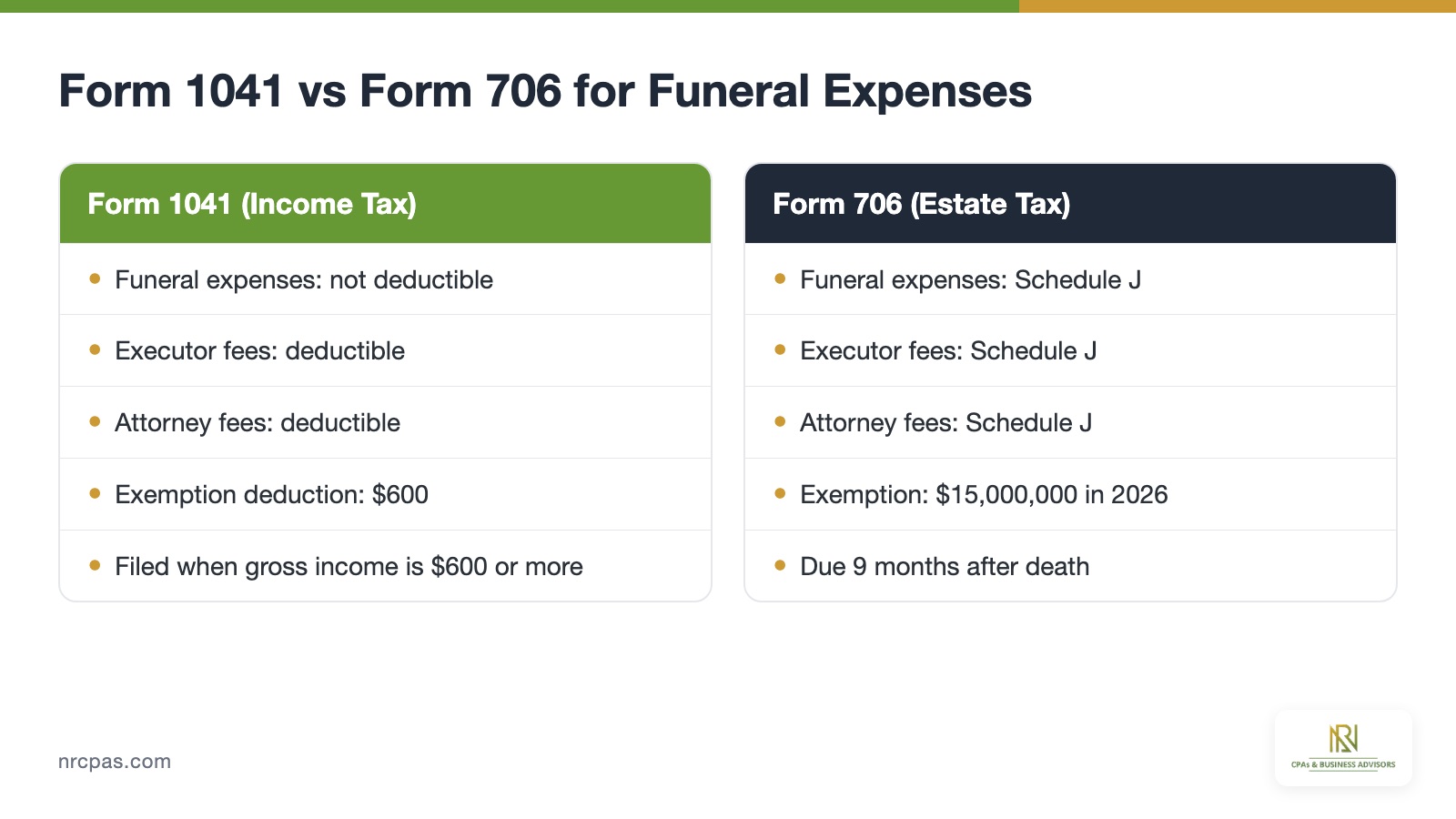
Expenses deductible on an estate income tax return are costs that exist only because the estate exists. Form 1041 is the income tax return an estate files for earnings after death. According to the IRS, an estate files Form 1041 when gross income for the year is $600 or more.
Section 67(e) of the Internal Revenue Code sets the test for what expenses are deductible on an estate income tax return. The test allows costs that would not exist if the property were not held in an estate. Costs that any individual owner would pay, such as homeowners insurance or condominium fees, do not pass.
Executors who also oversee a family's wider finances often pair these deductions with estate administration support during the first year. That support keeps invoices sorted by the return that will accept them. The list below shows the main deductions an executor claims on Form 1041.
- Executor fees and other fiduciary fees.
- Attorney fees for administering the estate.
- Probate court costs and fiduciary bond premiums.
- Fees for preparing the estate's tax returns.
- Appraisal fees that set date-of-death values.
- State and local taxes the estate pays.
- Charitable gifts paid under the will.
Two more deductions sit beside those costs. The income distribution deduction lets the estate deduct income it passes to beneficiaries, who then report that income on a Schedule K-1. According to the IRS, an estate also takes an exemption deduction of $600. Funeral expenses on Form 706 are the missing piece, and the next section explains why.
Are Funeral Expenses Tax Deductible on an Estate Return?
Funeral expenses are not tax deductible on an estate income tax return, though the estate tax return accepts them. Form 1041 bars the funeral deduction, while Form 706 allows it. According to IRS Publication 559, funeral costs paid by an estate are deductible only in figuring the taxable estate.
The table below sorts common estate costs by the return that accepts them, in 5 rows and 4 columns.
| Cost | Form 1041 | Form 706 | Final Form 1040 |
|---|---|---|---|
| Funeral and burial costs | No | Yes, Schedule J | No |
| Executor fees | Yes | Yes, Schedule J | No |
| Attorney fees for administration | Yes | Yes, Schedule J | No |
| Estate tax return preparation | Yes | Yes | No |
| Medical bills paid within 1 year of death | No | Yes, if not on Form 1040 | Yes, by election |
Each Yes in the Form 706 column needs a second look when the same cost also fits Form 1041. The comparison graphic below lines up the two returns side by side.
Why Are Funeral Expenses Not Deductible on Form 1041?
Funeral expenses are not deductible on Form 1041 because Section 67(e) reaches only estate administration costs. A funeral is a cost of the death itself. The estate tax return is the only return that takes the funeral deduction.
The cost is real, though. According to the National Funeral Directors Association (NFDA), the 2023 median cost was $8,300 for a funeral with viewing and burial. The NFDA median for a funeral with viewing and cremation was $6,280. Neither bill earns an income tax deduction, and the final Form 1040 follows the same rule.
Are Funeral Expenses Deductible on the Final Form 1040?
Funeral expenses are not deductible on the final Form 1040, the last individual income tax return of the person who died. According to the IRS, no funeral deduction can be taken on the final Form 1040 or Form 1040-SR. A relative who pays the bill personally cannot deduct it on a personal return either.
The final Form 1040 still carries some deductions, and medical bills are the main one. The next question covers that exception.
Can Medical Bills Be Deducted on the Final Form 1040?
Medical bills can be deducted on the final Form 1040 when the estate pays them within 1 year of death. According to the IRS, the executor elects to treat those bills as paid by the decedent. The deduction applies only to the amount above 7.5% of adjusted gross income.
Amounts lost to that 7.5% floor cannot move to the estate tax return. The executor attaches the election statement, in duplicate, to the return. Good return planning compares the final Form 1040 against Form 706 before the executor chooses.
The final Form 1040 closes the income tax side, and the estate tax side rests on a different Code section.
How Does Section 2053 Treat Funeral Expenses?
Section 2053 treats funeral expenses as a deduction from the gross estate when the estate computes its taxable estate. The deduction is limited to what local law allows for the estate being administered. Qualifying costs usually include the funeral service, burial or cremation, a burial plot and a headstone.
Section 2053 also allows estate administration expenses, claims against the estate and certain debts. Executor fees and attorney fees belong in the same group as the funeral bill. Each of them reduces the taxable estate dollar for dollar.
According to the IRS Form 706 instructions, reimbursed amounts come off the deduction. Death benefits from the Social Security Administration or the Veterans Administration are examples. A reimbursed dollar was never a cost to the estate, so the form excludes it. The form that records the deduction is Schedule J.
What Is Schedule J on Form 706?
Schedule J of Form 706 is the schedule that lists funeral expenses and the expenses of administering property subject to claims. Schedule J is where the funeral deduction lands on the estate tax return. The IRS tells the executor to itemize funeral expenses on line 2 and to list the deductible amount of each one.
The same schedule holds executor commissions, attorney fees, interest expense and miscellaneous expenses. Each entry needs an invoice and proof of payment behind it. The 5 steps below move a funeral bill onto Schedule J.
- Confirm the estate must file, using the filing threshold for the year of death.
- Collect the funeral invoices and proof of payment.
- Subtract reimbursements, such as Social Security or Veterans Administration death benefits.
- Itemize each remaining funeral cost on line 2 of Schedule J.
- File Form 706 within 9 months of death, or extend the deadline with Form 4768.
The same 5 steps appear in the graphic below, in the same order.
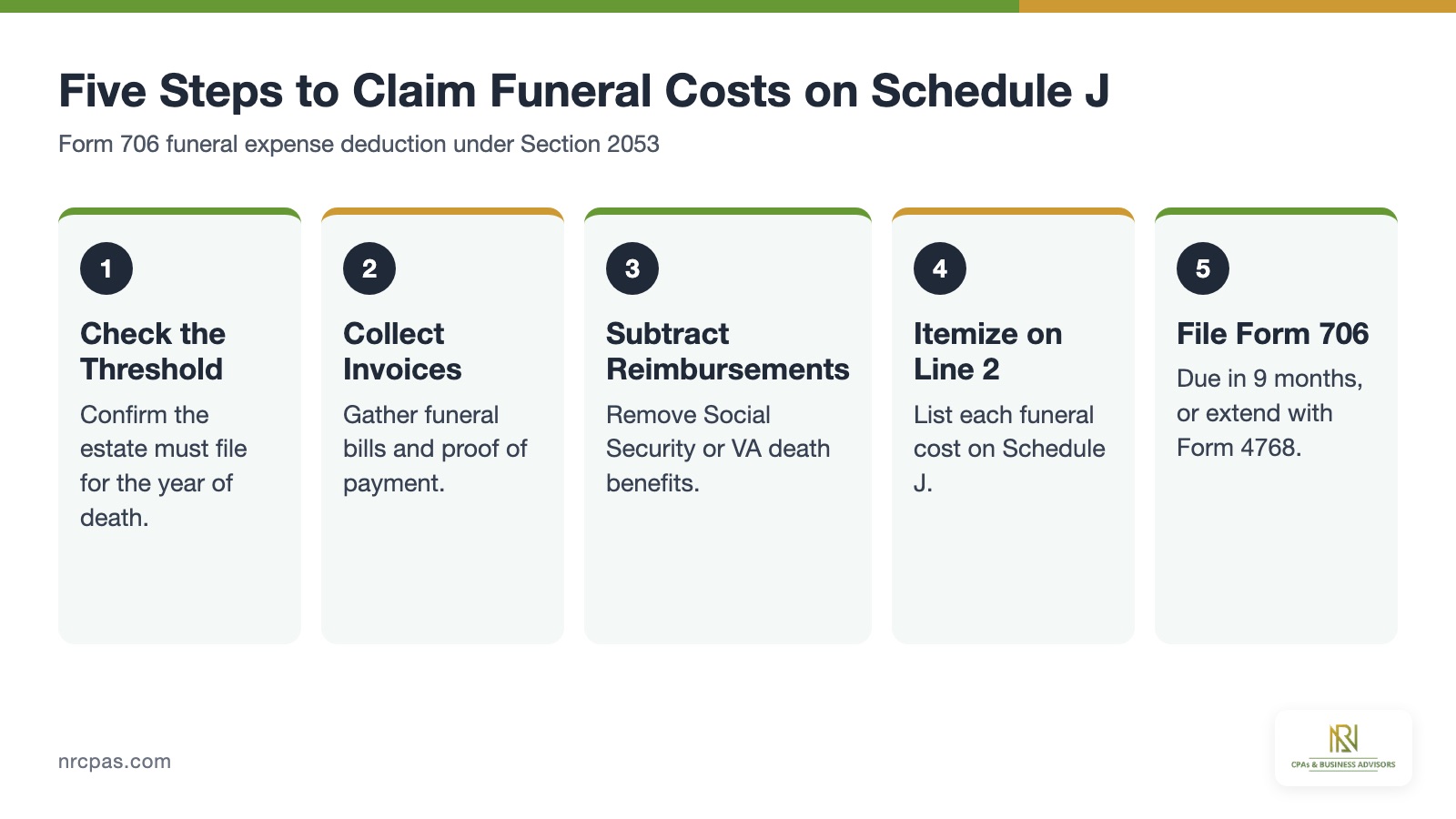
According to the IRS, Form 706 is due 9 months after the date of death. Form 4768 gives an automatic 6-month extension of time to file. Missed deadlines lead to penalty notices, so the calendar matters as much as the schedule. The filing threshold decides whether the schedule is needed at all.
Does the Federal Estate Tax Exemption Decide Whether the Funeral Deduction Helps?
The federal estate tax exemption decides whether the funeral deduction helps, because only a taxable estate turns a deduction into saved tax. The exemption is $13,990,000 for 2025 deaths and $15,000,000 for 2026 deaths. According to the IRS, an estate must file Form 706 when the gross estate plus adjusted taxable gifts exceeds that amount.
The One Big Beautiful Bill Act set the $15,000,000 figure for 2026 and adjusts it for inflation after 2026. The top estate tax rate is 40%. The graphic below shows both exemption figures and the rate.

A taxable estate that deducts an $8,300 funeral saves $3,320 at the 40% rate. An estate under the exemption saves $0, because no estate tax is due. Most families fall in the second group and file only Form 1041.
A married couple can still gain from filing Form 706. According to the IRS, a surviving spouse can claim a deceased spouse's unused exemption through a portability election. Life insurance owned by the decedent counts in the gross estate. Life insurance ownership therefore affects how close an estate sits to the threshold.
Closely held business interests count in the gross estate too. A founder's plan for the business therefore affects the same threshold. That makes succession planning part of the same math.
Estates under the exemption still deduct administration costs, and the question becomes which return gets each one.
Can Estate Administration Expenses Go on Form 1041 or Form 706?
Estate administration expenses can go on Form 1041 or Form 706, but the same dollar cannot reduce both returns. Section 642(g) of the Internal Revenue Code blocks the double deduction. The estate must waive the estate tax deduction before it claims the cost for income tax.
The Section 642(g) waiver is a statement signed by the personal representative. According to IRS Publication 559, the statement says the expenses were not claimed for estate tax and waives that right. The executor files the statement in duplicate.
An estate can split one expense between the returns. Assume executor fees of $20,000 and attorney fees of $15,000, for $35,000 in total. The estate can put $35,000 on Form 706, put $35,000 on Form 1041 after the waiver, or divide the amounts.
The better return depends on the numbers. According to IRS Revenue Procedure 2025-32, the 37% estate income tax bracket starts above $16,000 for 2026, compared with $15,650 for 2025. An estate under the exemption owes no estate tax, so Form 1041 is the only return that pays those costs back. Strategies like that fit within the work of a virtual family office, where one team tracks both returns.
The answer to what expenses are deductible on an estate income tax return therefore depends on which return the estate files. The grouped questions below cover the remaining side topics executors raise.
What Other Estate Deduction Questions Do Executors Ask?
Executors ask about fees, final-year deductions, planning costs, state taxes and records. Each of those side topics gets a short answer below.
Are Executor Fees Deductible on an Estate Return?
Executor fees are deductible on Form 1041 or Form 706, and the executor reports the fee as income. According to the IRS Form 706 instructions, executors' commissions are taxable income to the executors. A family member who serves without a fee has no income to report.
What Happens to Excess Deductions When an Estate Closes?
Excess deductions pass to the beneficiaries in the estate's final tax year under Section 642(h). According to the University of Illinois Tax School, the final Schedule K-1 shows each deduction by type. Administration costs reach the beneficiary as an above-the-line deduction.
Capital loss carryovers also pass to beneficiaries. They offset gains and up to $3,000 of other income per year, which parallels loss carryover rules on a personal return.
Do Estate Planning Fees Qualify as Deductions?
Estate planning fees follow different rules than funeral and administration costs, because the owner paid them while alive. Fees paid before death are not Schedule J costs. The rules for those fees are explained in the guide to planning fees.
Do State Estate Taxes Change the Funeral Deduction?
State estate taxes can change the funeral deduction, because several states set exemptions far below the federal $15,000,000. A funeral cost that saves nothing federally can still matter on a state return. The state return needs its own check, even when no Form 706 is due.
Which Records Should an Executor Keep?
An executor should keep every record that proves a cost and its link to the estate. Proof of payment and the reason for the cost are what an examiner asks for first. The records below cover the deductions in this post.
- Funeral home invoices and receipts for burial or cremation.
- Proof of any Social Security or Veterans Administration reimbursement.
- Engagement letters and bills from attorneys and appraisers.
- The signed Section 642(g) waiver statement and its filing date.
- Estate accounting records, such as fiduciary statements.
How Can NR CPAs Help With Estate Returns?
We help executors sort each cost onto the right return, prepare Form 1041 and coordinate Form 706 with advisors. The firm is led by founder Nischay Rawal, CPA, EA, and the office line is (305) 872-3096.
Executors can reach the team through the NR CPAs website at any point in the 9-month Form 706 window. The team also works with business owners, investors and families across the country, so an estate with several asset types fits.
Families who want one team to track every return can start with estate return support.