Does the Recipient Pay Gift Tax or Does the Donor


No, the recipient does not pay gift tax, because the donor is responsible for the tax and for the Form 709 return. A cash gift is not income to the recipient and needs no report on Form 1040. In 2026, gifts above $19,000 per recipient only reduce the donor's $15,000,000 lifetime exemption. A net gift is the exception.
Key Takeaways
- The donor pays any gift tax, and the donor files Form 709 by April 15 of the next year.
- The recipient owes no income tax on a gift, and cash gifts need no report on the recipient's return.
- A net gift moves the gift tax to the recipient by written agreement, and the donor may owe income tax on it.
- The IRS can collect unpaid gift tax from a recipient, up to the value of the gift received.
- Gifted property keeps the donor's cost basis, so a later sale can create a taxable gain for the recipient.
- A U.S. recipient reports foreign gifts above $100,000 in one year on Form 3520.
Does the Recipient Pay Gift Tax or Does the Donor?
The recipient does not pay gift tax, because federal law places the tax on the donor. Section 2502(c) of the Internal Revenue Code states that the donor pays the gift tax. According to the Internal Revenue Service (IRS), the donor is generally responsible for paying it.
The donor is the person who gives property, and the donee is the person who receives it. According to the IRS, a gift is any transfer where full payment in money or money's worth is not received in return. The donor carries the tax, and the donee carries nothing for the transfer itself.
Most donors never pay a dollar either, because two exclusions shelter nearly every gift. A written plan from donor planning specialists tracks those exclusions year by year. The donor's duty covers more than the payment, as the next section shows.
Who Is Responsible for Paying Gift Tax and Filing the Return?
The donor is responsible for paying gift tax and for filing the return, which is Form 709. According to the IRS, the donor files even when no tax is due. Spouses cannot file a joint gift tax return, so each spouse files alone.
Form 709 is due April 15 of the year after the gift. A gift made in 2026 is therefore reported by April 15, 2027. The recipient files nothing for the gift itself.
Other taxes can still reach the recipient, and the table below sorts each item by who handles it.
| Tax item | Who is responsible | Form or rule | 2026 figure |
|---|---|---|---|
| Gift tax on taxable gifts | Donor | Form 709 | Top rate of 40% |
| Gift tax return | Donor | Due April 15 of next year | Gifts over $19,000 per recipient |
| Income tax on the gift itself | No one | Gift is not income | $0 |
| Tax on income the gift earns | Recipient | Form 1040 | Ordinary rates |
| Tax on a later sale | Recipient | Carryover basis | Gain above donor's basis |
| Report of foreign gifts | Recipient | Form 3520 | Over $100,000 in one year |
The first three rows stay with the donor or with no one, while the last three rows reach the recipient only later. The graphic below compares both sides.
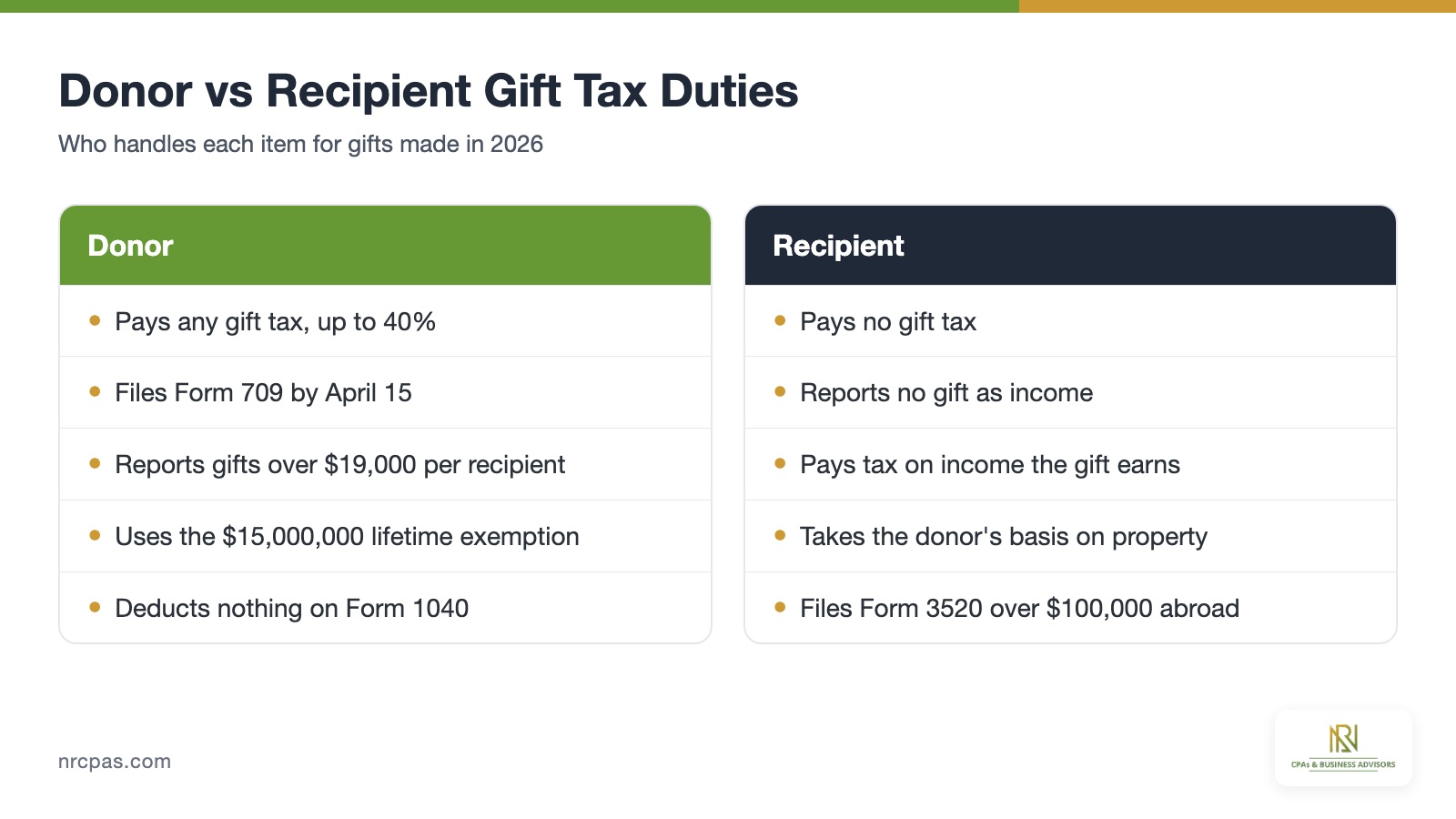
Those donor duties only turn into a tax bill above two limits, which come next.
When Does the Donor Owe Gift Tax for 2026 Gifts?
The donor owes gift tax only after taxable gifts pass the $15,000,000 lifetime exemption. According to the IRS, the annual exclusion is $19,000 per recipient for gifts made in 2026. Gifts above that amount are reported on Form 709 and reduce the lifetime exemption.
The One Big Beautiful Bill Act, Public Law 119-21, set the 2026 lifetime exemption at $15,000,000. According to the IRS, the 2025 amount was $13,990,000. The top gift tax rate is 40%, and it applies only above the exemption.
A $100,000 gift shows the math. The first $19,000 is excluded, the remaining $81,000 reduces the exemption, and $14,919,000 is left. Married couples who split gifts exclude $38,000 per recipient.
Several payments never count toward either limit, and the list below names them.
- Tuition paid directly to a school, with no dollar limit.
- Medical bills paid directly to the provider.
- Gifts to a spouse who is a U.S. citizen.
- Gifts to a spouse who is not a citizen, up to $194,000 in 2026.
- Gifts to a political organization for its own use.
A gift tax advice review shows which of these payments fit a family's goals. A donor who has used the whole exemption faces the real tax, and that is when a net gift appears.
Does the Gift Recipient Ever Have to Pay Gift Tax?
The gift recipient has to pay gift tax in only two cases, and both are uncommon. The rule for does the recipient pay gift tax is therefore no, with two exceptions. The first case is a net gift, where the recipient agrees to pay. The second case is a donor who fails to pay, and then the IRS can turn to the recipient.
According to the IRS, a donee may agree to pay the tax under special arrangements. A net gift is a gift made on the condition that the recipient pays the gift tax. The agreement belongs in writing before the transfer.
Net gifts mostly involve real estate or business interests, because those assets are hard to sell in pieces. An owner who holds shares through a holding company setup may prefer one transfer of shares. The net gift arithmetic is the next question.
Does Receiver Pay Gift Tax in a Net Gift?
The receiver pays the gift tax in a net gift, but the tax is computed on a smaller gift value. According to Revenue Ruling 75-72, the tax paid by the donee reduces the value of the gift. The tax and the taxable gift depend on each other, so the math is circular.
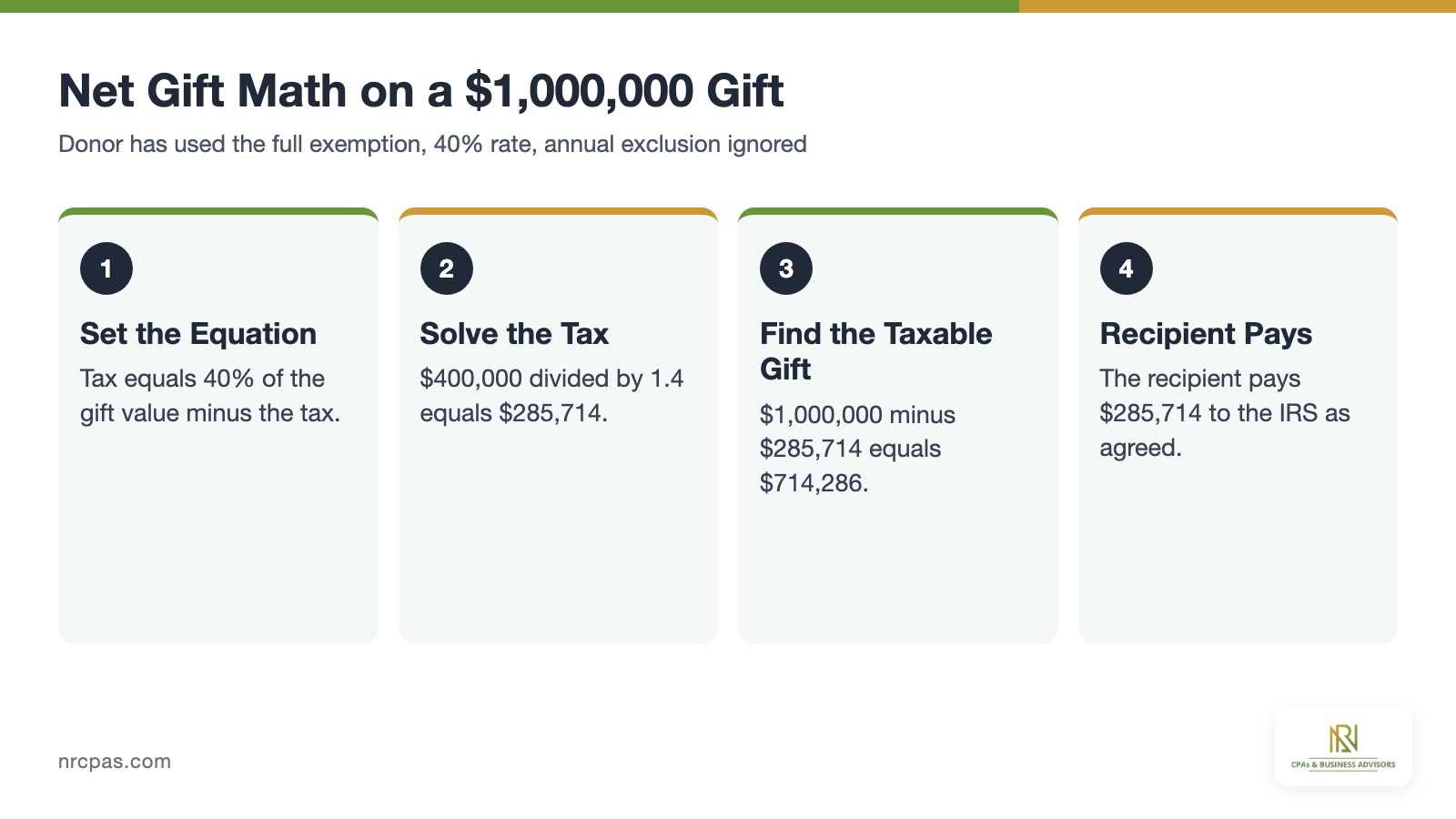
Take a donor who has used the full exemption and gives property worth $1,000,000. The 40% rate applies, and the annual exclusion is ignored for simplicity. The numbered steps below solve the example.
- Set the tax as 40% of the gift value minus the tax itself.
- Solve the equation, so the tax equals $400,000 divided by 1.4, or $285,714.
- Subtract the tax from $1,000,000, so the taxable gift is $714,286.
- The recipient pays the $285,714 to the IRS as agreed.
The graphic below shows the same four steps in order.
The donor also faces income tax in this setup. According to the Supreme Court in Diedrich v. Commissioner, a donor who makes a net gift has income to the extent the tax exceeds the donor's basis. A donor with a $200,000 basis reports $85,714 of income here.
A net gift lowers the taxable gift but can create income for the donor. Donors who die within 3 years of the gift also see the gift tax added back to the estate. Families often compare those results with estate planning costs before choosing this route. The second case, an unpaid tax, follows next.
Can the IRS Collect Unpaid Gift Tax From the Recipient?
The IRS can collect unpaid gift tax from the recipient, up to the value of the gift received. Section 6324(b) of the Internal Revenue Code makes each donee personally liable for the unpaid tax. This rule is called transferee liability.
The same section places a lien on the gifts for 10 years from the date of the gift. The lien attaches to the gifted property, even after the recipient receives it. A recipient who sells the property can leave the buyer with a cloudy title.
Transferee liability needs a donor who left the tax unpaid. Most donors owe $0, so most recipients never face this rule. A donor who owes tax and ignores a notice can ask for IRS gift notices help before the recipient is contacted.
Gift tax is only one side of a gift, because income tax also matters to the recipient.
Does Gifted Money Count as Income?
Gifted money does not count as income, so the recipient reports nothing on Form 1040. According to the IRS, gifts and inheritances are not taxable income to the person who receives them. A $50,000 check from a parent adds $0 to the recipient's taxable income.
The gift must be a real gift, given without anything expected in return. A payment for work, even from a relative, is income and not a gift. A bonus from an employer is wages, whatever the card says.
Income earned after the transfer belongs to the new owner. Interest on a gifted savings account, dividends on gifted stock and rent from a gifted building are all taxable to the recipient. The gift itself stays tax free, while its earnings do not.
Payment apps add a reporting wrinkle. According to the IRS, Form 1099-K starts above $20,000 and 200 transactions, so family gifts rarely trigger one. Property gifts add a different issue, which is basis.
Does Property Received as a Gift Carry a Tax Bill Later?
Property received as a gift carries a tax bill later, because the recipient takes the donor's cost basis. Basis is the original cost used to measure gain. According to the IRS, stock bought at $10 per share and sold at $100 per share creates a $90 gain.
The graphic below follows that stock from the donor to the sale.
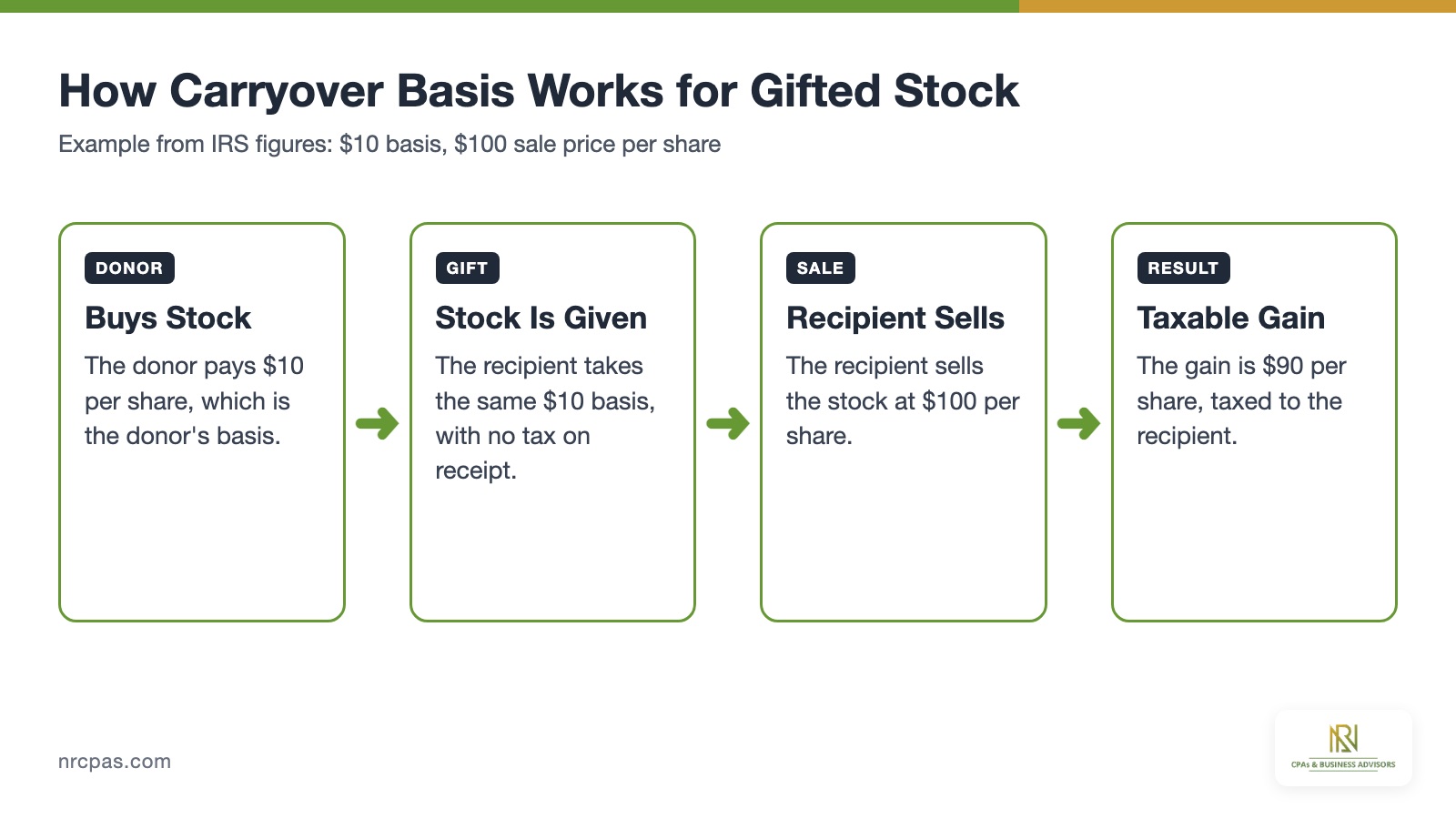
Four basis rules matter to a recipient of property, and the list below gives them.
- The recipient takes the donor's basis, so built-in gain transfers with the gift.
- Gift tax paid by the donor raises the basis by the share tied to appreciation.
- A property worth less than basis at the gift date has a lower basis for losses.
- The recipient also takes the donor's holding period for long-term treatment.
The second rule has a simple example. A $100,000 taxable gift of stock with a $40,000 basis creates $40,000 of gift tax at 40%. Appreciation is 60% of the value, so the basis rises by $24,000 to $64,000.
Inherited property usually receives a stepped-up basis, while gifted property does not. Recipients of digital assets follow the same carryover rule, as crypto gifts guidance explains. A gift of $50,000 in coins bought at $5,000 passes only $5,000 of basis to the recipient. A sale at $50,000 then leaves a $45,000 gain.
Recipients who sell at a loss can pair the sale with the year-end technique of tax-loss harvesting to offset other gains. Several smaller recipient questions remain.
What Else Should a Gift Recipient Know?
A gift recipient should also know the reporting rules, state taxes and lender requirements. The short answers below cover each one.
Do I Have to Pay Gift Tax on Money Received?
You do not have to pay gift tax on money received, because the donor pays any gift tax. A recipient owes no federal gift tax on cash from a parent, friend or relative. The only exceptions are a signed net gift agreement and a donor's unpaid tax.
Does the Recipient of a Gift Need to Report It?
The recipient of a gift does not need to report it on a federal income tax return. A foreign gift is the exception for a U.S. person. According to the IRS, gifts from a nonresident alien or foreign estate above $100,000 in one year go on Form 3520.
Each single gift above $5,000 inside that total is listed separately. Form 3520 is an information return, and no tax is due on the gift. The penalty for missing it is 5% of the gift per month, capped at 25%. Families with relatives overseas often review foreign gift rules before a transfer arrives.
What Happens If You Don't Report a Gift to the IRS?
The donor faces penalties if a gift is not reported, and the recipient generally faces none. According to the Instructions for Form 709, late filing costs 5% of the unpaid tax per month, capped at 25%. The IRS can waive penalties for reasonable cause.
An unreported gift keeps the IRS review window open. Adequate disclosure on Form 709 starts the clock. Missing returns also hide how much exemption the donor has already used.
Can My Parents Gift Me $100,000 Without Paying Gift Tax?
Your parents can gift you $100,000 without paying gift tax, because the amount stays far below the $15,000,000 lifetime exemption. One parent excludes $19,000 and reports $81,000 on Form 709. Two parents who split the gift exclude $38,000 and each report $31,000.
You owe nothing, and the parents owe $0 in tax. Written family gifting advice helps parents decide between one large gift and several yearly gifts.
Do States Charge Gift Tax or Inheritance Tax to Recipients?
Most states charge no gift tax, and a recipient pays no state tax on a lifetime gift in those states. According to Key Wealth Institute, Connecticut is the only state with a gift tax in 2026, and the donor pays it. Five states charge an inheritance tax, which a beneficiary pays after a death, not after a gift.
Does a Down Payment Gift Need a Lender Letter?
A down payment gift needs a lender letter in most mortgage files. The letter states that the money is a gift and not a loan. The recipient signs the letter alongside the donor. The letter does not create any gift tax for the recipient.
How Can a Family Office Team Help Donors and Recipients?
A family office team tracks each gift, each Form 709 and the remaining lifetime exemption for the whole family. We coordinate gifts of cash, stock and business interests with the rest of a family's tax picture. Founder Nischay Rawal, CPA, EA, leads the firm, and the office answers at (305) 872-3096.
The team at NR CPAs online helps donors file accurate returns and helps recipients track basis on every gifted asset.
Families that want to settle does the recipient pay gift tax in their own case can start with family wealth guidance.