Does a Sole Proprietor Need a DBA to Operate Under a Business Name

No, a sole proprietor does not need a DBA unless the business uses a name other than the owner's full legal name. A DBA, short for doing business as, registers that trade name with a state, county or city office. Banks usually ask for the filing before they open an account in the trade name. The rules differ by state, so the county or state filing office has the final word.
Key Takeaways
- A sole proprietor operating under a full legal name files nothing, according to the Small Business Administration (SBA).
- Any other name, including a first name plus a descriptor, counts as a fictitious name.
- A DBA gives no liability protection and creates no separate company.
- Florida bars an unregistered business from suing in state court until it registers.
- A DBA never needs an IRS registration, and the owner still files Schedule C.
Does a Sole Proprietor Need a DBA to Operate Under a Business Name?
A sole proprietor needs a DBA to operate under a business name only when that name differs from the owner's legal name. A legal name needs no registration, and every other name does. According to the SBA, a person who conducts business under a legal name registers nowhere.
A DBA is also called a trade name, a fictitious name or an assumed name. The SBA says most states require a DBA registration once a business uses one. Florida Statutes section 865.09 defines a fictitious name as any name other than the person's legal name.
The rule is simple to test with two freelancers. Maria Gonzalez who invoices as Maria Gonzalez files nothing. Maria Gonzalez who markets copywriting as Words That Sell files a DBA. A DBA is only a name record, and company formation is the step that creates a separate legal entity.
That difference explains why a sole proprietor can hold a DBA at all.
Can a Sole Proprietor Have a DBA?
A sole proprietor can have a DBA, and the DBA is the standard way a sole proprietor registers a trade name. The sole proprietorship stays the legal owner of the business while the DBA supplies the public name. According to the Internal Revenue Service (IRS), a sole proprietor is someone who owns an unincorporated business alone.
The SBA adds that a sole proprietorship produces no separate business entity. Business assets and debts remain the owner's personal assets and debts. The SBA also says a DBA offers no legal protection by itself.
The Census Bureau counted 29.8 million nonemployer businesses in 2022. Those firms have no paid employees and produced $1.7 trillion in receipts, about 6.8% of the 2022 economy. Each solo owner who picks a brand name faces the same DBA question.
Can I Use My Personal Name as a DBA?
A personal name works as a DBA only when the name is not the owner's complete legal name. A name that adds a descriptor to the owner's name still counts as fictitious. Jane's Bakery and Jane Smith Design both differ from Jane Smith.
Some states exempt names that carry the owner's full surname, so the county clerk's rule decides the filing. A sole proprietor also cannot add words such as Inc. or LLC to the name. Those words imply an entity that does not exist.
A name that skips a required filing creates legal risk, as the next section shows.
What Happens If a Sole Proprietor Operates Without a Required DBA?
A sole proprietor without a required DBA loses court access in some states and bank access in the trade name. Florida lets an unregistered business defend a lawsuit but blocks it from filing one. Florida Statutes section 865.09 bars the business from maintaining any court action until the registration is complete.
The same statute keeps contracts valid, so customers cannot void a sale over a missing filing. A party harmed by a noncomplying business may recover reasonable attorney fees and court costs.
Banks add a practical barrier. According to the SBA, a DBA plus an Employer Identification Number (EIN) lets an owner open a business bank account. A check payable to Words That Sell cannot enter an account held only as Maria Gonzalez.
The cost of that gap is small compared with the filing itself, which has a clear sequence.
How Does a Sole Proprietor File a DBA?
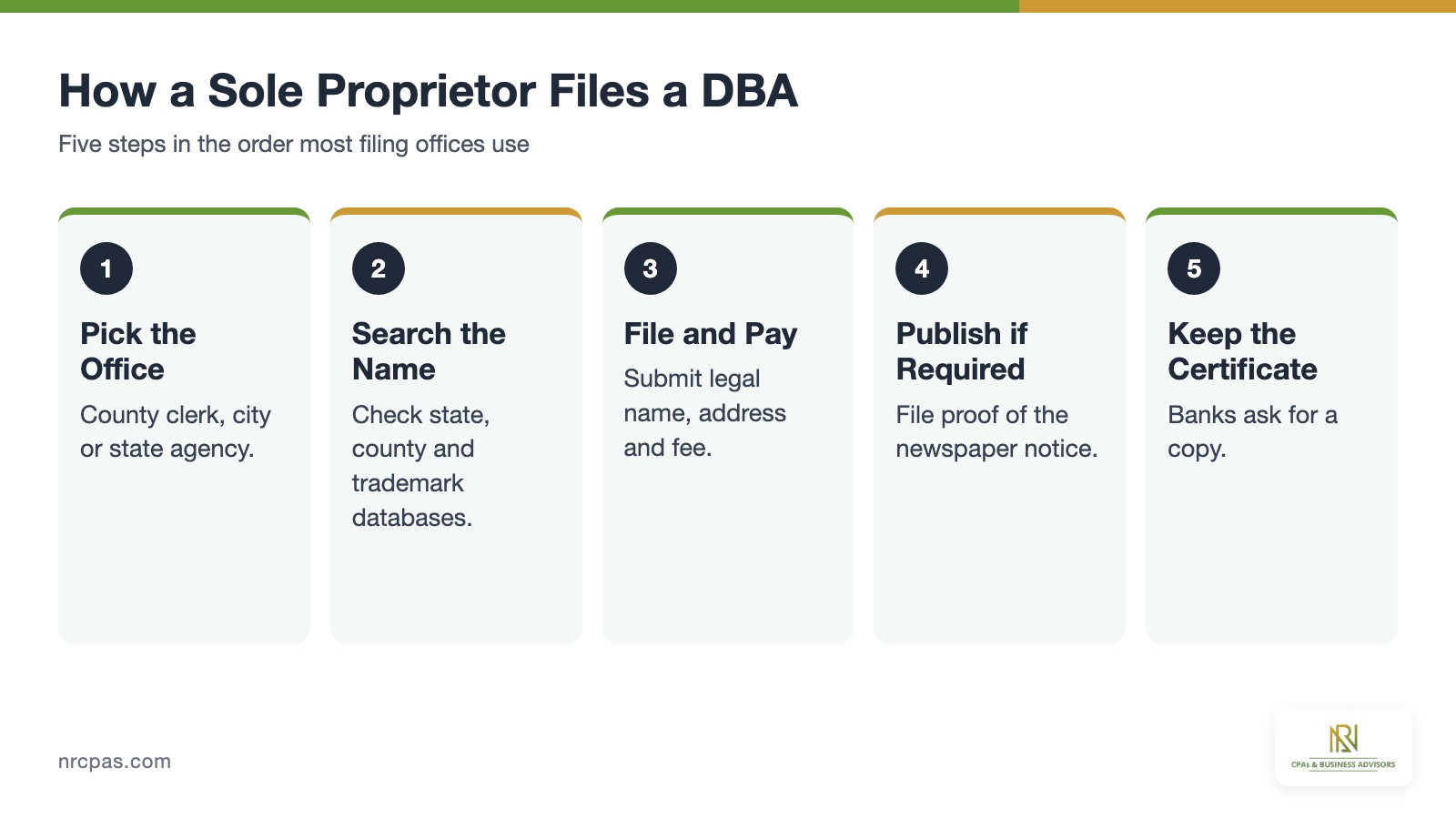
A sole proprietor files a DBA by registering the trade name with the state, county or city office that local rules name. The filing office depends on the state. The five steps below follow the order most offices use.
- Confirm the filing office, which is a county clerk in some states and a state agency in others.
- Search the state or county database and the federal trademark database for the name.
- Gather the owner's legal name, street address and activity description, then file and pay the fee.
- Publish the required newspaper notice and file the proof, in states that demand notice.
- Keep the certificate or receipt, because banks ask for a copy.
The steps appear in the graphic below, in the order a filer completes them.
State rules change the office, the term and the notice duty. The table below compares four states that hold large shares of small businesses. According to the SBA Office of Advocacy, California has 4.34 million small businesses, Texas has 3.52 million and Florida has 3.49 million.
| State | Filing office | Term | Newspaper notice |
|---|---|---|---|
| California | County clerk | 5 years | Once a week for 4 weeks |
| Florida | Division of Corporations | Through December 31 of the 5th calendar year | One ad in a county newspaper |
| Texas | County clerk | Up to 10 years | Not required |
| New York | County clerk | No expiration | Not required |
Florida charges a $50 filing fee, according to the Florida Division of Corporations. Fees in the other states are set by each county clerk, so a call to the clerk confirms the amount. Each registration is public record, so the county or state sets the exact steps.
Does a Sole Proprietor Need a DBA in Every State?
A sole proprietor needs a DBA in a state only when state or county rules require a filing for the chosen name. The same trade name can need a filing in one county and none in the next. The SBA says requirements vary by business structure, state, county and city.
Owners who sell in several counties confirm each county clerk's rule, then run a statewide name search. Public record rules also apply, which leads to the tax question.
Does a DBA Need to Be Registered With the IRS?
A DBA does not need to be registered with the IRS, because the IRS taxes the owner and not the name. The trade name simply goes on the business name line of Schedule C. According to the IRS, a sole proprietor files Form 1040 with Schedule C and Schedule SE.
A new DBA also does not require a new EIN. The IRS ties the number to the owner and the tax setup, so a name change leaves the number unchanged. The EIN question matters mostly for owners who hire help.
Can You Get an EIN Number as a Sole Proprietor?
Yes, a sole proprietor can get an EIN number, and the IRS issues the number at no charge. A sole proprietor without employees may use a Social Security number instead. The IRS requires an EIN once the owner hires employees, files excise tax returns or sets up a Keogh plan.
Owners can apply anyway to keep a Social Security number off invoices and W-9 forms. The SBA pairs the EIN with the DBA when it describes a business bank account. Both records then feed the tax return.
Do You Pay Taxes on a DBA?
A DBA carries no tax of its own, and the sole proprietor pays income tax and self-employment tax on the profit. Self-employment tax runs 15.3%, made of 12.4% Social Security and 2.9% Medicare. The IRS says the tax applies when net self-employment earnings reach $400.
The IRS applies the rate to 92.35% of net earnings. A profit of $60,000 therefore produces $55,410 of taxable earnings and about $8,478 of self-employment tax. According to the Social Security Administration (SSA), the Social Security portion stops at $184,500 of 2026 earnings.
A DBA registration fee is a business expense. The IRS lets a new business deduct up to $5,000 of startup costs in the first year. Early business tax advice places those costs in the right year.
Profit from a sole proprietorship is not taxed as wages, so the owner also looks at deductions that reduce that profit. Sole proprietors may claim the 20% pass-through deduction, within the IRS limits. Taxes look the same under a DBA and under an LLC.
Is It Better to Get a DBA or LLC?
A DBA is better for naming a business, and an LLC is better for separating personal assets from business debts. A DBA changes the name, and an LLC changes the legal owner. The table below sets the two options side by side.
| Feature | DBA | LLC |
|---|---|---|
| Creates a separate legal entity | No | Yes |
| Protects personal assets | No | Yes, with limits |
| Filing office | County, city or state | State |
| Default federal tax form | Schedule C | Schedule C for one member |
| Self-employment tax rate | 15.3% | 15.3% for one member |
The SBA confirms that a sole proprietorship offers no separation between owner and business. The IRS treats a single-member LLC as a sole proprietor for income tax, so an LLC does not cut the 15.3% rate. Owners comparing both can review LLC self-employment tax before filing.
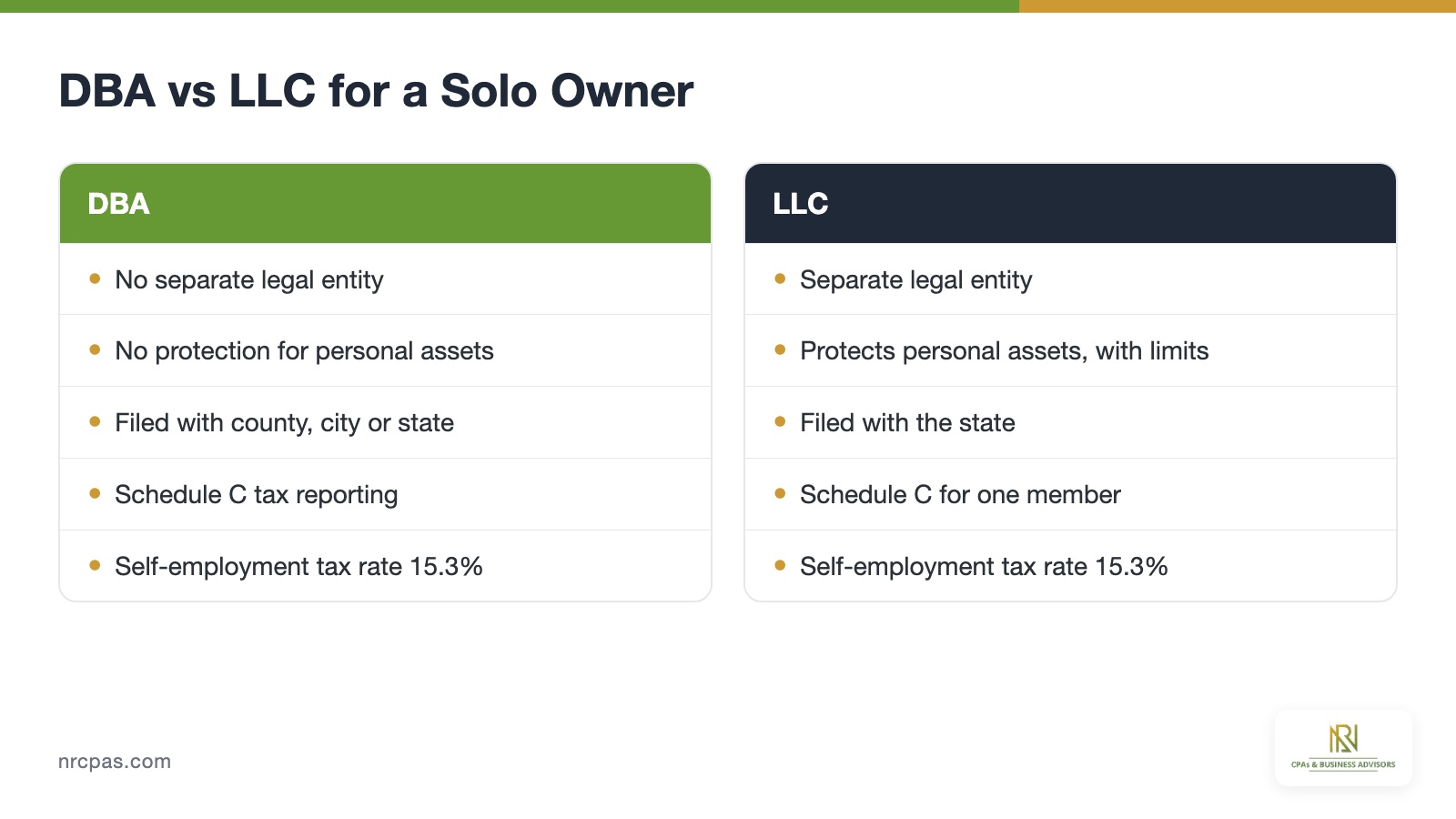
The graphic above shows the same DBA and LLC comparison for a solo owner who weighs liability against paperwork. Owners who want a lower self-employment tax base can study the S corp option and its tradeoffs after the LLC exists. The next question is whether the LLC must come first.
Can You Have a DBA Without an LLC?
Yes, you can have a DBA without an LLC, and sole proprietors and partnerships use DBAs that way. A DBA never requires an LLC, and an LLC never requires a DBA. The SBA says a DBA lets a business trade under an identity different from the owner's personal name or entity name.
The order for a solo owner is flexible. Founders can file the DBA first and move to an LLC when hiring employees, signing a lease or taking on injury risk. An LLC can then keep the DBA as a second name.
Sequence matters for the bank account, the EIN and the contracts. A new LLC setup follows that order, and every contract moves to the LLC name.
The DBA and LLC choice leaves several side questions open.
What Else Should a Sole Proprietor Know Before Filing a DBA?
A sole proprietor should know the drawbacks, the trademark gap, the federal reporting rules and the renewal duties before filing a DBA. The sections below answer each topic in short form.
What Are the Disadvantages of a DBA?
The disadvantages of a DBA are the lack of protection, the public record and the upkeep. A DBA leaves the owner personally liable for every business debt. The list below covers the main drawbacks.
- No liability protection, because the SBA says a DBA gives no legal protection by itself.
- No ownership of the name, because Florida law calls registration public notice only.
- A public record that links the trade name to the owner's name and address.
- Renewal duties that vary from 5 years to 10 years by state.
- Separate filings when the business operates in more than one county.
Does a Sole Proprietor Need a DBA for a Bank Account?
A sole proprietor needs a DBA for a bank account only when the account carries the trade name. An account in the owner's legal name needs no DBA. The SBA says a DBA and an EIN together let an owner open a business bank account.
Does a DBA Protect a Business Name?
A DBA does not protect a business name from a trademark claim, because registration is public notice only. Only a federal trademark gives nationwide rights to a name. The SBA warns that trademark infringement laws still apply to every DBA.
According to the U.S. Patent and Trademark Office (USPTO), the base application fee has been $350 per class since January 18, 2025. A trademark search before a DBA filing costs nothing and prevents a forced rebrand. Owners can run the name through brand consulting before printing it.
A name that passes the trademark search still needs a launch plan. That plan covers the bank, the EIN, the books and the filing dates. Founders can use launch advisory to set it before filing.
Does a Sole Proprietor Have to Report to FinCEN?
A sole proprietor with a DBA has no beneficial ownership report to file with the Financial Crimes Enforcement Network (FinCEN). A DBA filing creates no entity, so the DBA was never a reporting company. FinCEN also issued an interim final rule on March 26, 2025. That rule removed the duty for U.S. companies.
How Long Does a DBA Last and How Is It Cancelled?
A DBA lasts 5 years in California and Florida, up to 10 years in Texas and indefinitely in New York. A lapsed registration carries the same court limits as a missing one. Florida requires a cancellation filing within 30 days after the owner stops using the name.
Records of each filing belong in the owner's books. Clean bookkeeping setup keeps the DBA name, the bank account and the tax return consistent.
Each added name follows the same renewal calendar and public record rules. A second filing doubles the dates to track. Owners of startup businesses can file a second DBA for each new product line.
How Can a Sole Proprietor Get Help With a DBA Filing?
A sole proprietor can get help with a DBA filing from a CPA who also handles the tax return. We coordinate the DBA, the EIN and the entity choice for new owners. We also keep each filing date on the owner's calendar.
The team at NR CPAs specialists is led by founder Nischay Rawal, CPA, EA. Reach the office at (305) 872-3096.
The office also checks the DBA name against the owner's tax return each filing season. Owners ready for an LLC can start with entity formation ahead of a lease or a first hire.