Does an IRS Payment Plan Affect Your Credit Score or Mortgage


No, an IRS payment plan does not change your credit score, because the IRS never reports it to the bureaus. A mortgage lender still sees the plan in your tax file, counts its monthly payment and asks for proof of on-time payments. The lender also searches county records for a lien. A recorded federal tax lien is the real risk to a home loan.
Key Takeaways
- An IRS payment plan creates no tradeline, no hard inquiry and no payment history on a credit report.
- The three credit bureaus finished removing federal tax liens from credit reports in April 2018.
- Fannie Mae counts the plan payment in debt-to-income and requires proof that the borrower is current.
- FHA lenders want 3 months of timely payments under a valid repayment agreement.
- Direct debit plans with a balance of $25,000 or less can qualify for a lien withdrawal.
Does IRS Payment Plan Affect Mortgage Approval and Your Credit Score?
An IRS payment plan affects mortgage approval and your credit score in two separate ways. The score ignores the plan, while the mortgage file counts the plan. That split explains why borrowers with perfect scores still get questions about tax debt.
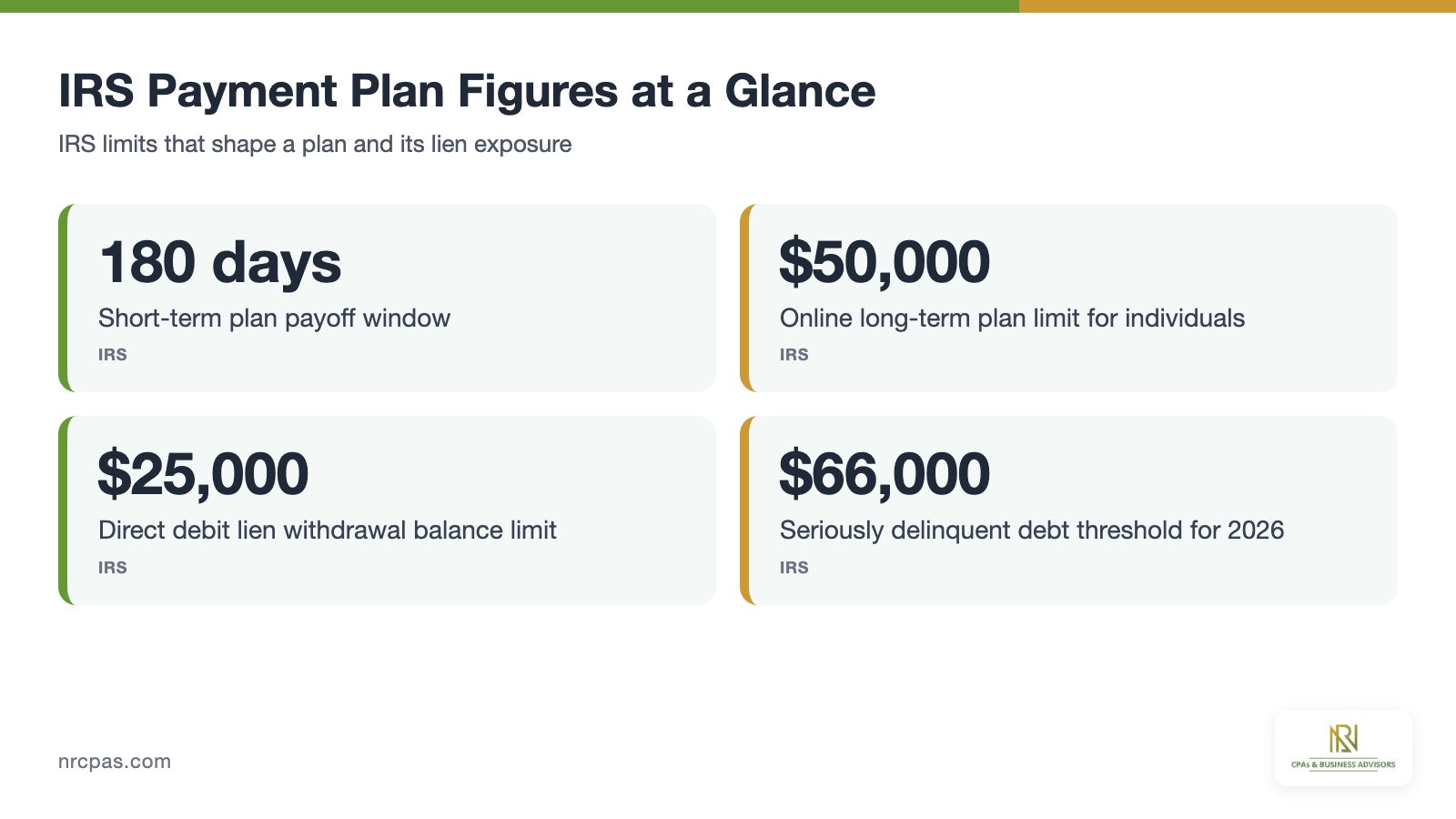
According to the Internal Revenue Service (IRS), a long-term plan is open online to individuals. Those individuals must owe $50,000 or less in combined tax, penalties and interest. The IRS also offers a short-term plan with a 180-day payoff window. Individuals can apply online for the short-term plan when they owe under $100,000.
Both plans give a lender the same three facts: the agreement, the monthly payment and the payment record. Taxpayers who already have a lien notice benefit from IRS lien protection before any loan application starts. The credit side of the question comes first, because the bureaus never receive the plan.
Does IRS Payment Plan Show on Credit Report?
An IRS payment plan does not show on a credit report, because the IRS is not a lender that furnishes account data. No tradeline, balance or payment history from the plan reaches the three bureaus. Taxpayers who search for IRS debt on credit report files find no IRS account there.
Credit bureaus build files from lenders, card issuers and collectors that report accounts. A tax agreement with the IRS is not one of those accounts. Applying for the plan also leaves the score alone, so no hard inquiry posts to the file.
Late plan payments stay off the report as well. The IRS handles a missed payment inside its own system, and the consequences show up later as notices and liens. The graphic below compares what a credit report holds with what a mortgage lender reads.

The one IRS record that once reached credit files is the federal tax lien.
Can a Federal Tax Lien Still Hurt Your Credit and Mortgage?
A federal tax lien no longer hurts your credit score directly, but it still hurts your mortgage options. In July 2017, the bureaus removed all civil judgments and almost half of tax liens, according to the Consumer Financial Protection Bureau. The IRS tax lien credit report entry was gone from consumer files by April 2018.
A Notice of Federal Tax Lien (NFTL) is the public notice of the government's claim against your property. According to the IRS, it files the notice after it assesses the balance, sends a bill and receives no payment. The IRS Fresh Start rules set its usual filing threshold at $10,000.
Lenders search county records for that notice, so the lien stays visible even without a credit entry. A lien can stall a refinance, a home equity loan or a purchase until the debt is paid, withdrawn or subordinated. Owners who want the notice gone can review lien removal options before they apply.
According to the IRS, a lien is released within 30 days after the debt is paid in full. Even without a lien, the plan can still touch a score through the money used to fund it.
How Does an IRS Payment Plan Affect Your Credit Score Indirectly?
An IRS payment plan affects your credit score indirectly through the other bills and cards in the same budget. The plan changes cash flow, and cash flow drives payment history. According to myFICO, payment history makes up 35% of a FICO Score and amounts owed make up 30%.
Four indirect routes explain most of the score damage that taxpayers on a plan report.
- Funding the plan with a credit card raises card utilization, which sits inside the amounts-owed factor.
- Borrowing a personal loan to pay the IRS adds a new account and a hard inquiry.
- Refund offsets move future refunds to the IRS balance, which removes cash that paid other bills.
- A tight budget causes late payments on other accounts, and those late payments do report.
Self-employed owners size quarterly estimates better after reading about deducting self-employment tax, which lowers the income base. Accurate estimates keep a second balance from forming beside the plan.
A budget built around quarterly tax bills keeps the plan payment and the other accounts current. Owners can pair that budget with tax bill planning to avoid a second balance.
A plan payment also shifts the debt ratio that mortgage underwriters study.
What Do Mortgage Lenders Require With an IRS Payment Plan?
Mortgage lenders require an approved agreement, a clean payment record and a plan payment that fits the debt-to-income (DTI) ratio. An IRS payment plan mortgage file needs the agreement letter, the payment history and a county lien search. Each loan program sets its own proof.
According to Fannie Mae Selling Guide topic B3-6-05, the lender must include the monthly plan payment in the borrower's monthly debts. The lender also needs evidence that the borrower is current on the plan. The guide applies only when no Notice of Federal Tax Lien is on file in the property's county.
Otherwise, Fannie Mae topic B3-6-07 requires the IRS balance to be paid before closing. According to HUD Handbook 4000.1, FHA lenders count the plan payment in the DTI ratio. FHA also wants at least 3 months of timely payments under a valid repayment agreement. The table below sets the rules side by side.
| Where it is read | Plan payment | Tax lien |
|---|---|---|
| Credit report and score | Not reported | Removed from reports by April 2018 |
| Fannie Mae conventional loan | Counted in DTI, proof of current payments | Balance paid before closing if a lien is on file |
| FHA loan | Counted in DTI, 3 months of timely payments | Valid repayment agreement required |
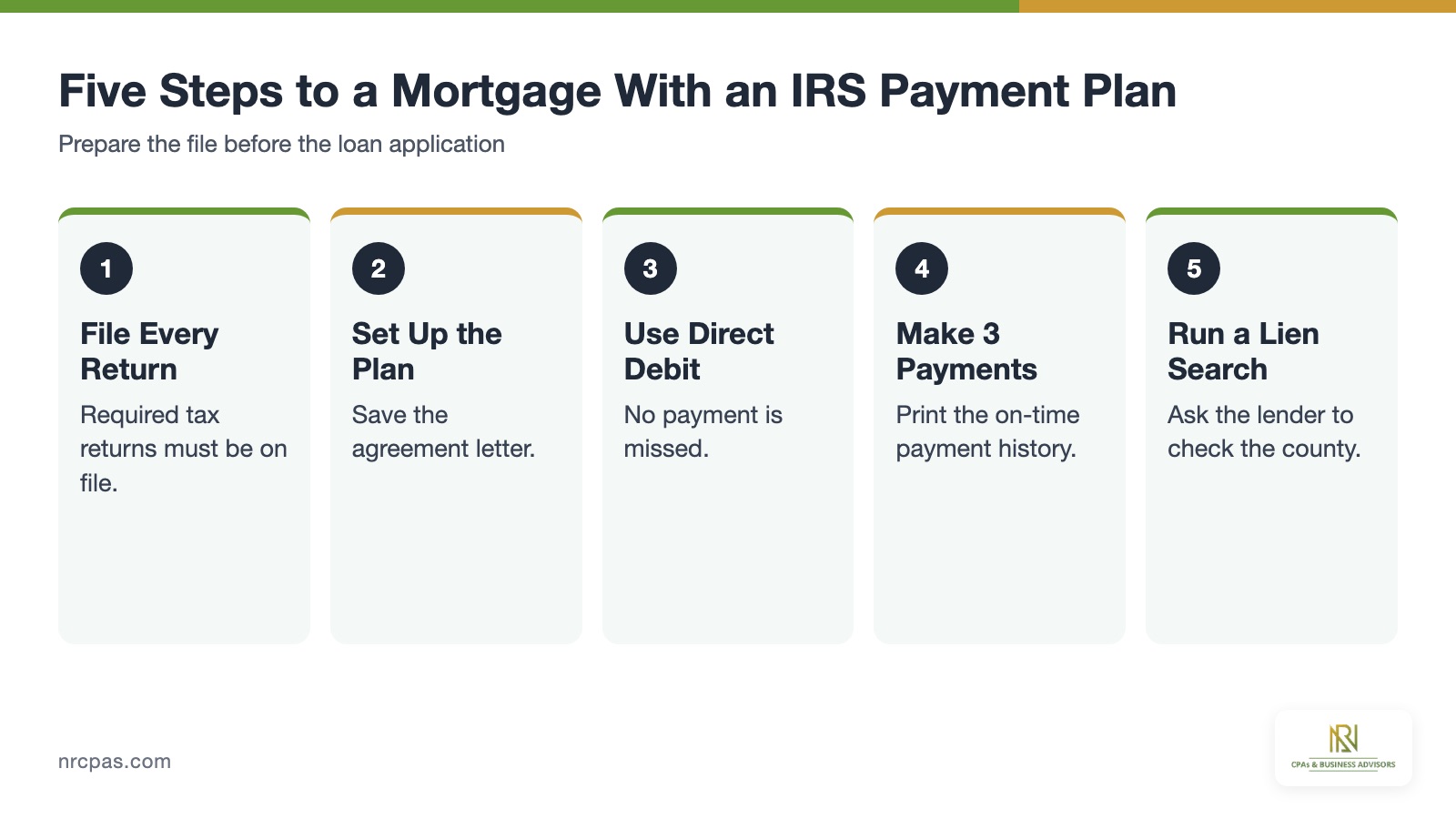
The table shows why a clean score does not settle a mortgage file. Five steps prepare a plan holder for the application.
- File every required tax return, since the IRS ties the plan to filing compliance.
- Set up the plan and save the agreement letter.
- Choose direct debit so no payment is missed.
- Collect 3 straight on-time payments and print the payment history.
- Ask the lender to run a county lien search before the purchase contract.
The steps graphic below shows the same order from first return to lien search.
Self-employed borrowers also need clean mortgage-ready financials because lenders qualify them on business income. A current profit and loss statement supports that income. The next question is how a plan can keep the lien out of the file.
How Can a Payment Plan Keep a Federal Tax Lien Off Your Record?
A payment plan keeps a federal tax lien off your record when it uses direct debit and the balance stays low. The IRS withdrawal rules favor balances of $25,000 or less. According to the IRS, the plan must pay in full within 60 months and show 3 consecutive direct debit payments.
Taxpayers request the withdrawal in writing on Form 12277. A withdrawal removes the public notice, but the debt stays on the IRS books. According to the IRS, a later default can bring a new notice and renewed collection.
Withdrawal timing matters. Taxpayers with a filed notice can ask an IRS debt resolution specialist to schedule the request after the third payment.
Penalties matter too. According to the IRS, the failure-to-pay penalty is 0.5% of the unpaid tax per month, up to 25%. The rate falls to 0.25% a month during a plan for timely filers.
The graphic below lists the IRS figures that shape a plan and its lien exposure.
Every one of those protections disappears when the plan defaults.
What Happens to Your Credit and Mortgage After a Plan Default?
A defaulted IRS payment plan stays off your credit report, but it opens the door to a lien and a levy. Default turns a private agreement into an enforcement case. The IRS sends Notice CP523 before it ends an agreement.
Termination makes the full unpaid balance collectible again. The IRS can then file a lien, levy a bank account or garnish wages. A lender that sees the plan end can no longer treat the borrower as current, so a mortgage denial follows.
Passport rules add another risk. According to the IRS, seriously delinquent tax debt means more than $66,000 for 2026. The IRS excludes debt that is timely paid under an approved installment agreement.
Taxpayers can request a Collection Due Process hearing after a lien filing. According to the IRS, the lien notice goes out within 5 business days of filing. The hearing request window then runs 30 days. Several side questions come up at this stage of the process.
What Other Questions Do Borrowers With IRS Debt Ask?
Does IRS Payment Plan Affect Mortgage Rates?
An IRS payment plan affects mortgage rates only through the score and ratios that lenders price from. The plan leaves the score alone, while its monthly payment raises the DTI ratio. A lien can stop the loan entirely, so rate shopping should wait until the lien question is settled.
The search "does IRS payment plan affect mortgage" has one short answer: the score stays put and the loan file changes.
Will an IRS Inquiry on Credit Report Files Hurt Your Score?
An IRS inquiry on credit report files does not follow a plan request, because the IRS does not pull credit. Mortgage lenders do read tax records. They ask borrowers to sign Form 4506-C so they can request tax transcripts.
Can an IRS Tax Lien Mortgage Problem Delay Closing?
An IRS tax lien mortgage problem can delay closing until the lien is paid, withdrawn or subordinated. According to the IRS, subordination does not remove the lien. It lets other creditors move ahead of the IRS, which may make a loan easier to get. IRS Publication 784 covers that request.
Should You Pay the IRS With a Credit Card?
No, paying the IRS with a credit card usually costs more than a payment plan. A card balance raises utilization and adds interest. According to the Federal Reserve, the average rate on all commercial bank credit card accounts was 20.94% in May 2026.
Can a Spouse's Tax Debt Affect Your Mortgage?
A spouse's tax debt can affect your mortgage, because joint filers share liability for a joint return. Joint filers can ask for spousal tax relief when the other spouse caused the error. Relief changes who owes the balance, so lenders then see a smaller debt on the application.
How Does Cash Flow Planning Keep a Payment Plan on Track?
Cash flow planning keeps a payment plan on track by matching each monthly payment to expected income. Owners with uneven income can add budget oversight from a part-time finance lead.
Matched payments protect payment history on every other account and give the lender steady numbers for the whole file. Cash reserves then matter, because a cash flow buffer covers the plan payment in slow months and keeps payments on time.
Who Can Help With an IRS Payment Plan and a Mortgage Application?
A CPA or Enrolled Agent can help with an IRS payment plan and a mortgage application. That help covers the agreement, the lien search and the lender paperwork. We prepare the documents lenders ask for and handle IRS contact for the borrower. The team at NR CPAs EA is led by founder Nischay Rawal, CPA, EA. Call the office at (305) 872-3096. The firm serves individual taxpayers and business owners across the country.
Borrowers who want a lender-ready plan can start with IRS installment help.