Can You Apply for a Business Credit Card With Only an EIN


Yes, you can apply for a business credit card with an EIN, but standard cards still ask for a Social Security number. Those cards add a personal guaranty. Cards that skip the personal credit check underwrite on business revenue, bank balances and cash flow. An EIN alone rarely wins approval, so the business needs verifiable financials behind the number.
Key Takeaways
- An Employer Identification Number (EIN) identifies a business, and the IRS issues it for free.
- Standard business cards ask the owner for a Social Security number and a personal guaranty.
- EIN-focused cards judge revenue, cash flow and bank balances instead of the owner's credit score.
- A registered LLC or corporation, a business bank account and 12 months of statements strengthen an application.
- Loans follow the same pattern, because the SBA requires a personal guaranty from every 20% owner.
Can I Apply for a Credit Card With My EIN Number?
You can apply for a credit card with your EIN number, because business applications accept a federal tax ID for the company. The form still asks for an individual owner, and that owner usually supplies a Social Security number. Owners who type "can i apply for a credit card with my ein number" into a search box get a conditional answer. The EIN names the business, while the Social Security number (SSN) names the person who answers for it.
According to the Internal Revenue Service (IRS), an EIN is a federal tax ID number for businesses, tax-exempt organizations and other entities. The IRS issues the number for free, and online applicants receive the EIN immediately.
A new EIN carries no payment history, so an issuer looks to the owner or to business cash instead. That reliance explains why the SSN stays on the form.
Can I Use My EIN Instead of My SSN When Applying for Credit?
You can use your EIN instead of your SSN only with issuers that underwrite on business financials. Standard cards treat the SSN as the key to the owner's personal credit report. The issuer pulls that report, and the owner signs a personal guaranty.
A personal guaranty is a written commitment that the owner repays the debt personally when the business cannot. The guaranty makes the owner liable even when the company is an LLC or a corporation. Lenders accept a new company on those terms because the owner carries the risk.
The Small Business Administration (SBA) applies the same logic to loans. According to the SBA, every owner of 20% or more of a small business applicant must give an unlimited personal guaranty. A spouse's share is added to the owner's share for that 20% test.
Only a few card programs drop the guaranty. Those programs sit in a different product category, which is the next question.
Which Types of Business Cards Approve Applicants With Only an EIN?
Corporate cards and charge cards from financial technology firms approve applicants with only an EIN more often than standard small business cards. Those programs replace the personal credit check with a review of business revenue and cash. Approval still depends on the numbers, so an EIN by itself does not qualify a company. The table below compares four card types.
| Card type | Personal credit check | Personal guaranty | What the issuer reviews |
|---|---|---|---|
| Standard small business card | Usually yes | Usually yes | Owner credit score and income |
| Corporate charge card | Often no | Often no | Revenue, cash flow and bank balances |
| Fintech spend card | Varies by issuer | Varies by issuer | Linked bank balance and cash flow |
| Secured business card | Varies by issuer | Varies by issuer | The cash deposit that sets the limit |
According to NerdWallet, corporate and fleet cards are among the few EIN-only business credit cards. Minimum linked business bank balances run from $20,000 to $25,000 on two corporate programs. Each row shows a different trade between owner risk and business proof. A corporate program asks for stronger business proof because the owner is not on the hook. The next section lists that proof.
What Do Issuers Check When You Apply With Only an EIN?
Issuers check business revenue, cash balances, cash flow, time in business and entity registration when you apply with only an EIN. Verified cash is the main substitute for a personal guaranty. The list below shows the six items that appear most in underwriting files.
- Annual revenue shown on tax returns or bank statements.
- Average monthly balance in the business checking account.
- Cash flow, meaning deposits minus withdrawals over 6 to 12 months.
- Time in business, measured from the formation date.
- Entity registration with the state, such as an LLC or corporation.
- Existing business credit file with payment history at the business bureaus.
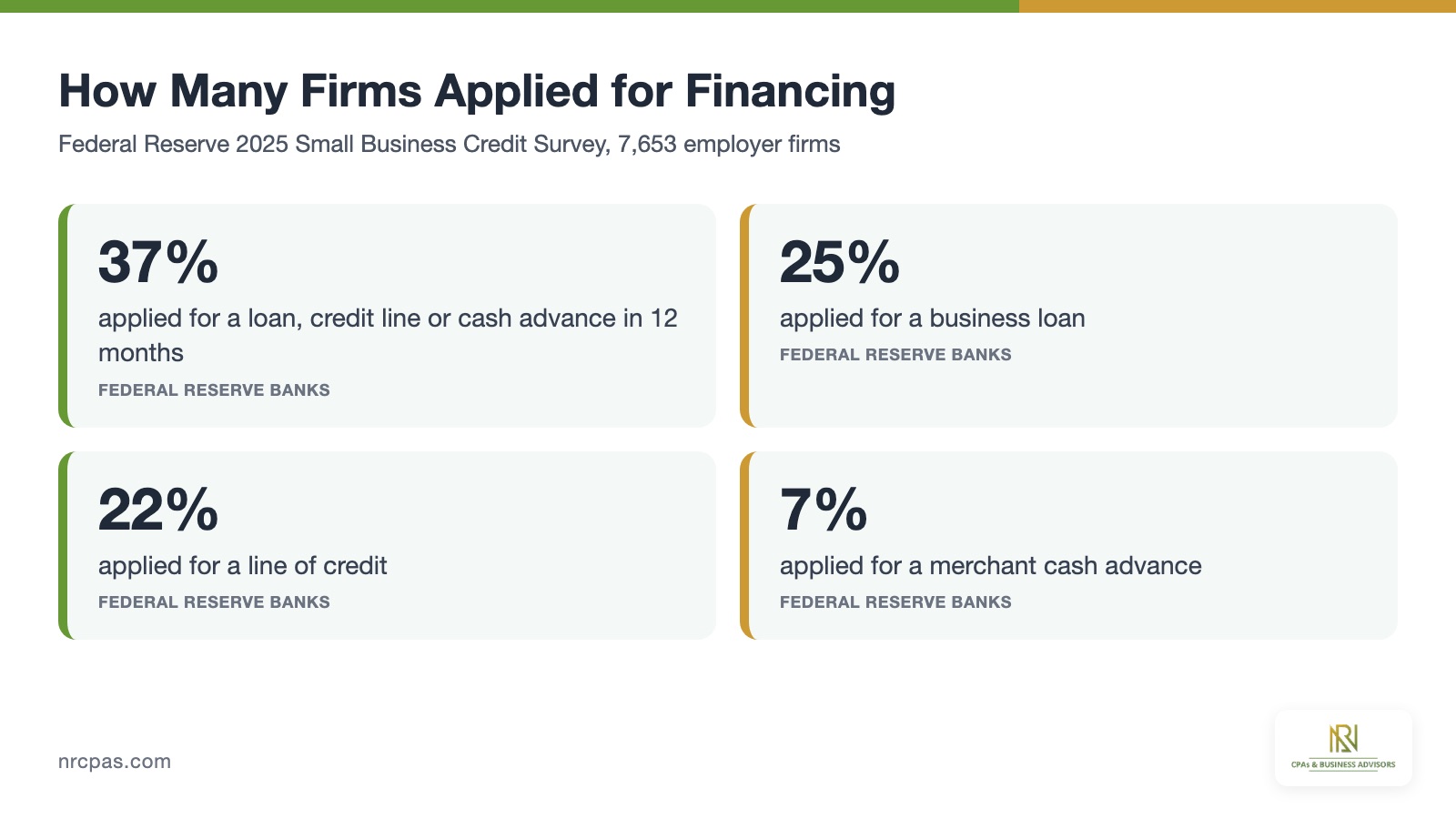
A lender cannot judge these items from memory, so the records must be ready before the application. According to the Federal Reserve Banks, 37% of employer firms sought a loan, credit line or cash advance in 12 months. The 2025 Small Business Credit Survey covered 7,653 firms.
The Federal Reserve report separates the three products. Loans drew applications from 25% of firms, lines of credit from 22% and cash advances from 7%. The graphic below shows those figures side by side.
Prepared records prevent denials. The steps for building that file come next.
How Do You Get a Business Credit Card With Just Your EIN?
You get a business credit card with just your EIN by registering the company and opening a business bank account. Then you apply to an issuer that underwrites on business cash. The process takes 5 steps, and the order matters. The numbered list below follows that order.
- Register the business entity with the state, such as an LLC or corporation.
- Apply for an EIN with the IRS, which costs nothing.
- Open a business checking account with the EIN and the formation documents.
- Collect 6 to 12 months of bank statements and the latest tax return.
- Apply to an issuer that lists revenue and cash flow as its main criteria.
This section covers how to get a business credit card with EIN number records in hand. The graphic below turns those 5 steps into one visual path.

Step 1 sets the foundation for steps 2 through 5. Owners who need help with formation support can complete step 1 and step 2 in the same week. According to the IRS, each responsible party can apply for only 1 EIN per day. The application needs that person's SSN or Individual Taxpayer Identification Number (ITIN).
The ITIN requirement shows that an EIN never fully replaces a personal identifier. A formal entity also changes how issuers see the owner, which is the next question.
Does an LLC or Corporation Help an EIN Credit Card Application?
An LLC or corporation helps an EIN credit card application because the entity shows a separate legal business with its own records. Entity registration proves the company exists apart from its owner. A state filing, an operating agreement and a business bank account together form that proof.
The entity does not remove the guaranty on a standard card, because a lender can still require the owner to sign personally.
The U.S. Census Bureau counted 29.8 million nonemployer businesses in 2022, with $1.7 trillion in receipts. Owners in that group compare single-member LLCs against a sole proprietorship before they apply for credit.
Tax treatment also shapes the books that issuers read. Choosing between an LLC and an S corporation changes how owner pay appears on the return. Owners weigh an S corp status before the first credit application. Clean entity records then feed the business credit file, which is the next topic.
Can You Apply for a Business Card Without an SSN?
You can apply for a business card without an SSN only with issuers that accept another identifier. Anti-money-laundering rules require every issuer to verify the person behind the company. According to NerdWallet, that identifier can be an SSN, an ITIN or a passport.
Most EIN-focused issuers then skip the personal credit check or run a soft pull. A standard card runs a hard inquiry, which according to Chase has a small, temporary effect on the owner's score. Report handling is the next question.
Does an EIN Card Report to Personal Credit?
An EIN card normally reports to business credit bureaus only, not to the owner's personal file. Reporting to personal credit usually happens only after serious delinquency. According to NerdWallet, most business cards share data with consumer bureaus only in that case. That separation is why a good payment record builds business credit on the EIN.
How Do I Build Credit on My EIN Number?
You build credit on your EIN number by paying vendors on time while those accounts report to the business credit bureaus. Business credit files attach to the EIN, not to the owner's SSN. Dun & Bradstreet, Experian and Equifax each keep a separate business file.
According to Dun & Bradstreet, the PAYDEX score runs from 1 to 100. A score of 80 means the business pays within agreed terms, and higher scores reflect early payment. A vendor that reports payment history is the usual starting point. According to Nav, new tradelines appear in 1 to 3 months. A business score can follow after 90 to 120 days.
Three habits move the file forward, and each one relies on the EIN.
- Pay supplier invoices on or before the due date.
- Keep every business expense in the business bank account.
- Use the same legal name, address and phone number on every account.
The steps for how to apply for a business loan with EIN number records mirror the card steps. Age also matters to lenders. According to the Bureau of Labor Statistics (BLS), 34.7% of business establishments born in 2013 were still operating in 2023. That survival rate explains why lenders reward a longer record. Founders who track cash flow management build that record faster, and strong records raise the odds on loans as well as cards.
Can I Borrow Money With My EIN Number?
You can borrow money with your EIN number, but lenders usually still review the owner's personal credit and require a personal guaranty. An EIN opens the application, and the business record decides the result. Banks, credit unions and online lenders all follow that pattern.
The SBA offers two clear examples. According to the SBA, the maximum 7(a) loan is $5 million. The SBA microloan program lends up to $50,000, with an average near $13,000 and a maximum term of 7 years.
The SBA also sets a lower bar for smaller owners. According to the SBA, owners below 20% may give a limited or full guaranty of the loan.
The Federal Reserve Banks report that firms applied at large banks less often in 2024 than in 2023, at 39% versus 44%. Applicants at small banks were fully approved 54% of the time. Owners planning a larger raise often build forecast planning into the loan package. Several side questions follow from these answers.
What Else Should You Know Before Applying With an EIN?
Applying with an EIN raises side questions about sole proprietors, denials, fuel cards, bank accounts, consumer protections and reporting rules. The sections below answer each one in short form.
Can I Apply for a Credit Card With My EIN Number as a Sole Proprietor?
A sole proprietor can apply with an EIN or an SSN. The IRS requires an EIN once the business has employees. A sole proprietor without employees can use an SSN as the business identifier. Many owners still request a free EIN to keep the SSN off vendor forms.
The comparison graphic below lines up an EIN-focused card against a standard card for a new owner.

Can You Use Your EIN Number to Apply for Credit?
You can use your EIN number to apply for credit with business lenders, trade suppliers and vendors that report to business bureaus. Trade credit is the easiest EIN-only credit to open. Many suppliers extend net-30 terms after a short application and bank reference.
Each on-time payment then adds to the file that later card issuers read.
What Disqualifies You From Getting a Business Credit Card?
Late payments, a low owner credit score, missing revenue records and an unregistered business disqualify an applicant. Missing documents cause as many denials as weak credit. The list below names the common causes.
- Late or missed payments on personal or business accounts.
- Bankruptcy, a lien or an unpaid judgment on the owner or the entity.
- Revenue or bank balances below the issuer's minimum.
- Application details that do not match the EIN letter or state filing.
- Too many new credit applications within a short period.
A denial letter names the reason, and the owner can fix the record before the next attempt.
Can I Get a Gas Card With My EIN Number?
You can get a gas card with your EIN number, because fuel and fleet programs accept business applicants. Fuel programs usually review business revenue, fleet size and payment history. Some programs still request a personal guaranty from the owner.
A fuel card also separates vehicle costs from other spending. That separation keeps mileage and fuel records clean for the tax return.
Can I Use an EIN Number to Open a Bank Account?
You can use an EIN number to open a business bank account, with formation documents and a government ID for each owner. The IRS EIN assignment letter, Notice CP 575, is the standard proof of the number. Banks also ask for an operating agreement or articles of incorporation.
The bank account then becomes the main source of evidence for every credit application.
Do Business Credit Cards Carry the Same Protections as Consumer Cards?
Business credit cards do not carry the same protections as consumer cards, because Regulation Z exempts business-purpose credit. Only 2 rules still reach business cards. According to the Consumer Financial Protection Bureau (CFPB), section 1026.12(a) limits when issuers may send cards. Section 1026.12(b) caps liability for unauthorized use.
Card agreements for business accounts can therefore change terms faster than consumer agreements. Owners should read rate, fee and liability terms before signing.
Do Beneficial Ownership Reports Apply to a New Company?
Beneficial ownership reports do not apply to a new U.S. company, because the Financial Crimes Enforcement Network (FinCEN) exempts domestic companies. According to FinCEN, U.S. companies no longer file beneficial ownership information reports under the final rule effective August 14, 2026.
Banks still collect owner details when they open an account. That collection comes from bank rules, not from the Corporate Transparency Act.
How Can an Accounting Firm Help You Qualify for Business Credit?
An accounting firm helps you qualify for business credit by preparing the statements and tax records that issuers read. We organize monthly books, set up the entity and build the bank-ready file that EIN-focused underwriting requires.
The team at NR CPAs advisors works with new LLCs, corporations and growing companies across the country. The firm is led by founder Nischay Rawal, CPA, EA. Reach the office at (305) 872-3096.
Start-up owners can pair launch support with clean financial records before the first application. A company with 6 months of organized deposits and a funded business account looks stronger on paper. Mixed personal and business spending weakens the same file.
Lenders read the books before they read the story. Monthly statements prepared on a regular schedule show revenue, expenses and cash, and lender-ready statements carry weight in every credit file.
Those same statements help a founder budget for growth after the first card is approved, month by month. Founders at that stage often add a CFO for startups for the spending plan. That plan sets a cash reserve target and a repayment schedule, one line at a time.
Credit approval follows organized records, a funded account and a registered entity. The path from EIN to approval starts with company registration that lenders trust.