What Are Current Assets on a Balance Sheet and What Counts

The answer to what are assets on a balance sheet is everything a company owns that holds value. The balance sheet splits assets into current assets, which turn into cash within one year, and non-current assets, which last longer. Assets are listed in order of liquidity, with cash first, and they must equal liabilities plus equity.
Key Takeaways
- Assets equal liabilities plus equity, and every asset sits in the top section of the balance sheet.
- Current assets are cash and items expected to become cash, sell or be used up within one year.
- Five lines make up most current assets: cash, securities, receivables, inventory and prepaid expenses.
- The current ratio equals total current assets divided by total current liabilities.
- Non-current assets include fixed assets, intangible assets and long-term investments.
What Are Assets on a Balance Sheet?
Assets on a balance sheet are the resources a business owns or controls that carry economic value. Every asset is reported in the assets section, above liabilities and equity. According to the Securities and Exchange Commission (SEC), assets include cash, inventory, investments, equipment, patents and trademarks.
Knowing what are assets on a balance sheet starts with one equation. The balance sheet rests on it, Assets = Liabilities + Equity. According to the SEC, the two sides must match, or balance. A company with $500,000 of assets must show $500,000 of liabilities plus equity.
Small firms keep this equation in every ledger. According to the U.S. Small Business Administration (SBA) Office of Advocacy, the country has 36.2 million small businesses. Those firms employ almost 46% of private-sector workers, so accurate balance sheet preparation touches a large share of the economy. Preparation starts with the order in which assets are listed.
How Are Assets Listed on the Balance Sheet?
Assets are listed on the balance sheet in order of liquidity, meaning the speed at which each asset turns into cash. Cash is listed first, and long-term holdings are listed last. Current assets sit above non-current assets under that order.
The graphic below shows the five current asset lines in liquidity order, from cash down to prepaid expenses.
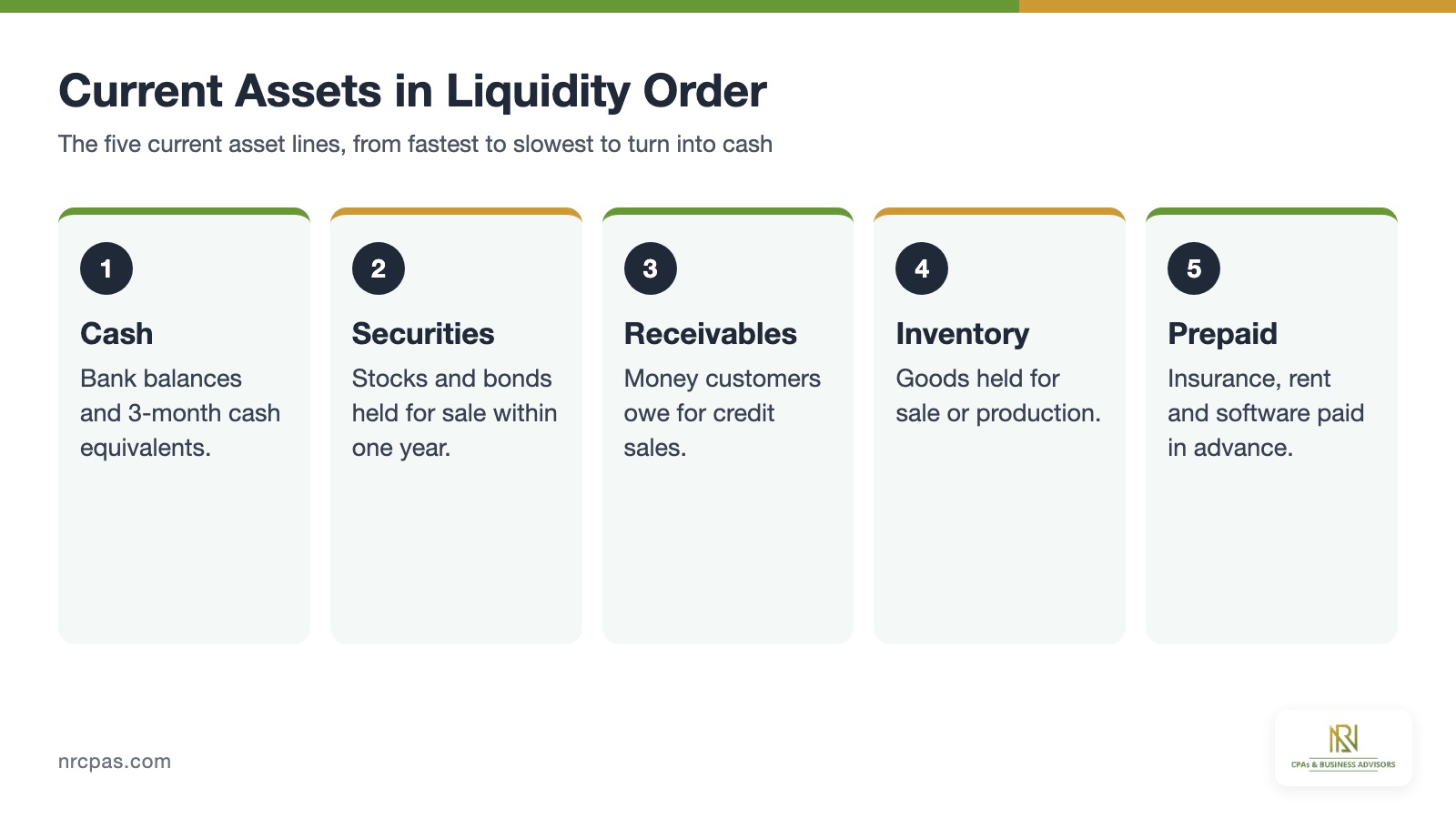
Each line carries a dollar amount at the balance sheet date, and the lines add up to a subtotal. That subtotal is the number behind the next question, which asks what current assets are.
What Are Current Assets on a Balance Sheet?
Current assets on a balance sheet are cash and assets expected to turn into cash within one year. The SEC describes current assets as items a company expects to convert to cash within one year. Inventory is the SEC's example.
The one-year window has an exception. The window becomes the operating cycle when that cycle runs longer than one year. The operating cycle is the average time from buying materials to collecting cash from the sale.
A winery that ages wine for 3 years, for example, counts that wine as a current asset under the longer cycle. A virtual CFO tracks cycle length for such clients, and CFO oversight keeps the classification consistent from year to year.
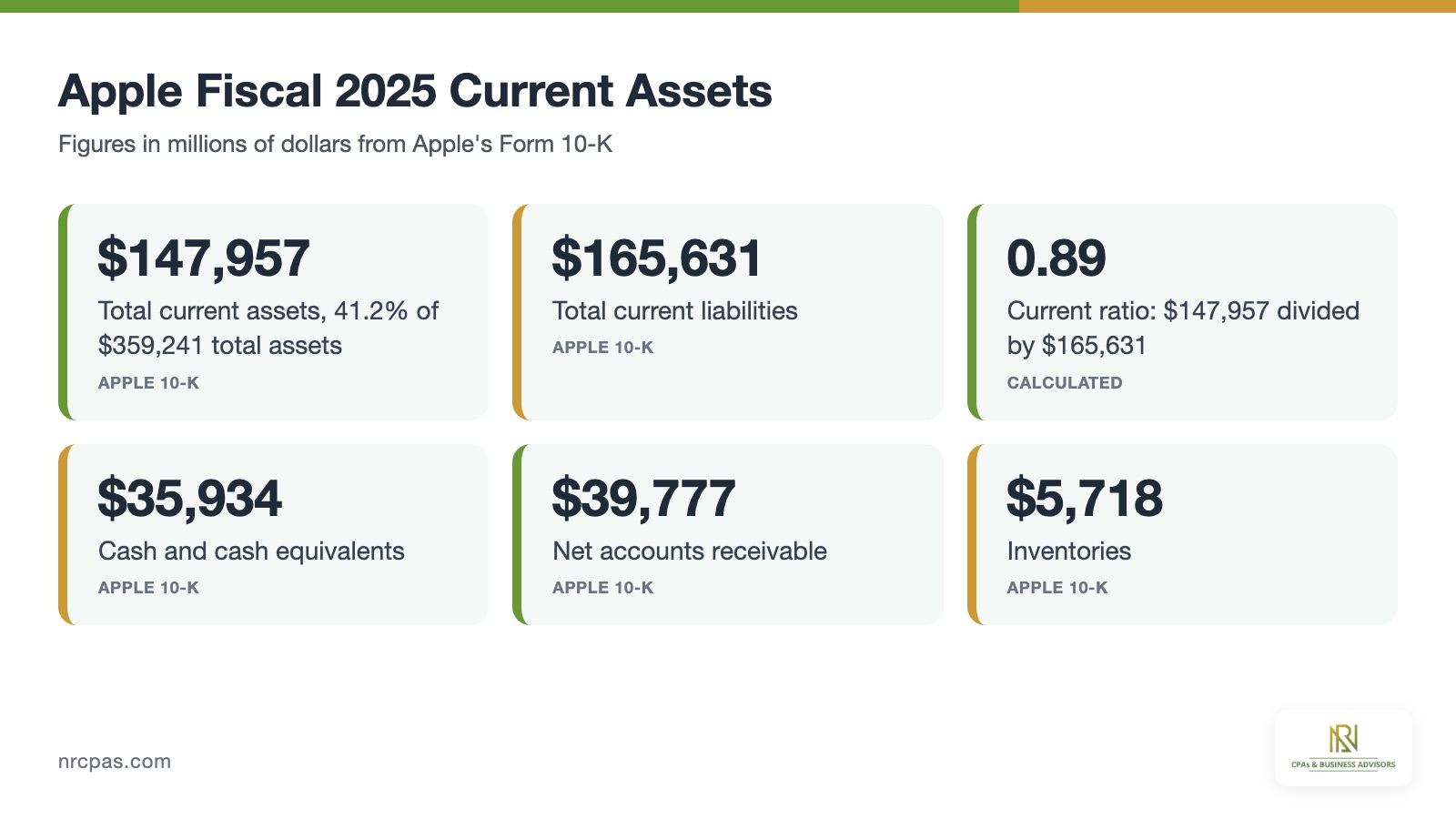
Large companies use the same layout. According to its fiscal 2025 Form 10-K, Apple reported $147,957 million of current assets and $359,241 million of total assets. Current assets made up 41.2% of Apple's total assets. The accounts inside that $147,957 million are the next topic.
What Counts as a Current Asset?
Six account types count as current assets on a standard balance sheet, and each one meets the one-year or operating cycle test. Cash, securities, receivables, inventory, prepaid expenses and other short-term items all qualify. The table below lists each account with its measurement basis.
| Account | What it holds | How it is measured |
|---|---|---|
| Cash and cash equivalents | Bank balances, cash on hand, money market funds, 3-month Treasury bills | Face amount |
| Marketable securities | Stocks and bonds the company plans to sell within one year | Fair value |
| Accounts receivable | Money customers owe for credit sales | Invoice total minus expected credit losses |
| Inventory | Raw materials, work in process and finished goods | Lower of cost and net realizable value |
| Prepaid expenses | Insurance, rent and software paid before use | Amount paid minus the part already used |
| Other current assets | Supplies, short-term notes and tax refunds due | Expected amount to be received |
Each of those six accounts follows its own reporting rule, starting with cash.
What Are Cash and Cash Equivalents?
Cash and cash equivalents are bank balances, cash on hand and short-term investments with original maturities of three months or less. Apple's fiscal 2025 Form 10-K treats investments maturing in three months or less at purchase as cash equivalents. A 3-month Treasury bill bought at issue is a cash equivalent.
According to the Federal Deposit Insurance Corporation (FDIC), deposits are insured to at least $250,000 at each insured bank. Apple reported $35,934 million of cash and cash equivalents at fiscal 2025 year end. Cash that is not spent becomes the pool for the next current asset, receivables.
How Are Accounts Receivable Reported?
Accounts receivable are reported at the invoice total minus an allowance for expected credit losses. The allowance lowers receivables to the amount the company expects to collect. Receivables not expected within one year are generally moved out of current assets.
Apple reported $39,777 million of net accounts receivable in fiscal 2025. Every credit sale starts as revenue and ends as a receivable, so revenue entries and receivable balances move together. Unsold goods then form the next line, inventory.
How Is Inventory Reported as a Current Asset?
Inventory is reported as a current asset at the lower of cost and net realizable value. According to its fiscal 2025 Form 10-K, Apple measures inventories using the first-in, first-out (FIFO) method. Net realizable value is the expected selling price minus the cost to finish and sell.
According to the Internal Revenue Service (IRS) Publication 538, FIFO treats the first items bought as the first items sold. The IRS adds that last-in, first-out (LIFO) produces a larger cost of goods sold and a lower closing inventory when prices rise. Food spoils fast, so restaurant inventory is counted often. Apple held $5,718 million of inventory in fiscal 2025.
What Are Prepaid Expenses?
Prepaid expenses are payments made before a service is used, such as insurance, rent and software. A $12,000 annual insurance premium paid on January 1 starts as a $12,000 current asset. Each month, $1,000 moves from prepaid expenses to insurance expense. The asset reaches zero after the twelfth entry.
Those six accounts must be found on a real statement before they can be added, and the steps come next.
How Do You Find Current Assets on a Balance Sheet?
Find current assets on a balance sheet in the assets section, where a Total Current Assets subtotal closes the group. The subtotal sits above the non-current assets. The numbered steps below locate and check that subtotal.
- Open the balance sheet and find the Assets heading at the top.
- Locate the Current Assets subheading, which sits above fixed or non-current assets.
- Read each line, from cash through prepaid expenses.
- Add the lines and confirm the total matches Total Current Assets.
- Compare the total with the prior-year column to see the change.
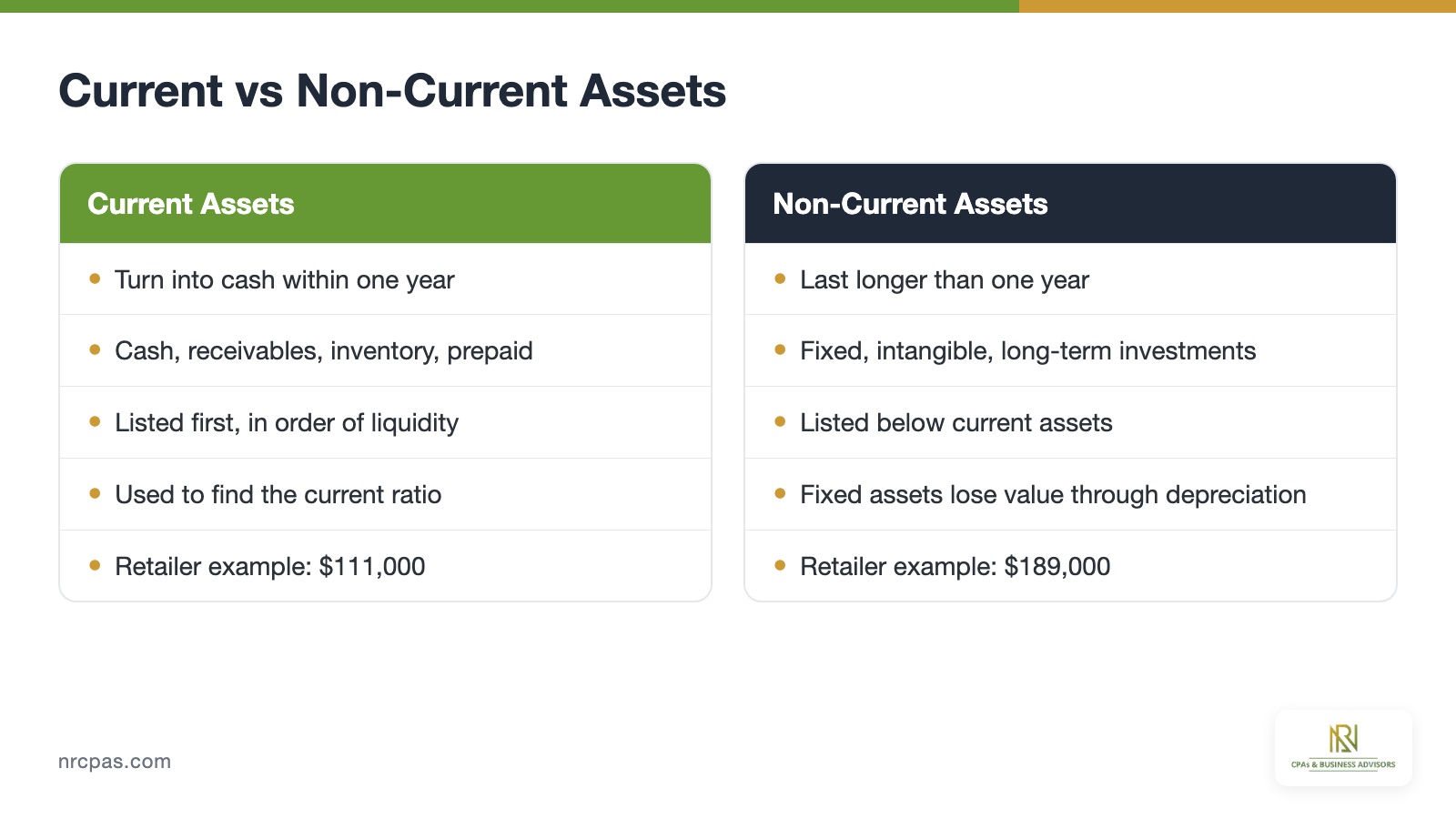
A small retailer shows how the addition works. The retailer holds $42,000 of cash, $28,000 of receivables, $35,000 of inventory and $6,000 of prepaid expenses. Total current assets equal $111,000.
How Do You Calculate Total Assets on a Balance Sheet?
Total assets on a balance sheet equal total current assets plus total non-current assets. The retailer adds $189,000 of net fixed assets to its $111,000 of current assets. Total assets for the retailer equal $300,000.
That $300,000 must also equal liabilities plus equity. Current assets are then compared with current liabilities, and the comparison is the current ratio.
How Do You Find the Current Ratio From a Balance Sheet?
Find the current ratio from a balance sheet by dividing total current assets by total current liabilities. The retailer's ratio equals $111,000 divided by $60,000 of current liabilities, or 1.85. Current liabilities are debts due within one year, according to the SEC.
A ratio above 1.00 means current assets exceed current liabilities, and a ratio below 1.00 means they fall short. Apple's fiscal 2025 numbers show the second case. Apple reported $147,957 million of current assets against $165,631 million of current liabilities, a ratio of 0.89. The stat graphic below lays out those figures.
Strong cash conversion lets a large company run below 1.00, but a small firm has less room. According to the Federal Reserve Small Business Credit Survey, 56% of small firms had trouble paying operating expenses. Another 51% reported uneven cash flow. Ratio trends feed cash planning for exactly that reason.
What Does a Current Ratio of 1.5 Mean?
A current ratio of 1.5 means a company holds $1.50 of current assets for every $1.00 of current liabilities. A ratio of 1.2 means $1.20, and a ratio of 2.5 means $2.50. A ratio of 0.5 means only $0.50 of current assets backs each $1.00 of current liabilities.
Targets differ by industry, so the company's own trend over several years is the cleanest comparison. A lender reading the ratio will also ask how much of the total is inventory, which leads to quick assets.
What Are Non-Current Assets on a Balance Sheet?
Non-current assets on a balance sheet are resources expected to last longer than one year. Non-current assets sit below current assets and include four groups. The bulleted list below names each group.
- Fixed assets, also called plant assets: land, buildings, vehicles, equipment and furniture.
- Intangible assets: patents, trademarks, licenses and goodwill.
- Long-term investments: bonds and stock held for more than one year.
- Other assets: security deposits and long-term notes receivable.
The answer to what are fixed assets on a balance sheet is land, buildings, vehicles and equipment. Fixed assets are reported at cost minus accumulated depreciation. The retailer's equipment cost $240,000 and carries $51,000 of accumulated depreciation, so net fixed assets equal $189,000. Apple reported $49,834 million of net property, plant and equipment and $211,284 million of total non-current assets. Depreciation changes the tax side of those fixed asset numbers as well.
The comparison graphic below sets current assets beside non-current assets.
Those two groups raise several side questions, and the sections below answer them in short form.
What Else Should You Know About Assets on a Balance Sheet?
Several side topics shape how assets are read, taxed and presented. The short answers below cover quick assets, the cash ratio, intangible assets, net assets, off-balance-sheet items, savings, red flags, lenders and taxes.
What Are Quick Assets on a Balance Sheet?
Quick assets on a balance sheet are current assets that convert to cash fastest, namely cash, marketable securities and accounts receivable. Quick assets leave out inventory and prepaid expenses. The retailer's quick assets equal $70,000, so its quick ratio is $70,000 divided by $60,000, or 1.17.
Apple's quick assets, with vendor receivables included, equal $127,654 million. Divided by $165,631 million of current liabilities, they give a quick ratio of 0.77.
What Are Intangible Assets on a Balance Sheet?
Intangible assets on a balance sheet are non-physical resources such as patents, trademarks, licenses and goodwill. Goodwill is recorded only when a company buys another business. Purchased intangibles appear below fixed assets in the non-current section.
Young companies often hold few recorded intangibles, because internally built brands are generally not capitalized. Startup balance sheets therefore show cash and receivables far more than software or brand value.
What Are Net Assets on a Balance Sheet?
Net assets on a balance sheet equal total assets minus total liabilities. Net assets and owner's equity are the same number. The retailer with $300,000 of assets and $180,000 of liabilities reports $120,000 of net assets.
Charities use the term net assets in place of equity, and nonprofit reporting splits net assets into with and without donor restrictions.
Other organizations label the same number by form, such as member equity for a limited liability company (LLC). The right label depends on the entity type chosen at formation, and the amount stays equal to assets minus liabilities.
What Assets Are Not on the Balance Sheet?
Assets not on the balance sheet include internally built brands, trained employees, customer loyalty and assets the owner holds personally. Costs that are expensed when paid, such as advertising, never become assets. Leased equipment is the one exception, because lease accounting now records a right-of-use asset.
Do Savings and Retirement Funds Count as Assets?
Business savings count as assets, and they appear in cash and cash equivalents. Owner savings and retirement funds belong to the owner, so they appear on a personal balance sheet instead. A business balance sheet lists only what the business owns. A family office tracks both sets of numbers side by side, and wealth tracking keeps them apart.
What Are Red Flags in Current Assets?
Red flags in current assets are warning patterns that show up in the current asset lines. Four patterns deserve a closer look:
- Receivables growing faster than revenue.
- Inventory rising while sales stay flat.
- Cash shrinking while net income stays positive.
- A current ratio that falls below 1.00.
Each pattern signals slower collection or slower sales. Owners who see two or more at once should review credit terms and stock levels that month.
How Do Taxes Treat Current Assets?
Taxes treat current assets through the accounting method, because inventory normally requires the accrual method. According to the IRS, the Section 448(c) gross receipts test is $31 million for 2025 tax years. Rev. Proc. 2025-32 sets the test at $32,000,000 for tax years beginning in 2026.
A business under that average receipts limit can skip formal inventory accounting. Method changes need advance review, and inventory method planning belongs in the year before the change.
What Is the Cash Ratio on a Balance Sheet?
The cash ratio on a balance sheet equals cash and cash equivalents divided by current liabilities. According to Investopedia, the cash ratio is the most conservative liquidity ratio, because it counts only cash and cash equivalents. The retailer's cash ratio is $42,000 divided by $60,000, or 0.70.
Apple's cash and cash equivalents of $35,934 million divided by $165,631 million of current liabilities give a cash ratio of 0.22. The current ratio, quick ratio and cash ratio rise in strictness from the broadest to the narrowest measure.
Why Is the Balance Sheet Important to Lenders?
The balance sheet is important to lenders because it shows whether assets cover debts on a single date. According to Investopedia, a company usually must give a lender its balance sheet to secure a business loan. Borrowing adds the same amount to cash and to liabilities.
A $4,000 bank loan, for example, raises cash by $4,000 and long-term debt by $4,000, so the two sides still match. Lenders then compare current assets with current liabilities, which is the current ratio again.
Who Can Help Keep Current Assets Accurate?
A CPA firm keeps current assets accurate through monthly reconciliations of cash, receivables, inventory and prepaid balances. We build balance sheets, ratio schedules and tax-ready statements for owners who need clean numbers. The team at NR Business Advisors is led by founder Nischay Rawal, CPA, EA.
Reach the office at (305) 872-3096 to discuss monthly closes, ratio schedules and year-end balance sheet reviews for a growing company. Owners who want a reviewed balance sheet each month can request financial statement help from the firm.