Does Section 179 Reduce Self-Employment Income and Tax


Yes, Section 179 reduces self-employment income for sole proprietors, single-member LLC owners and general partners. The deduction lowers net profit, and net profit sets the Schedule SE base. A $40,000 deduction cuts 2025 self-employment tax by $5,652 on a $100,000 profit. S corporation shareholders see no such effect. Limits and entity type decide the exact saving.
Key Takeaways
- Section 179 lowers Schedule C net profit, which lowers net earnings from self-employment.
- Self-employment tax is 15.3% of 92.35% of net profit, so each deduction dollar saves about 14.1 cents.
- The deduction cannot exceed taxable income from the active business, and extra amounts carry forward.
- General partners reduce Schedule K-1 Box 14 Code A by the deduction.
- S corporation shareholders gain income tax savings only, because K-1 income carries no self-employment tax.
Does Section 179 Reduce Self-Employment Income?
Section 179 reduces self-employment income because the deduction lowers the net profit that carries onto Schedule SE. A Section 179 deduction on Schedule C lowers net earnings from self-employment dollar for dollar. Schedule SE then multiplies the lower profit by 92.35% before it applies the tax rate.
According to the Internal Revenue Service (IRS), self-employment tax runs 15.3%, made of 12.4% for Social Security and 2.9% for Medicare. The IRS requires Schedule SE once net earnings from self-employment reach $400. A Section 179 deduction therefore shrinks two taxes at once, income tax and self-employment tax.
According to the Bureau of Labor Statistics (BLS), about 9.2 million nonagricultural unincorporated workers were self-employed in 2025. Each of those owners faces the same Schedule SE math.
Owners who buy equipment late in the year often pair the purchase with owner tax planning before December 31. The deduction then needs a path from the asset to the return, and that path is the next question.
How Does a Section 179 Deduction Flow From Form 4562 to Schedule SE?
A Section 179 deduction flows from Form 4562 to Schedule C and then to Schedule SE in four steps, listed below.
- Report the asset, its cost and its placed-in-service date in Part I of Form 4562.
- Carry the Form 4562 deduction to the depreciation line of Schedule C.
- Subtract that depreciation from gross profit to reach a lower Schedule C net profit.
- Carry the lower net profit to Schedule SE, where 92.35% and the 15.3% rate apply.
The graphic below shows the same four steps, from the asset purchase to the Schedule SE total.
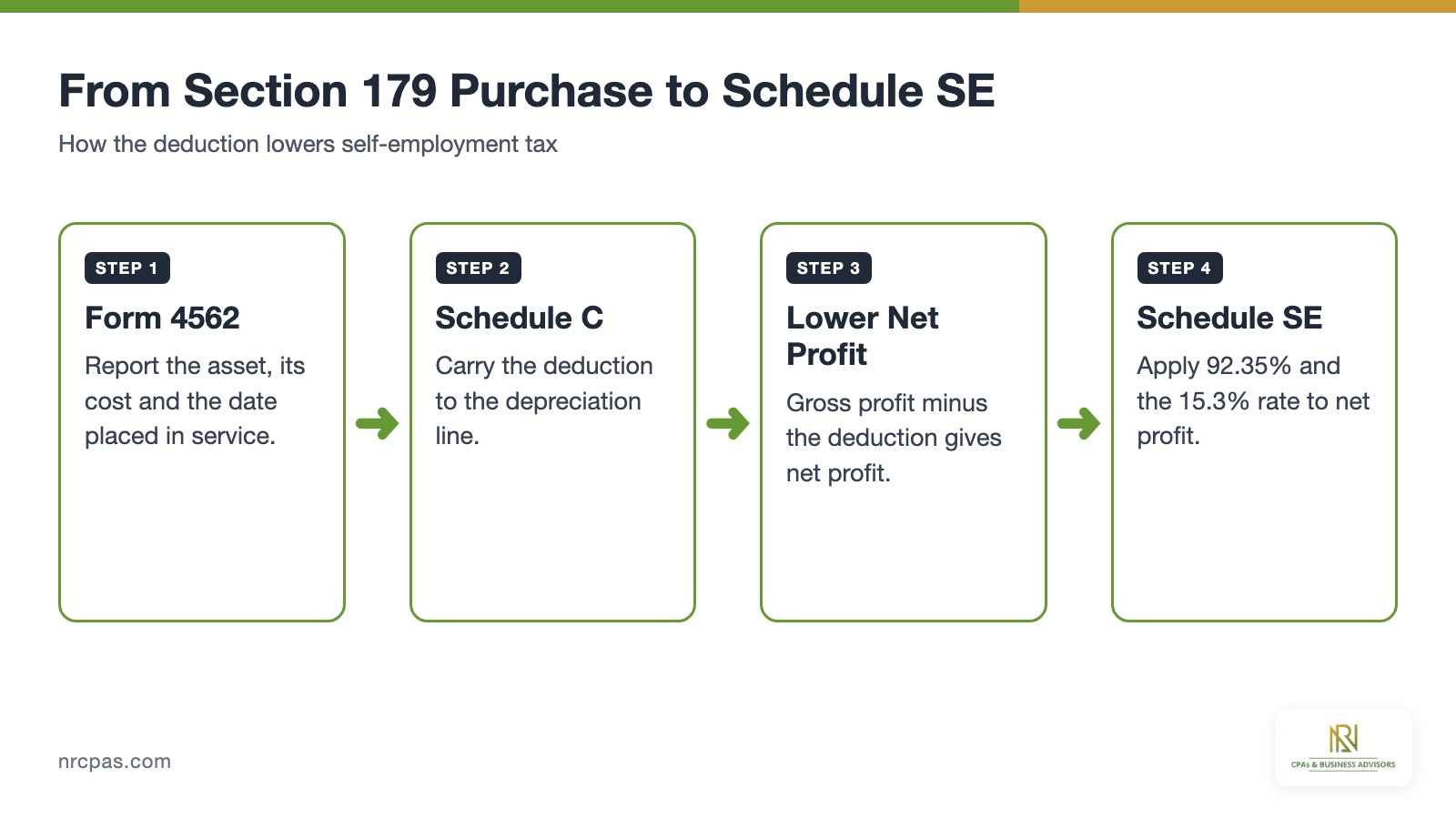
Net profit is the number that connects the deduction to self-employment tax. Owners who want line-by-line placement can review return placement before filing.
The deduction only counts for the year the asset is placed in service, meaning ready and available for use in the business. A truck delivered on December 28 but not yet in use does not qualify for that tax year. The purchase date alone does not decide the year.
The IRS also lets owners deduct one-half of self-employment tax when figuring adjusted gross income. A lower self-employment tax shrinks that half deduction slightly. The tax saving itself is the next number to price.
How Much Self-Employment Tax Does Section 179 Save?
Section 179 saves self-employment tax equal to 14.13% of the deduction, up to the Social Security wage base. A $40,000 deduction saves $5,652 of self-employment tax on a $100,000 profit. The 14.13% comes from 15.3% times 92.35%.
According to the IRS, the 2025 Social Security wage base is $176,100. Above the wage base, only the 2.9% Medicare portion keeps applying.
The table below compares 4 scenarios for the 2025 tax year, using the IRS rates and the $176,100 wage base.
| Scenario | Net profit after deduction | Self-employment earnings (92.35%) | Self-employment tax |
|---|---|---|---|
| $100,000 profit, no Section 179 | $100,000 | $92,350 | $14,130 |
| $100,000 profit, $40,000 Section 179 | $60,000 | $55,410 | $8,478 |
| $250,000 profit, no Section 179 | $250,000 | $230,875 | $28,532 |
| $250,000 profit, $40,000 Section 179 | $210,000 | $193,935 | $27,461 |
The first pair saves $5,652, while the second pair saves only $1,071, because the $250,000 owner already exceeds the wage base. The stat graphic below repeats both savings side by side.
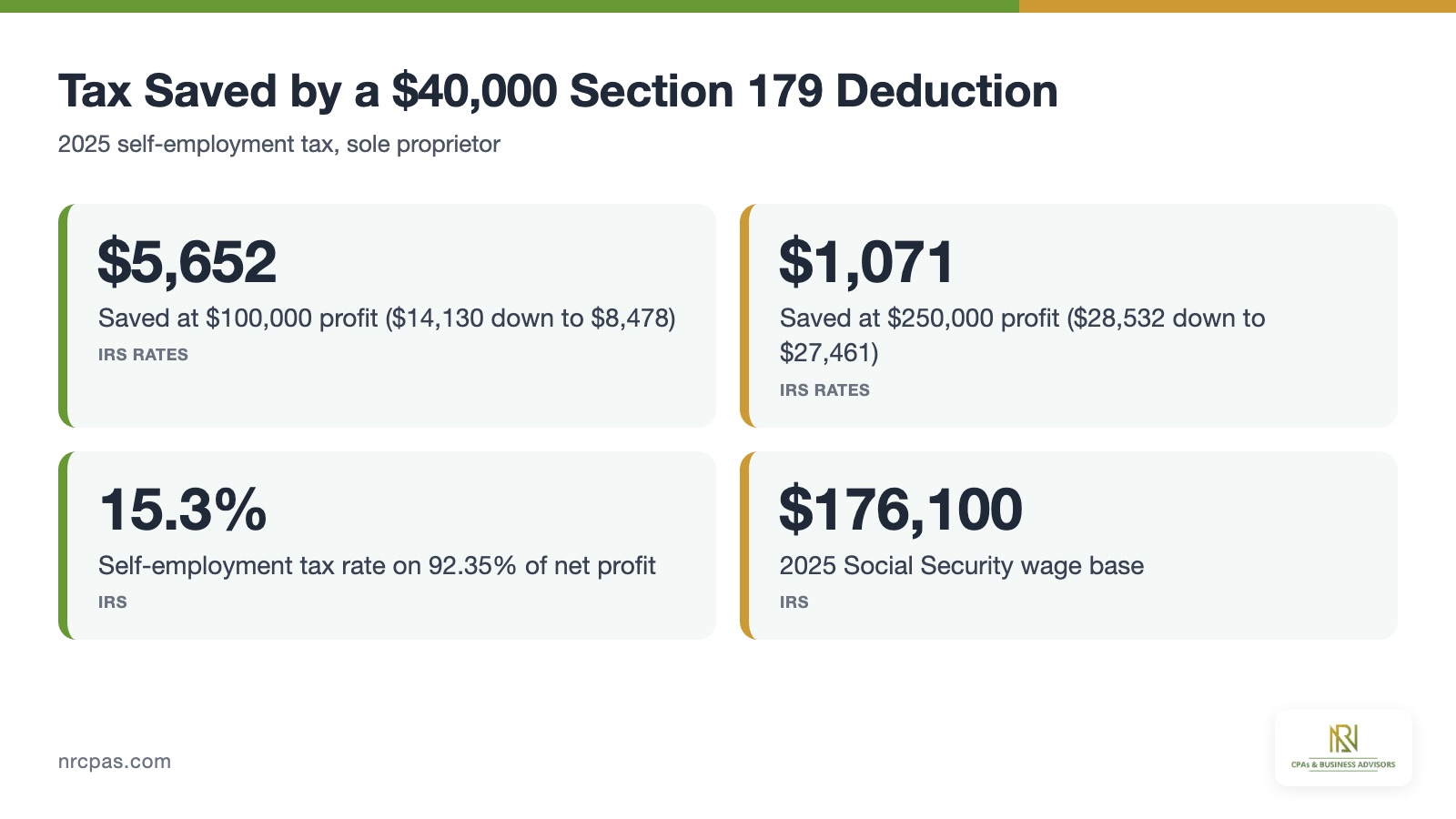
The wage base explains why the savings shrink for high earners. Social Security tax stops at $176,100 of 2025 earnings, so the 12.4% portion no longer falls with the deduction. The 2.9% Medicare portion keeps falling, because Medicare has no earnings cap.
The IRS also adds a 0.9% Additional Medicare Tax on self-employment income above $200,000 for single filers. The thresholds are $250,000 for joint filers and $125,000 for married filing separately. A deduction that pulls income below those lines saves that extra 0.9% as well.
Those savings work only inside the legal caps, so the limits that cap the deduction come next.
What Limits Cap the Section 179 Deduction?
The Section 179 deduction is capped by four limits, which the list below names.
- Dollar limit: $2,500,000 for 2025 and $2,560,000 for 2026.
- Phase-out: the limit shrinks dollar for dollar once purchases pass $4,000,000 in 2025 or $4,090,000 in 2026.
- Taxable income limit: the deduction cannot exceed taxable income from the active business.
- Business use: the property must be used more than 50% in the business.
According to the IRS Form 4562 instructions, the 2025 maximum is $2,500,000 under the One Big Beautiful Bill Act. Revenue Procedure 2025-32 sets the 2026 deduction to end at $6,650,000 of purchases. Owners can compare those totals with the phase-out schedule year by year.
The taxable income limit stops a deduction from creating a business loss. The IRS computes that limit before the Section 179 deduction and before the half self-employment tax deduction. A disallowed Section 179 amount carries forward to the next tax year.
According to the IRS, a heavy SUV rated 6,001 to 14,000 pounds GVWR has a Section 179 cap of $31,300 for 2025. GVWR means gross vehicle weight rating. The 2026 cap is $32,000. Vehicle buyers can add depreciation on the remaining cost under vehicle depreciation rules.
These caps apply to every owner, but the self-employment benefit differs by entity, which the partners and LLC members section covers.
Does Section 179 Reduce Self-Employment Income for Partners and LLC Members?
Section 179 reduces self-employment income for partners and LLC members taxed as partners or sole proprietors, but not for S corporation owners. General partners reduce Schedule K-1 Box 14 Code A by any Section 179 expense deduction. The IRS Partner's Instructions for Schedule K-1 (Form 1065) state that rule.
The table below sorts 4 business types by self-employment tax treatment.
| Business type | Self-employment tax applies | Section 179 effect | Where it reports |
|---|---|---|---|
| Sole proprietor | Yes | Lowers Schedule SE earnings | Schedule C |
| Single-member LLC | Yes | Same as a sole proprietor | Schedule C |
| General partner | Yes | Reduces Box 14 Code A | K-1 Box 12 and Box 14 |
| S corporation shareholder | No, on K-1 income | Lowers income tax only | Form 1120-S, K-1 Box 11 |
The comparison graphic below sets the two paths side by side, self-employed owners against S corporation owners.
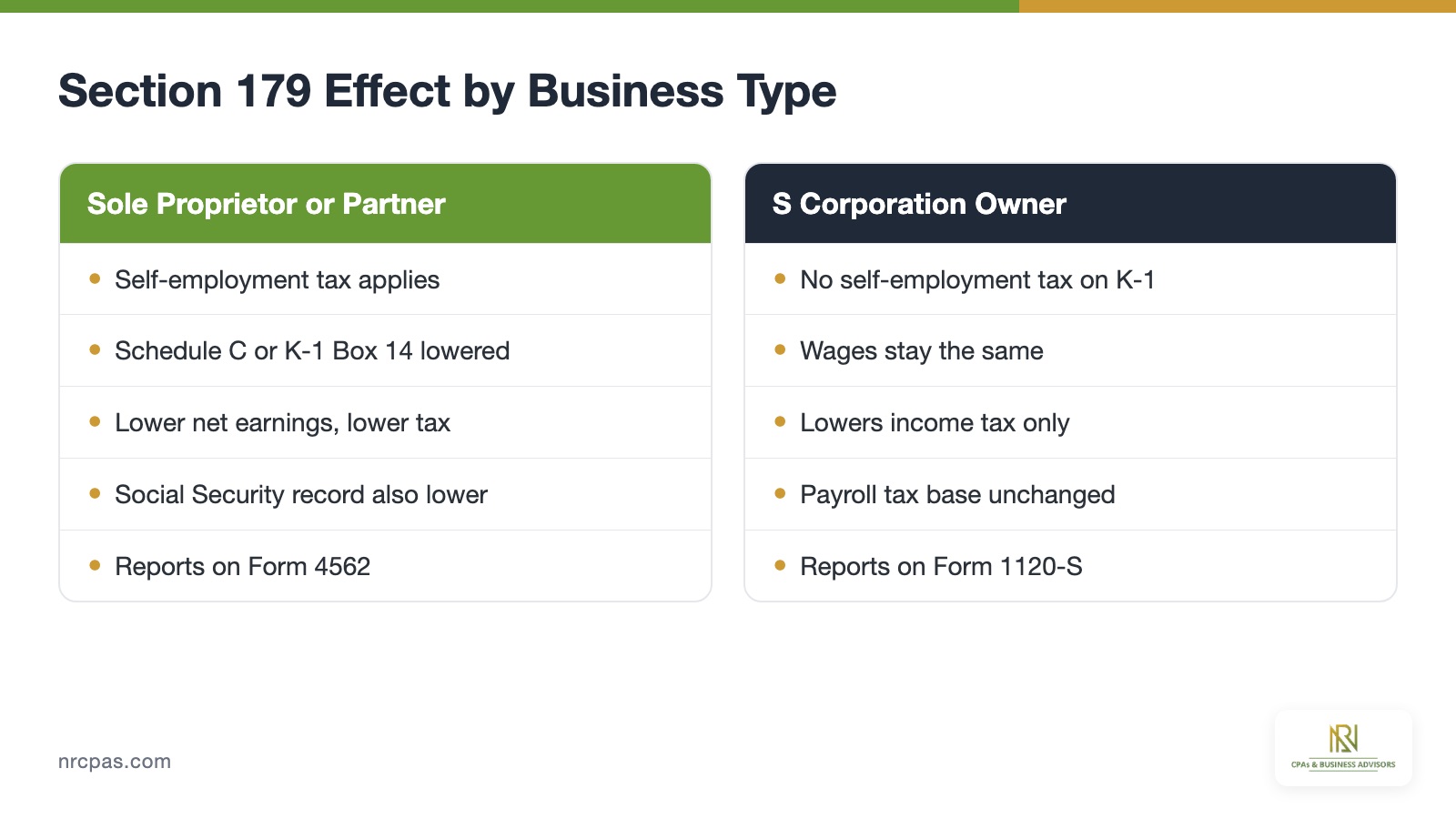
An S corporation owner pays payroll tax on wages, so the deduction lowers income tax but not payroll tax. A single-member LLC tax review shows which side of the table an owner sits on.
The entity choice also changes the payroll tax bill, beyond the deduction. Owners who weigh a corporate election can read an entity comparison of both structures. The comparison explains reasonable wages, which set the payroll tax base for an S corporation owner.
Savings alone do not justify a purchase, so the next section covers when to skip Section 179.
When Should You Skip Section 179 for Self-Employment Tax Savings?
You should skip Section 179 when the lower self-employment tax costs more elsewhere. Four tradeoffs matter most: Social Security credit, the QBI deduction, tax bracket and recapture. Each tradeoff has a clear mechanism.
The Social Security Administration (SSA) computes retirement benefits from earnings on which Social Security tax was paid. Lower self-employment earnings therefore lower the earnings record behind future benefits. Owners near the wage base lose little, while owners with thin earnings histories lose more.
The lower income also shrinks the QBI offset, which equals up to 20% of qualified business income. A $40,000 deduction can remove up to $8,000 of that QBI deduction. Income tax savings still usually exceed that loss.
Tax bracket timing matters as well. An owner in a low bracket this year can depreciate the asset over later years, when the bracket may be higher. A Section 179 planning review compares the two paths in dollars.
Recapture is the final tradeoff. The IRS requires recapture as other income when business use falls to 50% or less before the recovery period ends. The minimum holding period explains how long a vehicle must stay above that line.
Self-employed owners face several side questions beyond these four tradeoffs.
What Else Should Self-Employed Owners Know About Section 179?
Self-employed owners should know eight side topics about Section 179, answered in short form below.
Can an LLC Take a Section 179 Deduction?
An LLC can take a Section 179 deduction, because the tax return filed, not the LLC label, decides eligibility. A single-member LLC reports on Schedule C, and a multi-member LLC reports on Form 1065. An LLC that elected S corporation status reports on Form 1120-S.
Does a 179 Deduction Reduce Taxable Income?
A 179 deduction reduces taxable income, and for sole proprietors it also reduces self-employment income. The deduction lowers adjusted gross income because it lowers Schedule C profit. The lower profit changes the estimated payments an owner owes.
Is Section 179 or Bonus Depreciation Better for Self-Employed Owners?
Section 179 and bonus depreciation both reduce Schedule C profit, but they follow different limits. According to the IRS, bonus depreciation is 100% for property acquired after January 19, 2025. Bonus depreciation can create a business loss, while Section 179 cannot.
Section 179 also lets the owner pick assets one by one. Used property qualifies for both deductions, as the used asset eligibility rules show.
Is There Any Way to Reduce Self-Employment Tax Besides Section 179?
Ordinary business expenses reduce self-employment tax, because each expense lowers Schedule C profit. The half self-employment tax deduction, the self-employed health insurance deduction and retirement plan contributions lower income tax only. Only deductions that lower Schedule C profit also lower self-employment tax.
Do Estimated Tax Payments Change After a Section 179 Deduction?
Estimated tax payments fall after a Section 179 deduction, because the estimate uses lower expected profit. According to the IRS, owners generally owe estimated payments when they expect to owe $1,000 or more for the year. A mid-year purchase can drop the remaining quarterly payments.
What Assets Are Not Eligible for Section 179?
Section 179 does not cover land, buildings or property held only for investment. The deduction covers tangible personal property and certain software. Qualified real property improvements also count. The qualifying asset list covers the full set of eligible property.
How Does a Multi-Member LLC Apply Section 179 to Each Member?
A multi-member LLC applies Section 179 at the entity level first, then allocates the deduction to each member by ownership share. Each member then tests the deduction against the taxable income limit personally. A member who exceeds that limit carries the excess forward. The allocated deduction lowers each member's net earnings from self-employment on Schedule SE.
Can Landlords and Equipment Lessors Take Section 179?
Noncorporate lessors generally cannot take Section 179 on property they lease to others. The IRS allows two exceptions. One covers property the lessor manufactured. The other covers leases shorter than 50% of the property's class life. Corporations are not subject to this restriction. Estates and trusts cannot claim the deduction at all.
How Can NR CPAs Help With Section 179 and Self-Employment Tax?
We answer does Section 179 reduce self-employment income with a dollar figure for each client. The model covers the tax saving, the QBI effect and the Social Security tradeoff before a purchase order is signed. The team at NR CPAs practice is led by founder Nischay Rawal, CPA, EA. Reach the office at (305) 872-3096. Clients bring purchase quotes, prior returns and year-to-date profit. The team returns a written comparison of the deduction against depreciation alternatives.
Owners can line up each asset with its deduction through equipment purchase planning before year end.