Does G Wagon Qualify for Section 179 and How Is It Calculated

Yes, a G Wagon qualifies for Section 179 when a business uses it over 50% of the time. The SUV must also be placed in service during the tax year. The Mercedes-Benz G-Class has a 7,055 pound GVWR, so it counts as a heavy SUV. Section 179 expense is capped at $32,000 for 2026, and bonus depreciation covers the rest.
Key Takeaways
- A G Wagon must weigh more than 6,000 pounds GVWR to avoid the passenger car depreciation caps.
- The 2026 Section 179 cap on a heavy SUV is $32,000, and the 2025 cap was $31,300.
- Business use must stay above 50% for the full five-year recovery period.
- Bonus depreciation at 100% can deduct the remaining cost after the Section 179 cap.
- Business use of 50% or less triggers recapture as ordinary income.
Does G Wagon Qualify for Section 179 and How Is It Calculated?
A G Wagon qualifies for Section 179 when the business uses the SUV over 50% of the time. The SUV must be in service by December 31. The G-Class clears the weight test because its GVWR sits above 6,000 pounds. According to the Internal Revenue Service (IRS), Section 179 lets a business expense qualifying property in the purchase year. Depreciating the property slowly is the alternative.
The calculation takes four inputs: the cost basis, the business-use percentage, the $32,000 heavy SUV cap and bonus depreciation. Owners who map those inputs with vehicle tax planning before delivery avoid surprises, because the in-service date sets the tax year. The weight rating comes first, so the next section covers whether a G Wagon is over 6,000 pounds.
Is a G Wagon Over 6,000 Pounds?
A G Wagon is over 6,000 pounds by gross vehicle weight rating (GVWR), which is the weight the IRS uses. GVWR is the maximum loaded weight the manufacturer sets for the vehicle. The California Air Resources Board explains that GVWR includes the vehicle, fuel, passengers and cargo.
According to IRS Publication 946, a heavy sport utility vehicle (SUV) weighs over 6,000 and up to 14,000 pounds GVWR. Curb weight alone can mislead owners. Kelley Blue Book (KBB) lists the AMG G 63 curb weight at 5,842 pounds, which is under 6,000. The GVWR still clears the line, as the trim table below shows.
Which G Wagon Trims Are Over 6,000 Pounds?
Every current G Wagon trim is over 6,000 pounds GVWR, according to KBB listings for the 2026 model year. The table below lists the three trims and the 2026 Section 179 cap for each.
| Trim | GVWR | Over 6,000 pounds | 2026 Section 179 cap |
|---|---|---|---|
| G 550 | 7,055 pounds | Yes | $32,000 |
| AMG G 63 | 7,055 pounds | Yes | $32,000 |
| G 580 with EQ Technology | 7,716 pounds | Yes | $32,000 |
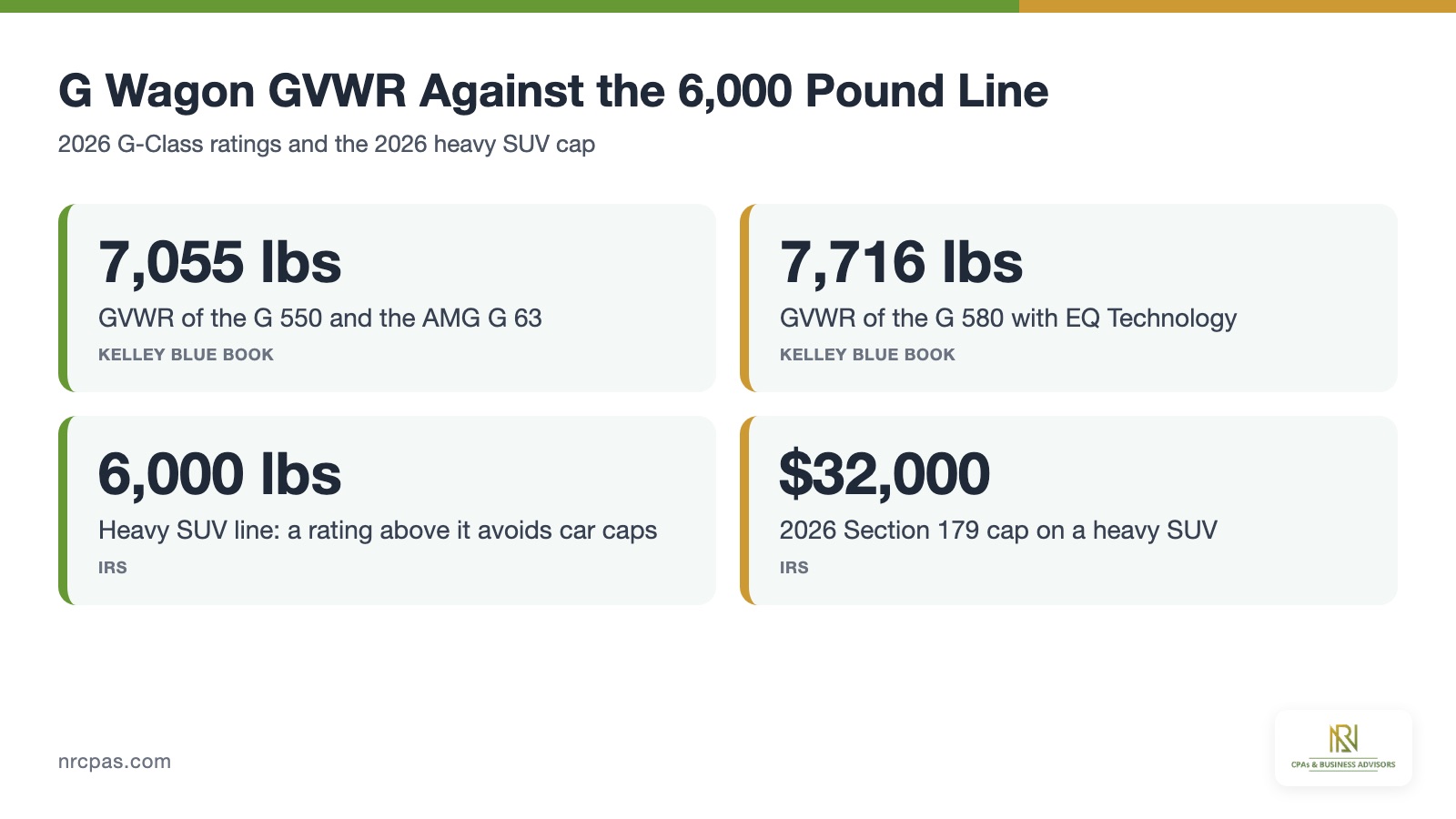
The electric G 580 is the heaviest trim. Mercedes-Benz USA lists the G 580 curb weight at 6,746 pounds, so even the unloaded SUV passes 6,000 pounds. The graphic below summarizes the weight figures used in this post.
How Do You Verify the GVWR of Your G Wagon?
Verify the GVWR of a G Wagon by reading the certification label on the driver's door jamb. The door-jamb label shows the exact rating for the vehicle in the driveway. Trim, model year and market can change the rating, so the label beats any website. Print a copy of the label for the tax file, because the rating decides the cap that applies.
How Much Can You Deduct on a G Wagon Under Section 179?
You can deduct up to $32,000 on a G Wagon under Section 179 for the 2026 tax year, according to the IRS. The IRS set the same heavy SUV cap at $31,300 for 2025. Congress sets the cap in Internal Revenue Code Section 179(b)(5), and the IRS adjusts it each year for inflation.
The heavy SUV cap sits inside a larger overall limit. According to the IRS, the 2026 Section 179 limit is $2,560,000, and the limit shrinks once purchases pass $4,090,000. The limit reaches zero at $6,650,000 of qualifying purchases. The 2025 figures were $2,500,000 and $4,000,000.
Taxable income also caps the deduction. The IRS limits Section 179 to the taxable income from the active conduct of the business, and unused amounts carry forward. Readers who want the full rules can review Section 179 basics before running numbers. The cap is only the first step, so the steps below show how the deduction is calculated.
How Is the Section 179 Deduction Calculated on a G Wagon?
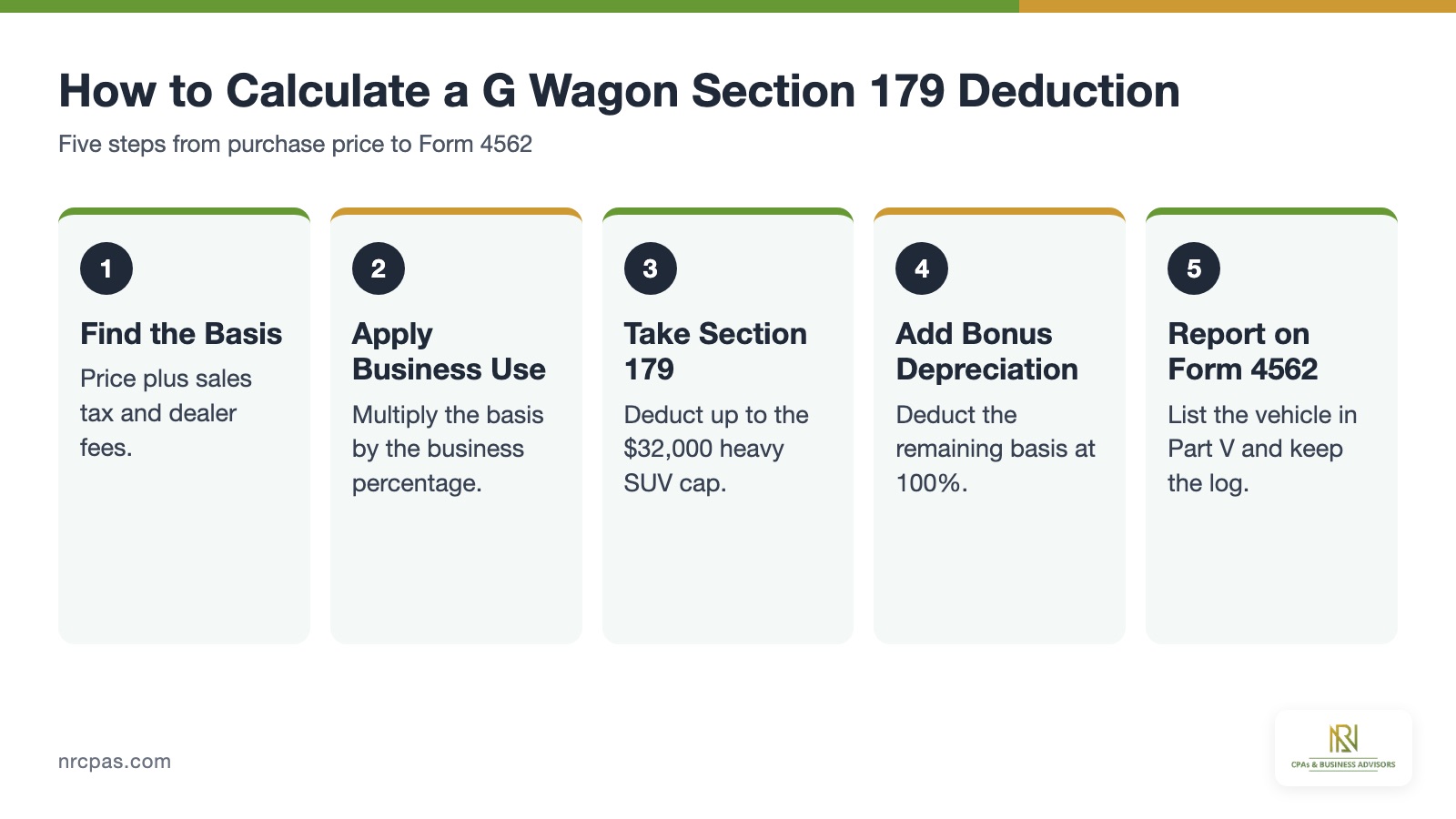
The Section 179 deduction on a G Wagon is calculated in five steps, which the numbered list below shows in order. The search "does G wagon qualify for Section 179 and how is it calculated" ends in these five steps.
- Add the purchase price, sales tax and dealer fees to find the cost basis.
- Multiply the cost basis by the business-use percentage.
- Take Section 179 on that amount, up to the $32,000 heavy SUV cap.
- Deduct the remaining basis with 100% bonus depreciation.
- Report the deduction on Form 4562, with the vehicle in Part V.
The same five steps appear in the graphic below.
A worked example shows the math. According to iSeeCars, the 2026 G 550 starts at $153,900 before destination charges. A round $150,000 basis keeps the numbers clean. The table below shows the deduction at three business-use levels.
| Business use | Deductible basis | Section 179 | Bonus depreciation |
|---|---|---|---|
| 100% | $150,000 | $32,000 | $118,000 |
| 80% | $120,000 | $32,000 | $88,000 |
| 60% | $90,000 | $32,000 | $58,000 |
Each row deducts the full deductible basis in year one. The personal share of the basis never becomes a deduction. Reporting that deduction correctly depends on Form 4562 reporting, and the bonus column needs its own explanation.
Can You Take Bonus Depreciation on a G Wagon With Section 179?
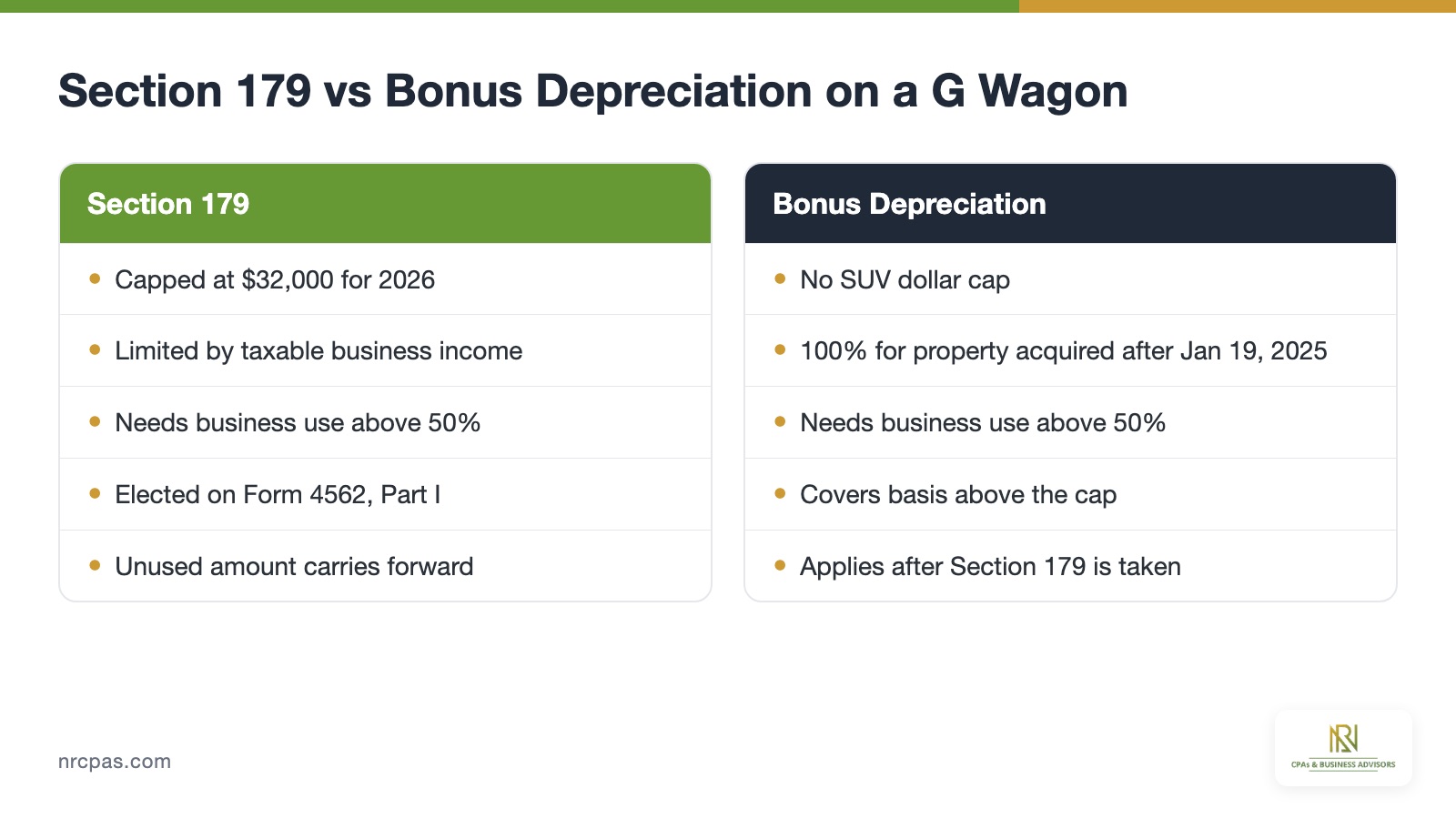
Yes, you can take bonus depreciation on a G Wagon with Section 179. The SUV cap limits only the Section 179 portion. Bonus depreciation covers the basis above the $32,000 cap. According to the IRS, Public Law 119-21 reinstated 100% special depreciation. It covers property acquired and placed in service after January 19, 2025.
Congress passed that law, known as the One Big Beautiful Bill Act, and it became law on July 4, 2025. The IRS also keeps the heavy SUV cap separate from bonus depreciation. Owners can study bonus depreciation rules for vehicles before choosing the order of the two deductions.
The comparison graphic below sets the two deductions side by side.
Can You Write Off 100% of a G Wagon in the 2026 Tax Year?
You can write off 100% of a G Wagon in the 2026 tax year with business use above 50%. The SUV must be placed in service by December 31. The 100% comes from $32,000 of Section 179 plus 100% bonus depreciation on the balance. A smaller passenger car cannot do the same, because the IRS holds its first-year deduction to $20,300 for 2026.
Timing the two deductions across the whole year is a matter of depreciation planning. Business use then becomes the deciding test, which leads to the next question about how much use a G Wagon needs.
How Much Business Use Does a G Wagon Need?
A G Wagon needs business use above 50% in the year it is placed in service, according to the IRS. Business use at or below 50% removes both Section 179 and bonus depreciation. The IRS also requires records that show business, investment and personal use of the vehicle.
A mileage log is the standard record. The bulleted list below shows what the log should hold.
- The date of each trip and the miles driven.
- The business purpose and the destination.
- Odometer readings at the start and end of the tax year.
- Total miles for business, commuting and personal use.
Commuting between home and a regular workplace counts as personal use, according to the IRS. Clean books make the log easier to defend, and monthly bookkeeping keeps vehicle costs separate from personal spending. A log protects the deduction in year one, and it also matters in later years.
What Happens If G Wagon Business Use Drops to 50% or Less?
Recapture happens when G Wagon business use drops to 50% or less during the recovery period. The IRS treats the recaptured amount as ordinary income. According to Publication 946, the owner reports it in Part IV of Form 4797 and adds the amount to the vehicle's basis.
The recovery period for a vehicle is five years under the Modified Accelerated Cost Recovery System (MACRS), according to the IRS. Selling the SUV early can also trigger recapture under Internal Revenue Code Section 1245. The holding period explains how long the vehicle should stay in the business.
Several side topics change the G Wagon deduction, and the next section answers each one in short form.
What Else Affects a G Wagon Tax Deduction?
A G Wagon tax deduction is also shaped by buyer motive, used-car rules, the 2026 law and other SUVs. The sections below answer each topic.
Why Do People Buy G Wagons for Taxes?
A G Wagon tax write-off draws buyers. People buy G Wagons for taxes because heavy SUV rules allow a first-year deduction far above the passenger car limit. A deduction lowers taxable income, but it never returns the full price of the vehicle. The vehicle must serve the business more than half the time.
The IRS car loan interest deduction does not help here. According to the IRS, that deduction of up to $10,000 covers personal-use vehicles only.
What Is the 6,000 Pound Vehicle Loophole?
The 6,000 pound vehicle loophole is the heavy SUV rule in Section 179. The rule treats vehicles over 6,000 pounds GVWR differently from passenger cars. The rule is a written part of the tax code, not a loophole. The IRS applies the same weight test to every SUV and truck.
Does a Used G Wagon Qualify for Section 179?
A used G Wagon qualifies for Section 179 when the business buys it from an unrelated seller, according to the IRS. The business must not have used the vehicle before. The same weight and business-use tests apply to a used G Wagon. Readers can review the rules for used vehicles before buying a pre-owned model.
Is Section 179 Going Away in 2026 Taxes?
No, Section 179 is not going away in 2026. The One Big Beautiful Bill Act raised the limit to $2,500,000 for 2025. The IRS then indexed the 2026 limit to $2,560,000. The latest 2026 changes explain the new thresholds.
How Does a G Wagon Compare With Other Heavy SUVs?
A G Wagon follows the same $32,000 cap as every SUV rated from 6,001 to 14,000 pounds GVWR. The cap depends on the weight rating, not on the brand. The BMW X5 rules show how a lighter SUV can land on either side of the 6,000 pound line. A G Wagon sits well above that line on every trim.
The IRS applies one rule to gas, hybrid and electric SUVs alike. Electric SUVs follow the same weight test, as the Tesla Model X page explains. Electric drive changes nothing about the cap.
Pickups work differently from SUVs. According to the IRS, a pickup with a cargo bed of six feet or more falls outside the SUV cap. The Ford F-150 page covers that pickup exception in detail.
Can You Use the Standard Mileage Rate on a G Wagon?
You cannot use the standard mileage rate on a G Wagon after claiming Section 179 or bonus depreciation, according to the IRS. The actual expense method is the only path for an expensed G Wagon. The choice is permanent for that vehicle, so the owner weighs the first-year deduction against the per-mile method before delivery.
What Happens When You Sell a G Wagon After Taking the Deduction?
Selling a G Wagon after the deduction creates ordinary income up to the depreciation taken, according to IRS Publication 544. Depreciation lowers the basis, so most of the sale price becomes gain. Section 1245 taxes that gain at ordinary rates instead of capital gain rates. A G Wagon that keeps its value produces a larger gain.
Does Leasing a G Wagon Qualify for Section 179?
Leasing a G Wagon does not qualify for Section 179 or bonus depreciation, because the lessee does not own the SUV. The lessee deducts the business share of the lease payments instead. Ownership is the condition for the first-year deduction, according to IRS Publication 463.
Is a G Wagon Tax Write-Off Free?
A G Wagon tax write-off is never free, because a deduction only cuts tax by the owner's rate. A $120,000 deduction at a 24% rate saves $28,800. The buyer still pays the rest of the price in cash. The vehicle should serve a real business need first.
How Can a CPA Help With a G Wagon Deduction?
A CPA can answer "does G wagon qualify for Section 179 and how is it calculated" for a specific purchase. A CPA can also confirm the GVWR, set the business-use percentage and time the purchase before December 31. We review the mileage log, the Form 4562 entries and the recapture risk for each client vehicle.
The team at NR CPAs office is led by founder Nischay Rawal, CPA, EA. The phone number is (305) 872-3096. A purchase reviewed before delivery avoids a missed December 31 deadline.
Owners who want a plan before the purchase can start with deduction planning.