
How to Create a DBA and File It the Right Way

How to create a DBA takes three actions: search the name, file the form, and pay the fee. The filing goes to the state or county clerk, and the Florida fee is $50. A DBA registers a trade name only and forms no company. The filing takes minutes online, and a Florida registration lasts 5 years. The owner stays personally liable, because a DBA adds no liability protection.
Key Takeaways
- A DBA (doing business as) is a registered trade name, also called a fictitious name or assumed name.
- The filing office is the state agency or the county clerk, depending on the state and the owner type.
- A Florida fictitious name costs $50 and expires on December 31 of the fifth calendar year.
- A DBA gives no liability protection, no trademark rights and no separate tax status.
- An LLC files the DBA in the LLC's name and keeps its own EIN.
How to Create a DBA Step by Step?
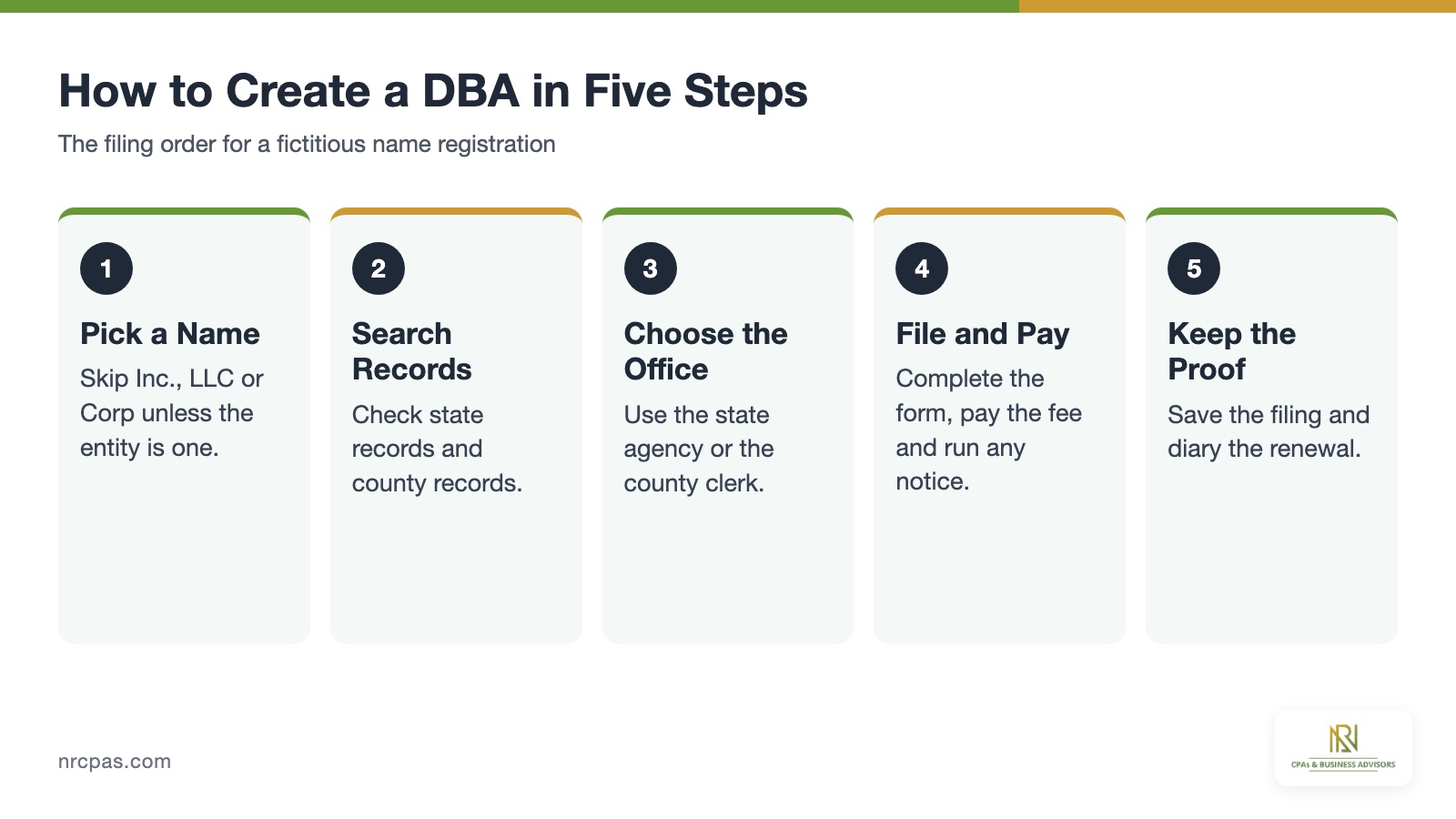
A DBA is created in five steps, listed below in filing order. The steps end with a state or county registration that makes the trade name legal for contracts, bank accounts and court filings.
- Pick a trade name that carries no Inc., LLC or Corp ending unless the business is that entity.
- Search the name in the state business database and in county records.
- Choose the filing office, either the state agency or the county clerk.
- Complete the fictitious name form, pay the fee and run the newspaper notice that states such as Florida require.
- Keep the filing proof for the bank and diary the renewal date.
The graphic below shows the five steps in the same order.
According to the U.S. Small Business Administration (SBA), registering a business usually costs less than $300 in total. The DBA portion is usually the smallest part of that bill. Owners who want a second opinion before filing can use DBA filings support from a CPA firm. Each of the five steps depends on the form, so the form comes next.
What Is a DBA Form?
A DBA form is the state or county application that registers a fictitious name for public record. The form links the trade name to the legal owner, so customers and agencies can see who stands behind the name.
According to Florida Statutes section 865.09, a Florida registration lists the information below.
- The fictitious name to register.
- The mailing address of the business.
- The name and address of each owner.
- For an entity, its Florida document number and its federal employer identification number (EIN).
- A certification that the name was advertised once in a county newspaper.
Other states ask for the same core data in different layouts. A DBA form is not a tax form, and the Internal Revenue Service (IRS) never receives it. The filing office decides where the form goes, as the next section shows.
Where Do You File a DBA?
A DBA is filed with the state agency, the county clerk or both, depending on the state and the owner type. Sole proprietors file at the county level in New York and Texas, while entities file with the state. The table below compares 4 states in 4 columns.
| State | Filing office | Fee | Term |
|---|---|---|---|
| Florida | Division of Corporations | $50 | To December 31 of the 5th year |
| Texas | Secretary of State for entities, county clerk for sole proprietors | $25 at the state | Up to 10 years |
| New York | County clerk for sole proprietors, Department of State for entities | Set by the county | No fixed end date |
| California | County clerk | Set by the county | 5 years |
The Florida, Texas and New York rows show how far the offices differ. According to the Texas Secretary of State, Form 503 costs $25 for an assumed name certificate. Each county sets its own fee when the clerk handles the filing, so a call to the clerk confirms the amount.
A trade name filed at the wrong office leaves the owner unregistered. That risk matters most for an LLC, which has a second set of filings to track.
How to Set Up a DBA Under an LLC?
How to set up a DBA under an LLC starts with an active LLC, since the DBA uses the LLC's legal name. The LLC keeps its EIN, its liability shield and its tax status after the DBA is added.
The filing lists the LLC's exact name, its state document number and the new trade name. In Florida, the Division of Corporations requires the LLC to be in active status before it accepts the registration. An LLC that skips its annual report can lose that status.
The LLC itself costs more to keep than the DBA does. According to the Florida Division of Corporations, articles of organization cost $125. The annual report costs $138.75 between January 1 and May 1. A late report adds a $400 fee. Readers who want the paperwork basics can compare articles of organization with the corporate version.
One LLC can hold several trade names. Each name needs its own registration, its own fee and its own renewal date on the compliance calendar. Owners can read how multiple DBAs multiply the renewal dates. The New York process splits its filings by owner type, as the next section shows.
How to Set Up a DBA in NY?
How to set up a DBA in NY depends on the owner type. The filing splits between county clerks and the state. A New York sole proprietor files a business certificate with the county clerk. A corporation or LLC files a certificate of assumed name with the New York Department of State.
Some entities need county filings as well. The county clerk's instructions should be read before the state form is sent. New York registrations carry no fixed end date. The owner still files a discontinuance when the name goes out of use.
The New York process differs from the Florida process in one more way. Florida adds a newspaper notice, and Florida also attaches a hard deadline to the term.
How Long Does a DBA Last and What Does Renewal Cost?
A DBA lasts for the term the state sets. A Florida fictitious name lasts until December 31 of the fifth calendar year. A Florida renewal costs $50 and opens on January 1 of the expiration year, according to the Florida Division of Corporations.
A lapsed Florida registration expires, and the Division removes it from the record. Florida also requires a cancellation within 30 days after the owner stops using the name. The cancellation filing costs $50 as well.
The graphic below lists the Florida figures for the fee, the term, the renewal and the cancellation.

A renewal date belongs on the same calendar as the annual report and the tax deadlines. Dates matter on tax paperwork too, and the next section covers that paperwork.
What Is DBA on Tax Form 1040 Schedule C?
The DBA on tax form 1040 Schedule C is the business name the owner trades under, entered on line C. The DBA is a label on the form and carries no tax of its own. According to the IRS, a sole proprietor reports profit or loss from the business on Schedule C.
The IRS Form W-9 asks for the same name. According to the IRS, a business name, trade name or DBA name goes on line 2 of Form W-9. The owner's legal name still goes on line 1.
Self-employment tax applies to the profit, whatever the trade name. According to the IRS, the rate is 15.3%, made of 12.4% for Social Security and 2.9% for Medicare. The IRS applies the tax once net earnings reach $400, and the rate applies to 92.35% of those earnings.
According to the Social Security Administration (SSA), the Social Security portion stops at $184,500 of 2026 earnings. LLC members can compare LLC owner self-employment rules before they choose a structure. Tax status comes from the entity, and the side topics below cover the other filings around a DBA.
What Else Should You Know Before You File a DBA?
A DBA filing touches an EIN, a bank account, a trademark search and an entity choice. The sections below answer each of those side topics in short form.
How to Start a DBA With a Name That Is Available?
How to start a DBA with an available name begins with a search of state records, county records and federal trademarks. A DBA filing does not reserve a name, according to Florida Statutes section 865.09. Others can still use the name.
A trademark search stops a forced rebrand later. According to the U.S. Patent and Trademark Office (USPTO), the base application fee is $350 per class. The search itself costs nothing, and domain and social handles belong in the same check.
How Do I Set Up a DBA With No LLC?
How do I set up a DBA with no LLC is answered by the sole proprietor route. The trade name is filed in the owner's personal name. The owner stays personally liable for the business after the filing.
A sole proprietor who trades under the full legal name files nothing, according to the SBA. A sole proprietor DBA is required only when the name differs from the legal name. The Census Bureau counted 30.4 million nonemployer businesses in 2023, with $1.8 trillion in receipts.
Do You Need an EIN for a DBA?
A DBA does not need its own EIN, because a DBA is a name and not an entity. The EIN belongs to the owner or the LLC that holds the DBA. According to the IRS, an EIN is free, and a business entity should have only one.
The IRS requires an EIN for employees, excise taxes and entities such as LLCs. An LLC EIN covers every DBA the LLC registers.
A second trade name therefore needs no second number, and a second brand adds no second IRS record. Owners with several brands can read why the same EIN serves every name.
How to Open a DBA Bank Account?
How to open a DBA bank account starts with the filing proof, the owner's identification and the EIN or Social Security number. Banks ask for the stamped registration before they open an account in the trade name.
The same paperwork supports credit. Owners can read how a business credit card works with an EIN. A DBA account still carries personal liability for a sole proprietor.
How to Form a DBA Instead of an LLC?
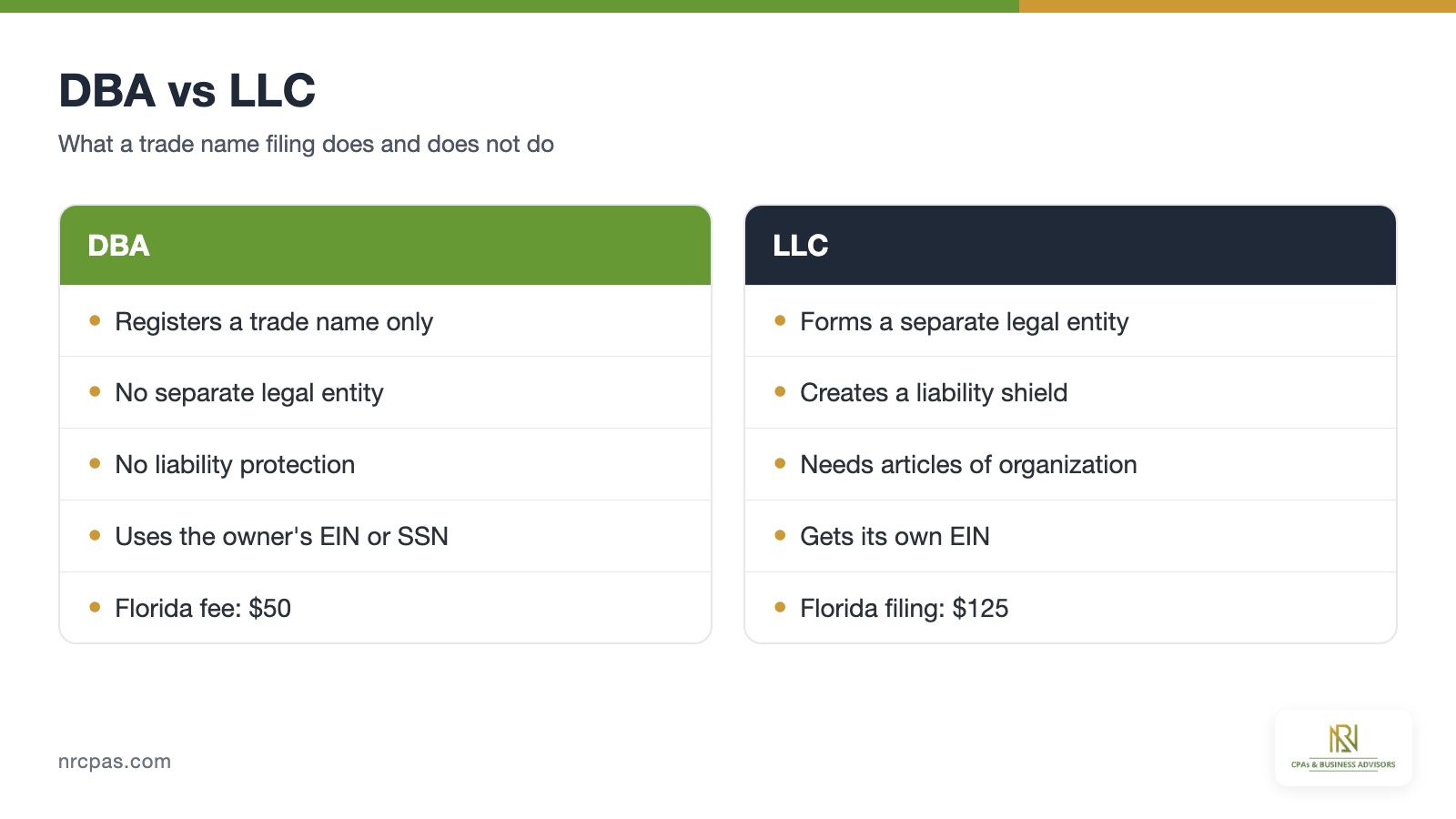
How to form a DBA instead of an LLC is a file-only route. The DBA registers a name, while the LLC forms a company. A DBA creates no separate legal entity, so the owner's personal assets stay exposed.
A DBA does not work like a company, and the answer on a separate legal entity is no. The comparison graphic below lines up a DBA and an LLC.
An owner who outgrows the DBA files the LLC later and moves the business into it. A filing team such as formation services can prepare the articles of organization and the operating agreement for the new company.
The conversion steps, from the new EIN to the name cancellation, appear in a guide on a DBA to LLC switch.
What Happens If You Skip a Required DBA Registration?
A business that skips a required DBA registration loses access to court in some states. Florida bars an unregistered business from filing suit until the owner registers, according to Florida Statutes section 865.09.
The same statute lets an unregistered business defend a lawsuit and keeps contracts valid. Florida also treats the violation as noncriminal and sets the penalty in its general statute. Registration closes the gap in minutes.
Can the Startup Costs of a DBA Be Deducted?
The startup costs of a DBA can be deducted, because a filing fee is a business expense. According to the IRS, a new business can deduct up to $5,000 of startup costs in the first year. The IRS spreads the rest over 180 months.
The $5,000 amount shrinks once total startup costs pass $50,000. The election is made on the first-year return. Early advice from tax advisers keeps the election on time.
How Can a CPA Firm Help With a DBA Filing?
A CPA firm can check the name, choose the filing office and match the DBA to the entity and tax setup. We handle that work for new owners, and the firm is led by founder Nischay Rawal, CPA, EA. Phone (305) 872-3096 reaches the office.
The guides from NR CPAs learning cover each filing step, from the name search to the bank account and the renewal.
Owners with filing questions about how to create a DBA in their state can use business formation services from the same team.