What Is a Cash Basis Balance Sheet and How Does It Differ From Accrual Basis


A cash basis balance sheet reports assets, liabilities and equity using only cash that has moved in or out. The cash basis balance sheet leaves out accounts receivable and accounts payable, because unpaid invoices and bills are not recorded. The accrual basis balance sheet records both, and GAAP requires the accrual version.
Key Takeaways
- A cash basis balance sheet records an item only when cash is received or paid.
- Accounts receivable, accounts payable and accrued expenses never appear on a cash basis balance sheet.
- GAAP does not allow the cash basis, but private companies can use a special purpose framework.
- The IRS sets the cash method limit at $32 million of average gross receipts for 2026 tax years.
- Switching from cash to accrual requires Form 3115 and a Section 481(a) adjustment.
What Is a Cash Basis Balance Sheet?
A cash basis balance sheet is a snapshot of what a business owns, owes and holds in equity. The snapshot comes from cash receipts and cash payments only. The statement counts money after it arrives or leaves. A $5,000 customer invoice stays off the page until the customer pays. An unpaid vendor bill stays off until the check clears.
A cash accounting balance sheet therefore shows the bank balance, the equipment already paid for and the loans still open. The page is short, which is why sole proprietors and small service firms favor it.
Short pages still need correct line items, and cash-basis statements from a CPA keep every line tied to the bank records. The next question is which lines make the cut.
What Does a Cash Basis Balance Sheet Include and Exclude?
A cash basis balance sheet includes cash, fixed assets, loans payable and owner's equity. The statement excludes every unpaid or unbilled item. Included lines have already moved through a bank account. The bulleted list below names the lines that appear.
- Cash on hand, checking accounts and savings accounts.
- Equipment, vehicles and furniture purchased with cash or financed with a loan.
- Loans payable, credit card balances and mortgages still open.
- Owner's equity, including capital contributions and cumulative net income.
Excluded lines are the ones that wait on a future payment. Accounts receivable, accounts payable, accrued wages, prepaid expenses and unearned revenue all stay off the page. Each excluded line returns on an accrual statement, so the layout of the full statement comes next.
What Does a Cash Basis Balance Sheet Look Like?
A cash basis balance sheet looks like a two-sided statement where total assets equal total liabilities plus equity. The example below uses a consulting firm with $42,000 in cash. The table sets the cash basis column beside the accrual column for the same firm on the same date.
| Line item | Cash basis | Accrual basis |
|---|---|---|
| Cash | $42,000 | $42,000 |
| Accounts receivable | Not recorded | $15,000 |
| Equipment, net | $18,000 | $18,000 |
| Total assets | $60,000 | $75,000 |
| Accounts payable | Not recorded | $9,000 |
| Loan payable | $12,000 | $12,000 |
| Owner's equity | $48,000 | $54,000 |
Equity differs by $6,000, which equals $15,000 of receivables minus $9,000 of payables. Both statements balance, because each one applies its own rules to the same business.
Building the cash column takes five steps, listed below in the order a bookkeeper follows them.
- Reconcile every bank, credit card and loan account to its statement balance.
- List fixed assets bought with cash or financed, at cost less depreciation.
- List loans and credit card balances still owed on the report date.
- Skip every unpaid invoice, unpaid bill, accrual and prepaid balance.
- Set owner's equity equal to total assets minus total liabilities.
Equity falls out of the last step as a balancing figure. That balancing figure is also where cash and accrual statements begin to split.
How Does a Cash Basis vs Accrual Basis Balance Sheet Differ?
The cash basis vs accrual basis balance sheet difference is timing. Cash basis waits for payment, while accrual basis records items when earned or incurred. Receivables, payables and accruals are the three lines that separate the two statements. The graphic below lines up both versions.

An accrual basis balance sheet adds the amounts customers owe, the amounts the business owes and the costs incurred but unpaid. A balance sheet accrual basis report also shows prepaid items as assets. A $12,000 annual insurance premium shrinks by $1,000 each month. The cash version expenses the full $12,000 on payment day.
Payment day, not usage, therefore moves equity under the cash method. The balance sheet basics explain how that equity change flows into the profit and loss statement. Accrual rules then bring up the GAAP question.
Does GAAP Allow a Cash Basis Balance Sheet?
No, GAAP does not allow a cash basis balance sheet. Generally Accepted Accounting Principles (GAAP) require accrual accounting. The accrual basis matches revenue and expenses to the period they belong to. The Financial Accounting Standards Board (FASB) writes those principles.
Private companies still have options outside GAAP. The American Institute of Certified Public Accountants (AICPA) recognizes special purpose frameworks. These include the cash basis, a modified cash basis and the income tax basis. The AICPA also released its Financial Reporting Framework for Small- and Medium-Sized Entities on June 10, 2013.
A CPA must label the framework on the face of the statements. Lenders then decide which framework they accept. According to the Federal Reserve Banks' Small Business Credit Survey, 60% of firms applied for financing in the prior 12 months. Of those applicants, 42% received the full amount.
Financing applications raise the question of which businesses may use the cash method in the first place.
Who Can Use the Cash Method for a Balance Sheet?
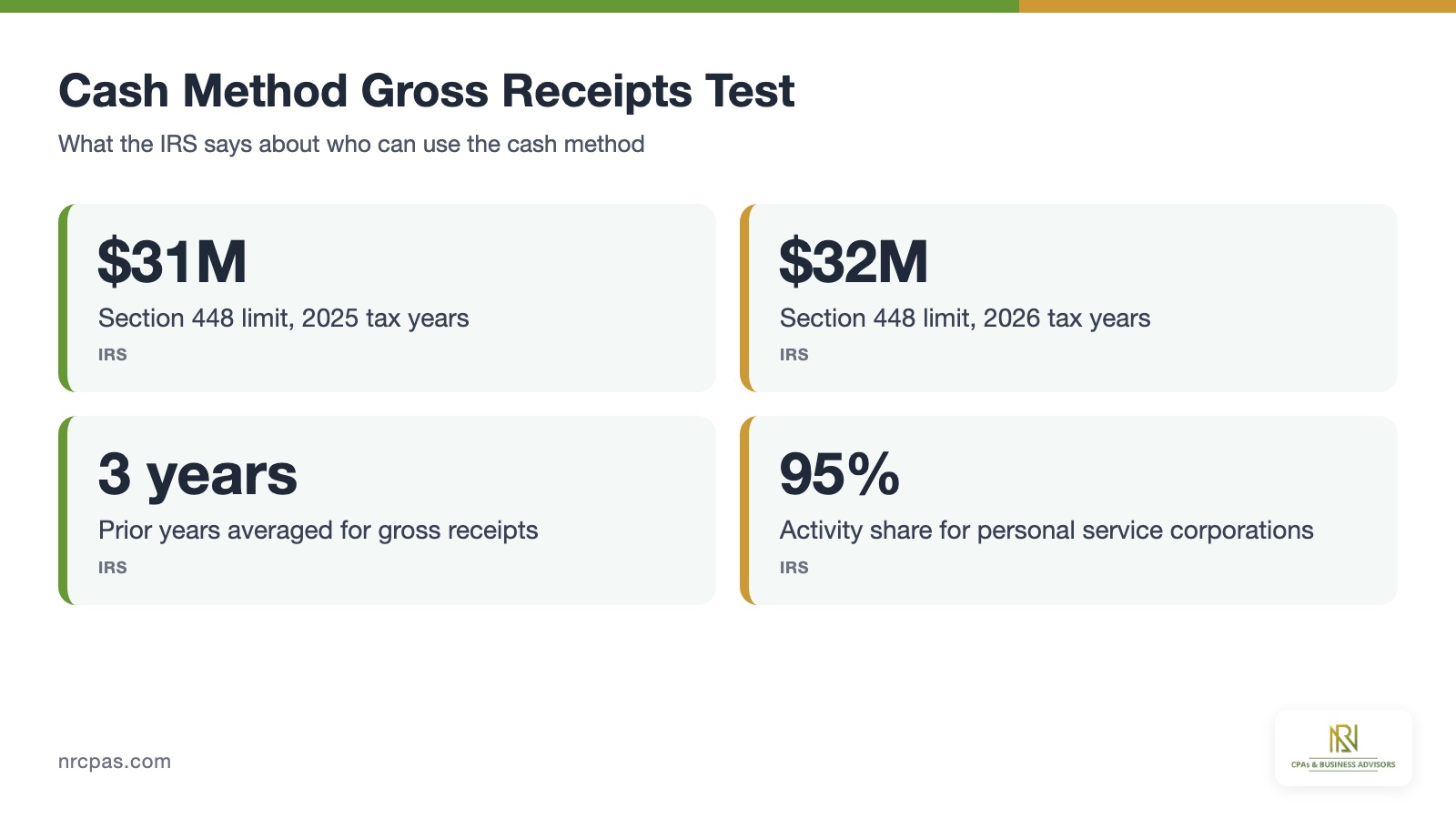
Sole proprietors, S corporations and entities under the gross receipts test can use the cash method. According to the Internal Revenue Service (IRS), the Section 448 gross receipts test is $31 million for 2025 tax years. The test rises to $32 million for 2026 tax years.
According to the IRS, the test averages gross receipts for the 3 prior tax years. A corporation or partnership with a C corporation partner above the limit must use the accrual method. Tax shelters cannot use the cash method at all.
Inventory adds a second condition. According to the IRS, a business that needs inventory to show income generally uses accrual for purchases and sales. Small business taxpayers under the gross receipts test can skip formal inventory accounting.
The IRS also exempts qualified personal service corporations, which need 95% of activities in fields such as health, law, accounting and consulting. The IRS requires every business to use the same method year after year. Method change planning therefore belongs before the first return, not after it.
The graphic below pulls the gross receipts test figures into one view before the tax basis version.
What Is a Tax Basis Balance Sheet?
A tax basis balance sheet reports assets, liabilities and equity using the same rules as the federal tax return. Tax basis balance sheet preparation starts from the Schedule L balance sheet and the tax depreciation schedule. Equity ties to the cumulative taxable income on past returns.
A tax basis balance sheet can be cash based or accrual based, because the return itself uses one of those two methods. A bakery on the accrual method for taxes shows receivables and payables on its tax basis balance sheet. A cash-method plumber shows neither.
Depreciation is the other split. Tax basis statements carry equipment at cost less tax depreciation, which includes Section 179 expensing. GAAP statements use straight-line schedules, so book and tax values drift apart.
According to the IRS, an S corporation with total receipts and year-end assets both under $250,000 skips Schedules L and M-1. Larger filers report the balance sheet on the return. Statement links then show how that balance sheet connects to the income statement and cash flow statement.
What Else Should Owners Know About Cash and Accrual Balance Sheets?
Cash and accrual balance sheets raise side questions about conversions, drawbacks, small business fit, classified layouts and nonprofit reporting. The sections below answer each one in short form.
How Do You Convert a Cash Basis Balance Sheet to Accrual?
Convert a cash basis balance sheet to accrual by adding receivables, payables, accruals and prepaid balances. Equity then moves by the net amount. The list below shows the steps in order.
- List unpaid customer invoices and add them as accounts receivable.
- List unpaid vendor bills and add them as accounts payable.
- Add accrued wages, utilities and interest through the report date.
- Move prepaid costs and customer deposits to prepaid assets and unearned revenue.
- Adjust equity by the net of all added assets and liabilities.
The conversion in the earlier table raised equity by $6,000. Tax conversions require Form 3115 and a Section 481(a) adjustment. According to the IRS, a negative adjustment is generally taken in 1 year. A positive adjustment is generally spread over 4 years.
The graphic below shows the five conversion steps.

What Are the Disadvantages of a Cash Basis Balance Sheet?
The disadvantages of a cash basis balance sheet are hidden obligations, hidden assets and timing distortions. A business can look cash rich while owing large unpaid bills. The bulleted list below shows the main gaps.
- Unpaid bills do not appear, so liabilities look smaller than they are.
- Earned but unbilled work does not appear, so assets look smaller than they are.
- Paying bills early or late shifts equity from one period to the next.
- Lenders and buyers cannot compare the statement against GAAP peers.
Those gaps explain why a growing business outgrows the cash basis. The same gaps affect how a CFO accrual review reads monthly numbers.
Is a Cash Basis or Accrual Basis Balance Sheet Better for a Small Business?
A cash basis accounting balance sheet suits a small business with no inventory, no credit sales and no GAAP requirement. An accrual basis balance sheet suits a business that sells on credit, carries inventory or seeks outside capital. The SBA Office of Advocacy counts 36.2 million small businesses, which employ almost 46% of private-sector workers.
Those firms can use either method. The accrual basis balance sheet gives better numbers for lenders, while the cash version gives easier numbers for the owner. Owners who watch cash visibility weekly catch unpaid bills before the due date. The IRS also allows a hybrid method that keeps inventory on accrual and everything else on cash.
Where Do Current Assets Sit on a Cash Basis Balance Sheet?
Current assets on a cash basis balance sheet consist of cash and bank balances, because receivables and prepaids are not recorded. A classified layout groups them above long-term assets. The current asset accounts on an accrual statement run longer.
A classified layout splits both sides into current and long-term sections. Current liabilities on the cash version hold only loan payments due within 12 months and open credit card balances.
Why Does a Cash Basis Balance Sheet Show Different Profit From Accrual?
A cash basis balance sheet shows different profit from accrual because equity carries cumulative net income, and net income differs by method. Profit on the cash method follows deposits and payments. Profit and cash movement are closer under the cash method, but they are still not identical. Loan principal and equipment purchases move cash without touching profit.
The gap between profit versus cash gets its own reconciliation on the cash flow statement.
Can a Nonprofit Use a Cash Basis Balance Sheet?
Yes, a nonprofit can use a cash basis balance sheet, unless a funder, lender or auditor requires GAAP. According to the IRS, gross receipts under $200,000 and assets under $500,000 allow Form 990-EZ instead of Form 990. Small nonprofit financials can start on the cash basis and move to accrual as grants and pledges grow.
Who Can Prepare a Cash Basis Balance Sheet for a Small Business?
A CPA firm can prepare a cash basis balance sheet, a tax basis balance sheet or an accrual basis balance sheet. All three come from the same bank and loan records. We build each format, and the lender decides which one fits.
The team at NR advisors is led by founder Nischay Rawal, CPA, EA. Reach the office at (305) 872-3096.
Each engagement starts with bank reconciliations, loan schedules and a review of the last filed return, so opening balances are correct. Owners who need an accrual conversion or lender-ready tax-basis financials can start with the financial statement team.