Cash Flow vs Income Statement and How Each One Is Used

Cash flow vs income statement comes down to timing. The income statement reports profit when revenue is earned and expenses are incurred. The cash flow statement reports cash only when money moves. A business can show a profit on one and a falling bank balance on the other. Each statement answers a different question, and lenders and investors read them for different reasons.
Key Takeaways
- The income statement measures profit on an accrual basis over a period, from revenue down to net income.
- The cash flow statement measures actual cash in and out, grouped into operating, investing and financing activities.
- Receivables, inventory, depreciation, loan principal and owner draws explain the gaps between profit and cash.
- Lenders lean on cash from operations, while growth investors lean on revenue and margin trends.
- Reviewing both statements monthly catches a profit-versus-cash gap before payroll is at risk.
What Is the Difference in Cash Flow vs Income Statement?
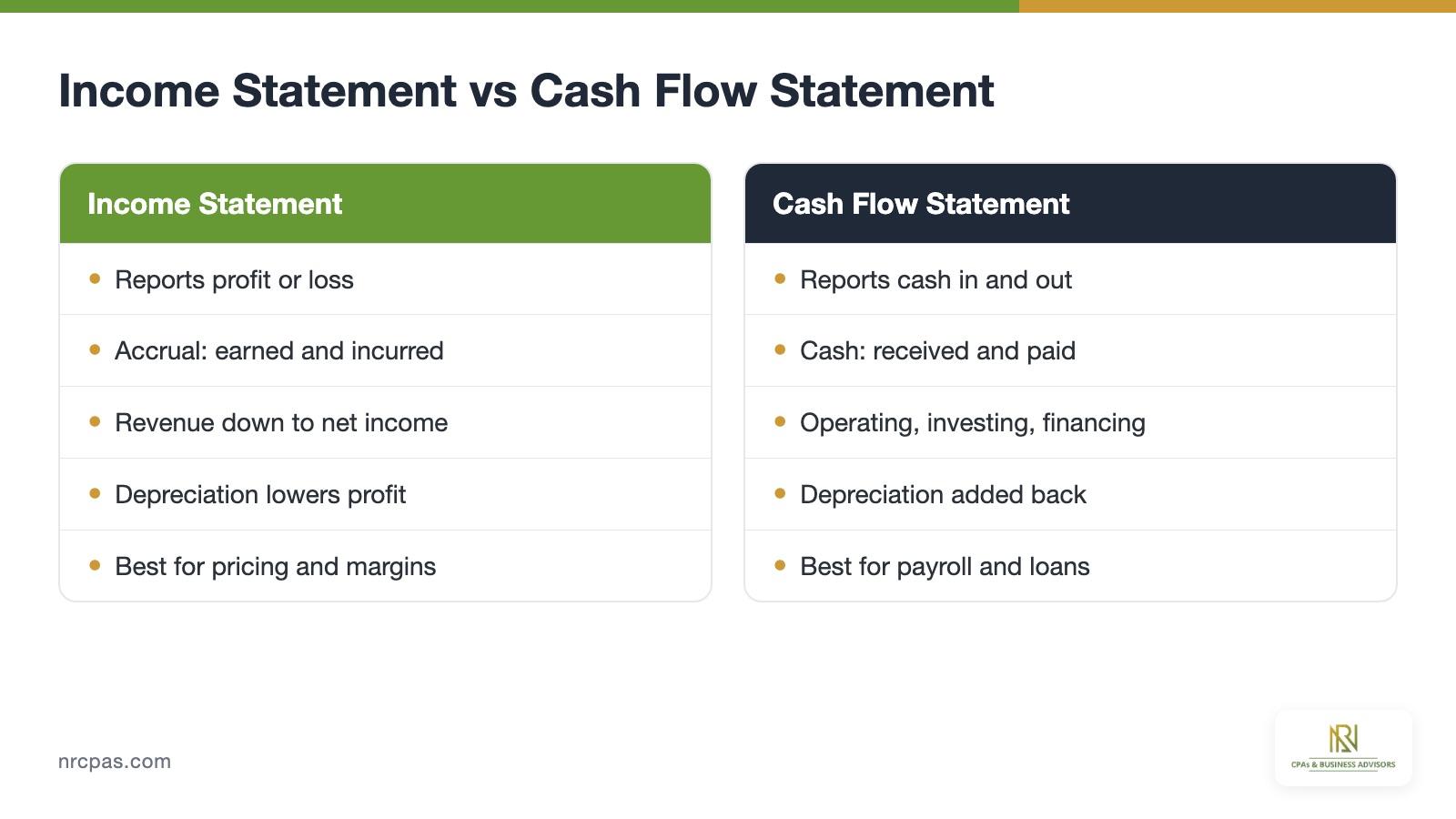
The difference in cash flow vs income statement is the basis of measurement. The income statement counts earned profit, and the cash flow statement counts cash received and paid. The income statement answers whether the business made money, and the cash flow statement answers whether the business has cash. Both cover the same period and draw on the same ledger.
The income statement is also called the profit and loss statement, or P&L. The cash flow statement is formally the statement of cash flows. Each one ends in a different bottom line, as the table below shows.
| Feature | Income statement | Cash flow statement |
|---|---|---|
| Core question | Did the business earn a profit? | Did cash rise or fall, and why? |
| Accounting basis | Accrual: earned and incurred | Cash: received and paid |
| Covers | A period, such as a month or year | The same period |
| Starting line | Revenue | Net income (indirect method) |
| Sections | Revenue, cost of sales, expenses, net income | Operating, investing, financing |
| Bottom line | Net income or net loss | Net change in cash |
| Depreciation | Reduces profit | Added back, no cash leaves |
| Loan principal | Not shown, only interest | Financing outflow |
The table shows two statements built from one set of books. Owners who need both on a fixed schedule can hand financial statement reporting to a CPA firm. The graphic below lines up the two statements side by side.
According to the U.S. Small Business Administration (SBA) Office of Advocacy, the country has 36.2 million small businesses. Each one can produce both statements from its books, and the gap between them begins with accrual timing.
Why Do Profit and Cash Flow Show Different Numbers?
Profit and cash flow show different numbers because accrual accounting records revenue when earned. Cash accounting records money when it moves. According to the Internal Revenue Service (IRS), the accrual method reports income in the year earned, regardless of when payment is received. The cash method reports income in the year received.
The difference between income statement and cash flow statement results therefore starts with the calendar. A consulting firm that finishes a $30,000 project in March books $30,000 of March revenue. The client pays in May, so the cash flow statement records the $30,000 two months later.
The graphic below traces that $30,000 from the March invoice to the May deposit.

The timing gap also runs the other way. A client that prepays a $12,000 annual retainer in January puts $12,000 into the bank at once. The income statement then recognizes only $1,000 of revenue each month. Revenue timing rules like these are covered in accrual revenue recognition.
Revenue is only one half of the income statement. Expenses follow the same accrual logic, and that is the second source of the gap.
Which Expenses Reduce Profit Without Reducing Cash?
Depreciation and amortization reduce profit without reducing cash in the same period. A $60,000 machine bought for cash in year one hits the bank balance in year one. Depreciation then spreads that cost across the machine's useful life, say 5 years at $12,000 per year.
Each year's $12,000 lowers net income but sends no cash out the door. The cash flow statement adds the $12,000 back, which is why operating cash can exceed net income. The next sections show what each statement reports in full.
What Does an Income Statement Tell You?
An income statement tells you whether revenue exceeded expenses during a period, and by how much. It reports performance as profit or loss, never as a cash balance. The layout runs from the top line down to the bottom line.
- Revenue, the total earned from customers.
- Cost of goods sold or cost of services, the direct cost of delivering the work.
- Gross profit, which is revenue minus direct cost.
- Operating expenses, such as rent, payroll and software.
- Interest and income taxes.
- Net income, the bottom line.
Owners use those six lines to judge pricing, margins and cost control. A business with $600,000 of revenue and $510,000 of total expenses earns $90,000 of net income, a 15% net margin. Margin trends across months show whether growth is profitable.
The income statement still leaves one gap. It cannot say whether the $90,000 sits in the bank, which is the job of the next statement.
What Does a Cash Flow Statement Tell You?
A cash flow statement tells you how much cash entered and left the business during a period, and which activity moved it. It reports the net change in cash and ties to the cash balance on the balance sheet. The statement groups every cash movement into three categories.
- Operating activities: cash from customers, minus cash paid to suppliers, employees and the IRS.
- Investing activities: cash spent on or received from equipment, property and long-term investments.
- Financing activities: cash from loans, loan principal repaid, owner contributions and owner draws.
According to the Financial Accounting Standards Board (FASB), Accounting Standards Codification (ASC) 230 requires those three categories. FASB also defines cash equivalents as short-term investments with an original maturity of three months or less. Those equivalents count as cash on the statement.
Net income is the first line of the operating section under the indirect method. Operating cash flow is where profit meets cash, and a worked example shows how a profitable business can still run short.
How Can a Profitable Business Still Run Out of Cash?
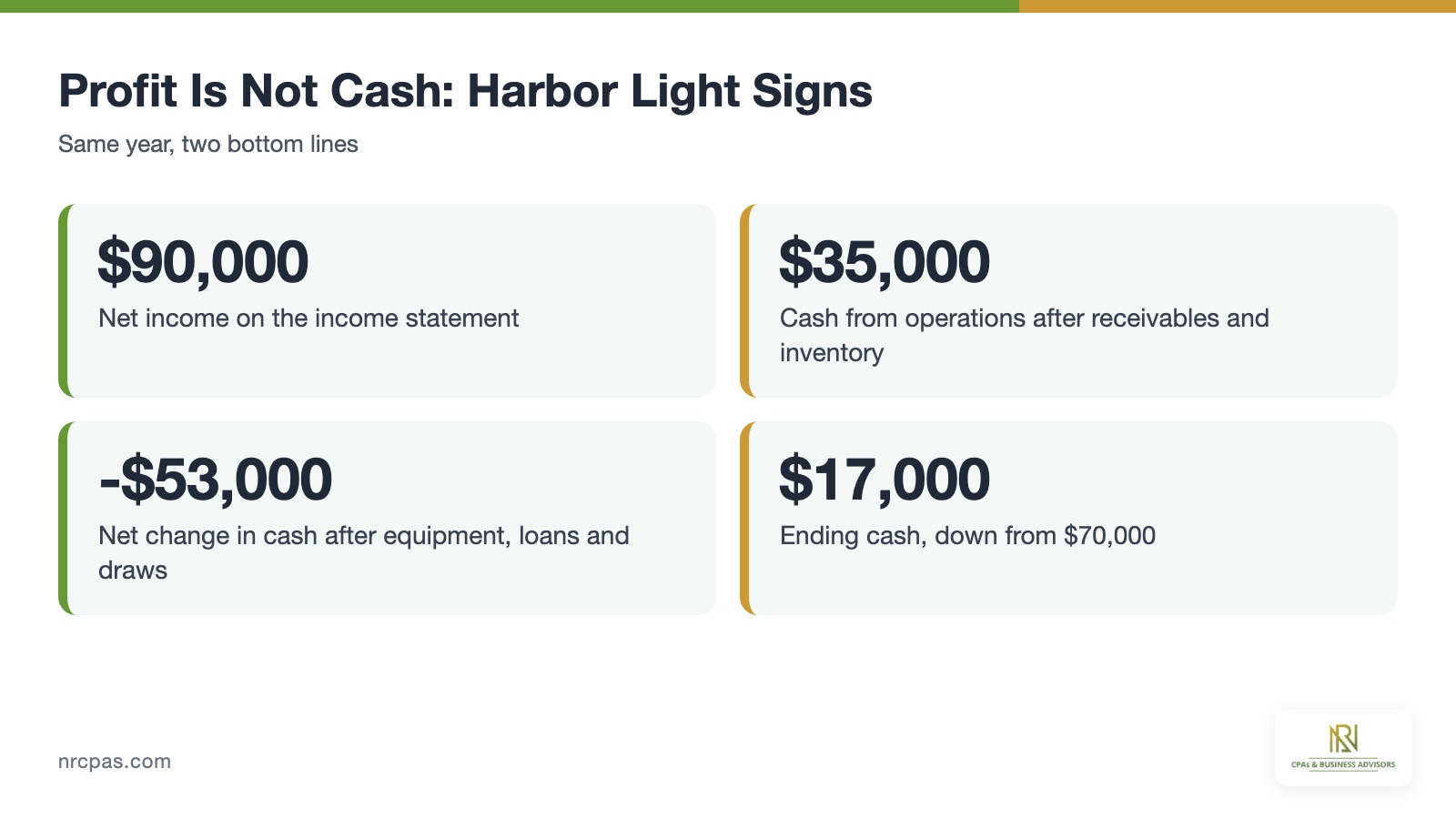
A profitable business runs out of cash when receivables, inventory, equipment, loans and owner draws absorb more cash than profit supplies. Profit is an accounting result, while cash is what pays payroll. The table below follows a sign shop with $90,000 of net income.
| Line item | Amount | Why it differs from profit |
|---|---|---|
| Net income | $90,000 | Starting point, accrual basis |
| Depreciation | +$12,000 | Expense with no cash outflow |
| Increase in receivables | -$55,000 | Sales booked, cash not yet collected |
| Increase in inventory | -$20,000 | Cash spent on unsold stock |
| Increase in payables | +$8,000 | Expenses booked, bills not yet paid |
| Cash from operations | $35,000 | Subtotal of the operating section |
| Equipment purchase | -$40,000 | Investing outflow, not an expense |
| Loan principal repaid | -$18,000 | Financing outflow, not an expense |
| Owner draws | -$30,000 | Financing outflow, not an expense |
| Net change in cash | -$53,000 | Bottom line of the cash flow statement |
Harbor Light Signs began the year with $70,000 in the bank and ended with $17,000. Profit was $90,000 on the income statement, while cash fell $53,000 on the cash flow statement. The graphic below shows both bottom lines together.
Cash trouble of this kind appears in small firm survey data. According to the Federal Reserve Banks Small Business Credit Survey, 51% of employer firms cited uneven cash flow as a financial challenge. The survey drew on 7,653 responding firms in late 2024, and 56% of them cited paying operating expenses.
Owners who spot the pattern early can start cash flow improvement work before the bank balance drops. The statement a reader checks first depends on who is reading.
Which Lenders and Investors Read Which Statement?
Lenders and investors each read the statement that answers their own risk question. Lenders start with cash flow, and growth investors start with the income statement. The table below maps six common readers to the number each one pulls.
| Reader | Checks first | Number or test |
|---|---|---|
| Bank term lender | Cash flow statement | Cash from operations against loan payments |
| SBA lender | Both, plus a debt schedule | Debt schedule tied to the statements |
| Equity investor | Income statement | Revenue growth and gross margin |
| Business buyer | Income statement, then cash flow | Earnings and cash conversion |
| IRS | Income statement basis | Gross receipts and net profit on the return |
| Vendor or landlord | Cash flow statement | Ability to pay on due dates |
A bank compares cash from operations with scheduled loan payments, because loans are repaid in cash. According to the SBA, the 7(a) program lends up to $5 million through participating lenders. The SBA 7(a) checklist asks for a business debt schedule that matches the latest financial statements.
Lenders also want proof that customers pay on time. According to the SBA, its working capital line of credit pilot expects receivables and payables aging reports. A profitability consulting review before a loan application often cleans up those reports.
Public investors read all three statements by law. According to the Securities and Exchange Commission (SEC) Regulation S-X, public companies file income and cash flow statements for 3 fiscal years. Balance sheets cover 2 years, and smaller reporting companies file 2 years of each.
The readers differ, so the decisions behind each statement differ too.
When Should You Use the Income Statement and When the Cash Flow Statement?
Use the income statement for decisions about margin and the cash flow statement for decisions about timing. A decision that spends cash soon belongs to the cash flow statement. The list below sorts common owner decisions by the statement that informs each one.
- Setting prices or cutting a service line: the income statement, because margin drives the call.
- Running payroll or paying a large vendor: the cash flow statement and the current bank balance.
- Buying equipment: the cash flow statement, because the full price leaves the bank at once.
- Hiring: the cash flow statement for affordability, then the income statement for long-run margin.
- Applying for a loan: both statements, plus the balance sheet.
Equipment buys show the split clearly. A tax deduction such as Section 179 write-offs lowers taxable income in the purchase year. The cash still leaves the bank on the purchase date.
Making each call from the right statement works best on a schedule, which is the next question.
How Do You Reconcile Net Income to Cash Flow Each Month?
Reconcile net income to cash flow each month by walking from the bottom line to the change in the bank balance. The reconciliation takes five steps after the books close. The numbered list below gives the order.
- Start with net income from the closed income statement.
- Add back non-cash expenses such as depreciation and amortization.
- Adjust for changes in receivables, inventory and payables, subtracting increases in assets and adding increases in liabilities.
- Subtract investing and financing outflows, including equipment, loan principal and owner draws.
- Compare the result with the change in the bank balance and trace any difference to a date or a classification.
A match in step 5 proves the statements agree. A mismatch points to a miscoded transaction or a missed accrual. Owners who want a second review can use CFO cash oversight during the close.
Step 5 also depends on the balance sheet, which ties both statements together.
Where Does the Balance Sheet Fit in Income Statement vs Balance Sheet vs Cash Flow?
The balance sheet fits in income statement vs balance sheet vs cash flow as the snapshot that the other two statements feed. The balance sheet reports assets, liabilities and equity on one date. The income statement and cash flow statement report activity over a period.
The cash flow statement vs balance sheet link is direct. Ending cash on the cash flow statement must equal the cash line on the balance sheet. Net income from the income statement closes into retained earnings on the same balance sheet. The balance sheet therefore contains cash and profit, but it explains neither.
Several side questions remain, and they fit under one wider question.
What Else Do Owners Ask About Cash Flow and Income Statements?
Owners ask about profit definitions, accounting methods, forecasts, losses, startups and preparation. The side topics below answer each in short form.
Is Net Profit the Same as Cash Flow?
No, net profit is not the same as cash flow. Net profit is accrual income, while cash flow is the net movement of cash. Net profit vs cash flow differs by every timing and non-cash item in the books. The two figures match only by coincidence.
The cash flow vs profit and loss statement comparison also depends on tax. Owners of pass-through businesses pay income tax on profit, even when receivables hold that profit as unpaid invoices. Planning tax payment planning around cash timing prevents a surprise April bill.
Does the Cash Method Make the Two Statements Match?
The cash method narrows the gap between the two statements, but does not close it. Cash-basis income statements still differ from cash flow statements on equipment, loan principal and owner draws. Those three items never reach a cash-basis P&L as expenses.
According to the IRS, a corporation or partnership can use the cash method for 2025 below a gross receipts limit. The 3-year average must not exceed $31 million. IRS Rev. Proc. 2025-32 raises the limit to $32 million for 2026.
What Is the Difference Between a Cash Flow Statement and a Cash Flow Forecast?
A cash flow statement reports cash movements that already happened. A cash flow forecast projects movements that have not happened yet. The cash flow statement vs cash flow forecast split is history against projection. The statement follows ASC 230, while a forecast follows whatever horizon the owner picks.
A 13-week forecast starts from the ending cash balance and layers expected collections and bills by week. Cash forecast planning turns the historical statement into a forward view.
Can Cash Flow Be Positive When the Income Statement Shows a Loss?
Yes, cash flow can be positive while the income statement shows a loss. Prepayments, depreciation and new loans add cash without adding profit. A statement of cash flow vs income statement check shows it in a subscription business.
A $12,000 annual prepayment lifts cash by $12,000 and profit by only $1,000 in the first month. Loan proceeds raise cash too, but loan proceeds are debt, not income. Positive cash from borrowing is not the same as healthy operations.
Which Statement Should a Startup Watch First?
A startup should watch the cash flow statement first, because cash runway decides survival before profit matters. According to the Bureau of Labor Statistics (BLS), 79.6% of establishments born in 2013 survived one year. Only 50.6% survived five years, and 34.7% survived ten.
Operating cash flow shows how many months of runway remain. The income statement then shows when margins can support the burn. Founders who need a runway model can ask for startup runway advice before the next raise.
How Long Should Both Statements and Their Records Be Kept?
Both statements and their supporting records should be kept for at least 3 years from the filing date, according to the IRS. The records include invoices, bank statements, loan agreements and the ledger behind each line.
Who Can Prepare Both Statements for a Small Business?
A CPA firm can prepare both statements for a small business and tie them to the bank and the tax return. Statements that reconcile on the first pass shorten loan reviews. We close the books monthly, so owners see the profit and cash numbers together.
The team at NR CPA accountants is led by founder Nischay Rawal, CPA, EA. Owners can call (305) 872-3096 to discuss their statements. Monthly statement support keeps cash flow vs income statement gaps visible every month.
A clean close ends with profit and cash on one page, and CPA-built accrual statement packages deliver that page.