What Is Additional Paid In Capital on a Balance Sheet


Paid in capital on a balance sheet is the cash and assets shareholders paid for a company's stock, reported in shareholders' equity. Paid in capital equals common stock at par value plus additional paid-in capital (APIC), the amount paid above par. Selling 1,000 shares with a $1 par at $10 each records $1,000 of common stock and $9,000 of APIC.
Key Takeaways
- Paid in capital is an equity account, so it is neither an asset nor a liability.
- Additional paid-in capital equals the issue price minus the par value, multiplied by the shares issued.
- Issuing stock debits Cash and credits Common Stock and Additional Paid-In Capital.
- Offering costs reduce APIC, while stock prices traded after the sale do not change it.
- Paid in capital shows what owners invested, and retained earnings shows what the business earned.
What Is Paid In Capital on a Balance Sheet?
Paid in capital on a balance sheet is the money that shareholders contributed in exchange for newly issued shares. Paid in capital is funding from owners, not profit from operations. The account is also called contributed capital, and it never has to be repaid like a loan.
A corporation that sells stock reports that raise on its equity statements, so every share issued needs a clean record. According to the U.S. Small Business Administration (SBA) Office of Advocacy, the country has 36.2 million small businesses. Those small businesses employ almost 46% of private-sector workers.
Every corporation among them that sells shares builds a paid in capital balance. Knowing what is paid in capital on a balance sheet also means knowing where the balance sits.
Where Does Paid In Capital Go on a Balance Sheet?
Paid in capital goes in the shareholders' equity section of the balance sheet, below liabilities. Common Stock and Additional Paid-In Capital are two separate lines inside that section. Retained earnings follows them, and the total of all three is total shareholders' equity.
The table below shows a small corporation that sold 200,000 shares at $5.00 each, with a par value of $0.01 per share.
| Equity line | Amount | Source | Part of paid in capital |
|---|---|---|---|
| Common Stock | $2,000 | 200,000 shares x $0.01 par | Yes |
| Additional Paid-In Capital | $998,000 | 200,000 shares x $4.99 excess | Yes |
| Retained Earnings | $80,000 | Net income minus dividends | No |
| Total Shareholders' Equity | $1,080,000 | Sum of the three lines | No |
The first two rows total $1,000,000, which is the paid in capital of that corporation. Assets and liabilities sit above the equity section, as short-term assets and debts do on any balance sheet. The line that holds the extra dollars above par has its own name.
What Is Additional Paid In Capital?
Additional paid in capital is the amount investors pay above the par value of a share. APIC records the premium over par, which is why it is also called capital in excess of par. Contributed surplus and paid-in capital in excess of par are other names for the same line.
Par value is the legal face value printed in the corporate charter. According to Apple's fiscal 2025 Form 10-K, its common stock carries a par value of $0.00001 per share. Apple reported 14,776,353,000 shares outstanding on October 17, 2025.
A par value that small pushes almost the whole sale price into APIC. Common stock then holds a token amount, and APIC holds the rest. Stock traded after the sale does not change either line, because those trades happen between investors and not with the company.
The same split applies to preferred stock, which gets its own APIC line. No-par stock works differently, because the full issue price is credited to Common Stock. The split between the lines comes from a short formula.
How Do You Calculate Additional Paid In Capital?
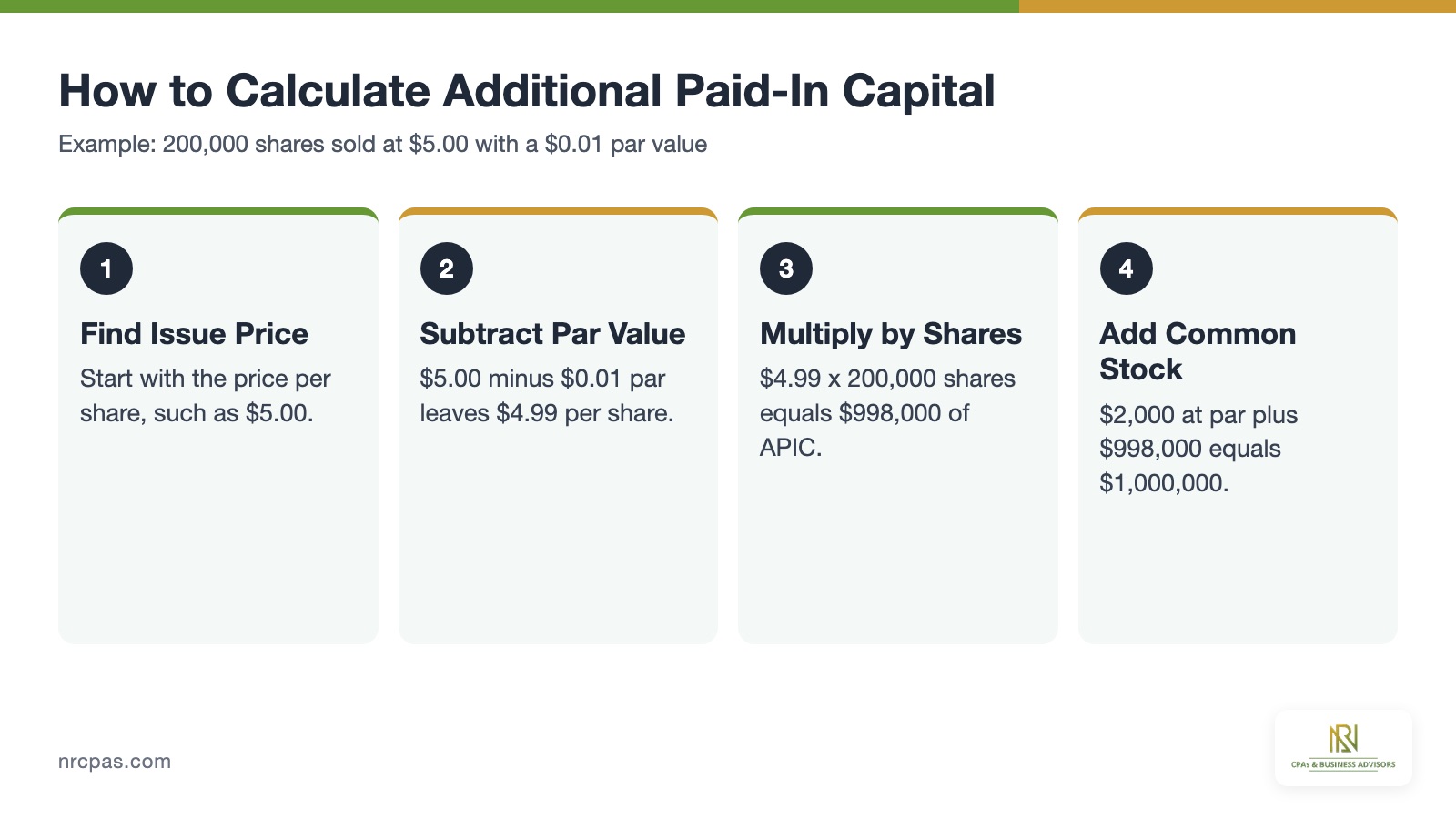
Calculate additional paid in capital by subtracting the par value from the issue price and multiplying by the number of shares. The additional paid in capital formula is (issue price - par value) x shares issued. The steps below apply that formula to one stock sale.
- Find the issue price per share, such as $5.00.
- Subtract the par value per share, such as $0.01, to get $4.99.
- Multiply the $4.99 excess by the 200,000 shares issued to get $998,000.
- Add the $2,000 of common stock at par to reach $1,000,000 of paid in capital.
The graphic below lays out those four steps in the same order.
Paid in capital also equals the shares issued times the issue price, which is $1,000,000 here. Both routes reach the same total, and the APIC line takes the $998,000 portion. Each of those amounts then needs a journal entry.
What Is the Journal Entry for Additional Paid In Capital?
The journal entry for additional paid in capital debits Cash and credits Common Stock and Additional Paid-In Capital. The debit equals the cash received, and the two credits split that cash between par value and the premium. The 200,000-share sale posts $1,000,000 to Cash, $2,000 to Common Stock and $998,000 to APIC.
Other events also move APIC, and the table below lists four of them with their entries.
| Event | Debit | Credit | Effect on APIC |
|---|---|---|---|
| Stock sold above par | Cash | Common Stock, APIC | Increases |
| Offering costs paid | APIC | Cash | Decreases |
| Stock compensation expensed | Compensation Expense | APIC | Increases |
| Treasury shares resold above cost | Cash | Treasury Stock, APIC from Treasury Stock | Increases |
Each entry keeps total debits equal to total credits, and monthly equity reconciliation confirms it. The flow graphic below traces how the $1,000,000 splits across the equity lines.

Both credits are equity accounts, and that classification answers a common account-type question.
Is Paid In Capital an Asset or a Liability?
Paid in capital is neither an asset nor a liability, because paid in capital is an equity account. The cash received from the stock sale is the asset, and paid in capital records who supplied it. Liabilities are debts owed to outsiders, and shareholders have no right to be repaid.
Stock is a claim on what remains after debts are paid. The company owes no interest and no maturity date on paid in capital. A lender can demand payment, while a shareholder can only sell the shares to another investor.
Does Paid In Capital Have a Debit or a Credit Balance?
Paid in capital has a credit balance, because equity accounts increase with credits. Issuing stock credits Common Stock and APIC, and only buybacks or offering costs debit them. The normal balance matches the rule that equity sits on the right side of the accounting equation.
That credit balance is a running total. The running total changes only when the company transacts in its own shares, as the next section shows.
What Changes Additional Paid In Capital After Shares Are Issued?
Additional paid in capital changes when the company issues, retires or resells its own shares. Five events move the APIC balance. The list below names each one.
- New stock sales above par increase APIC by the premium on each share.
- Stock-based compensation credits APIC as employees earn shares or options.
- Treasury stock resold above cost credits an APIC from treasury stock account.
- Retired shares remove their par and APIC amounts from the balance sheet.
- Offering costs reduce APIC, because they are charged against the proceeds.
According to the Securities and Exchange Commission (SEC), specific incremental costs of an offering are charged against its gross proceeds. A $30,000 underwriting fee on the 200,000-share sale would cut APIC from $998,000 to $968,000.
The same sale would then leave $970,000 of net paid in capital. Those figures stop growing once the raise ends, while a second equity account keeps growing with profit.
How Does Paid In Capital Differ From Retained Earnings?
Paid in capital differs from retained earnings because paid in capital comes from owners, while retained earnings comes from the business. Paid in capital vs retained earnings is the difference between money invested and profit kept. Retained earnings equals net income minus dividends, added up over the life of the company.
Retained earnings can turn negative after losses, while paid in capital cannot go below zero. The balance sheet reconciles the two through statement connections, since net income flows into retained earnings each year. A corporation with $80,000 of retained earnings and $1,000,000 of paid in capital has $1,080,000 of equity.
The graphic below sets both accounts side by side.

Net income itself is measured on the income statement, as the income statement differences show. The two equity accounts also trigger side questions from owners, covered next.
What Else Do Owners Ask About Paid In Capital?
Owners ask about the names, the tax rules and the state fees that surround paid in capital. The sections below answer each of those side topics in short form.
What Is Contributed Capital on a Balance Sheet?
Contributed capital on a balance sheet is another name for paid in capital. Contributed capital is common stock at par plus additional paid-in capital. The label covers cash and also property, such as equipment, that owners transfer to the corporation for shares.
Property transfers follow Section 351 of the Internal Revenue Code. According to the IRS, founders recognize no gain or loss when the transferors control 80% of the corporation afterward. Founders planning that exchange can use incorporation help before the shares are issued.
What Is Share Capital on a Balance Sheet?
Share capital on a balance sheet is the par value of issued shares, plus the premium in some countries. U.S. statements label the par portion Common Stock and the premium Additional Paid-In Capital. International statements often show share capital and share premium instead. A U.S. corporation sets both in its articles of incorporation, which state the authorized shares and par value.
What Is Total Capital on a Balance Sheet?
Total capital on a balance sheet usually means total shareholders' equity, which is paid in capital plus retained earnings. Lenders sometimes add long-term debt to that figure. The equity version in this post equals $1,080,000. A reader should confirm which definition a report uses.
What Is Capital on a Balance Sheet for an LLC?
Capital on a balance sheet for an LLC is the members' capital account, which replaces paid in capital and retained earnings. An LLC has no par value and no APIC line. Contributions and profits both flow into each member's account.
An LLC that wants stock-style paid in capital must elect corporate treatment. Owners weighing that move can study an LLC versus corporation comparison against their growth plans.
What Are Capital Expenditures on a Balance Sheet?
Capital expenditures on a balance sheet are purchases of long-term assets, shown as property, plant and equipment, not as paid in capital. Capital expenditures raise assets, while paid in capital raises equity. Both lines can grow from the same stock sale when the cash buys equipment.
How Does Section 1202 Affect Paid In Capital?
Section 1202 rewards shareholders who buy qualified small business stock directly from the company. According to the Internal Revenue Code, gains are excluded at 50% after 3 years. The exclusion is 75% after 4 years and 100% after 5 years. The per-issuer cap is $15,000,000 or 10 times basis for stock acquired after July 4, 2025.
The issuing corporation must hold no more than $75,000,000 in gross assets. Paid in capital records feed the basis and gross asset tests. Founders raising money can pair that with startup equity advice before the first round closes.
Do Delaware and Florida Charge Fees Based on Shares?
Delaware charges a franchise tax based on authorized shares or assumed par value capital. According to its Division of Corporations, Delaware's minimum is $175 for the authorized shares method. The minimum is $400 for the assumed par value capital method. The maximum is $200,000.
Florida charges a flat filing amount at formation. Florida's Division of Corporations charges a profit corporation $35 for the articles and $35 for the registered agent designation, or $70 minimum. Venture funded startups weigh both states before choosing where to incorporate.
How Does Paid In Capital Appear on a Corporate Tax Return?
Paid in capital appears on Schedule L of Form 1120, the balance sheet per books. According to the IRS, a C corporation pays tax at 21% of taxable income under Internal Revenue Code Section 11. Paid in capital is not income, so a stock sale itself triggers no corporate tax.
Schedule L must agree with the books, so equity accounts need reconciling before filing. Owners weighing stock sales against deductions can ask about stock sale planning early in the year.
Who Prepares Paid In Capital Schedules for a Private Company?
A CPA firm prepares paid in capital schedules, roll-forwards and equity statements for private companies. We build those schedules for founders who issue shares, and Nischay Rawal, CPA, EA, leads the work. Reach the office at (305) 872-3096.
The team at NR CPA preparers keeps the equity section accurate from the first share onward. Every stock sale is tied to the ledger, the stock certificates and the shareholder records the corporation keeps.
Owners can see what is paid in capital on a balance sheet in their own numbers through equity roll-forwards at each close.