Business Plan Exit Strategy and How to Write One

A business plan exit strategy is the plan section that explains how owners will sell, transfer or close the business. It names the exit route, the likely next owner, a valuation method, a timeline and the tax cost. Lenders and investors read it as proof of a repayment or return path. The section can be one paragraph or one page, depending on the reader.
Key Takeaways
- An exit strategy lists the route, the next owner, the value, the timeline and the tax cost.
- Equity investors need the most detail, while lenders need less.
- The 7 exit types range from a third-party sale to an IPO and liquidation.
- Federal long-term capital gains rates for 2026 are 0%, 15% and 20%, plus a 3.8% net investment income tax for higher earners.
- Owners should start the exit timeline several years before the planned sale date.
What Is a Business Plan Exit Strategy?
A business plan exit strategy is the written plan for how an owner will reduce or give up ownership of the business. It names the exit route, the next owner, the target value and the timeline. The route can end in a sale, a handover to family or staff, a partial sale or a closure.
Exits touch every small business sooner or later. According to the U.S. Small Business Administration (SBA) Office of Advocacy, the country has 36.2 million small businesses. Those businesses employ almost 46% of private-sector workers.
Owners are also aging. According to the Census Bureau, over half of employer business owners were age 55 and over in its Annual Business Survey. Advisors who give exit planning help treat this section as part of the whole plan, not an add-on.
The section matters most to the readers who fund the plan, so the next question is who reads it.
Who Reads the Exit Strategy in a Business Plan?
Four readers read the exit strategy in a business plan, and each looks for a different answer. Investors read it as the path to a return. Lenders read it for the repayment picture, and co-owners read it to align future ownership.
The reader also sets the length of the section. The bulleted list below shows what each reader needs from it.
- Equity investors need the exit route, the target timeline and the expected value.
- Lenders need proof that cash flow covers the loan before any exit happens.
- Co-owners need the buyout rules and the valuation method.
- The owner needs a plan that fits personal income and retirement goals.
Survival data shows why every reader cares. According to the Bureau of Labor Statistics (BLS), 79.6% of private-sector establishments born in March 2013 were still open after one year. Only 34.7% of that cohort was still operating in March 2023.
The other 65.3% of that cohort had closed, so a written exit route covers closure as well as sale. Clear growth milestones in the plan also show a buyer when the business is ready to change hands. The route itself comes from a short list of exit types.
What Are the Main Types of Exit Strategies for a Business?
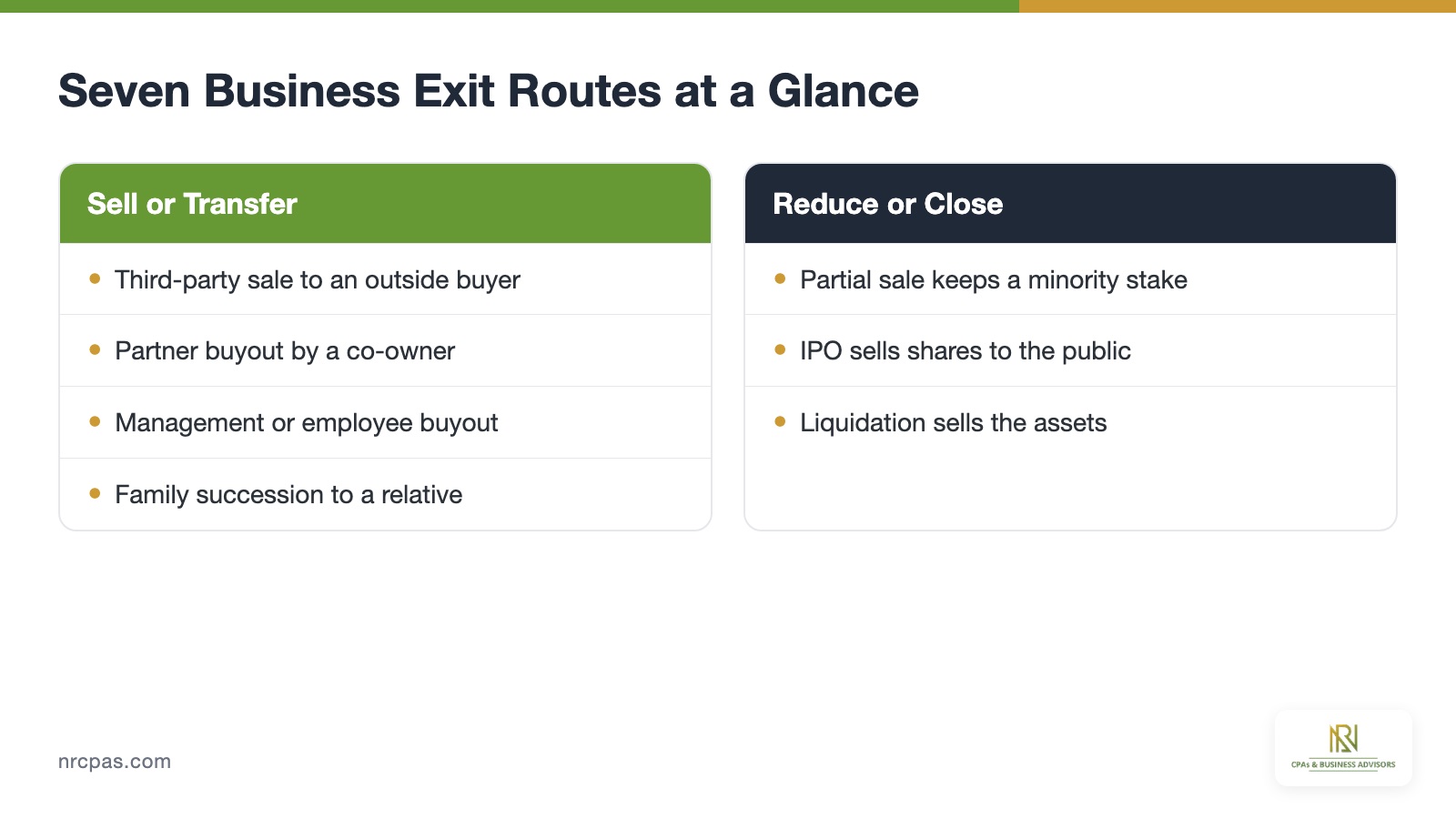
The main types of exit strategies for a business are 7 routes that differ by who takes over. The routes are a sale, a buyout, family succession, a partial sale, an IPO and liquidation. The table below compares them.
| Exit type | Who takes over | Owner keeps a stake | Business continues |
|---|---|---|---|
| Third-party sale | Outside buyer or larger company | No | Yes |
| Partner buyout | Remaining co-owner | No | Yes |
| Management or employee buyout | Managers or staff | No | Yes |
| Family succession | Child, sibling or relative | Sometimes | Yes |
| Partial sale | Investor buys a share | Yes | Yes |
| IPO | Public shareholders | Sometimes | Yes |
| Liquidation | No owner, assets sold | No | No |
Each row shows who buys, what the owner keeps and whether the business lives on. The graphic below splits the 7 routes into selling or transferring and reducing or closing.
How Does a Sale to a Third Party Work?
A sale to a third party works when an outside buyer purchases all or most of the ownership. The buyer can be another operator, an investor or a larger company that wants the customers, staff or technology.
Buyers pay for value that continues after the owner leaves. According to the SBA, 7(a) loans reach a $5 million maximum and cover complete or partial changes of ownership. Buyer financing like that widens the pool of possible purchasers. Sales to insiders follow a different path.
How Do Buyouts and Family Transfers Work?
Buyouts and family transfers work by moving ownership to someone who already knows the business. A partner buyout, a management buyout and an employee stock ownership plan (ESOP) all follow that pattern.
A family transfer needs a successor who wants the role and has the skills. Family transfers also use gifts, and the IRS annual gift exclusion is $19,000 per recipient for 2026. A yearly gift exclusion reduces how much of the transfer uses the lifetime exemption.
The IRS sets the 2026 basic exclusion amount at $15,000,000 per person. Whatever route the plan picks, the buyer needs a price, which brings up valuation.
How Do You Value a Business for an Exit Strategy?
You value a business for an exit strategy by combining earnings, assets and comparable sales into one price range. The value in a business plan is a range, not a final price. The range is rebuilt each year as profits change.
According to the Internal Revenue Service (IRS), Revenue Ruling 59-60 lists 8 factors for valuing closely held stock. Those factors include earning capacity, book value, goodwill, past stock sales and prices of comparable public companies.
Valuation professionals group those factors into 3 approaches, listed below.
- The asset approach totals what the business owns minus what it owes.
- The income approach applies a multiple to earnings or discounts future cash flow.
- The market approach compares the business to similar companies that sold.
Buyers test every approach against the revenue history, so accurate historical financials carry the price.
The statements must also tie out, with net income flowing into retained earnings and cash matching the balance sheet. Sellers who prepare the package before listing avoid delays, because buyers who check connected statements find errors fast during due diligence.
Owner dependence lowers every approach. A business whose customers and daily decisions rely on the owner is harder to sell. Value also depends on when the sale happens, which is the timeline question.
What Is a Realistic Timeline for a Business Exit?
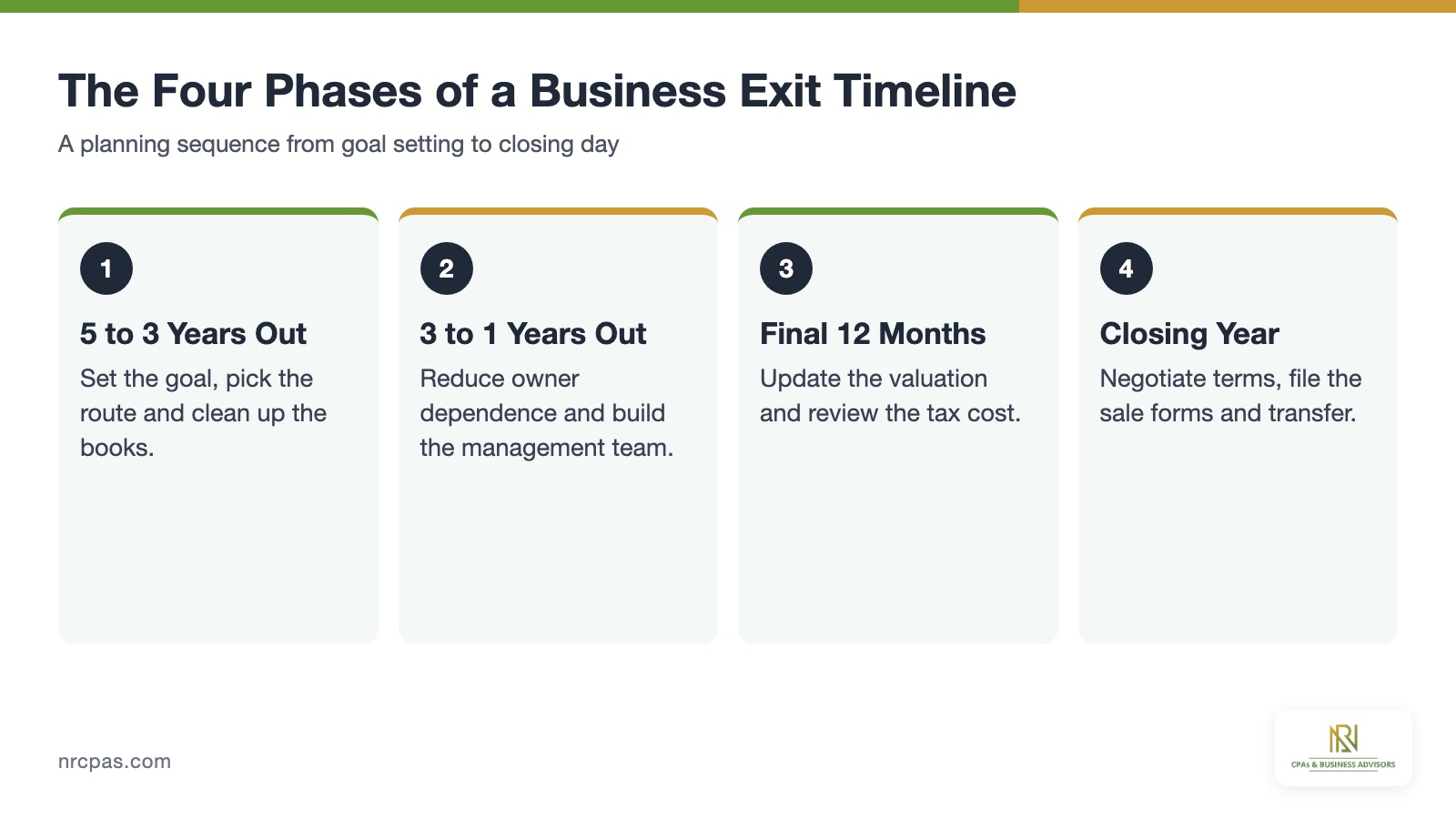
A realistic timeline for a business exit starts several years before the sale date and runs through 4 phases. A rushed timeline weakens negotiating power and the final price. The numbered list below gives the phases in order.
- 5 to 3 years out: set the exit goal, pick the likely route and clean up the books.
- 3 to 1 years out: reduce owner dependence, document processes and build the management team.
- Final 12 months: update the valuation, prepare buyer documents and review the tax cost.
- Closing year: negotiate terms, sign the agreement, file the sale forms and transfer the business.
The 4 phases appear in the graphic below, in the same order as the list.
Each phase has a finance task attached. A part-time finance lead can run those tasks, and CFO exit support covers the forecasting, the valuation updates and the buyer reports. The final phase brings the tax bill into focus.
How Is the Sale of a Business Taxed?
The sale of a business is taxed as capital gain, ordinary income or both, depending on what the buyer pays for. Goodwill produces capital gain, while depreciation recapture produces ordinary income. The purchase price is split across asset classes on Form 8594.
According to the IRS, assets held more than one year produce long-term gain. The table below lists the 2026 federal long-term capital gains rates from IRS Revenue Procedure 2025-32.
| Rate | Single filers | Married filing jointly |
|---|---|---|
| 0% | Up to $49,450 | Up to $98,900 |
| 15% | $49,451 to $545,500 | $98,901 to $613,700 |
| 20% | Above $545,500 | Above $613,700 |
Other layers sit on top of those rates. According to the IRS, the 3.8% net investment income tax applies above $200,000 of income for single filers. The joint filer threshold is $250,000. The IRS also caps unrecaptured section 1250 gain on real property at 25%.
Recapture changes the result for equipment sales. The IRS requires the ordinary-income part of a sale to be reported in the year of sale. An asset sale recapture review shows how earlier deductions come back as income.
The graphic below sums up the 2026 numbers from the table and the paragraphs above.

Several tools soften the bill. The installment method spreads gain over the years that payments arrive, and the IRS tracks it on Form 6252. Entity type also shapes the result, and the entity tax effects differ between an LLC and an S corporation.
Stock in a qualifying C corporation can qualify for a larger break. Under the One Big Beautiful Bill Act, qualified small business stock issued after July 4, 2025 can exclude $15 million of gain. The issuing company must have $75 million or less in gross assets.
The exclusion grows with the holding period, at 50% after 3 years, 75% after 4 years and 100% after 5 years. A tax review decides which tools apply, so exit tax planning belongs in the first phase. With the tax picture clear, the next step is writing the section.
How to Write an Exit Strategy for a Business Plan?
How to write an exit strategy for a business plan comes down to 6 steps, listed below. Each step turns one decision into one or two plain sentences. The steps work for an exit strategy for business plan drafts at any size.
- State the goal, such as full retirement, a partial sale or a family handover.
- Pick the exit route from the 7 types and say why it fits.
- Name the likely next owner or buyer group.
- Give a valuation range and the method behind it.
- Set the timeline in phases with a target year.
- Estimate the tax cost and note the structure that lowers it.
The exit strategy in business plan outlines sits after the financial plan and before the appendix. A short version fits a lender plan, and a one-page version fits an investor plan. Writers who want help tying the section to the numbers can lean on business plan advisors for the full draft.
The steps leave room for examples, and the sections below cover the other questions that owners raise.
What Else Belongs in the Exit Section of a Business Plan?
The exit section also needs a sample, an industry view, strategy links and a closing path. The short answers below cover each one.
What Does an Exit Strategy Business Plan Example Look Like?
An exit strategy business plan example reads as 4 or 5 sentences with the route, the buyer, the value and the year. This sample is illustrative.
"The owners plan to sell 100% of the company to a strategic buyer in year 7. The target value is a range from a yearly valuation. The owners will document all processes by year 4 and expect to stay 12 months after closing to train the buyer."
How Does an Exit Strategy for a Restaurant Business Plan Differ?
An exit strategy for a restaurant business plan differs because the value sits in the lease, the license and the location. A buyer needs the lease assignment and the liquor license transfer before closing.
The exit strategy for restaurant business plan drafts should also show food cost and labor cost trends. Buyers price from those margins. Food service owners who track prime cost monthly present a cleaner sale file.
How Does a Financial Strategy in a Business Plan Support the Exit?
A financial strategy in a business plan supports the exit by building the profit history that a buyer pays for. The financial strategy sets margins, debt levels and cash reserves that feed the valuation.
The financial strategy in business plan drafts should run to the exit year. A valuation support review checks that the forecast and the exit value agree.
How Does a Business Strategy in a Business Plan Shape the Exit?
A business strategy in a business plan shapes the exit by deciding which buyers find the company attractive. The business strategy in business plan drafts should name the target buyer type. A business plan and strategy that point to the same buyer type give the exit a clear target. A technology firm aims at strategic acquirers, while a local service firm aims at owner-operators.
What Steps Close a Business When No Buyer Appears?
The steps to close a business when no buyer appears start with a final tax return and end with an EIN cancellation. According to the IRS, a corporation files Form 966 when it adopts a plan to dissolve.
The IRS will not close the business account until all returns are filed and all taxes are paid. Employers also file final employment tax returns and keep employment tax records for at least 4 years.
Who Can Help Write the Exit Section of a Business Plan?
A CPA-led advisory team can help write the exit section by tying the exit route to the financial statements. We build the valuation range, the tax estimate and the timeline from the owner's own numbers.
The firm is led by founder Nischay Rawal, CPA, EA. Reach the office at (305) 872-3096. Additional planning articles for owners who want to keep reading appear in NR CPA insights. Those articles cover valuation, tax planning, financial statements and entity choice for owners at every stage of growth.
Owners ready to draft the exit section can start with a business plan strategy session.