How Much Can You Gift Without Tax in 2026


You can gift up to $19,000 per recipient in 2026 without filing a gift tax return or using any lifetime exemption. Married couples who split gifts can give $38,000 per recipient. Bigger gifts rarely trigger tax, because gifts above $19,000 only reduce the $15,000,000 lifetime exemption and require Form 709.
Key Takeaways
- The 2026 annual gift tax exclusion is $19,000 per recipient, the same as 2025.
- A married couple can give $38,000 per recipient by splitting gifts.
- The 2026 lifetime exemption is $15,000,000 per person, up from $13,990,000 in 2025.
- Gifts over $19,000 to one person need Form 709, even when no tax is due.
- Tuition and medical bills paid directly to the school or provider have no dollar limit.
- The donor pays gift tax, and the recipient does not report a gift as income.
How Much Can You Gift Without Tax During 2026?
You can gift $19,000 per recipient in 2026 without tax, and the number of recipients is unlimited. According to the Internal Revenue Service (IRS), the annual exclusion is $19,000 for gifts made in calendar year 2026. A donor with five children can give $95,000 in one year before any reporting starts. That total answers how much can you gift without tax in one year across five recipients.
The IRS counts each recipient separately, so gifts of $19,000 to a son and to a daughter are both excluded. The exclusion resets every January 1. A gift of $19,000 on December 31 and another $19,000 on January 1 are both fully excluded.
The exclusion has risen in steps, according to the IRS: $16,000 in 2022, $17,000 in 2023 and $18,000 in 2024. The 2025 and 2026 figures both hold at $19,000. A gift planning calendar keeps each January reset working for the donor.
The annual exclusion is only one of two limits, and the second limit is much larger.
What Is the Difference Between the Annual Exclusion and the Lifetime Exemption?
The annual exclusion is a yearly limit per recipient. The lifetime exemption is one total limit across all taxable gifts and your estate. The 2026 lifetime exemption is $15,000,000 per person. The IRS calls this figure the basic exclusion amount.
The One Big Beautiful Bill Act, Public Law 119-21, set the 2026 basic exclusion amount at $15,000,000. According to the IRS, the 2025 amount was $13,990,000. A married couple therefore shelters $30,000,000 in 2026 when both spouses use their full exemptions.
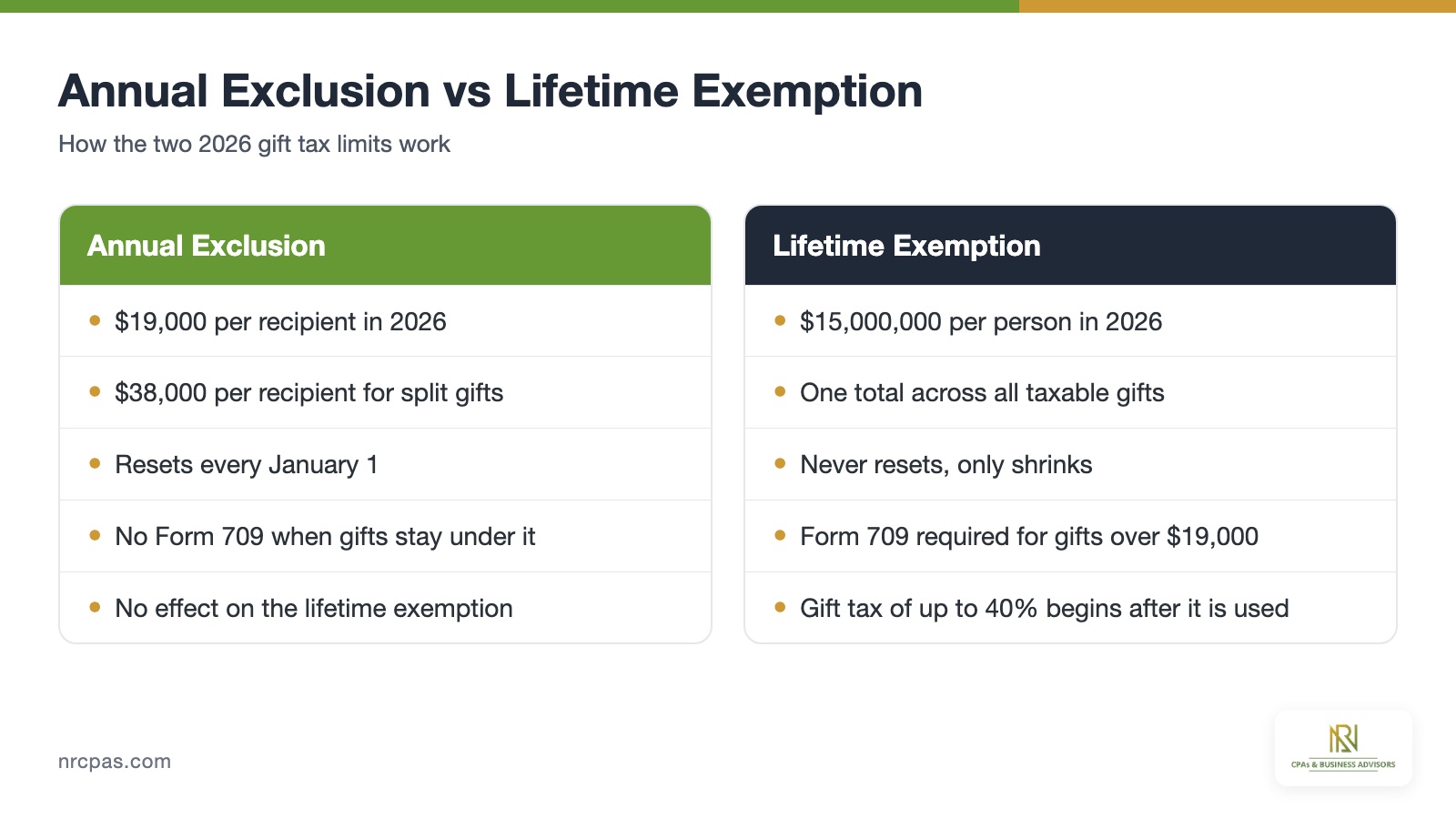
The graphic below sets the main 2026 gift tax numbers side by side.

Gift tax itself starts only after taxable gifts pass the lifetime exemption. According to the IRS, the top gift tax rate is 40%. Most donors never reach that point, so gifts above the annual exclusion mostly reduce the exemption on paper.
The reduction is recorded on a tax return, which leads to the filing question.
Do You Have to Report a Gift to the IRS?
You must report a gift to the IRS on Form 709 when you give more than $19,000 to one person in 2026. According to the IRS, the donor files the return, and filing is required even when no gift tax is payable. Gifts of future interests must be reported at any dollar amount.
Form 709 is due April 15 of the year after the gift. Gifts made in 2026 are therefore reported by April 15, 2027. According to the IRS, Form 8892 adds an automatic 6-month extension, but the extension does not delay payment of any tax. An income tax extension also extends Form 709 by 6 months, and interest runs from April 15.
The filing steps are the same each year, and the numbered list below shows them in order.
- Total every gift made to each recipient during the calendar year.
- Subtract the $19,000 annual exclusion for each recipient.
- List the remaining taxable amount on Form 709 with a description of each gift.
- Attach appraisals for real estate, business interests or other hard-to-value property.
- File by April 15 of the next year, or extend with Form 8892.
Spouses cannot file a joint gift tax return, according to the IRS, so each spouse files separately. A filed return is corrected with a supplemental Form 709 marked across the top of page 1. Some filers hand the return to tax planning advisers who track the running exemption total. That running total is easiest to see through real dollar examples.
How Much Gift Tax Do I Have to Pay on a $100,000 Gift?
You will pay no gift tax on a $100,000 gift in 2026, unless your lifetime taxable gifts already exceed $15,000,000. The first $19,000 is excluded, and the remaining $81,000 reduces the lifetime exemption. The exemption left after a $100,000 gift is $14,919,000.
The table below applies the same math to five common gift sizes from a single donor with no earlier taxable gifts.
| Gift to one person | Over the $19,000 exclusion | Form 709 needed | Lifetime exemption left |
|---|---|---|---|
| $19,000 | $0 | No | $15,000,000 |
| $30,000 | $11,000 | Yes | $14,989,000 |
| $50,000 | $31,000 | Yes | $14,969,000 |
| $75,000 | $56,000 | Yes | $14,944,000 |
| $100,000 | $81,000 | Yes | $14,919,000 |
Each row shows tax of $0, because every exemption balance stays far above zero. A parent who gifts a child $75,000 toward a down payment follows the fourth row. A married couple can shrink the reportable amounts, as the next section shows.
How Much Is the Gift Tax Exclusion for 2026 for Married Couples?
The gift tax exclusion for 2026 is $38,000 per recipient for married couples who elect gift splitting. According to the IRS, a couple that splits gifts treats each gift as made half by each spouse. Gift splitting doubles the $19,000 exclusion to $38,000.
Gift splitting requires Form 709 from the giving spouse, even when the total stays under $38,000. Both spouses must be married on the gift date and be citizens or residents. According to the IRS, both spouses sign a Notice of Consent on the return. A couple who gifts a child $100,000 excludes $38,000 and reports $62,000, which is $31,000 per spouse.
Splitting is optional, because each spouse can also give $19,000 from separate funds with no return. A written gifting strategy shows which choice fits each year. Gifts between spouses follow different rules, which brings up gifts that tax never touches.
How Much Can You Gift Without Paying Tax Beyond the Annual Limit?
Several gifts have no dollar cap, because they never count against the $19,000 exclusion or the lifetime exemption. According to the IRS, the main exceptions are listed below.
- Tuition paid directly to a qualifying school, with no dollar limit.
- Medical expenses and health insurance premiums paid directly to the provider.
- Gifts to a U.S.-citizen spouse, covered by the unlimited marital deduction.
- Gifts to a political organization for its own use.
- Gifts to qualifying charities, which are deductible from the gifts reported, including those to a nonprofit organization.
The direct payment rule applies to tuition only, so books, supplies and room and board do not qualify. Payments must go straight to the school or provider, and reimbursing the student does not qualify. A grandparent who pays a $60,000 tuition bill directly can still give the student $19,000 in cash that year.
Tax-free categories explain why a donor can give far more than $19,000 over time. The next question is how the IRS ever learns about gifts.
How Does the IRS Know If You Gift Money?
The IRS knows about a gift when the donor reports it on Form 709 or when an estate return lists it. Form 709 is the main way the IRS learns about gifts, and the donor files it. Form 706, the estate tax return, adds earlier taxable gifts back into the lifetime total.
According to the IRS, a gift must be adequately disclosed on Form 709 for the statute of limitations to start running. Adequate disclosure means a complete return, a property description and the donor and recipient names. Appraisals back up the value of real estate and business interests.
A missing return keeps the IRS review window open. According to the IRS, late filing and late payment penalties apply under section 6651 unless there is reasonable cause. Reporting accurately now avoids those penalties and leads into the wider gift topics below.
What Else Should You Know Before Making a Large Gift?
Large gifts raise side topics about income, property, education accounts and foreign rules. The short answers below cover the most common ones.
What Counts as a Gift for Tax Purposes?
According to the IRS, a gift is any transfer to an individual without full payment in return. Gifts include cash, property, forgiven loans and sales below fair market value. A $400,000 home sold to a child for $200,000 creates a $200,000 gift.
An interest-free loan can also create a gift equal to the forgone interest. The IRS expects interest at the applicable federal rate. Each deemed gift adds to the $19,000 total for that recipient.
Who Pays the Gift Tax?
The donor pays the gift tax, according to the IRS, and the recipient pays nothing in the usual case. The donee pays only under a special agreement with the donor. Such arrangements change how the tax is computed, so a tax professional should review them first.
How Much Can You Gift Before Paying Tax Over a Lifetime?
You can gift $15,000,000 over a lifetime before paying tax in 2026, and a married couple can gift $30,000,000. Gift tax starts only after taxable gifts pass the lifetime exemption. Each Form 709 lowers the remaining balance by the taxable amount reported.
How Much Is the Gift Tax for 2026 on Large Gifts?
The gift tax for 2026 tops out at 40%, according to the IRS, and it applies only above the $15,000,000 exemption. A donor who has used $14,919,000 of the exemption owes tax on the next taxable dollar. Most families owe $0 in gift tax, because their taxable gifts stay below the exemption.
How Much Can You Gift Without Tax to Adult Children?
You can gift each adult child $19,000 without tax in 2026, and a married couple can gift $38,000 per child. A couple with two adult children can therefore give $76,000 in one year with no return. Larger gifts, such as a $75,000 down payment, only reduce the lifetime exemption.
How Much Can You Gift Without Gift Tax to Grandchildren?
You can gift each grandchild $19,000 without gift tax in 2026, and the same limit applies to every other recipient. Grandchildren are separate recipients, so their gifts never combine with gifts to the grandchildren's parents. Education savings accounts give grandparents a larger option, as the 529 election below shows.
Do Gifts Count as Income to the Recipient?
Gifts do not count as income to the recipient, so a child who receives $50,000 reports nothing on Form 1040. According to the IRS, the donor is generally responsible for any gift tax. The recipient owes no income tax on the gift itself.
Income earned afterward is different, because interest on a gifted savings account is taxable to the new owner. The IRS also says gifts cannot be deducted from the donor's income tax, except qualifying charitable gifts. Estate planners often review estate planning fees alongside the gift plan.
Can Your Parents Gift You $30,000?
Your parents can gift you $30,000 without you owing tax, though a parent may file Form 709. Each parent can give $19,000 in 2026, so two parents give $38,000 with no return at all. A $100,000 gift from both parents reduces their exemptions by $31,000 each when they split it.
The parent files Form 709, and the child does not. Down payment gifts often come with a lender letter that states the money is a gift, not a loan.
What Is the 529 Five-Year Election?
The 529 five-year election lets a donor treat a large 529 plan contribution as spread over 5 years. According to the IRS, a contribution above $19,000 can be treated as made evenly over five years, up to $95,000. The election is made on Form 709 for the contribution year.
The donor can then give a grandchild $95,000 in one year with no exemption used. Extra gifts to the same child during the five years reduce the available exclusion. The graphic below compares the annual exclusion with the lifetime exemption for planning purposes.
Is It Better to Inherit or Receive Property as a Gift?
Inheriting property is often better for taxes than receiving it as a gift, because gifted property keeps the donor's cost basis. According to the IRS, a recipient generally takes the donor's basis. Stock bought at $10 per share and sold at $100 per share creates a $90-per-share taxable gain.
Inherited property follows different basis rules, so the recipient's gain is usually smaller. Appreciated assets carry their built-in gain to the recipient when given as gifts. Donors who give investments can weigh loss harvesting before choosing which shares to transfer.
How Much Can You Gift a Spouse Who Is Not a U.S. Citizen?
You can gift a spouse who is not a U.S. citizen $194,000 in 2026 without a taxable gift. According to the IRS, the 2025 figure was $190,000. The limit replaces the unlimited marital deduction, which only applies to citizen spouses.
The noncitizen spouse limit is $194,000 for 2026. Gifts above that amount reduce the lifetime exemption and need Form 709. Families with cross-border ties often combine this limit with expat tax planning.
Do Gifts From Abroad Need Reporting?
Gifts from abroad need reporting on Form 3520 when a U.S. person receives over $100,000 in one year from a foreign donor. According to the IRS, the penalty is 5% of the gift for each month unreported, capped at 25%.
The foreign donor does not file a U.S. gift return, and the recipient owes no income tax. The reporting duty falls on the U.S. recipient, and the threshold is $100,000. Gifts of digital assets from a foreign relative follow the same rule, as digital asset reporting guidance explains.
What Is a Clever Way to Give Money as a Gift?
A clever way to give money is to spread gifts across years and recipients, and to pay tuition or medical bills directly. A couple with three children and six grandchildren can give $342,000 in one year with no return, at $38,000 per recipient. Family businesses held in a family LLC let owners gift small ownership slices each year.
Many families also fund life insurance premiums through annual exclusion gifts to a trust.
How Can a Family Office Team Help With Gifting?
A family office team tracks each gift, each Form 709 and the remaining lifetime exemption across the whole family. We coordinate gifts of cash, stock and business interests with the rest of a family's tax picture. The team at NR CPAs professionals is led by founder Nischay Rawal, CPA, EA, and the Miami office answers at (305) 872-3096.
Families that want one place to plan annual gifts, exemption tracking and filings can lean on family wealth team support.