Is a DBA a Separate Legal Entity and Does It Protect Your Assets

No, a DBA is not a separate legal entity, because a DBA only registers a trade name for an existing owner. A DBA is also called an assumed name or fictitious name. The owner and the business stay legally identical, so the owner stays personally liable. Only an LLC or corporation filing creates a separate entity.
Key Takeaways
- A DBA is a name registration, not a business structure, and it creates no new legal person.
- A sole proprietor with a DBA is personally liable for every business debt and lawsuit.
- An LLC member is generally shielded from company debts under Florida Statutes 605.0304.
- A DBA adds no tax layer, so income still lands on the owner's Schedule C.
- A Florida fictitious name costs $50 and lasts 5 years, while a Florida LLC filing costs $125.
Is a DBA a Separate Legal Entity?
Search results for "is a DBA a separate legal entity" agree on one answer. A DBA is not a separate legal entity, because the registration attaches a second name to the same owner. A DBA is a label, and a label cannot own property, sign contracts or owe debts. The person or company behind the label does all three.
Florida shows how the rule works in practice. According to the Florida Division of Corporations, a fictitious name registration costs $50 and runs 5 years. The filing records who owns the name, and it never forms a new company.
A legal entity is a person in the eyes of the law, with its own name, assets and liabilities. A state creates that status only when an owner files articles of organization or incorporation. A DBA skips that step, so the name has no legal existence apart from the owner. That owner is the next question.
Who Is Legally Responsible for a Business Operating Under a DBA?
The owner who registered the DBA is legally responsible for the business operating under that DBA. A sole proprietor and the sole proprietorship are the same legal person. Contracts signed under the trade name bind the owner directly.
Sole proprietorships are everywhere in the economy. According to the U.S. Census Bureau, the country had 29.8 million nonemployer businesses in 2022. The Census Bureau also reported 8.3 million employer businesses that year.
Florida leads that count by density. According to the Census Bureau, Florida had 13.3 nonemployer establishments per 100 residents in 2022. Many of those owners trade under a personal name or a registered trade name. None of them gets liability protection from the name alone.
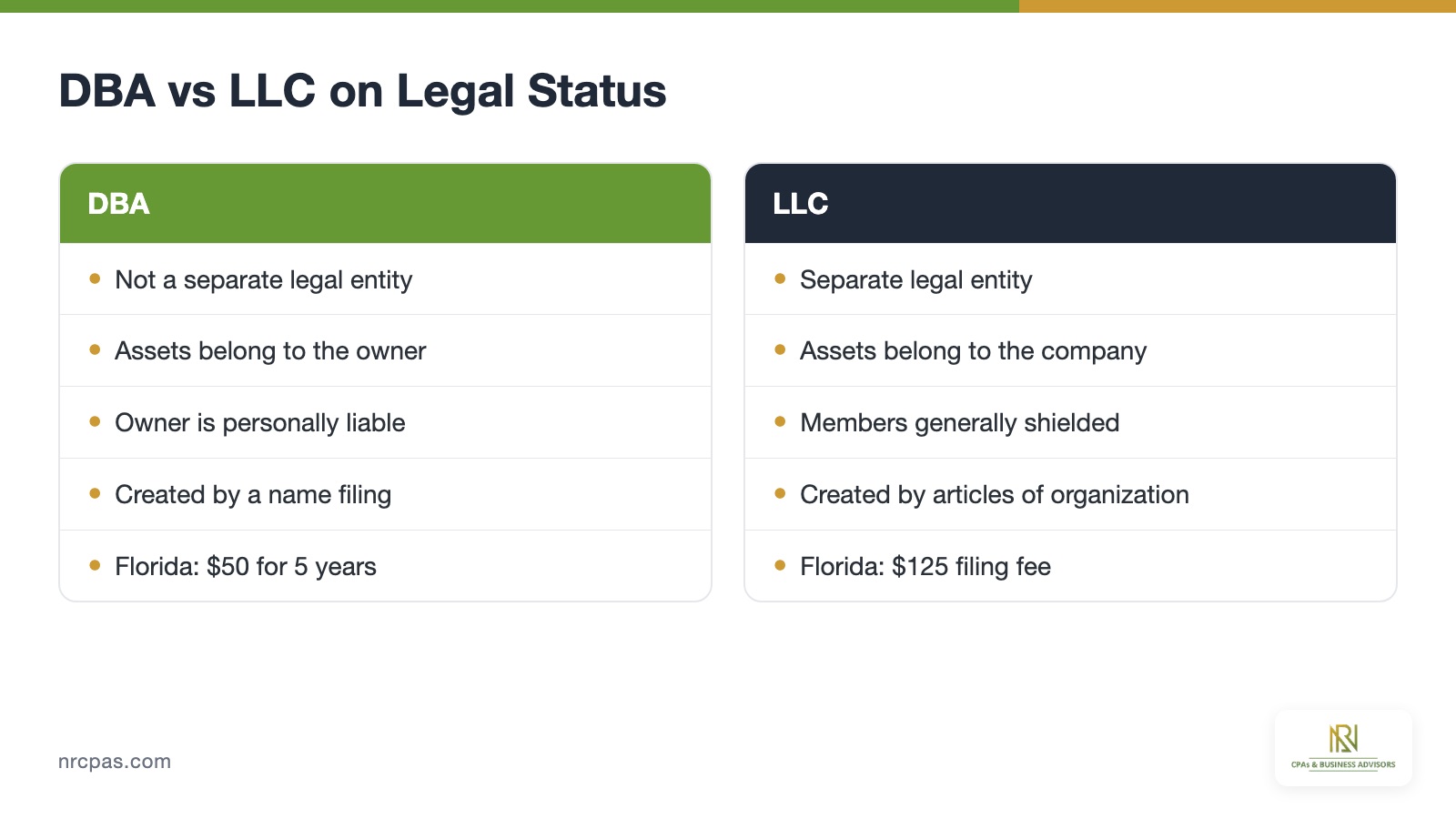
Corporations and LLCs behave differently, because the entity itself holds the legal duties. The table below compares the two paths on the points that matter for legal status.
| Point | DBA | LLC |
|---|---|---|
| Separate legal entity | No | Yes |
| Who owns the assets | The owner | The company |
| Personal liability for business debts | Yes | Generally no |
| Created by | A name filing | Articles of organization |
| Florida filing fee | $50 for 5 years | $125 plus an annual report |
The comparison graphic below shows the same split in plain terms. Each row of the graphic matches one question owners ask about asset protection.
Does a DBA Protect Your Personal Assets?
A DBA does not protect your personal assets, because the owner and the DBA share one set of assets. A creditor of the DBA is a creditor of the owner. The home, savings and personal vehicles can all be reached by a judgment.
The Small Business Administration (SBA) states that registering a DBA does not provide legal protection by itself. The SBA adds that most states require owners to register a DBA when they use one. The registration serves the public record, not the owner.
Business and personal assets blend into one pool under a DBA. A single unpaid supplier invoice can therefore threaten personal accounts. Owners who want a wall between the two pools need a different structure, and a lawsuit shows why the wall matters.
Can a DBA Be Sued?
A DBA can be named in a lawsuit, but the court judgment lands on the owner behind the DBA. A plaintiff sues the owner "doing business as" the trade name. The trade name itself holds no assets to seize.
Federal courts follow state law on who may be sued. According to Federal Rule of Civil Procedure 17(b), an individual's capacity to be sued comes from the law of the individual's domicile. A sole proprietor therefore answers to the court as a person.
The judgment then reaches personal property under state collection rules, and tax debts can bring IRS collection help into play. Florida exemptions cover some assets, such as a qualifying homestead. Exemptions differ from entity protection, because exemptions limit what a creditor can take, while an entity limits who the creditor can pursue. That entity route leads to the LLC question.
Is a DBA Protected Under an LLC?
A DBA is protected under an LLC only as far as the LLC is protected. The DBA is simply a name the LLC uses. A DBA adds no protection of its own to an LLC. The LLC's shield covers every trade name it registers.
Florida Statutes section 605.0304 states that a debt of a limited liability company is solely the debt of the company. Members and managers are not liable for that debt only because they hold those roles. The shield therefore comes from the LLC, never from the name.
Registering a DBA for the LLC keeps contracts in the correct legal name. Contracts should name the LLC first, then the trade name. One example reads "Sunrise Cleaning LLC doing business as Bright Home Services". Owners who skip the LLC name risk claims of personal signing. Forming the entity first is the cleaner route, and forming an LLC sets that order.
An LLC shield is strong but not absolute. Courts can pierce an LLC when owners mix funds or ignore the company's separate existence. The shield also does not cover a member's own wrongful acts, and courts weigh a missing operating agreement against the owner. Entity taxes follow separate rules, as the S corporation taxes comparison shows.
Do You Pay Taxes With a DBA?
You pay taxes with a DBA on the owner's own return, because a DBA has no separate tax identity. A sole proprietor reports DBA income on Schedule C. The same owner then pays self-employment tax on the net profit.
According to the Internal Revenue Service (IRS), the self-employment tax rate is 15.3%. That rate combines 12.4% for Social Security and 2.9% for Medicare. The IRS requires the tax once net self-employment earnings reach $400. The tax applies to 92.35% of net earnings.
According to the Social Security Administration (SSA), the Social Security portion stops at $184,500 of earnings for 2026. The 2.9% Medicare portion has no cap. A DBA changes none of these numbers. The graphic below lists the four figures side by side.

Single-member LLCs follow the same default path. According to the IRS, a single-member LLC is disregarded as separate from its owner for income tax. That default holds unless the owner files Form 8832 or Form 2553. Owners comparing paths can read about LLC owner taxes before choosing.
The IRS makes one exception for employment taxes. A disregarded LLC uses its own name and identification number for payroll. The steps below show how a DBA owner and an LLC owner each file a return.
- Pick the legal owner of the business, either a person or an entity.
- Register the trade name with the state or county for that owner.
- Obtain an Employer Identification Number (EIN) when the business hires staff.
- Report income on Schedule C for a sole proprietor or a disregarded LLC.
- Pay self-employment tax on net profit unless an S corporation election applies.
What Are the Disadvantages of a DBA?
The disadvantages of a DBA are unlimited personal liability, no exclusive name rights and a weaker business profile. The biggest disadvantage is that personal assets answer for business debts. The other limits are listed below.
- No liability shield, so a lawsuit can reach personal assets.
- No exclusive ownership of the name in most states.
- No separate tax return, so no entity-level planning options.
- Renewal tracking, since Florida names expire after 5 years.
- Less credibility with lenders and larger clients than an LLC or corporation.
Name rights deserve a closer look. According to the U.S. Patent and Trademark Office (USPTO), a state business name registration grants no trademark rights. The registration only means that the state allows the business to use the name.
A trade name may also conflict with a similar name used elsewhere. These gaps explain why growing owners compare a DBA with an LLC, and financial leadership often enters that talk. The final question is whether the DBA alone is enough.
Do You Need an LLC or Just a DBA?
You need an LLC instead of just a DBA when business debts, lawsuits or growth could put personal assets at risk. A DBA fits a low-risk side business, and an LLC fits any business with real exposure. The phrase "is a DBA a separate legal entity" ends in the same answer every time. The choice depends on risk, not on the name.
Failure risk is real for new businesses. According to the Bureau of Labor Statistics (BLS), 34.7% of business establishments born in 2013 were still operating in 2023. Most years of operation therefore carry some chance of a claim or a default.
Cost differences are small next to that exposure, and technology founders weigh them early. A Florida LLC costs $125 to file with the Division of Corporations. The Florida annual report costs $138.75 when filed between January 1 and May 1, and a late report adds a $400 penalty.
Many owners start with a DBA and form an LLC later. Good startup planning sets the timing around the first client contract. Owners who hold an LLC can file a DBA for it, which keeps brand names flexible. A short list of related topics follows.
What Else Should Owners Know About DBA Legal Status?
DBA legal status raises several smaller questions about renewal, name rights, creditors and business classification. The sections below answer each one in short form.
Do You Have to Register a DBA?
You have to register a DBA in most states once the business uses a name other than the owner's legal name. The trigger is the name, not the business size. A sole proprietor trading under a non-personal name generally files. An LLC trading under a name missing from its articles files too.
Skipping the filing carries a cost. Several states bar an unregistered business from suing on contracts made under the trade name until the owner complies. Penalties and refused bank accounts are other results, so owners should confirm the county and state rules before opening for business.
Can an LLC Have a DBA?
An LLC can have a DBA, and one LLC can register several. Every DBA under one LLC shares the same liability pool. A claim against one brand can therefore reach the other brands. All of them belong to a single entity.
Lines of business with very different risk, such as consulting and construction, usually fit better in separate LLCs. Each LLC then needs its own registered agent and its own operating agreement, which adds cost but isolates the risk.
Do You Need an EIN for a DBA?
You do not need an EIN for a DBA alone, because the IRS ties the number to the legal owner. A sole proprietor may use a Social Security number until the business hires staff. Adding or changing an assumed name does not require a new EIN.
The name still appears on Form W-9. The legal name goes on line 1 and the DBA goes on line 2, and the taxpayer number must match line 1. A mismatch can trigger backup withholding on payments.
How Long Is a DBA Good For?
A DBA is good for the term the state sets, and a Florida fictitious name is good for 5 years. According to the Florida Division of Corporations, the registration expires on December 31 of the fifth year. An expired Florida name cannot be reinstated, so the owner must file a new registration.
Renewal costs $50 in Florida and opens on January 1 of the expiration year. Other states set their own terms, so county rules need a check. A tax calendar should list each renewal date.
Can Someone Else Use Your DBA Name?
Someone else can use your DBA name in most states, because a DBA does not grant exclusive rights. The SBA notes that multiple businesses can go by the same DBA in one state. Trademark law, not DBA law, decides who owns a brand.
A federal trademark registration with the USPTO creates rights across the whole country. State registrations cover only that state. Owners with a brand worth defending should pair the legal filing with brand strategy advice.
Is a DBA Considered a Business?
A DBA is considered a business name, not a business. The business is the activity, and the owner is the legal person behind it. A DBA with no sales, no clients and no books is only a registered name.
Tax filers still treat the activity as a trade or business once income appears. Clean business records prove that activity to lenders and the IRS. Records also protect owners after an audit notice.
How Does a Creditor Reach LLC Assets Compared With DBA Assets?
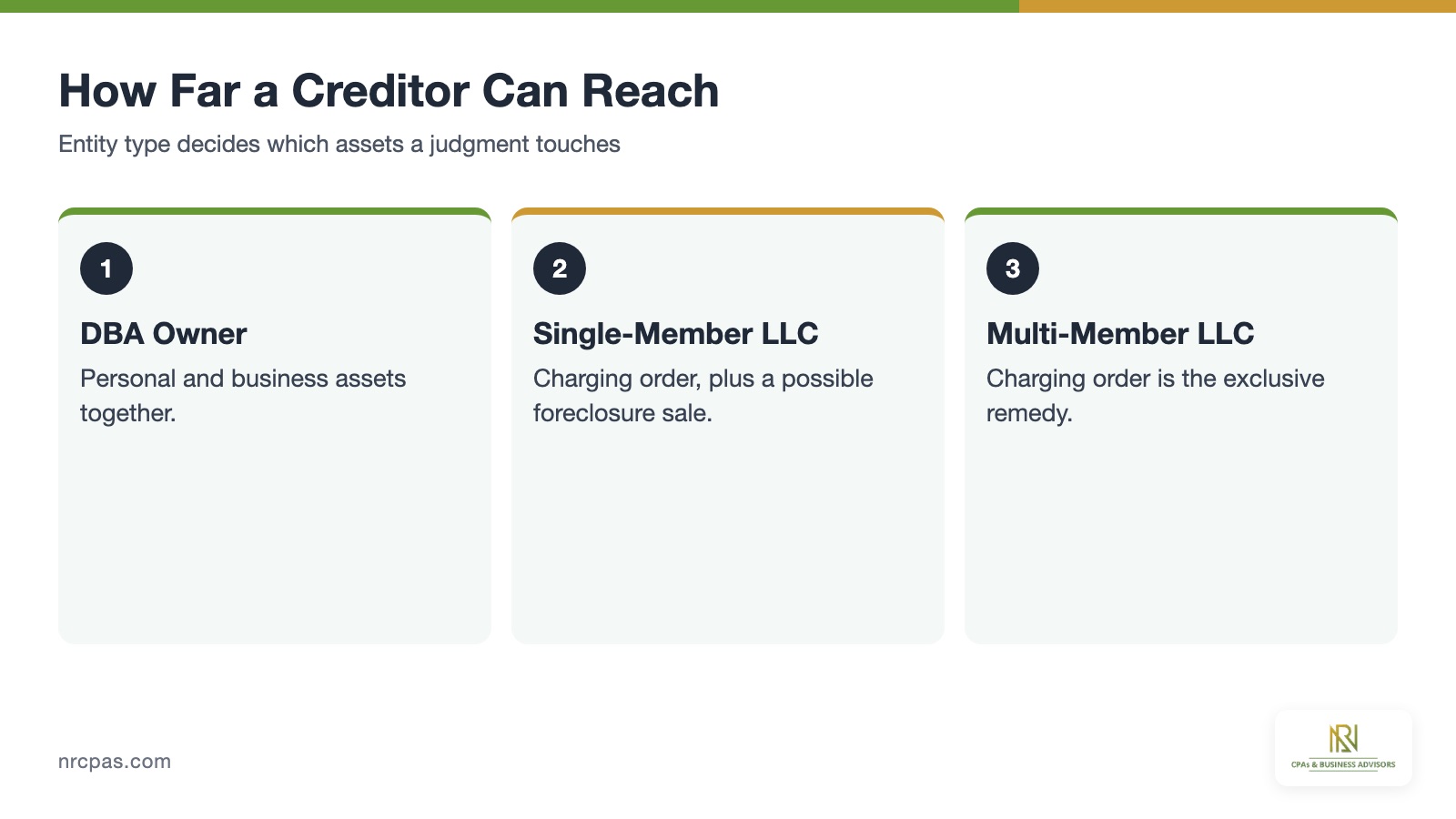
A creditor of a DBA owner reaches personal and business assets together. A creditor of an LLC member usually reaches only distributions. Florida Statutes section 605.0503 makes a charging order the exclusive remedy for a multi-member LLC creditor. Single-member LLC creditors can seek a foreclosure sale of the interest in some cases.
Entity type changes how far a creditor can reach. The graphic below shows the reach for each structure.
How Does NR CPAs Help With DBA and Entity Choices?
We help owners compare a DBA, an LLC and an S corporation against their tax and risk picture. Founder Nischay Rawal, CPA, EA, leads the work, and the office line is (305) 872-3096.
The team at nrcpas.com also supports owners who move from a DBA into an LLC. Moving the books across cleanly keeps the new entity's protection intact. Owners who still wonder is a DBA a separate legal entity can rely on one rule: only a state-formed entity is.
Owners ready to form the entity can start with business formation support.