Does Kia Telluride Qualify for Section 179 and When Does It Apply


No, a Kia Telluride misses the Section 179 heavy SUV cap unless its door-jamb GVWR is above 6,000 pounds. GVWR, the gross vehicle weight rating, runs 5,578 to 5,917 pounds on Kia's published Telluride listings. Weights that low put the vehicle in the passenger-auto class. The passenger-auto caps apply at those weights, and business use must top 50% of total miles.
Key Takeaways
- Published Telluride GVWR figures run from 5,578 to 5,917 pounds, below the 6,000-pound line.
- Section 179 goes by the GVWR on the door-jamb label, not by curb weight.
- Under 6,000 pounds, the 2026 first-year cap is $20,300 with bonus depreciation and $12,300 without it.
- Above 6,000 pounds, the 2026 heavy SUV cap is $32,000, and bonus depreciation covers the rest.
- Business use must exceed 50%, and the vehicle must be placed in service by December 31.
Does Kia Telluride Qualify for Section 179 and When Does It Apply?
A Kia Telluride qualifies for Section 179 as business property, but the deduction stays small unless its GVWR is above 6,000 pounds. Under 6,000 pounds, the Telluride falls under the Section 280F passenger-auto caps. Above 6,000 pounds, the heavy SUV rules allow $32,000 of Section 179 expensing, plus bonus depreciation on the remaining cost.
According to the Internal Revenue Service (IRS), the 2026 Section 179 limit is $2,560,000, and the phase-out starts at $4,090,000 of purchases. Those totals sit far above one vehicle, so the weight test and the vehicle caps decide the Telluride result.
The deduction applies in the year the Telluride is placed in service. Early vehicle purchase planning sets the size of the write-off. The weight rating is the first number to check.
Is the Kia Telluride Over 6,000 Pounds?
The Kia Telluride is under 6,000 pounds on every published first-generation rating, though the GVWR changes with seating and drivetrain. GVWR is the maximum loaded weight the manufacturer allows. According to Kia's 2020 specification sheet, the 8-passenger Telluride is rated 5,776 pounds in front-wheel drive and 5,917 pounds in all-wheel drive.
The same Kia sheet rates the 7-passenger Telluride at 5,578 pounds in front-wheel drive and 5,736 pounds in all-wheel drive. Every first-generation configuration sits below the 6,000-pound line. The table below lists the four ratings in order.
| Configuration | GVWR | Above 6,000 pounds |
|---|---|---|
| 7-passenger, front-wheel drive | 5,578 pounds | No |
| 7-passenger, all-wheel drive | 5,736 pounds | No |
| 8-passenger, front-wheel drive | 5,776 pounds | No |
| 8-passenger, all-wheel drive | 5,917 pounds | No |
The graphic below shows the same four ratings against the 6,000-pound line.

Later model years follow a similar range. Kelley Blue Book lists 5,776 pounds for the 2025 LX and S, and 5,917 pounds for the 2023 SX X-Pro. Listings for the redesigned 2027 Telluride disagree. One dealer spec page shows 6,063 pounds. The site iSeeCars shows 6,283 and 6,504 pounds for 2027 hybrid trims. According to Crest Capital, current gas models are rated 6,063 to 6,261 pounds.
Those numbers cannot all be right for one trim, so the driver-side door pillar label settles the answer. The IRS reads that label, not a brochure or a listing.
Does Section 179 Go by GVWR or Curb Weight?
Section 179 goes by GVWR, not curb weight. According to the IRS, a heavy SUV for these rules has a GVWR above 6,000 pounds and not above 14,000 pounds. The curb weight of the Telluride does not matter for the test.
Curb weight is the empty vehicle weight. Kelley Blue Book lists the 2024 Telluride LX at 4,134 pounds curb weight and 5,776 pounds GVWR. The Toyota Sienna crosses the line at about 6,170 pounds GVWR, so the Sienna example shows the opposite result.
What Can You Deduct on a Telluride Under 6,000 Pounds?
A Telluride under 6,000 pounds can be deducted only up to the Section 280F passenger-auto caps. According to Revenue Procedure 2026-15, the first-year cap is $20,300 with bonus depreciation and $12,300 without it. The cap for year 2 is $19,800, and year 3 is $11,900.
Each year after year 3 is capped at $7,160. The caps limit Section 179 and bonus depreciation combined, so a higher purchase price does not raise year one. The caps also shrink in proportion to personal use.
A $48,000 Telluride used 100% for business shows the pattern. The table below compares that vehicle under both weight tiers.
| Year | Under 6,000 pounds | Above 6,000 pounds |
|---|---|---|
| Year 1 | $20,300 | $48,000 |
| Year 2 | $19,800 | $0 |
| Year 3 | $7,900 | $0 |
| Total | $48,000 | $48,000 |
The capped path still recovers the full cost, only over three years instead of one. The graphic below puts the two tiers side by side.

Timing a purchase around those caps is a deduction strategy question, because a three-year spread changes taxable income in each year. The first-year number also changes at the weight line.
Can You Write Off 100% of a 6,000 Pound Vehicle In 2026?
You can write off 100% of a 6,000 pound vehicle in 2026 only above 6,000 pounds GVWR with 100% business use. A vehicle rated at exactly 6,000 pounds does not clear the test, because the rule says above. Above 6,000 pounds, a Section 179 cap of $32,000 plus bonus depreciation can cover the full cost.
According to the One Big Beautiful Bill Act, 100% bonus depreciation applies to property acquired after January 19, 2025. A heavy SUV costing $48,000 takes $32,000 of Section 179 and $16,000 of bonus depreciation in year one. That $48,000 result is the right column in the table above.
Weight is only one half of the test. The other half is how much of the Telluride's use is for the business, and vehicle bonus depreciation follows the same percentage.
What Business Use Does a Telluride Need for Section 179?
A Telluride needs business use above 50% of total miles to qualify for Section 179. Exactly 50% fails, while 50.1% passes. The deduction is then limited to the business-use percentage of the cost.
An 80% business-use Telluride has a depreciable basis of 80% of its cost. The year-one passenger-auto cap also shrinks by that percentage, so $20,300 becomes $16,240. Four steps set the percentage each year.
- Record the odometer reading on January 1 and December 31.
- Log each business trip with the date, miles and purpose.
- Divide business miles by total miles for the year.
- Apply the percentage to the cost and to the yearly cap.
Business use must stay above 50% after the first year as well. Recapture applies when business use falls to 50% or less during the five-year Modified Accelerated Cost Recovery System (MACRS) period. The recapture window decides how much deduction returns to income. The in-service date matters just as much.
When Does the Section 179 Deduction Apply to a Telluride?
The Section 179 deduction applies to a Telluride in the tax year it is placed in service. Placed in service means the vehicle is ready and available for business use, not the day of the contract. A Telluride delivered and driven for business by December 31 counts for that year.
Section 179 also cannot exceed the business's taxable income for the year. Bonus depreciation has no income limit, so the two work together. Any disallowed Section 179 amount carries forward to the next year.
The steps for claiming the Telluride deduction run in order.
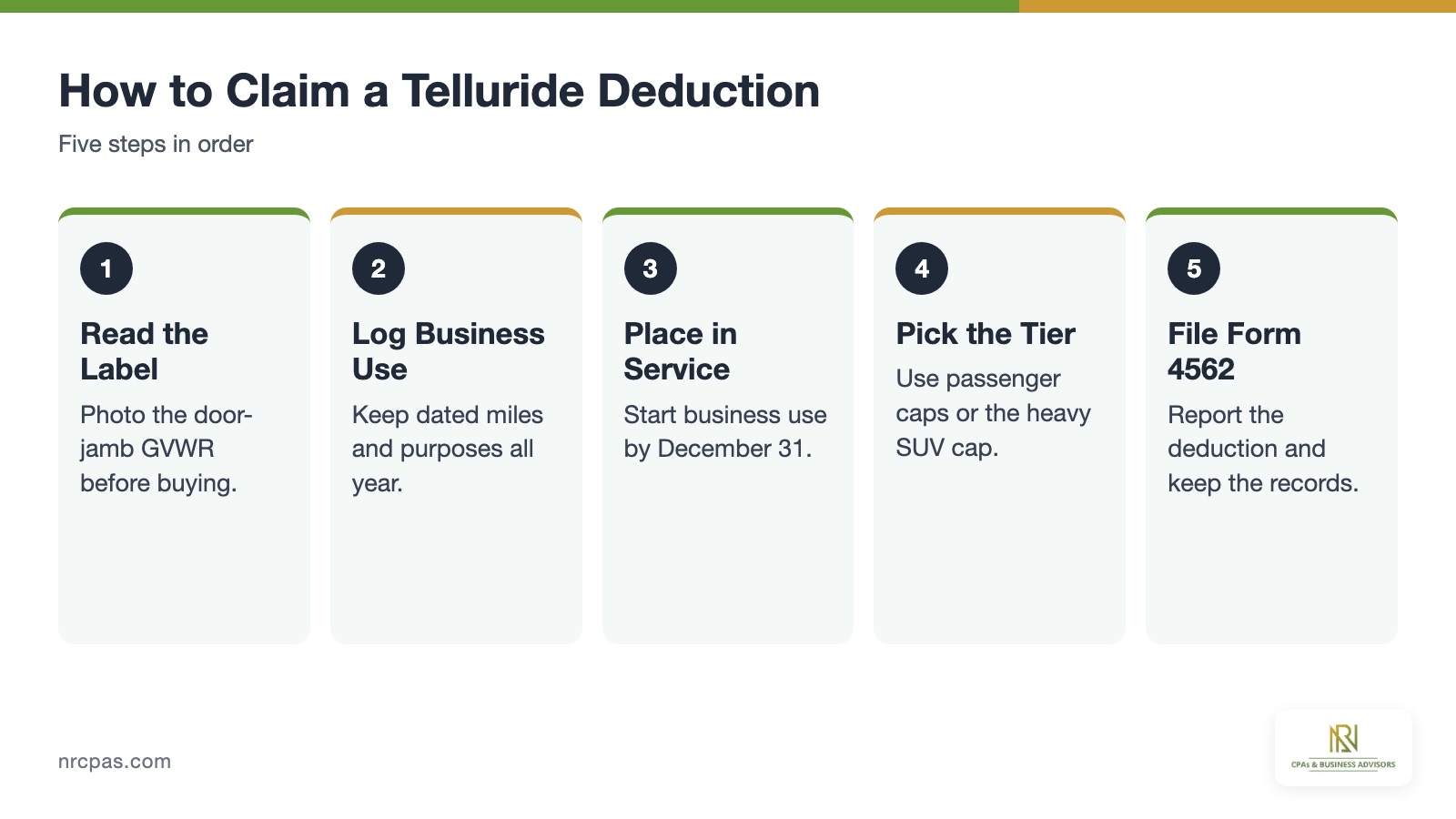
Form 4562 carries the final numbers, and Form 4562 filing follows the business-use log. Buyers who skip the log lose the deduction in an audit. A used purchase raises a separate question.
Does Kia Telluride Qualify for Section 179 and When Does It Apply to Used or Leased Models?
A used Telluride qualifies for Section 179 when the buyer acquires it from an unrelated seller and has not used it before. Bonus depreciation also covers used property.
The same weight and business-use tests apply to a used Telluride. The used vehicle rules add the unrelated-seller condition. A leased Telluride is different, because the lessee deducts lease payments instead of claiming Section 179.
Lease deductions also carry an income inclusion amount for higher-value vehicles. That leaves a group of side questions that Telluride buyers ask next.
What Other Section 179 Questions Do Telluride Buyers Ask?
What Vehicles Are Eligible for the 2026 Section 179 Vehicle Deduction?
Eligible vehicles for the 2026 Section 179 vehicle deduction are business-use cars, SUVs, pickups and vans, with different caps by weight. Passenger autos under 6,000 pounds GVWR follow the Section 280F caps. SUVs rated 6,001 to 14,000 pounds take the $32,000 cap, according to the IRS.
Seven- and eight-seat SUVs such as the Telluride fall in the SUV class. The Section 179 deduction basics apply to each of them. Vehicles that seat more than nine passengers behind the driver are exempt from the SUV cap.
Which SUVs Qualify for Section 179?
SUVs with a GVWR above 6,000 pounds qualify for the $32,000 heavy SUV cap. The BMW X5 is another model owners test against the line, and the X5 comparison shows its result. Pickups with a cargo bed of at least six feet escape the SUV cap entirely.
What Is Not Eligible for Section 179?
Vehicles used 50% or less for business are not eligible for Section 179. Property held for investment and property used mainly outside the United States also fail. A Telluride used mostly for commuting does not qualify. Commuting miles count as personal miles.
How Long Do You Have to Keep a Vehicle Under Section 179?
You must keep a vehicle under Section 179 for the five-year MACRS recovery period, with business use above 50% each year. Selling early or dropping business use triggers recapture of part of the deduction. Recapture is taxed as ordinary income.
What Records Do You Need to Claim a Telluride?
A Telluride claim needs records that prove the weight rating, the purchase and the business use. The list below shows the core file.
- A photo of the door-jamb GVWR label.
- The purchase contract and the bill of sale.
- The date the vehicle was placed in service.
- A mileage log with dates, miles and business purpose.
- Fuel, insurance and maintenance receipts for the business share.
Is Section 179 Going Away In 2026?
Section 179 is not going away in 2026. The One Big Beautiful Bill Act set the 2025 limit at $2,500,000 and the phase-out start at $4,000,000. The 2025 heavy SUV cap is $31,300. The 2026 figures rose to $2,560,000, $4,090,000 and $32,000. The 2026 limit changes follow inflation indexing.
Does Kia Telluride Qualify for Section 179 and When Does It Apply to the Hybrid?
The hybrid Telluride takes the heavy SUV cap only above 6,000 pounds GVWR. According to iSeeCars, 2027 hybrid ratings are 6,283 and 6,504 pounds. Those ratings would clear the line, but the label decides for each trim.
Can You Finance a Telluride and Still Take Section 179?
You can finance a Telluride and still take Section 179 in the year the vehicle is placed in service. The full allowed deduction does not wait for loan payments. The financed price counts as the cost basis. The caps and the business-use percentage still apply.
Can You Use the Standard Mileage Rate After Section 179?
You cannot use the standard mileage rate on a Telluride after claiming Section 179 or bonus depreciation on it. Actual expenses must be tracked in later years instead. Fuel, insurance and repair receipts then support the business share.
How Can a CPA Help With a Telluride Purchase?
A CPA can read the GVWR label, model both caps and set the in-service date before year end. We run that comparison for business owners before they sign a purchase contract. Founder Nischay Rawal, CPA, EA, leads the team at the NR CPAs homepage, and the office line is (305) 872-3096. The conversation starts with the label, the business-use log and the planned in-service date.
Owners ready to compare the capped and heavy SUV paths can start with deduction timing.