Gift Tax vs Inheritance Tax and Estate Tax Compared


The gap between gift tax vs inheritance tax is timing and payer. The giver pays any federal gift tax during life, while an heir pays state inheritance tax after a death. Only five states levy an inheritance tax in 2026, and the federal government levies none. A separate federal estate tax is paid by the estate, not by the heir.
Key Takeaways
- The donor pays any federal gift tax and files Form 709, while the recipient owes none.
- The estate pays the federal estate tax, and Form 706 is due nine months after death.
- Gift tax and estate tax share one $15,000,000 exemption per person for 2026 and a 40% top rate.
- Five states levy an inheritance tax in 2026: Kentucky, Maryland, Nebraska, New Jersey and Pennsylvania.
- Gifted property keeps the donor's cost basis, while inherited property takes the value at death.
What Is the Difference Between Gift Tax vs Inheritance Tax?
The difference between gift tax vs inheritance tax is timing, payer and level of government. Gift tax is a federal tax on transfers made during life. Inheritance tax is a state tax on property received after a death. According to the Internal Revenue Service (IRS), a gift is any transfer made without full payment in money or money's worth.
The giver, called the donor, owes any federal gift tax. The heir owes any state inheritance tax, and no federal inheritance tax exists. Households that give and inherit in one year can track all three taxes with a family office team. The table below starts the comparison.
| Feature | Federal gift tax | Federal estate tax | State inheritance tax |
|---|---|---|---|
| When it applies | Gift made during life | Death of the owner | Death of the owner |
| Who pays | Donor | Estate | Heir |
| 2026 limit | $19,000 per recipient, then the $15,000,000 exemption | $15,000,000 exemption | Set by each state |
| Top rate | 40% | 40% | 16% in Kentucky and New Jersey |
| Return | Form 709, due April 15 | Form 706, due nine months after death | State return |
The table shows one pattern. Gift tax and estate tax are federal taxes on the giver's side. Inheritance tax is a state tax on the heir's side. The graphic below compares gift tax and inheritance tax on five points.
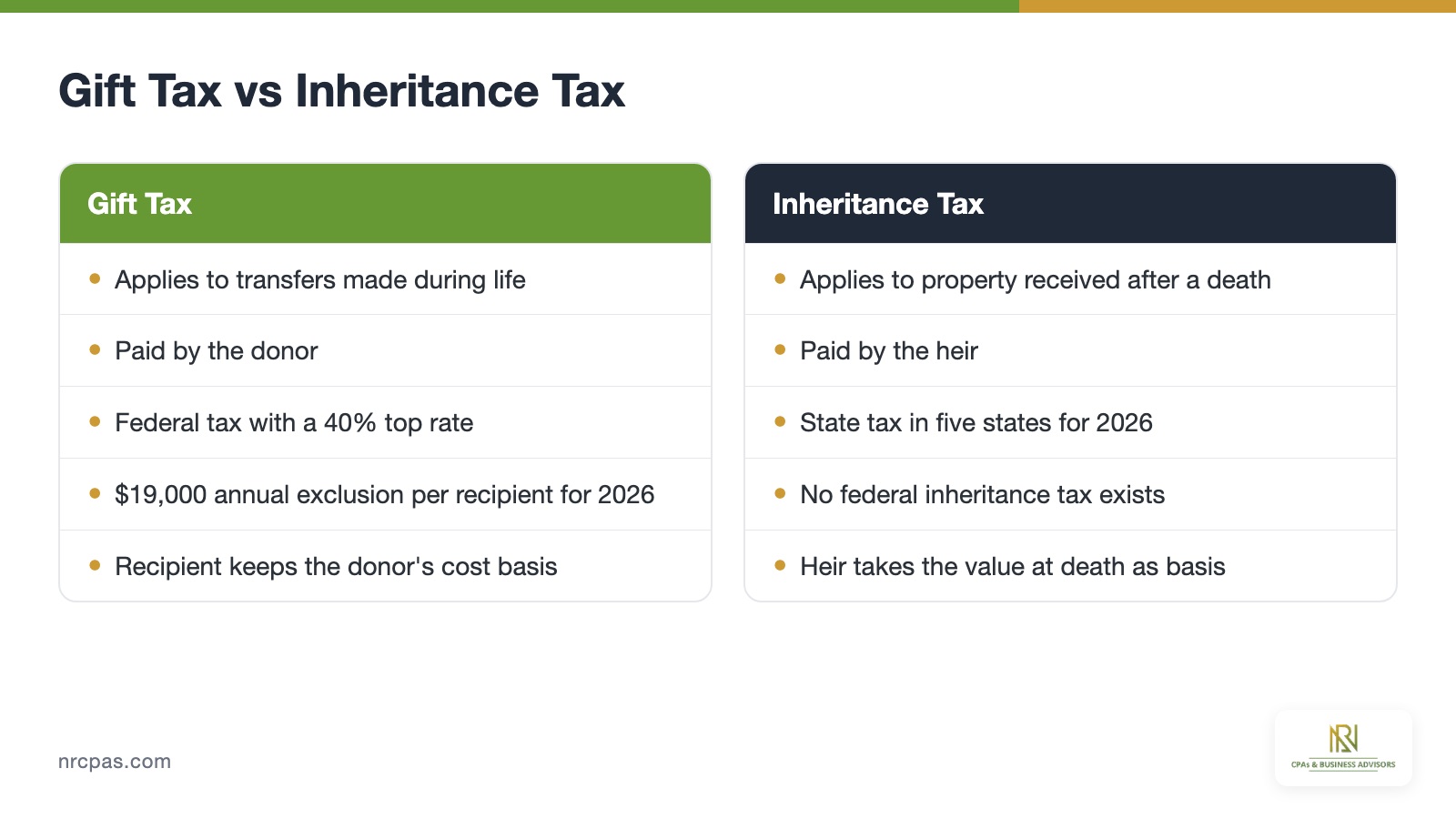
The payer is the first point to settle, and the donor comes first.
Who Pays Gift Tax, the Giver or the Receiver?
The giver pays gift tax, not the receiver. The donor pays any federal gift tax and files Form 709. According to the IRS, the donor is generally responsible for the tax, and the recipient generally owes none.
Form 709 is due April 15 of the year after the gift. A $100,000 gift in 2026 shows the math. The first $19,000 is excluded, the other $81,000 reduces the $15,000,000 lifetime exemption, and no tax is due.
Spouses who split gifts exclude $38,000 per recipient, according to the IRS. The rules on donee liability cover the one exception, a net gift, where the receiver agrees to pay the tax. That exception is rare, and the donor still files Form 709 for the gift.
The annual limits that shelter each gift set the tax-free gift amounts for a year. The gift tax payer is the donor, and death moves the payer to the estate.
Who Pays Estate Tax When Someone Dies?
The estate pays estate tax when someone dies, before assets reach the heirs. The executor files Form 706 and pays the tax from estate funds. According to the IRS, a return is required when the gross estate plus adjusted taxable gifts exceeds $15,000,000 for 2026.
The IRS sets the Form 706 due date at nine months after the date of death. An executor can request a six-month extension on Form 4768. The extension does not delay payment, because interest accrues on unpaid tax.
The top estate tax rate is 40%, according to the IRS. Heirs receive what remains after the tax. The next question is whether any federal tax lands on the heir directly.
Is There a Federal Inheritance Tax?
No, there is no federal inheritance tax, because the federal government taxes the estate instead of the heir. Only states levy an inheritance tax, and the heir pays it. Inheritance tax vs gift tax is therefore a state-versus-federal split. A state tax can apply even when the federal estate tax does not.
Fees for estate planning have their own tax treatment, and estate fee deductions follow separate rules. The federal estate tax connects to the gift tax through one shared exemption.
What Is the Difference Between Estate vs Gift Tax?
The difference between estate vs gift tax is the moment of transfer, because both taxes draw on one shared exemption. The 2026 basic exclusion amount is $15,000,000 per person for both taxes. The One Big Beautiful Bill Act, Public Law 119-21, set that amount.
According to the IRS, the 2025 amount was $13,990,000. The IRS has announced $15,480,000 for 2027. A married couple can combine two exemptions, which reaches $30,000,000 through portability.
The credit applies to gift tax first, as taxable gifts are made. Any credit left at death applies to the estate tax. A $100,000 gift in 2026 therefore leaves $14,919,000 for the estate.
The annual exclusion works apart from that shared exemption. The IRS sets the 2026 annual exclusion at $19,000 per recipient and the 2027 amount at $20,000. Gifts under the annual exclusion never touch the exemption.
Funeral costs and administration costs reduce the taxable estate, and funeral expense rules explain which ones count. Federal rules set one exemption, while states set their own, and the state list comes next.
Which States Levy an Inheritance Tax Today?
Five states have an inheritance tax in 2026, according to the Tax Foundation. The five states are Kentucky, Maryland, Nebraska, New Jersey and Pennsylvania. The table below gives the top rate and the largest exemption for each state.
| State | Top rate | Largest exemption | Estate tax too |
|---|---|---|---|
| Kentucky | 16% | $1,000 | No |
| Maryland | 10% | $1,000 | Yes, $5,000,000 exemption |
| Nebraska | 15% | $100,000 | No |
| New Jersey | 16% | $25,000 | No |
| Pennsylvania | 15% | None | No |
Older lists name six states because Iowa once taxed inheritances. According to the Iowa Department of Revenue, the Iowa inheritance tax does not apply to deaths on or after January 1, 2025. The graphic below shows the 2026 count and the main figures.
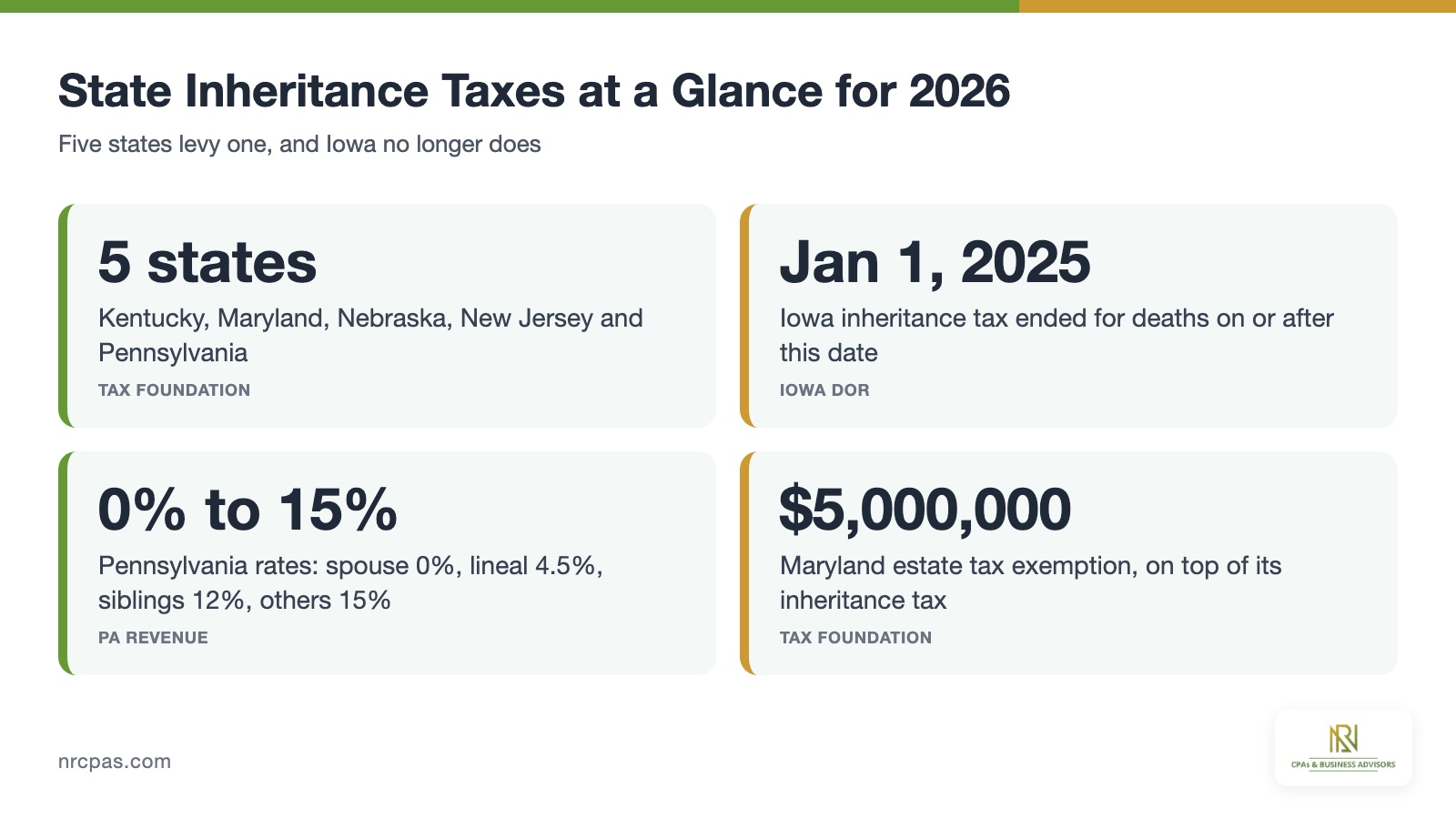
Rates depend on the heir's relationship to the person who died. According to the Pennsylvania Department of Revenue, a spouse pays 0%. Lineal heirs pay 4.5%, siblings pay 12% and other heirs pay 15%. Tax Foundation data also shows exemptions that vary by heir class in Kentucky, Nebraska and New Jersey.
Pennsylvania gives a 5% discount for payment within three months of death, and the tax turns delinquent nine months after death. Maryland is the only state with both an inheritance tax and an estate tax, according to the Tax Foundation. State rules shape how much an heir keeps, and the basis rules shape how much tax follows a later sale.
Which States Levy an Estate Tax Today?
Twelve states and the District of Columbia have an estate tax in 2026, according to the Tax Foundation. A state estate tax is paid by the estate, like the federal tax, but with its own exemption. Maryland sets a $5,000,000 exemption with rates from 0.8% to 16%.
How Does a Basis Step-Up Differ From Carryover Basis?
A basis step-up resets an heir's cost basis to value at death, while a carryover basis keeps the giver's original cost. Inherited property takes the fair market value at the date of death as its basis. According to the IRS, gifted property generally keeps the donor's adjusted basis for figuring gain.
The IRS gives a short example. A donor buys property for $10 and gives it away when it is worth $100. The recipient sells it for $100 and reports a $90 gain.
A larger case uses stock bought for $40,000 that is worth $240,000. A child who receives the stock as a gift keeps the $40,000 basis and reports a $200,000 gain on a sale. An heir who inherits the stock takes a $240,000 basis and reports no gain. The table below sets both paths side by side.
| Item | Gifted stock | Inherited stock |
|---|---|---|
| Basis rule | Carryover of the donor's cost | Step-up to value at death |
| Basis after transfer | $40,000 | $240,000 |
| Gain on a $240,000 sale | $200,000 | $0 |
| Rule for a sale at a loss | Value at the date of gift | Value at death |
The loss row follows an IRS rule on gifts. According to the IRS, a recipient figures a loss using the gift-date value. That rule applies when the value is lower than the donor's basis. A sale between those two numbers produces neither gain nor loss.
Owners who plan to sell appreciated stock can offset gains by harvesting losses. The gift vs inheritance tax result for an heir starts with basis, which is why the choice is not a simple tie.
Which Costs Less in Tax, a Gift or an Inheritance?
A gift costs less in tax when the asset is cash. An inheritance costs less when the asset has grown in value. Cash has no built-in gain, so cash gifts avoid the carryover basis problem. Appreciated property gains the most from the step-up at death.
Both routes face the same federal rates on the transfer itself. The gift tax and the estate tax share one 40% top rate and one $15,000,000 exemption. Estate size, asset type and state all change the final cost.
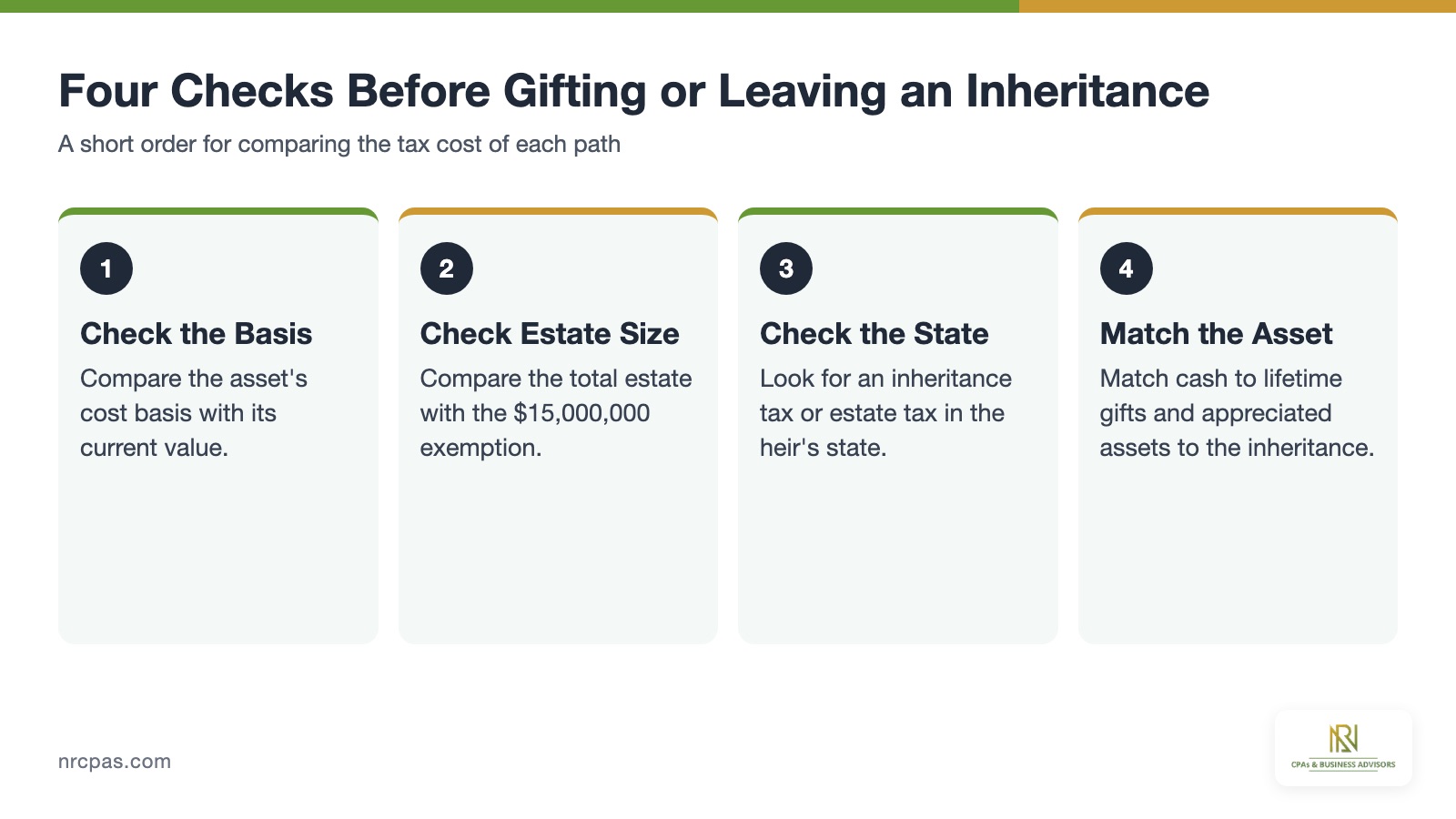
Four checks put the gift-or-inherit choice in order, and the numbered list below follows that order.
- Compare the asset's cost basis with its current value.
- Compare the total estate with the $15,000,000 exemption.
- Check the heir's state for an inheritance tax or estate tax.
- Match cash to lifetime gifts and appreciated assets to the inheritance.
The graphic below turns those four checks into a decision path.
An estate above the exemption changes the order of checks. A lifetime gift moves future growth out of the estate, which can outweigh a lost step-up. A team of tax planners models both outcomes before an asset moves.
Is It Better to Inherit or Be Gifted?
Inheriting is better for the heir's income tax when the asset has appreciated. A gift is better when the asset is cash. The heir's basis is the deciding number in any inheritance vs gift tax comparison. Wealth fees on a large portfolio add another cost, and wealth fee deductions follow their own rules.
What Else Should You Know About Gift and Inheritance Taxes?
Gift and inheritance taxes also raise questions about income tax, donations, reporting and early inheritances. The sections below answer each of those side topics in short form.
Is Gift Tax the Same as Income Tax?
No, gift tax is not the same as income tax. Gift tax applies to the transfer, and income tax applies to earnings. A gift is not income to the recipient. The comparison of gift tax vs income tax ends with earnings, since income from gifted property is taxable to the recipient.
A dividend paid on gifted stock is taxed to the recipient, not the donor. The same holds for dividends on inherited stock. A transfer tax and an income tax can therefore both apply to one asset in different years.
Is a Gift the Same as a Donation for Tax Purposes?
No, a gift to a person and a donation to a charity follow different tax rules. The gift vs donation tax split depends on the recipient. Gifts to qualifying charities are excluded from gift tax, according to the IRS.
Gifts to individuals are not deductible by the donor. The rules for deducting gifts explain the limits for each type of recipient.
How Does the IRS Know You Gave a Gift?
The IRS knows about a gift when the donor reports it on Form 709. Adequate disclosure on Form 709 starts the statute of limitations on the gift. According to the IRS, late filing can bring penalties.
How Much Tax Do You Pay on a $50,000 Gift?
A $50,000 gift to one person produces no tax in 2026 when the donor has exemption left. The first $19,000 is excluded, and the other $31,000 is reported on Form 709. The $31,000 reduces the exemption to $14,969,000, and the tax due is $0.
What Happens If You Do Not Report a Gift?
An unreported gift above the annual exclusion leaves the donor open to penalties and an open audit period. Form 709 is required even when no tax is due. The recipient owes nothing for the missed report itself.
Can You Give Your Children Their Inheritance While You Are Alive?
Yes, a parent can give children an early inheritance as lifetime gifts, unless the gifts exceed the shared exemption. Each gift above $19,000 per child is reported on Form 709. Children who receive appreciated assets as gifts take the parent's carryover basis.
Who Can Help Compare Gift Tax and Inheritance Tax?
A CPA can compare gift tax vs inheritance tax for one family before any asset moves. We review basis, exemption use and state rules together. The firm is led by founder Nischay Rawal, CPA, EA, and the office line is (305) 872-3096.
Families can start with NR CPA online and the planning team.
A written comparison lists the donor, the payer, the basis and the state for each asset. The comparison also lists each deadline, including April 15 for Form 709 and nine months after death for Form 706. Those dates keep each filing on schedule.
Each gift and inheritance plan fits into long-range estate planning, built on the numbers above.