Is a DBA a Sole Proprietorship or a Separate Business

No, a DBA is not a sole proprietorship, because a DBA is only a registered name. A sole proprietorship is a way of owning a business. The phrase what is a DBA sole proprietorship describes one owner who sells under a trade name. That owner stays personally liable, gets no separate tax status and reports all profit on Schedule C.
Key Takeaways
- A DBA (doing business as) is a trade name, also called a fictitious name or an assumed name.
- A sole proprietorship is the default structure for one owner with no registered entity, according to the Small Business Administration (SBA).
- A DBA creates no separate legal entity and adds no liability protection.
- A Florida fictitious name costs $50 and lasts 5 years, while a Florida LLC filing costs $125.
- A DBA owner reports profit on Schedule C and pays 15.3% self-employment tax.
What Is a DBA Sole Proprietorship?
A DBA sole proprietorship is a one-owner business that sells under a registered trade name instead of the owner's legal name. DBA stands for doing business as. The sole proprietorship is the business, and the DBA is only its name.
According to the SBA, a person who does business without registering another structure is a sole proprietor by default. The SBA also says a sole proprietorship has no separate business entity. The owner and the business share one legal identity.
Solo ownership is common across the country. According to the U.S. Census Bureau, the United States had 29.8 million nonemployer businesses in 2022. Those firms earned $1.7 trillion, about 6.8% of the 2022 economy. Owners who want a second opinion before filing a name can use formation CPAs to review the paperwork.
Both the name and the structure matter, so the next question is whether the name changes the structure.
Is a DBA a Sole Proprietorship or a Separate Business?
A DBA is not a sole proprietorship and not a separate business, because a DBA registers a name and nothing else. The registration attaches a second name to the same owner. The owner keeps the same assets, debts and tax return after the filing.
A structure is a legal and tax category, while a name is a label. A label cannot sign contracts, own property or owe debts. The owner behind the label does all three, as the DBA entity rules explain in detail.
Only a state filing for an LLC or a corporation creates a separate legal entity. A DBA skips that filing. Owners often mix up the three terms, so the next section sets all three side by side.
Is a DBA the Same as a Sole Proprietorship?
A DBA is not the same as a sole proprietorship, because a DBA is a name. A sole proprietorship is a structure. A sole proprietorship can exist with no DBA at all. A DBA can also belong to an LLC, which makes the two terms independent.
The table below compares a sole proprietorship, a DBA and an LLC on five points.
| Point | Sole Proprietorship | DBA | LLC |
|---|---|---|---|
| What it is | Business structure | Registered trade name | Legal entity |
| How it starts | Doing business alone | Name filing at the state or county | Articles of organization |
| Personal liability | Owner is liable | Owner is liable | Generally the company is liable |
| Florida fee | None | $50 for 5 years | $125 plus annual report |
| Federal tax form | Schedule C | Schedule C, same as the owner | Schedule C for one member by default |
The first two columns match on liability and tax, because a DBA never changes the owner. The LLC column differs on liability, and that gap shapes the filing decision in the next section.
Do You Need a DBA for a Sole Proprietorship?
You need a DBA for a sole proprietorship only when the business name differs from the owner's legal name. According to the SBA, a person who does business under a legal name registers nothing. Every other name counts as a fictitious name that most states require owners to register.
Florida defines a fictitious name as any name other than the owner's legal name. According to Florida Statutes section 865.09, an unregistered business cannot maintain a court action until it registers. Contracts stay valid, so the penalty is lost court access and not a voided sale.
Banks add a practical reason to file. According to the SBA, a DBA plus an Employer Identification Number (EIN) lets an owner open a business bank account. A check made out to a trade name cannot enter an account held only in the owner's personal name. The legal name test for sole proprietors is covered in more detail.
Once a filing is required, the owner needs a clear order of steps to add it.
How to Add a DBA to a Sole Proprietorship?
How to add a DBA to a sole proprietorship takes five steps, listed below in filing order. The steps end with a registration that makes the trade name usable for contracts and bank accounts.
- Pick a trade name with no Inc., LLC or Corp ending, because the business is none of those.
- Search the name in the state business database and in county records.
- Confirm the filing office, which is the state agency in some states and the county clerk in others.
- Complete the fictitious name form, pay the fee and run any newspaper notice the state requires.
- Keep the filing proof for the bank and diary the renewal date.
The graphic below shows the five steps in the same order.
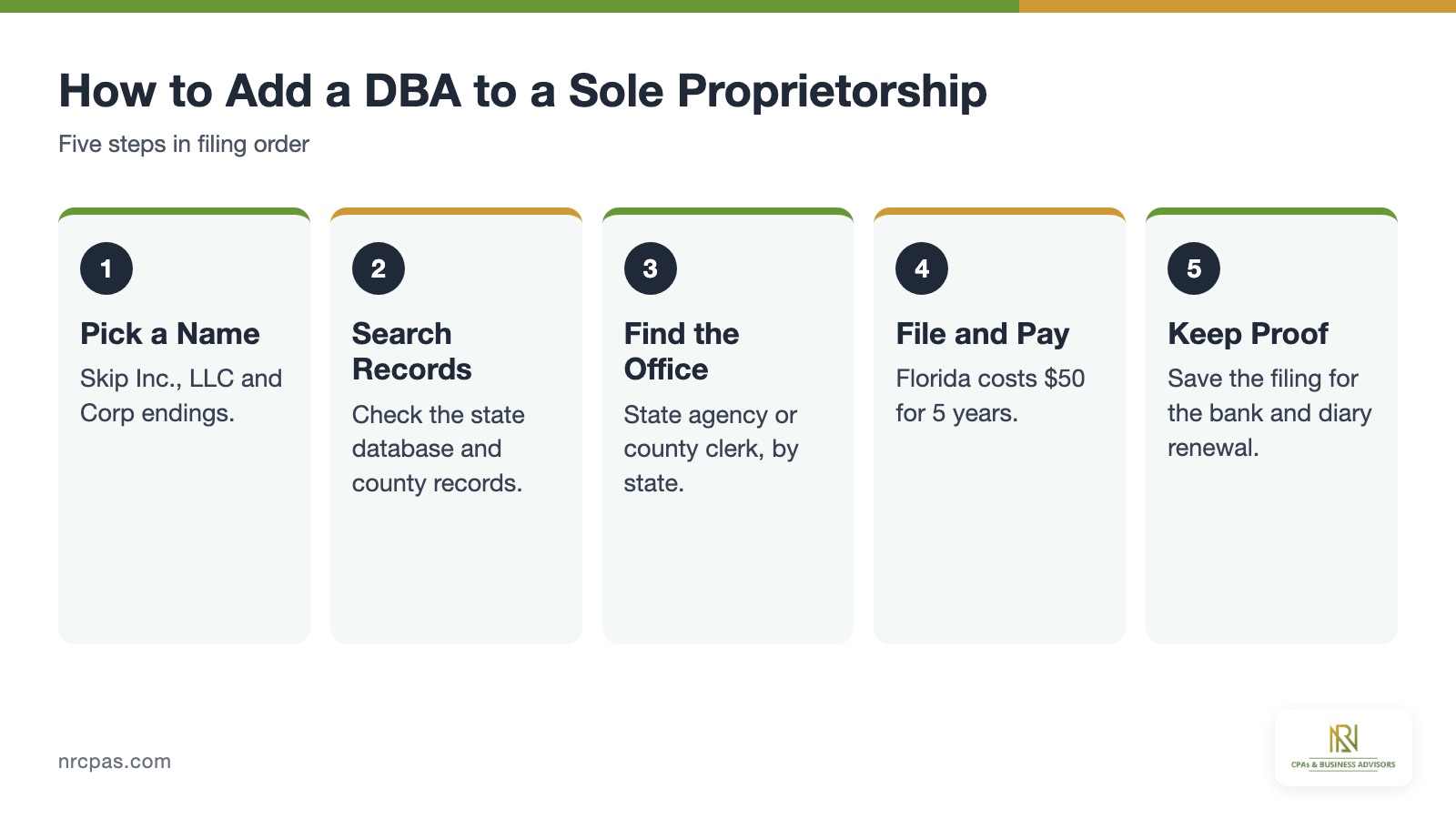
According to the Florida Division of Corporations, a fictitious name registration costs $50. Florida Statutes section 865.09 sets the term at 5 years, ending December 31 of the fifth calendar year. According to the Texas Secretary of State, an assumed name certificate on Form 503 costs $25.
Each county sets its own fee when the clerk handles the filing. A DBA filed by an LLC follows different rules, and that case is the next question.
Is a DBA Considered a Sole Proprietorship When an LLC Files It?
A DBA is not considered a sole proprietorship when an LLC files it, because the LLC is the owner of the name. The LLC keeps its own legal status, its liability shield and its filing record. The DBA only adds a second brand name to that company.
The filing lists the LLC's exact name and state document number. A single-member LLC also keeps its tax identity. The LLC tax numbers stay the same after the DBA is added.
Income tax is where the sole proprietorship label returns. According to the Internal Revenue Service (IRS), a single-member LLC is a disregarded entity by default. Its profit appears on Schedule C unless the owner files Form 8832 to elect corporate treatment. The solo LLC taxes match sole proprietor taxes for that reason, including the 15.3% self-employment tax on net profit.
One LLC can also hold several trade names. Each name needs its own filing and its own renewal date, as the guide to LLC trade names shows. Those filings add paperwork but no extra liability protection.
The LLC shield is the real difference from a bare DBA, so liability comes next.
Does a DBA Protect You From Personal Liability?
A DBA does not protect you from personal liability, because the owner and the DBA share one set of assets. According to the SBA, registering a DBA provides no legal protection by itself. A creditor of the DBA is a creditor of the owner.
A judgment can reach the home, savings and personal vehicles of a sole proprietor. One unpaid supplier invoice can therefore threaten personal accounts. Florida exemptions protect some assets, such as a qualifying homestead, but they do not stop the lawsuit.
An LLC changes that outcome. According to Florida Statutes section 605.0304, an LLC member is not liable for company debts only because of being a member. The shield holds when business and personal money stay in separate accounts.
The comparison graphic below shows how liability differs between a DBA owner and an LLC owner.
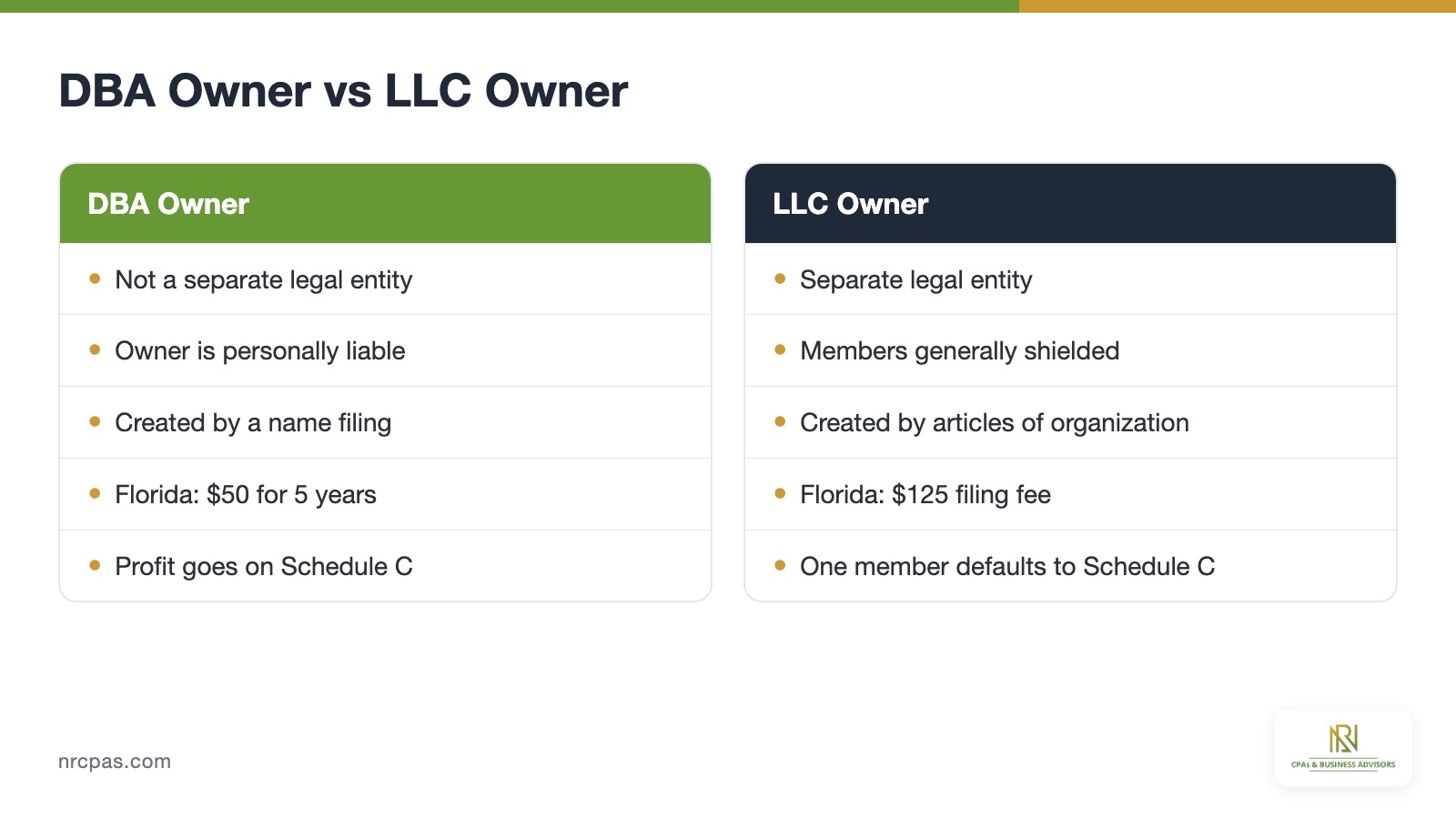
The LLC costs more to keep than a DBA. According to the Florida Division of Corporations, articles of organization cost $125. The annual report costs $138.75 when filed between January 1 and May 1. Owners with real lawsuit exposure can get LLC filing support before the first large contract.
Liability is only half of the structure choice, and the tax return is the other half.
How Is a DBA Taxed on Schedule C?
A DBA is taxed on Schedule C, because the owner reports the business as a sole proprietor. According to the IRS, sole proprietors report profit or loss on Schedule C and attach it to Form 1040. A DBA files no separate return and pays no separate income tax.
According to the IRS, each sole proprietorship needs its own Schedule C. An owner with two DBAs that are two separate businesses files two forms. One DBA used for one business needs only one form.
The profit on Schedule C also carries self-employment tax. The list below gives the federal figures for a DBA owner.
- According to the IRS, self-employment tax is 15.3%, made of 12.4% Social Security and 2.9% Medicare.
- According to the IRS, net earnings of $400 or more require Schedule SE.
- According to the Social Security Administration (SSA), the 2026 Social Security wage base is $184,500.
- According to the IRS, self-employment tax applies to 92.35% of net profit.
- According to the IRS, an Additional Medicare Tax of 0.9% applies to earnings above $200,000 for single filers.
Owners can subtract half of that tax from income, as the SE deduction rules show. According to the IRS Form 1040-ES instructions, estimated payments are due when an owner expects to owe $1,000 or more.
A DBA owner may also claim the 20% qualified business income (QBI) deduction. According to the IRS, the 2026 taxable income threshold is $201,750 for single filers. The QBI write-off applies to a sole proprietor the same way with or without a DBA.
The flow graphic below traces a DBA sale from the customer to Form 1040.
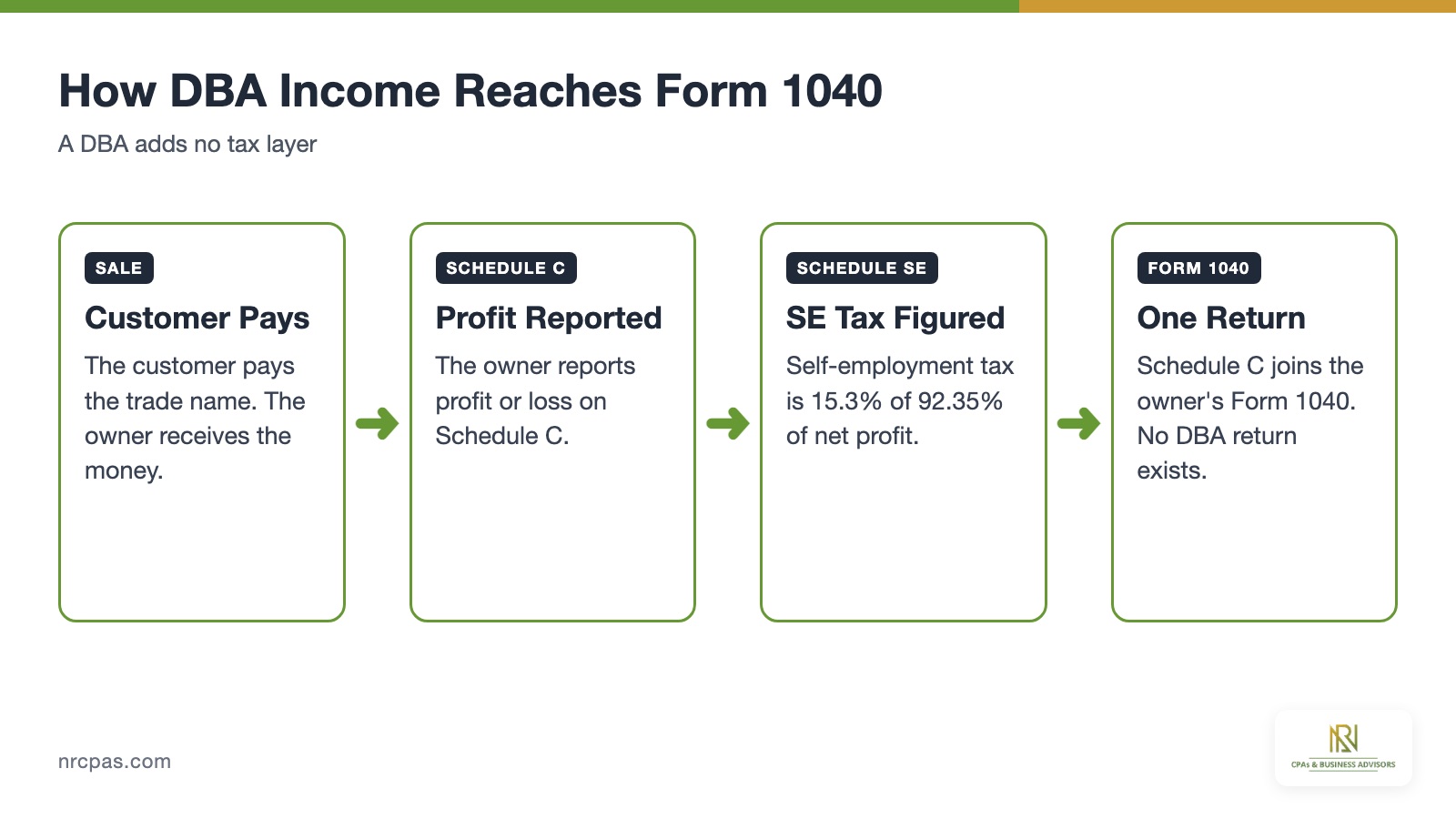
The graphic shows why the name never changes the tax result. Several side topics around names, banks and trademarks add detail to that picture.
What Else Should a DBA Sole Proprietor Know Before Filing?
A DBA sole proprietor should also know how the name works at the bank, on tax forms, across counties and against trademarks. The sections below answer each side topic in short form.
Is DBA and Sole Proprietorship the Same When Opening a Bank Account?
No, DBA and sole proprietorship are not the same when opening a bank account. The bank checks the name filing and the owner separately. The bank asks for the owner's identification and the DBA certificate. A sole proprietor without a DBA can still open an account in the owner's legal name.
Is a Sole Proprietorship the Same as a DBA on Tax Forms?
No, a sole proprietorship is not the same as a DBA on tax forms, because the IRS has no DBA form. The DBA name fills line C of Schedule C, which stays blank when no separate name exists. Line D holds an EIN, and the owner's Social Security number stays on Form 1040.
According to the IRS, a sole proprietor with no employees and no excise or pension plan returns needs no EIN. The owner can use a Social Security number instead.
Do I Need to File a DBA for a Sole Proprietorship in Every County?
An owner needs to file a DBA for a sole proprietorship in each place that requires one. A filing covers only its own jurisdiction. Florida registers fictitious names with the state. New York and Texas sole proprietors file with the county clerk. The clerk confirms the local rule before the owner pays a fee.
Does a DBA Give Trademark Rights?
A DBA does not give trademark rights, because a name filing records the owner and not the brand. According to the U.S. Patent and Trademark Office (USPTO), the base trademark application fee is $350 per class. A federal trademark is the filing that lets an owner stop a similar name.
When Should a Sole Proprietor With a DBA Form an LLC?
A sole proprietor with a DBA should form an LLC when lawsuit risk, employees or growing profit make personal liability costly. The LLC upgrade path keeps the trade name and moves it under the new company.
An LLC can later elect S corporation status. That election changes how payroll tax applies to profit, as the S status benefits show for owners with steady profit.
Who Can Help a Sole Proprietor Choose a Structure?
A CPA firm can help a sole proprietor compare a DBA, an LLC and an S corporation on liability and tax cost. We review the owner's income, risk and growth plans before any filing.
The team at NR tax firm is led by founder Nischay Rawal, CPA, EA. Reach the office at (305) 872-3096. The answer to what is a DBA sole proprietorship stays short: one owner, one trade name and no new entity.
A sole proprietor who is ready to add a shield can start with entity guidance from the formation team.