Profit and Loss Statement for Small Business and How to Make One


A profit and loss statement for small business is a report that subtracts costs and expenses from revenue over one period. The result is net profit or net loss. Net profit equals total revenue minus total expenses, and the period can be a month, quarter or year. Owners make one in six steps, from picking a period to matching totals with bank records.
Key Takeaways
- A profit and loss (P&L) statement, also called an income statement, covers a period, while a balance sheet covers one date.
- Gross profit equals net revenue minus cost of goods sold, and net profit comes after operating expenses and interest.
- Monthly reporting catches cost problems early, while yearly reporting hides a problem for 12 months.
- Sole proprietors copy P&L totals to Schedule C, and net profit of $400 or more triggers 15.3% self-employment tax.
- Restaurants track prime cost, and nonprofits use a statement of activities instead of a P&L.
What Is a Profit and Loss Statement for Small Business Owners?
A profit and loss statement for small business owners is a financial report that lists revenue, costs and expenses for one period. The report ends with net profit or net loss, the bottom line. Accountants also call the same report an income statement or an earnings statement.
The report matters because small firms are everywhere and survival is uneven. According to the U.S. Small Business Administration (SBA) Office of Advocacy, the country has 36.2 million small businesses. According to the Bureau of Labor Statistics (BLS), 79.6% of private establishments born in March 2013 were still open in March 2014. Only 34.7% were still operating in March 2023.
Owners who read a P&L every month see cost problems before those problems end a business. A bookkeeper or CPA can produce monthly profit reports from the same ledger the tax return uses. That ledger feeds every line of the report, so the lines come next.
What Does a Small Business Profit and Loss Statement Include?
A small business profit and loss statement includes revenue, cost of goods sold, gross profit, operating expenses, operating income and net profit. Each line subtracts one more layer of cost from the line above it. The list below shows the six sections from top to bottom.
- Revenue: money earned from sales or services, less returns and discounts, which leaves net revenue.
- Cost of goods sold (COGS): the direct cost of products or delivered services, such as materials, direct labor and packaging.
- Gross profit: net revenue minus COGS.
- Operating expenses: rent, office payroll, marketing, insurance, software, utilities and depreciation.
- Operating income: gross profit minus operating expenses.
- Net profit: operating income minus interest, other expenses and entity-level income tax.
Revenue sits at the top, and the sales revenue line should match the invoices and deposits for the period. Revenue only counts income earned, so loans and owner deposits stay off the report.
COGS changes with each sale, while operating expenses stay fixed even in a month with zero sales. Owner pay follows its own rule. A sole proprietor's draw is not an expense, so a draw never lowers net profit. An S corporation owner's W-2 wages are an expense. Those definitions set up the build, which turns the lines into steps.
How Do You Make a Profit and Loss Statement Step by Step?
To make a profit and loss statement, follow the six steps in the numbered list below. How to make a profit and loss statement starts with one fixed reporting period, because mixed periods break every comparison.
- Pick one reporting period, such as a month, and keep the same period every time.
- Gather sales reports, bank statements, credit card statements and vendor invoices for that period.
- Total revenue and subtract returns and discounts to reach net revenue.
- Subtract cost of goods sold from net revenue to reach gross profit.
- List operating expenses by category and subtract them to reach operating income.
- Subtract interest and any entity-level income tax to reach net profit, then match the totals to bank records.
The steps graphic below shows the same six actions in order.
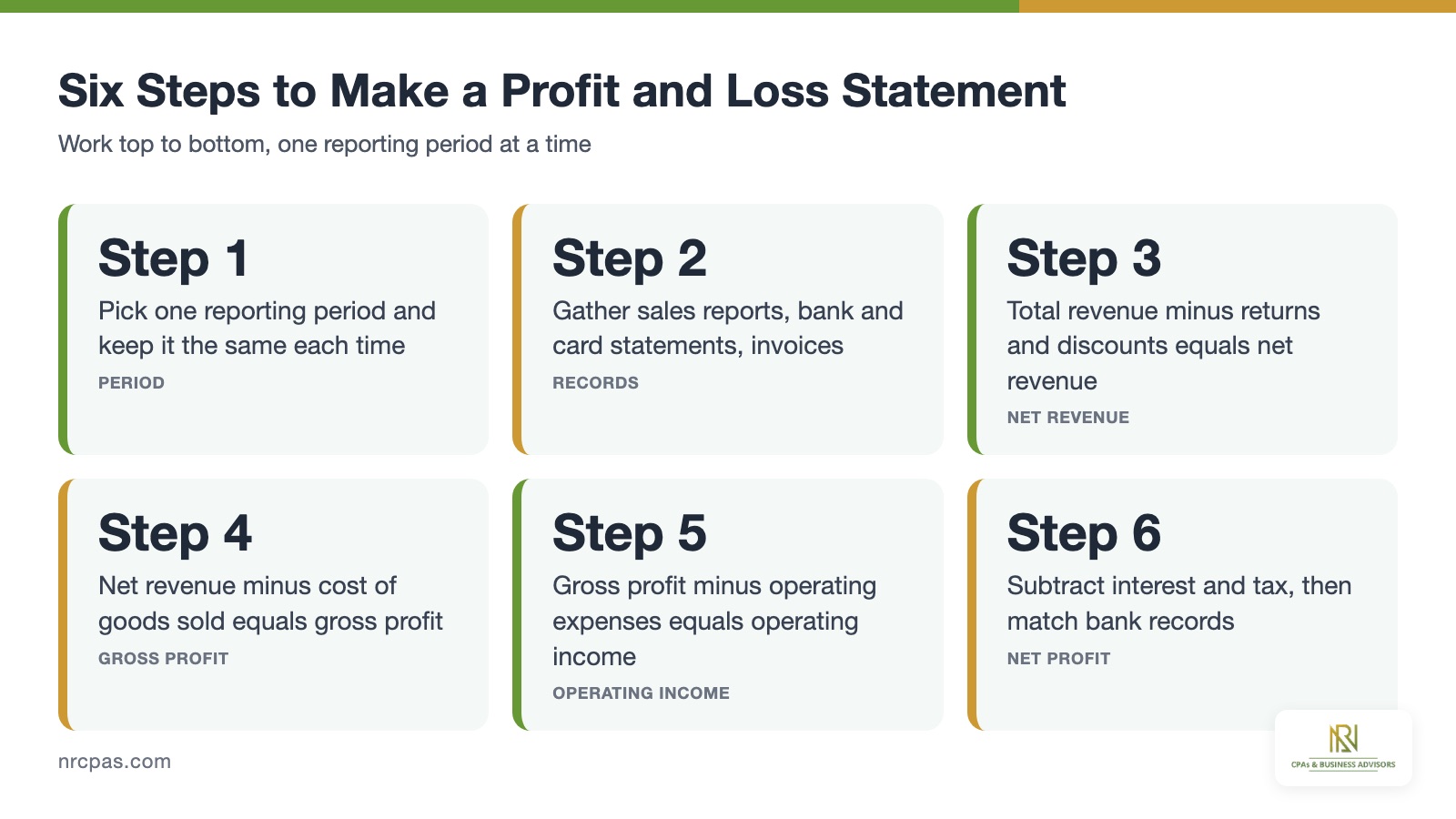
A simple profit and loss statement keeps one line per category and fits on one page. Step 2 takes the longest because every receipt needs a category. Clean categories make the finished report easy to read. Numbers make the steps concrete, so one full profit and loss statement comes next.
What Does a Profit and Loss Statement Example Look Like?
A profit and loss statement example for a retail shop with $250,000 of gross sales appears in the table below. The shop earns $30,000 of net profit, a 12.5% net profit margin. The table has 9 rows and 3 columns.
| Line Item | Amount | Percent of Net Revenue |
|---|---|---|
| Gross sales | $250,000 | Not applicable |
| Returns and discounts | ($10,000) | Not applicable |
| Net revenue | $240,000 | 100.0% |
| Cost of goods sold | ($96,000) | 40.0% |
| Gross profit | $144,000 | 60.0% |
| Operating expenses | ($111,600) | 46.5% |
| Operating income | $32,400 | 13.5% |
| Interest expense | ($2,400) | 1.0% |
| Net profit before tax | $30,000 | 12.5% |
The $111,600 of operating expenses breaks into rent of $24,000 and payroll of $60,000. Marketing adds $9,600, insurance $4,800, software and utilities $7,200, and depreciation $6,000. The flow graphic below traces $240,000 of net revenue down to $30,000 of net profit.

Readers who want a longer sample can study an income statement example with more lines. The percent column in the table also sets up the next skill, which is reading the report.
How Do You Read a Profit and Loss Statement?
Read a profit and loss statement from the top down, then compare each margin with the prior period. Gross margin and net profit margin are the two ratios to check first. Gross margin equals gross profit divided by net revenue, so the shop's 60% means 60 cents of every sales dollar survives COGS.
Net profit margin equals net profit divided by net revenue, which gives the shop 12.5%. A 3-point drop in gross margin points to supplier price increases, heavy discounts or waste. Compare the same month across two years and the same lines across consecutive months.
Expense lines deserve the same attention. Marketing that doubles while revenue stays flat is a warning, and a utility bill that jumps 30% needs a cause. Net profit also flows into equity, so the three financial statements must tie to each other. Any unexplained difference in equity or retained earnings signals an error.
Profit is not cash either. A shop can show $30,000 of profit and still run short of money. A cash flow statement reveals that gap between profit and cash. Every margin depends on when income and expenses are counted, and that timing depends on the accounting method.
Should a Small Business Use Cash or Accrual Accounting on a Profit and Loss Statement?
A small business can use cash or accrual accounting on a profit and loss statement. The method changes when each dollar is counted. Cash-basis reports count revenue when payment arrives, and accrual reports count revenue when it is earned. Expenses follow the same split, so a December invoice paid in January lands in different years.
The IRS limits the cash method for some entity types. According to the Internal Revenue Service (IRS), the Section 448 limit is $31 million of average gross receipts for 2025. The 2026 limit is $32 million. C corporations and partnerships with a C corporation partner above that limit must use accrual accounting.
Pick one method and keep it, because switching methods requires IRS Form 3115. The cash method is easier to maintain, while accrual shows true monthly results. A team of financial statement experts can set the method up once and keep every period comparable. The method choice leaves a few side topics, such as restaurants, nonprofits and tax returns.
Which Other Questions Shape a Small Business P&L?
Seven side topics change how a P&L is built or used, and each one is answered below in short form.
What Is a Profit and Loss Statement for a Restaurant?
A profit and loss statement for a restaurant adds labor and prime cost to the standard lines. Prime cost equals cost of goods sold plus labor costs. Restaurants split sales into food, beverages and catering, and card processing fees sit in operating expenses.
According to the National Restaurant Association, 42% of operators said their restaurants were not profitable in 2025. The association projects 2026 industry sales of $1.55 trillion and 15.8 million jobs. Owners who watch prime cost every week spot margin pressure early, and detailed restaurant financials also separate dine-in, takeout and delivery sales.
What Is the Profit and Loss Statement for Nonprofit Organization Reporting?
The profit and loss statement for nonprofit organization reporting is the statement of activities. The statement of activities reports revenue, expenses and the change in net assets. A positive change is a surplus, and a negative change is a deficit.
According to the Financial Accounting Standards Board (FASB), Accounting Standards Update 2016-14 was issued on August 18, 2016. The update sorts net assets into two classes, with donor restrictions and without donor restrictions. It took effect for calendar-year 2018 reports.
Expenses also split into program services, management and general, and fundraising. According to the IRS, Form 990-EZ fits organizations with gross receipts under $200,000 and total assets under $500,000. Form 990-N covers gross receipts that are normally $50,000 or less. Boards read nonprofit statements next to the filed return.
Where Does a Profit and Loss Statement Go on a Tax Return?
A profit and loss statement feeds the business income section of the tax return. Sole proprietors copy gross receipts to line 1 of Schedule C and net profit to line 31. S corporations file Form 1120-S, and partnerships file Form 1065.
According to the IRS, self-employment tax is 15.3% when net earnings reach $400. According to the Social Security Administration (SSA), the Social Security part applies to the first $184,500 of 2026 earnings. The shop's $30,000 profit times 92.35% leaves $27,705, so the tax is about $4,239.
Platform reports must match revenue as well. According to the IRS, Form 1099-K applies above $20,000 and 200 transactions. According to the IRS, business records stay for 3 years, or 6 years when unreported income exceeds 25%. Early net profit planning uses the P&L to shape the tax bill before year end.
Where Can You Find a Profit and Loss Statement Template?
A profit and loss statement template is a spreadsheet with the lines from the table already built. A usable template has monthly columns, a total column and formulas that sum every row. Add rows for new expense categories, then confirm the totals still capture them.
Save each finished month as a PDF so the original numbers never change. A template calculates, but the owner still assigns each cost to COGS or operating expenses.
What Mistakes Make a Profit and Loss Statement Wrong?
Six mistakes make a profit and loss statement wrong, and the list below names them.
- Putting rent or office payroll in COGS, which understates gross profit.
- Missing small cash purchases, refunds and subscriptions.
- Switching between cash and accrual from one period to the next.
- Reporting once a year instead of every month.
- Counting owner draws as expenses.
- Skipping the reconciliation of net profit to the balance sheet and bank records.
Monthly review catches these errors while the records are fresh. A part-time CFO partner can own that review for owners without a finance team.
Is a Profit and Loss Statement for a Small Business Different From a Balance Sheet?
Yes, a profit and loss statement for a small business differs from a balance sheet. The P&L covers a period, while the balance sheet captures one date. The P&L measures performance, while the balance sheet measures what the business owns and owes. The comparison graphic below lines up both reports.
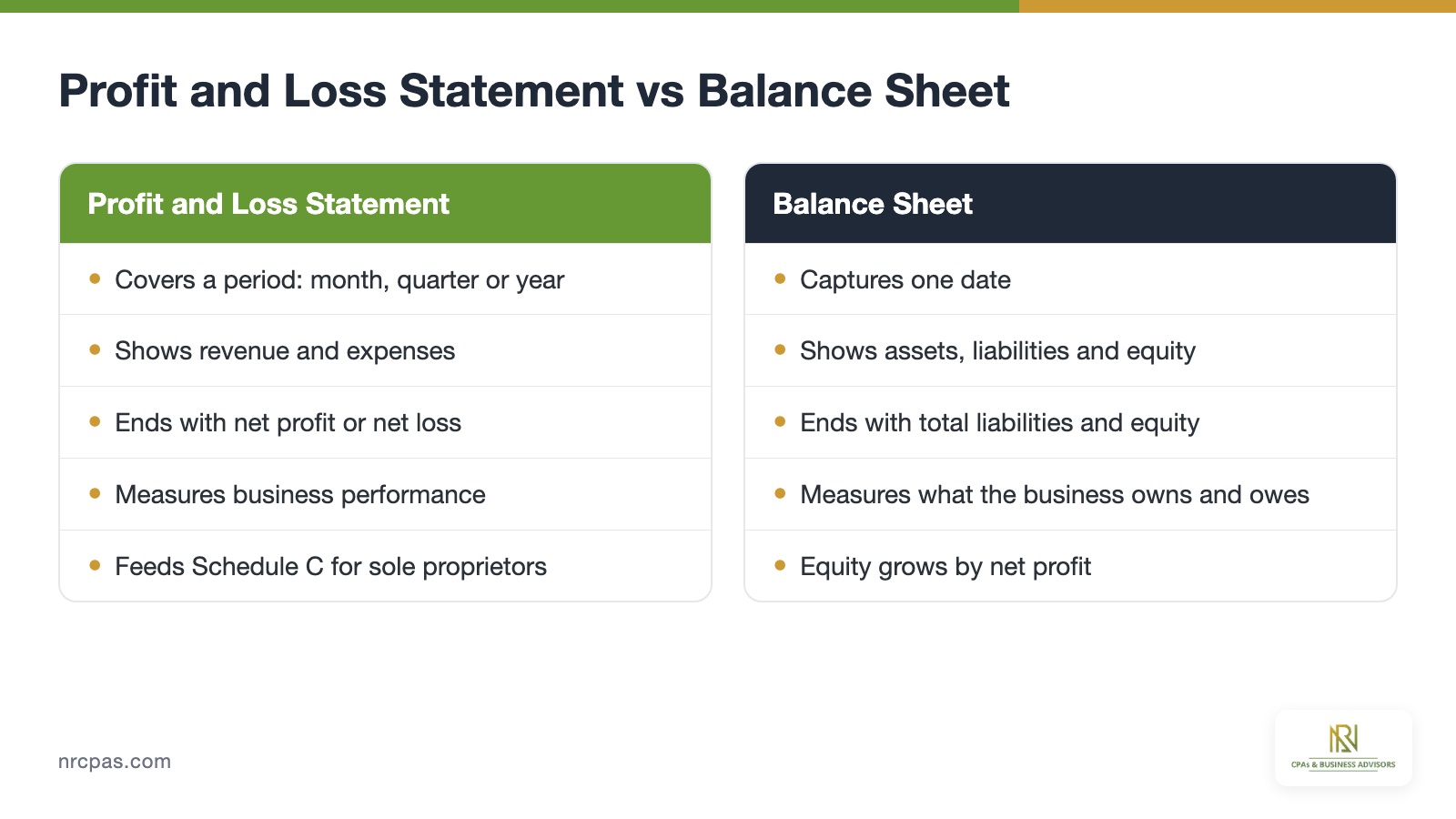
Net profit from the P&L closes into equity, which links both reports. A full balance sheet comparison shows the line-by-line differences.
Who Can Help Prepare a Small Business Profit and Loss Statement?
A CPA, an enrolled agent or a bookkeeper can prepare a small business profit and loss statement. We build monthly P&L reports and tax-ready statements for owners across the country. The firm is led by founder Nischay Rawal, CPA, EA, and the office line is (305) 872-3096.
Owners can meet the NR CPA staff and review the services the firm offers, from monthly reporting to tax planning.
Owners who want every period to stay comparable, accurate and ready for lenders and tax filing can request a monthly statement package.