What Is a Family Office in Wealth Management


A family office is a private firm that runs the investments, taxes, estate plans and daily finances of a wealthy family. The firm acts as the family's own financial headquarters. According to Deloitte, 8,030 single family offices operated worldwide in 2024. A single family office serves one family, while a multi-family office shares one team across several unrelated families.
Key Takeaways
- A family office coordinates investments, tax filings, estate plans and household administration for one family or a few families.
- The three types are the single family office, the multi-family office and the virtual family office.
- A wealth manager serves many clients, while a family office serves one family and manages its whole balance sheet.
- No law sets a minimum net worth, and cost sets the practical threshold at about 0.6% of assets for small offices.
- The SEC family office rule excludes a qualifying family office from investment adviser registration.
What Is a Family Office for Wealth Management?
A family office for wealth management is a private team that runs a wealthy family's full financial life. A family office coordinates investments, tax filings, estate plans and household administration under one roof. The office is a team, and that team may sit inside the family or at an outside firm.
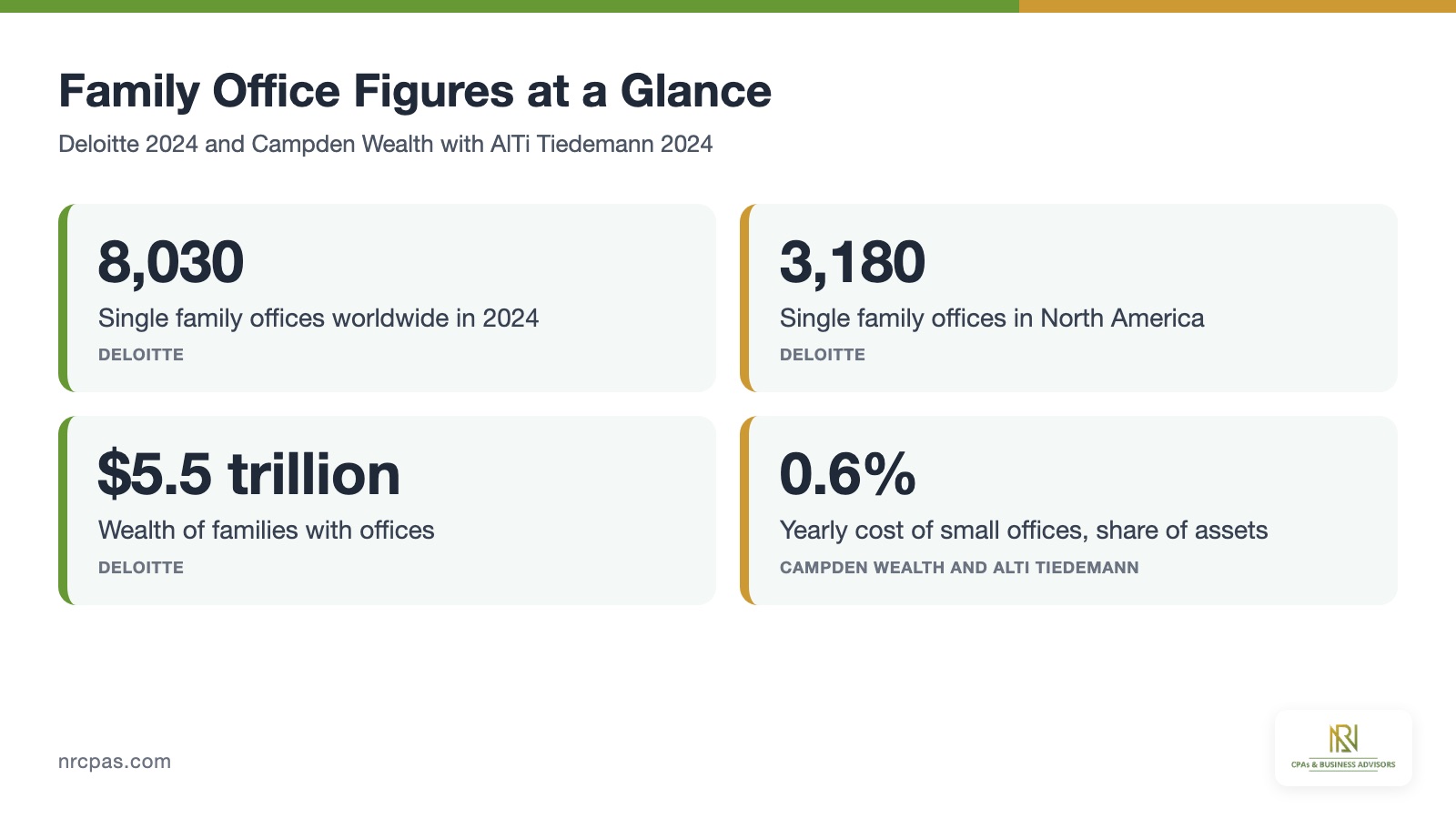
The scale of this industry is measurable. According to Deloitte, families with single family offices held about $5.5 trillion of wealth in 2024. Deloitte put the assets under management (AUM) of those offices at $3.1 trillion. Deloitte counted 3,180 of the 8,030 offices in North America.
Families can use an outsourced family office for this coordination without hiring staff. A CPA firm delivers the same oversight under that model. Outsourcing changes who employs the team, not the work the team does. That work is the next question.
What Services Does a Family Office Provide?
Family office services cover investment oversight, tax and accounting, estate planning, philanthropy and household administration. The five core functions appear in the list below.
- Investment oversight: asset allocation, manager selection and performance reporting across public and private holdings.
- Tax and accounting: income tax returns, trust and estate returns, bookkeeping and consolidated statements.
- Estate and succession planning: wills, trusts, gifting and the handover of wealth between generations.
- Philanthropy: private foundations, donor-advised funds and grant tracking.
- Administration and lifestyle: bill pay, insurance, property, household staff and travel coordination.
Each function needs a different professional, and the family office connects those professionals through accurate consolidated reporting. A tax decision can change an investment structure, and a trust distribution can change liquidity. According to the Umbrex family office playbook, the key word in the definition is integrated. Integrated decisions need one team that sees the full picture, so the team structure comes next.
What Are the Types of Family Offices?
The types of family offices are the single family office, the multi-family office and the virtual family office. Each type differs in who the clients are, who employs the staff and how costs are shared. Any answer to what is a family office for wealth management must name all three types.
What Is a Single Family Office?
A single family office is a private company that serves one family and employs its own staff. Deloitte surveyed 354 single family offices for its 2024 report. The average office in that survey managed $2.0 billion, and the average family wealth was $3.8 billion.
The single family office gives one family full control and full privacy. That control carries payroll, rent and compliance costs, and a shared model spreads those costs across more families.
What Is a Multi-Family Office?
A multi-family office is a firm that serves several unrelated families with one shared team. The shared team splits salaries, technology and research across every client family. The multi-family office costs each family less than a private office but gives each family less direct control. Some families accept that trade, and others remove the office building altogether.
What Is a Virtual Family Office?
A virtual family office is a set of family office services delivered by an outside team instead of in-house employees. A lead advisor, a CPA, an attorney and shared software deliver the services remotely. The virtual model keeps the coordination and drops the payroll. Dedicated family office accounting supplies the records that the lead advisor needs. Clear data rules matter here, because several outside teams touch the same family records.
The table below compares the three types by client base, staffing and cost pattern.
| Type | Clients | Staff | Cost pattern |
|---|---|---|---|
| Single family office | One family | Employed by the family | Highest fixed cost, full control |
| Multi-family office | Several families | Employed by the firm | Shared cost, less control |
| Virtual family office | One family or a few | Outside CPAs, advisors and attorneys | Lower fixed cost, one lead advisor |
The comparison graphic below lines up the single family office and the multi-family office on control, privacy and cost.

Each type overlaps with another financial professional, the wealth manager, so the contrast between them needs its own answer.
How Is a Family Office Different From a Wealth Manager?
A family office differs from a wealth manager in client count and in scope. A wealth manager serves many clients and mainly manages investments. A family office serves one family and manages the whole balance sheet. The family office vs wealth manager comparison appears in the table below.
| Feature | Wealth manager | Family office |
|---|---|---|
| Clients | Many unrelated clients | One family or a small group |
| Scope | Investments and planning | Investments, tax, estate, administration and governance |
| Service model | Standard offering for each client | Structure set by the family |
| Advisor role | Delivers portfolio advice | Coordinates every advisor |
The two models work together in practice. A family office hires wealth managers for portfolio work, then compares their advice against the family's goals. Joint family tax planning keeps the tax advisor and the portfolio manager aligned. According to Umbrex, a mature family office relies on outside advisors more effectively, not less.
Advisor coordination has a price, so the next question is how much wealth supports it.
How Much Money Do You Need for a Family Office?
No law sets a minimum net worth for a family office, so advisors set the practical bar by cost. A Morgan Stanley adviser writing in Kiplinger advises a traditional family office only above $100 million of total net worth. The same adviser says assets below $50 million fit a regular advisor team.
Those thresholds sit far above typical household wealth. According to the Federal Reserve's 2025 Survey of Consumer Finances, median U.S. family net worth is $215,900. The same survey puts mean net worth at $1.24 million.
The gap between the median and the mean points to concentration at the top. According to the Federal Reserve, the top 1% held 32.5% of household net worth in the second quarter of 2026. A family office serves a narrow group of families far above those national figures.
The minimum net worth for a family office sets eligibility, and the annual budget sets sustainability. That budget is the next question.
How Much Does a Family Office Cost?
The cost of a family office depends on size. The 2024 report from Campden Wealth and AlTi Tiedemann measured cost as a share of assets. That report surveyed 98 family offices, mostly in North America, with average assets of $1.4 billion. Small offices spent about 0.6% of assets each year, and large offices spent about 0.2%.
The math shows the scale. On $100 million of assets, 0.6% equals $600,000 a year. On $2 billion of assets, 0.2% equals $4 million a year.
Costs cover salaries, technology, outside advisor fees and investment fees. The tax treatment of investment advisory fees is a separate budget line. Spreading those costs across families is the reason the multi-family model exists.
The statistics graphic below collects the family office figures from this section and the first section.
Cost is one gate, and regulation is the other.
What Is the SEC Family Office Rule?
The SEC family office rule is the Securities and Exchange Commission regulation that excludes qualifying family offices from the investment adviser definition. The commission adopted the rule on June 22, 2011, and it took effect on August 29, 2011. A family office that meets the rule does not register as an investment adviser.
The rule sets three conditions, shown in the list below.
- The office has no clients other than family clients.
- Family clients wholly own the office, and family members or family entities exclusively control it.
- The office does not present itself to the public as an investment adviser.
The three conditions appear in the steps graphic below.

The rule defines family clients in 11 categories, which include family members, key employees, certain trusts, estates and charities. A family member is any lineal descendant of a common ancestor. That ancestor may be no more than 10 generations removed from the youngest generation.
A multi-family office serves unrelated families, so the exclusion does not cover that structure. Multi-family firms follow the ordinary investment adviser rules instead. Registration is one legal question, and taxes are the next set of questions.
What Else Should Families Know Before Starting a Family Office?
Families weighing a family office also need the tax filings, the drawbacks, the legal structure and the reporting roles. The side topics below answer each one in short form.
Which Taxes and Filings Does a Family Office Handle?
A family office handles gift, estate, trust and foreign account filings along with income tax returns. According to the Internal Revenue Service (IRS), the 2026 basic exclusion amount for estates is $15,000,000. That amount was $13,990,000 in 2025.
The IRS sets the 2026 annual gift exclusion at $19,000 per recipient. The annual exclusion amount resets each year and does not use any lifetime exemption. Form 709 reports taxable gifts, Form 706 reports estates, and Form 1041 reports trust income.
Foreign accounts add a separate report. According to the IRS, the Report of Foreign Bank and Financial Accounts (FBAR) is required when foreign accounts exceed $10,000. The FBAR is due April 15, with an automatic extension to October 15. Families with overseas holdings can review foreign account reporting before the deadline.
What Are the Disadvantages of a Family Office?
The disadvantages of a family office are cost, management time and shared confidentiality. A family office does not replace trust or communication between family members. The Kiplinger adviser notes that hiring staff means interviews, benefits, performance reviews and personal responsibility for every employee.
Umbrex adds that an office built before the family agrees on expectations can harden an unresolved conflict. The virtual model reduces the staffing burden but adds coordination across outside teams.
What Legal Structure Does a Family Office Use?
A family office can be organized as a limited liability company (LLC), a corporation, a partnership or a trust. The structure affects tax filings, liability and who controls decisions. Families can form the office and its investment entities together.
The setup work includes operating agreements, ownership records and bank accounts for each entity. Careful LLC holding entities keep those records clean from the first filing.
How Do Investment Losses Fit Into Family Office Tax Work?
Investment losses fit into family office tax work as an offset against realized gains. Tax-loss harvesting sells a losing position so the loss reduces taxable gains elsewhere. A family office tracks those losses across every account and entity.
Tracking losses across entities prevents missed offsets at year end. A single ledger of capital loss harvesting shows which accounts have losses to use.
Who Leads Financial Reporting Inside a Family Office?
A chief financial officer or controller leads financial reporting inside a family office. The leader builds the consolidated balance sheet, the cash forecast and the entity-level statements. One consolidated set of numbers gives every advisor the same view.
Smaller families can hire part-time CFO-level oversight instead of a full-time executive.
How Does a Family Office Plan for the Next Generation?
A family office plans for the next generation through governance rules, trusts, gifting and a written succession roadmap. Succession planning names who decides, who advises and who inherits control. Families that own operating businesses add generational planning for the company itself.
How Can a Virtual Family Office Support a Family?
A virtual family office supports a family by coordinating the CPA, the attorney and the investment advisor through one lead team. We build consolidated statements, tax calendars and gift tracking for families that want that structure. Families asking what is a family office for wealth management should begin by listing their entities, accounts and advisors.
The team at NR CPA main is led by founder Nischay Rawal, CPA, EA. Reach the office at (305) 872-3096. The team prepares consolidated statements for families with several entities, trusts and accounts in different states.
Families that start with one consolidated balance sheet from a family office CPA can add investment and estate coordination later.