What Should a Business Plan Look Like Section by Section


A business plan should look like a structured document with nine sections, starting with an executive summary and ending with appendices. According to the Small Business Administration (SBA), a traditional plan runs dozens of pages and a lean plan fits on one page. The sections below show what goes in each part and how the pages are laid out.
Key Takeaways
- A full business plan has 9 sections, from the title page to the appendices.
- A traditional plan runs dozens of pages, and a lean plan fits on 1 page.
- The executive summary comes first, is written last, and stays at 2 pages or fewer.
- Financial projections cover 5 years, with the first year shown by quarter or month.
- Lenders read for repayment ability, and investors read for growth and a return.
What Should a Business Plan Look Like?
A business plan should look like a document of nine ordered sections that move from a summary to financial proof. According to the Corporate Finance Institute (CFI), those nine sections are the ones banks and investors expect. The list below gives the order.
- Title page with the legal name, address and contact details.
- Executive summary of the whole plan.
- Industry overview with trends and major competitors.
- Market analysis and competition.
- Sales and marketing plan.
- Management plan with owners and key roles.
- Operating plan covering space, labor, equipment and suppliers.
- Financial plan with projected statements.
- Appendices and exhibits with supporting documents.
The question of what should a business plan look like has a short answer, and the numbers show why the answer matters. According to the SBA Office of Advocacy, the country has 36.2 million small businesses. According to the Bureau of Labor Statistics (BLS), 79.6% of private-sector establishments born in March 2013 were still open in March 2014.
The BLS adds that 50.6% were open after 5 years and 34.7% after 10 years. A written plan tests the numbers before money is spent. A firm that offers business plan writing can attach the financial model to the document. The layout of those pages is the next decision.
What Does a Business Plan Look Like on Paper?
A business plan looks like a formatted report on paper. The report has a title page, numbered sections, tables of figures and appendices. The title page and the summary set what a business plan looks like to a first-time reader. The title page carries the registered business name, address, phone number, email, date and logo, according to CFI.
The executive summary follows, and CFI says it should not exceed two pages. Owners write the executive summary last, because it restates every other section. The table below pairs each section with the proof a reader expects to find there.
| Section | What It Holds | Proof to Include |
|---|---|---|
| Title Page | Name, address, phone, email, date, logo | Registered legal name |
| Executive Summary | Mission, offer, market, funding ask | Two pages or fewer |
| Industry Overview | Trends, major competitors, estimated revenue | Dated industry figures |
| Market Analysis | Target customers, demand, rivals | Reachable customer count |
| Sales and Marketing | Channels, pricing, promotion | Cost of each channel |
| Management Plan | Legal structure, owners, key roles | Ownership percentages |
| Operating Plan | Space, labor, equipment, suppliers | Headcount and equipment list |
| Financial Plan | Income statement, balance sheet, cash flow | Five-year forecast |
| Appendices | Leases, research, credit data, quotes | Source documents |
The graphic below groups those nine sections into five stages, so the page order is easy to follow.
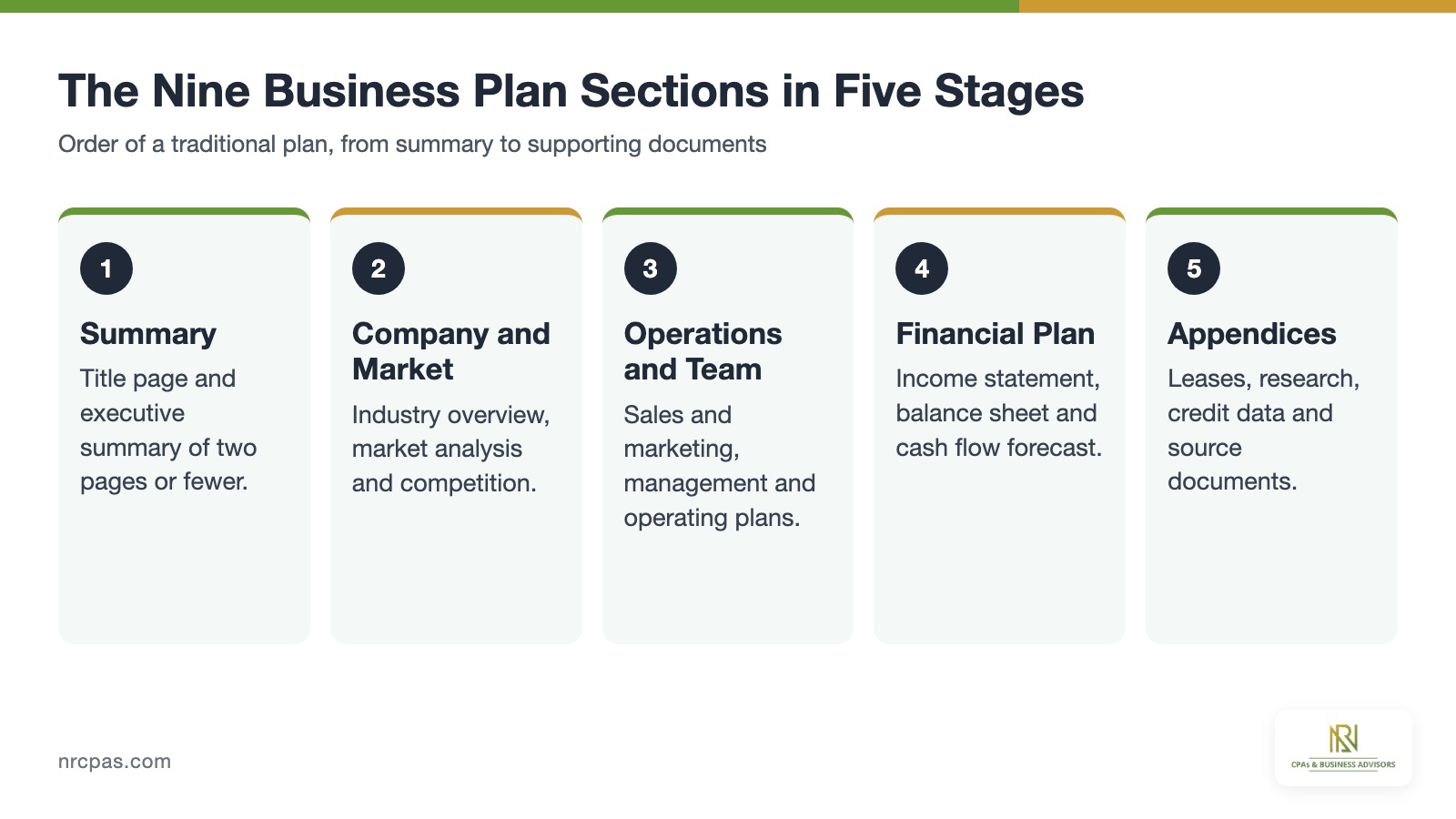
Each stage still needs a length, and the length depends on the plan format.
How Should a Business Plan Look in Traditional and Lean Formats?
A business plan should look like either a traditional plan or a lean plan, and the SBA recognizes both formats. A traditional plan is detailed, comprehensive and dozens of pages long. Lenders and investors commonly request that traditional plan, according to the SBA.
A lean startup plan summarizes only the key elements. According to the SBA, a lean plan can take as little as one hour to make and is typically one page. A lean plan suits an owner who needs a roadmap instead of a loan application.
New owners can start lean and expand later, and new business guidance helps pick the format that matches the funding goal. The graphic below sets the two formats side by side.
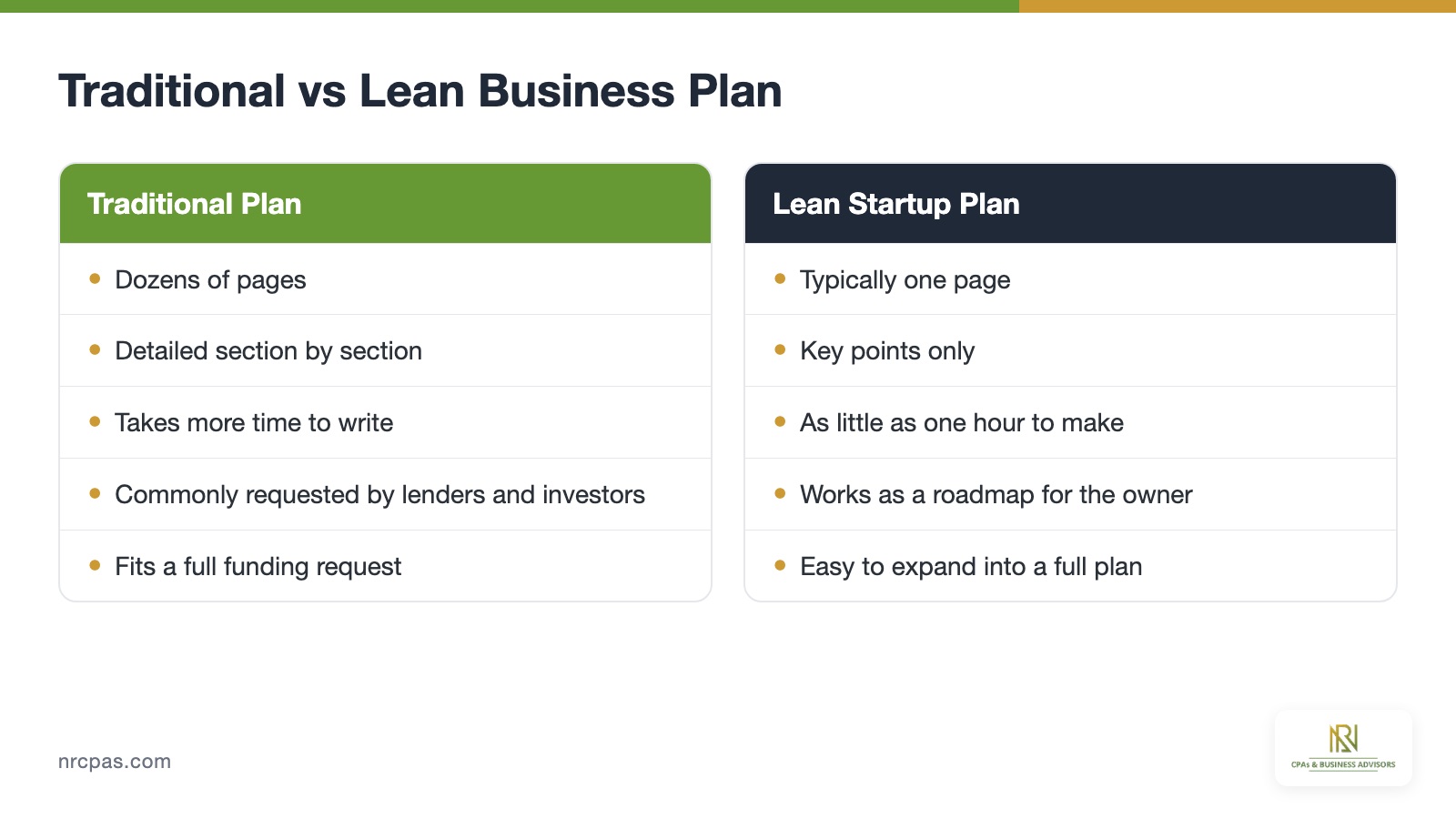
Both formats open with the same summary, so the summary and the company description come next.
What Goes in the Executive Summary and Company Description?
The executive summary and company description go first, and they hold the mission, the offer, the leaders and the legal details. The executive summary is a short teaser for the rest of the plan. The summary names the product, the target market, the competitive edge and any financing need.
The company description then lists the registered name, legal structure, address, key employees and ownership stakes. A table works well for those facts, according to Forbes Advisor. The legal structure line depends on the legal entity chosen at formation.
The summary answers three points for the reader: the problem, the timing and the owner's fit. Those points lead directly to the market that has the problem.
How Should a Business Plan Show the Market and Competition?
A business plan should show the market and competition with counted customers, named rivals and dated figures. A reachable customer count is stronger than a national market-size number. A local firm can count the buyers within its service area and show how those buyers are reached today.
The SBA lists six questions for market research, and the bullets below name them.
- Demand for the product or service.
- Total market size.
- Economic indicators in the area.
- Location of the target customers.
- Market saturation by existing firms.
- Pricing that customers accept.
Competitor analysis then adds market share as a percentage of sales, plus a plain comparison of products and prices. The analysis has to show a gap in the market and also proof that firms can succeed there. A sized market leads to the operations that serve it.
How Should a Business Plan Present Operations and Management?
A business plan should present operations and management as an operating plan and a management plan with named roles. The operating plan lists space, labor, equipment, suppliers and inventory. A home-based consulting firm needs a short operating plan, while a manufacturer needs raw materials and a supply chain.
The management plan shows the legal structure, the owners with their percentages and the key executives. Open roles belong in the plan too, with the hiring date for each one. Founders who lack a finance lead can add an early-stage CFO to that team chart.
Every role and machine in these sections becomes a cost line, and those cost lines feed the financial section.
What Should the Financial Section of a Business Plan Look Like?
The financial section of a business plan should look like a five-year forecast built from three statements. The statements are the income statement, the balance sheet and the cash flow statement. According to the SBA, the first year should be detailed by quarter or even by month.
The SBA also asks for a capital expenditure budget and a funding request that covers the next 5 years. The request states the amount, the debt or equity type and what the money pays for. Professionally prepared projected statements keep those figures consistent from page to page.
Established businesses add history. According to the SBA, those firms include income statements, balance sheets and cash flow statements for the past 3 to 5 years. Owners can see how three statements connect before they build the forecast.
Cash timing deserves its own page, because profit and cash move on different dates. A late customer payment can leave a profitable month with an empty account. Each month shows a different balance, so a cash flow report shows when each dollar lands in the bank. Lenders test that page against repayment, and the next section explains how.
What Do Lenders Look for in a Business Plan?
Lenders look for proof that the business can repay the loan from its own cash flow. What lenders look for in a business plan is a clear path from each sale to a bank deposit. History, management experience, collateral and the stated purpose of the loan support that path.
The Federal Reserve Banks 2026 Report on Employer Firms shows how often lenders say yes. According to the report, 38% of firms applied for a loan, line of credit or merchant cash advance. Of the applicants for financing, 42% received the full amount, 36% received some or most, and 22% received none.
The same report found that applicants at small banks were fully approved 57% of the time. The graphic below shows those outcomes.

Loan size changes the paperwork. According to the SBA, the maximum 7(a) loan is $5 million, and the lender decides which documents a borrower files. A plan drafting engagement lines the forecast up with those documents. Equity investors read the same plan with different questions.
What Do Investors Look for in a Business Plan?
Investors look for a large market, a team that can execute and a path to a return on the money invested. What investors look for in a business plan is growth and a return, beyond repayment. A lender asks whether demand covers the payments, while an investor asks how big the business can become.
The executive summary carries most of that weight. It answers the problem, the timing and the owner's fit in two pages or fewer. Lenders and investors share one view of what a business plan should look like: clear, short and backed by numbers.
The nine sections stay the same for both readers, so the side topics below only change emphasis.
What Else Changes How a Business Plan Looks?
Business plans change in appearance with the age of the company, the legal structure and the tax figures. The records behind the numbers matter too. The topics below cover each change in short form.
What Does a Good Business Plan Look Like for a Startup Versus an Existing Company?
A good business plan for a startup looks forward, while a plan for an existing company also shows history. A startup plan centers on the funding need and the five-year forecast. An existing company adds 3 to 5 years of past statements, according to the SBA.
Which Business Structure Should the Plan Show?
The business plan should show the legal structure the owners actually filed, such as a limited liability company (LLC) or a corporation. According to the Florida Division of Corporations, LLC articles of organization cost $125 to file. The structure also sets how profit is taxed. Owners weighing an LLC comparison against an S corporation should settle that choice before the plan is final.
Which Tax Figures Belong in a Business Plan?
The tax figures that belong in a business plan are start-up costs, self-employment tax and equipment expensing limits. According to the Internal Revenue Service (IRS), a new business can elect to deduct up to $5,000 of start-up costs. That deduction shrinks once start-up costs pass $50,000, and the remainder is amortized over 180 months.
The IRS sets self-employment tax at 15.3%, made of 12.4% Social Security and 2.9% Medicare. The Section 179 limit for 2026 is $2,560,000, according to the IRS. Owners planning equipment purchases can read a Section 179 guide before they set the capital budget.
Pass-through owners may also qualify for a 20% deduction on business income. That deduction changes the projected tax bill in each forecast year. The forecast should apply the QBI basics before it projects taxes.
Which Records Should Back Up a Business Plan?
The records that back up a business plan are bank statements, invoices, contracts, tax returns and the ledger behind each projection. According to the IRS, records should be kept for 3 years after filing. The keep period rises to 6 years when unreported income exceeds 25% of the gross income shown.
Can a CPA Help Build a Business Plan?
A CPA can build the financial model, test the assumptions and match the plan to lender and investor requirements. We prepare forecasts, three-statement packages and funding schedules for owners across the country.
The firm is led by founder Nischay Rawal, CPA, EA. Owners can reach NR CPAs today at (305) 872-3096. That conversation settles what should a business plan look like for each owner's goal.
Each plan starts from the owner's own books, goals and funding target. Owners ready to draft all nine sections can start with business plan support from our team.