2025 Self Employment Tax and 2026 Rates, Wage Base and Dates


The 2025 self-employment tax rate is 15.3%, and the rate stays 15.3% for 2026. The rate combines 12.4% Social Security and 2.9% Medicare on 92.35% of net earnings. According to the Internal Revenue Service (IRS), the Social Security part stops at $176,100 for 2025 and at $184,500 for 2026. Owners with $400 or more of net earnings owe the tax, and the final 2026 estimated payment is due January 15, 2027.
Key Takeaways
- The self-employment tax rate is 15.3% in both 2025 and 2026.
- The Social Security wage base rises from $176,100 in 2025 to $184,500 in 2026.
- Self-employment tax applies once net earnings reach $400 for the year.
- Half of the tax is deductible on Schedule 1, and credits do not offset the tax itself.
- The final 2026 estimated payment is due January 15, 2027.
What Is the 2025 Self Employment Tax Rate and How Does 2026 Compare?
The 2025 self employment tax rate is 15.3%, the same rate that applies to 2026. Only the Social Security wage base changes between the two years. According to the IRS, the 15.3% rate is 12.4% for Social Security and 2.9% for Medicare.
Employees split those payroll taxes with an employer, and each side pays 7.65%. Self-employed owners pay both halves, which is why the rate doubles to 15.3%. Owners who plan around that doubling can use SE tax planning to time income and deductions.
The table below compares the rate and wage base for tax years 2024, 2025 and 2026. The last column multiplies each wage base by 12.4%.
| Tax year | Social Security wage base | Medicare rate | Maximum Social Security tax |
|---|---|---|---|
| 2024 | $168,600 | 2.9% | $20,906.40 |
| 2025 | $176,100 | 2.9% | $21,836.40 |
| 2026 | $184,500 | 2.9% | $22,878.00 |
The Social Security wage base is the earnings cap behind that last column. The next section explains how the cap works.
What Is the 2026 Self Employment Tax Wage Base?
The self-employment tax wage base for 2026 is $184,500. Earnings above $184,500 owe no 12.4% Social Security tax in 2026. The Social Security Administration (SSA) set that cap in its 2026 cost-of-living announcement, which also raised benefits by 2.8%.
The graphic below shows the 2025 and 2026 wage bases side by side, with the $8,400 increase.
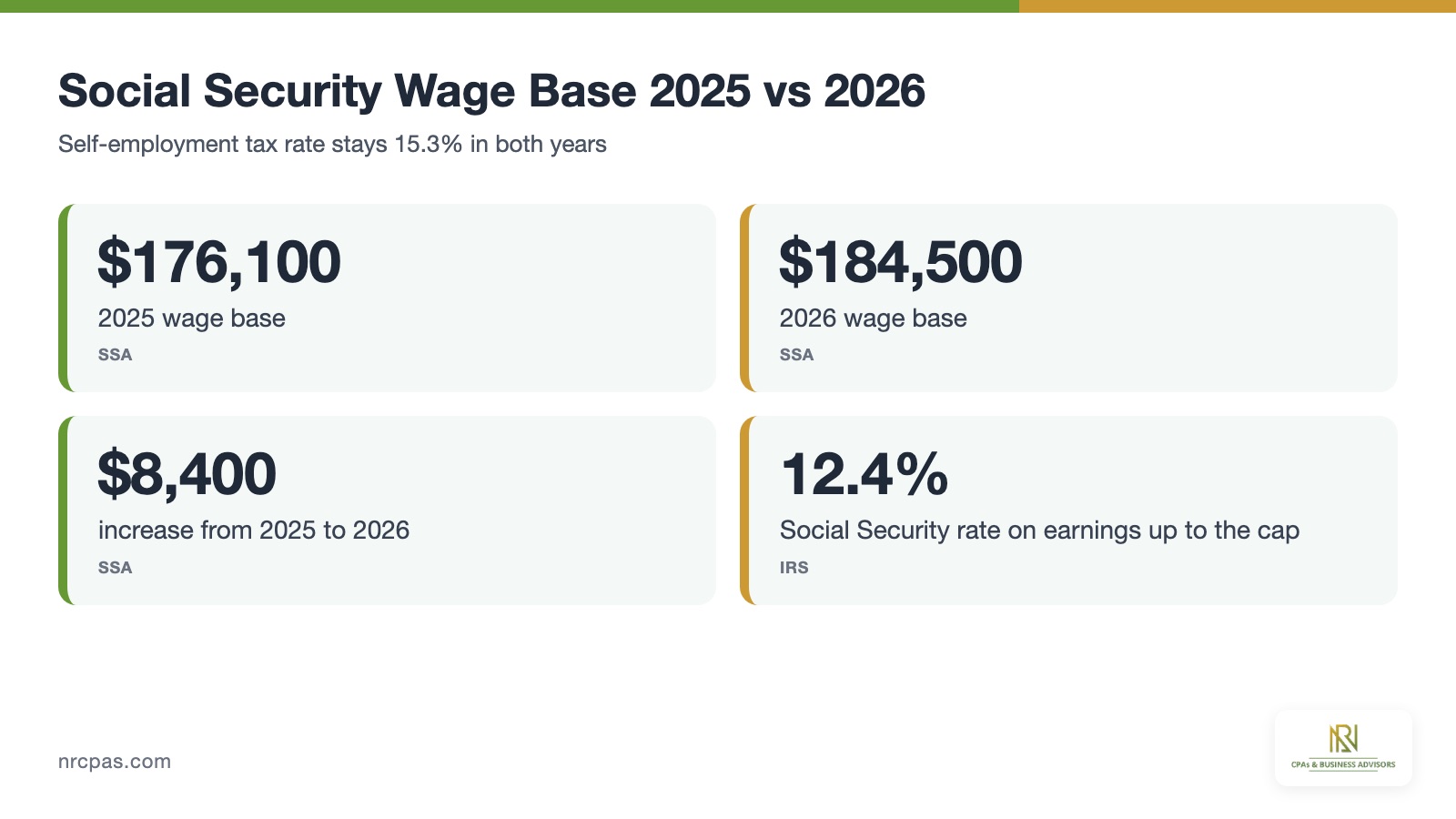
Medicare tax has no cap, so the 2.9% applies to every dollar of net earnings. The IRS adds a 0.9% Additional Medicare Tax above $200,000 for single filers. That threshold is $250,000 for joint filers and $125,000 for married filing separately.
Wages from a job count toward the same cap. According to the IRS, an owner whose wages and tips already reach $184,500 owes only the Medicare part on business profit. The SSA has also announced a 2027 wage base of $192,300. The 2026 wage base is $8,400 above the 2025 wage base. The wage base only matters for owners who owe the tax, so the next question is who owes it.
Who Has to Pay 2026 Self Employment Tax?
Anyone with $400 or more of net earnings from self-employment must pay self-employment tax in 2026. The $400 trigger applies to sole proprietors, independent contractors and partners. The IRS sets the church employee trigger lower, at $108.28 of church wages.
Age does not change the rule. According to the IRS, owners pay the tax even when they already collect Social Security or Medicare. Filers report net earnings on Schedule SE, and Schedule C feeds that number for sole proprietors.
Owners need a Social Security number or an Individual Taxpayer Identification Number (ITIN) to pay the tax. A net loss creates no tax, and the IRS offers an optional method for some owners with net profit under $8,186. That method lets low earners still build Social Security credits.
Entity type changes the answer, since S corporation owners take wages instead of profit draws. So choosing an entity shapes the bill. The sections below return to that point, but the calculation comes first.
How Do You Calculate 2026 Self Employment Tax?
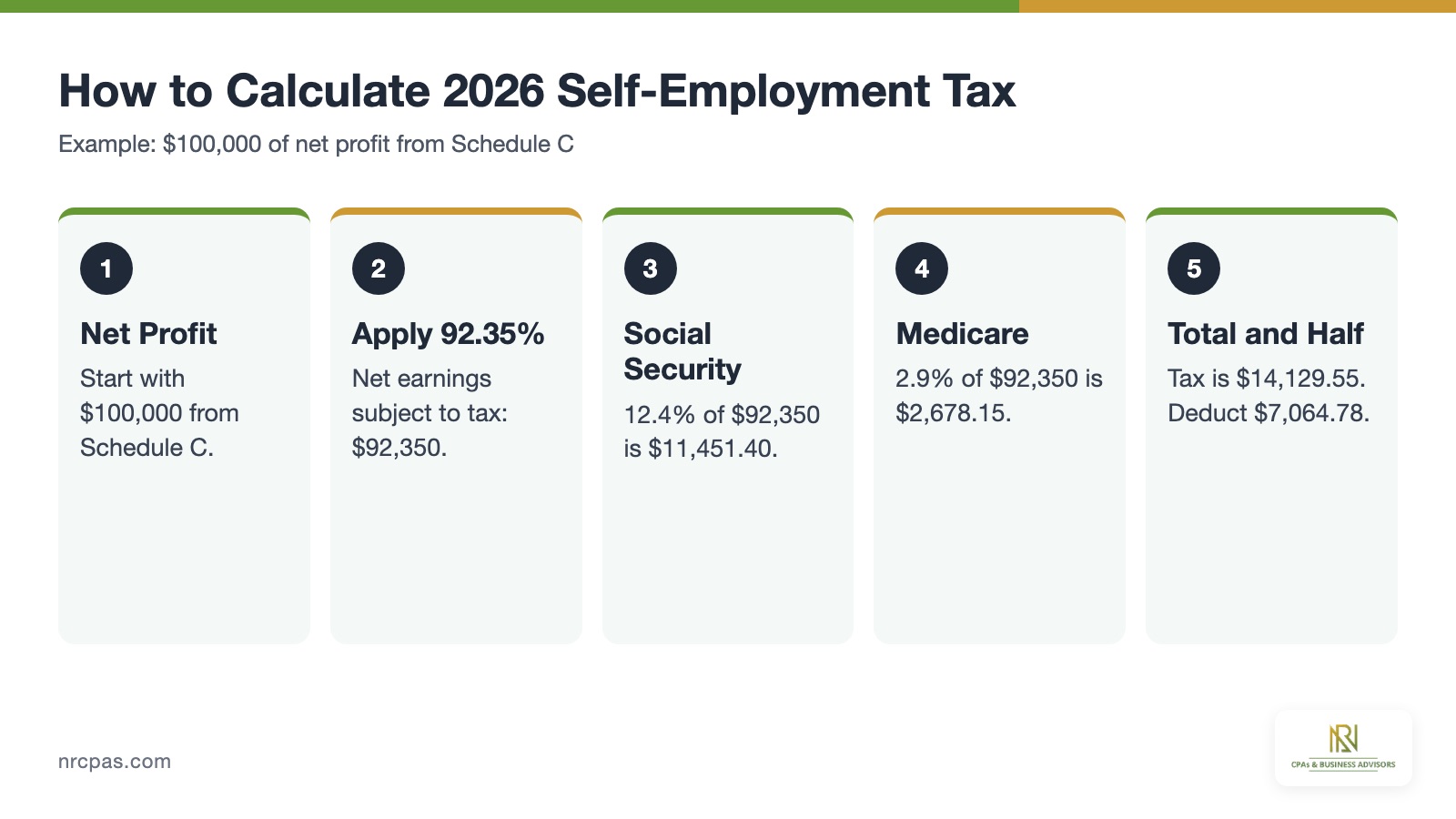
Calculate self-employment tax 2026 amounts by multiplying net profit by 92.35% and then applying the 15.3% rate. The 92.35% factor removes the employer-equivalent half of the tax from the base. The numbered steps below use a $100,000 profit.
- Start with net profit from Schedule C: $100,000.
- Multiply by 92.35% to get net earnings subject to tax: $92,350.
- Apply 12.4% Social Security, because $92,350 sits under the $184,500 wage base: $11,451.40.
- Apply 2.9% Medicare to the same $92,350: $2,678.15.
- Add both parts for total self-employment tax: $14,129.55.
- Deduct half of the tax, $7,064.78, on Schedule 1 when figuring income tax.
The steps above also fit the self-employment tax for 2025, because $92,350 sits under the 2025 wage base as well. The graphic below shows the same steps, with the last two steps combined.
A higher profit shows how the cap works. A $200,000 profit gives $184,700 of net earnings after the 92.35% factor. Social Security applies to only $184,500 of that, which is $22,878.00. Medicare applies to all $184,700, which is $5,356.30. The total is $28,234.30.
That total is paid through estimated payments during the year, and the schedule for those payments follows.
What Are the 2026 Self Employment Tax Dates?
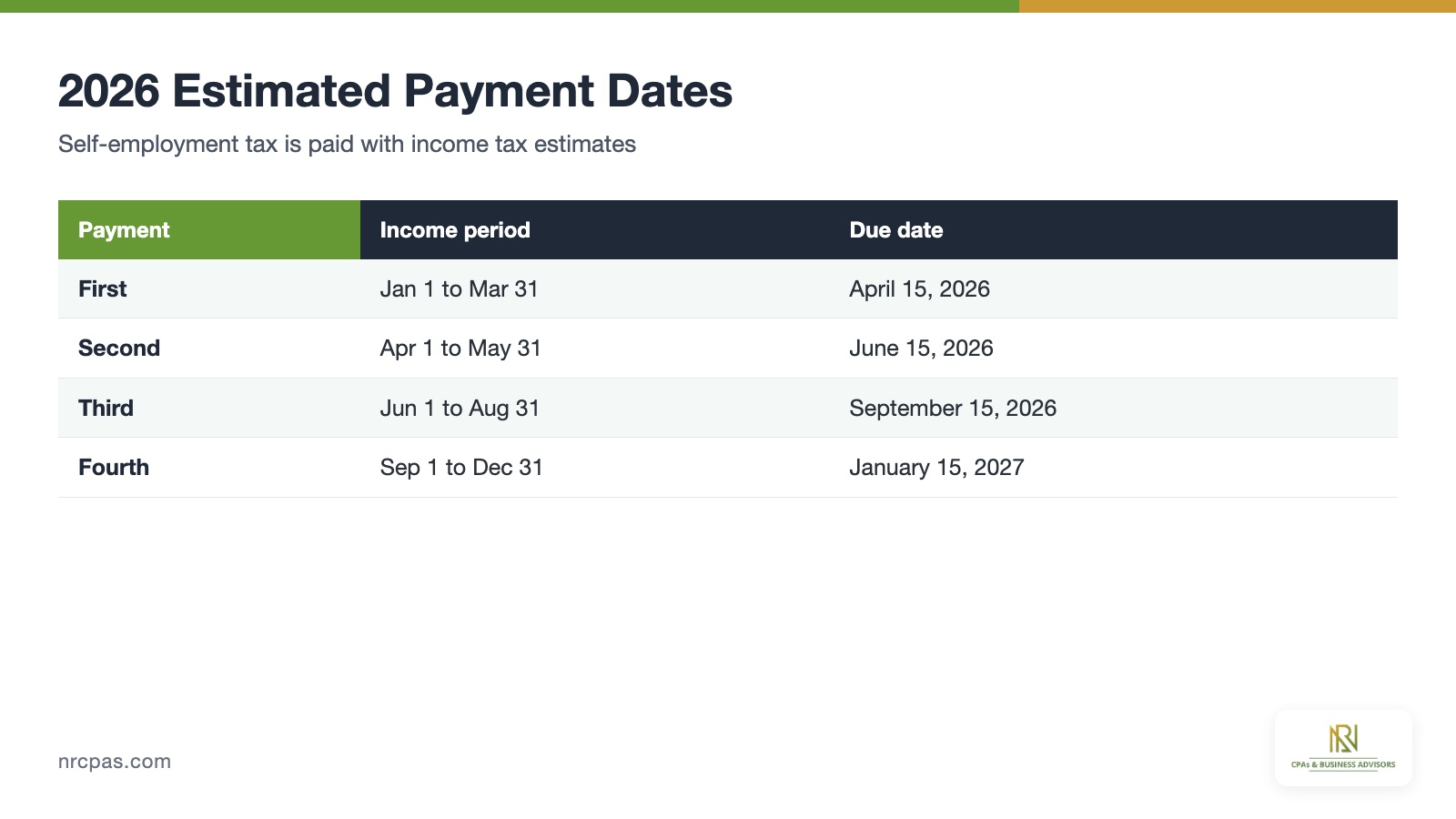
The 2026 self employment tax dates are four estimated payment deadlines. Payments are due April 15, June 15 and September 15 of 2026, then January 15, 2027. According to the IRS, estimated payments cover income tax and self-employment tax together.
The table below lists each deadline with the income period it covers, and the graphic after it repeats the same four dates.
| Payment | Income period | Due date |
|---|---|---|
| First | January 1 to March 31 | April 15, 2026 |
| Second | April 1 to May 31 | June 15, 2026 |
| Third | June 1 to August 31 | September 15, 2026 |
| Fourth | September 1 to December 31 | January 15, 2027 |
A due date that lands on a weekend or holiday moves to the next business day, according to the IRS. Mailed payments count on the postmark date.
Estimated payments are required when the expected tax is $1,000 or more, according to the IRS. Owners avoid a penalty by paying 90% of the current-year tax or 100% of the prior-year tax. The prior-year share rises to 110% when adjusted gross income tops $150,000.
The 2025 tax year followed the same pattern, ending with a January 15, 2026 payment and an April 15, 2026 return deadline. Owners who miss a deadline can seek late payment help from tax resolution specialists. The payment schedule leads to the deductions that shrink the bill.
How Much Is the 2026 Self Employment Tax Deduction?
The self-employment tax deduction 2026 owners claim is half of the tax owed. The deduction equals 50% of self-employment tax and lowers adjusted gross income. A $14,129.55 bill therefore produces a $7,064.78 deduction.
The 2025 self-employment tax deduction works the same way. According to the IRS, the deduction lowers income tax only and leaves the self-employment tax unchanged. Owners claim it on Schedule 1, line 15, with no itemizing needed.
Self-employment tax deductions 2025 owners claim also include business expenses on Schedule C, which shrink the profit before the 92.35% factor. The deductible half rule has its own line-by-line walkthrough. Deductions do not work like credits, and that difference raises the next question.
Can a 2025 Credit Offset Self Employment Tax?
No self-employment tax credit 2025 owners claim offsets the 15.3% tax directly. Credits reduce income tax, while self-employment tax is a separate line on the return. The IRS lets Schedule C filers claim the Earned Income Tax Credit, which is refundable and depends on net earnings.
Credits such as the Earned Income Tax Credit sit on a different part of Form 1040. Business expenses are the main tool for lowering the tax base. The 92.35% factor applies after those expenses, so each $1,000 of added deductions saves about $141 of self-employment tax. The math is $1,000 times 92.35% times 15.3%.
Several other rules also move the bill. The grouper section below covers the most common ones.
What Else Changes 2026 Self Employment Tax?
Self-employment tax for 2026 also depends on prior-year rates, entity type, equipment deductions, retirement plans and Social Security credits. The short answers below cover each side topic.
What Was the 2024 Self Employment Tax?
The self-employment tax 2024 rate was 15.3%, with a Social Security wage base of $168,600. The 2024 maximum Social Security tax was $20,906.40. The 2026 wage base is $15,900 higher than the 2024 wage base.
How Much More Is 2026 Tax Than 2025 Tax?
The 2026 self-employment tax is higher than 2025 only for owners with net earnings above $176,100. The most the Social Security part can rise is $1,041.60, which is 12.4% of $8,400. Owners with profit of $199,784 or more pay that full increase.
Do S Corp Owners Pay Self Employment Tax?
S corporation owners pay payroll tax on their wages but not self-employment tax on distributions. Reasonable wages are the condition that keeps that treatment safe. The S corporation rules explain where the line sits.
Does a Single-Member LLC Pay Self Employment Tax?
A single-member LLC pays self-employment tax on its net profit unless it elects corporate tax treatment. The IRS treats the LLC as a sole proprietorship by default. A one-owner LLC reports the profit on Schedule C.
Does Section 179 Reduce Self Employment Income?
Section 179 reduces self-employment income when equipment is used in the business. The 2026 Section 179 limit is $2,560,000, according to the IRS. The Section 179 effect lowers net profit and therefore the tax base.
Does the QBI Deduction Reduce Self Employment Tax?
No, the QBI deduction does not reduce self-employment tax, because the deduction applies after net earnings are set. The 20% deduction lowers income tax only. Its 2026 thresholds are $201,750 for single filers and $403,500 for joint filers, per the IRS. The QBI reduction page covers the math.
Does a Solo Retirement Plan Reduce Self Employment Tax?
No, a solo retirement plan does not reduce self-employment tax, because contributions come out of income tax. The 2026 solo 401(k) employee deferral limit is $24,500, and the overall plan limit is $72,000, according to the IRS. The Solo 401(k) savings page covers the effect on taxable income.
How Much Income Earns a Social Security Credit This Year?
Net earnings of $1,890 earn one Social Security credit in 2026, up from $1,810 in 2025, according to the SSA. Four credits is the most a worker can earn in one year. Self-employment tax payments therefore build future benefits.
How Can a Tax Team Help With Self Employment Tax?
A tax team can model the 2026 bill, set estimated payments and pick the entity that fits the profit level. We handle those steps for owners across the country, and the firm is led by founder Nischay Rawal, CPA, EA.
Business owners join the NR CPAs family when they want year-round tax support from a CPA and Enrolled Agent team. The office number is (305) 872-3096, and the team answers questions about estimated payments and wage base changes.
Owners who want the 2026 tax bill modeled before the final January 15, 2027 payment can start with 2026 tax planning.