Are Wealth Management Fees Tax Deductible and How Does It Work in 2026


No, wealth management fees are not tax deductible for individuals on the federal return, and the rule now has no end date. The Tax Cuts and Jobs Act suspended the deduction for 2018 through 2025. The One Big Beautiful Bill Act made that suspension permanent. Exceptions cover trusts and estates, business-related advice, business-schedule tax preparation, fees paid from an IRA, and some state returns.
Key Takeaways
- Wealth management fees are miscellaneous itemized deductions, and those deductions are permanently suspended starting in 2026.
- Fees paid from a traditional IRA reduce pre-tax money, which works like a deduction.
- Trusts and estates still deduct costs unique to administration under Section 67(e), but not ordinary investment advice.
- Business advice and the Schedule C, E and F share of tax preparation fees stay deductible.
- California and New York still allow a state deduction for investment expenses.
Are Wealth Management Fees Tax Deductible and How Does It Work?
Wealth management fees are not tax deductible for individuals. The Internal Revenue Code treats them as miscellaneous itemized deductions, and those are suspended. The fee is paid with after-tax dollars and does not reduce taxable income. Wealth management fees include investment advisory fees, financial planning charges, custodial fees and portfolio management charges.
Advisors typically bill wealth management fees as a percentage of assets under management. A 1% fee on a $500,000 portfolio costs $5,000 per year. A taxpayer in the 24% bracket who could not deduct that $5,000 loses $1,200 of potential tax savings.
Several narrow exceptions still reduce the cost of those fees. The exceptions depend on who pays the fee, which account pays it, and what the advice covers. Families who coordinate that structure through family office planning keep the paperwork consistent from year to year. The starting point is the law that created the suspension.
What Did the Tax Cuts and Jobs Act Change for Miscellaneous Itemized Deductions?
The Tax Cuts and Jobs Act (TCJA) suspended miscellaneous itemized deductions for tax years 2018 through 2025. Before 2018, taxpayers could deduct investment advisory fees, tax preparation fees and IRA custodial fees. Only the amount above 2% of adjusted gross income (AGI) was deductible.
The old floor limited the benefit even for people who itemized. A taxpayer with $200,000 of AGI and a $5,000 advisory fee had a $4,000 floor. Only $1,000 of the fee was deductible, and only when total itemized deductions beat the standard deduction.
The TCJA also nearly doubled the standard deduction, which pushed itemizing out of reach for many households. According to the IRS Statistics of Income, 9.5% of returns itemized deductions for tax year 2022. Another 88.6% of returns took the standard deduction.
The 2025 standard deduction is $15,750 for single filers, according to the IRS. The 2026 amounts are $16,100 for single filers and $32,200 for married couples filing jointly. A deduction must clear those amounts before it saves any tax. The suspension was written to expire after 2025, which raises the next question.
Did the One Big Beautiful Bill Act Make the Suspension Permanent?
The One Big Beautiful Bill Act (OBBBA) made the suspension of miscellaneous itemized deductions permanent. President Trump signed the law on July 4, 2025, as Public Law 119-21. Section 70110 of the OBBBA removes the sunset date for the Section 67(g) suspension.
Investment advisory fees, financial advisor fees, tax preparation fees and IRA custodial fees therefore stay non-deductible after 2025. The OBBBA carves out only educator expenses. Investment fees receive no such carve-out, so the 2026 return follows the same rule as the 2025 return.
The graphic below summarizes the timeline and the key federal figures for individuals.
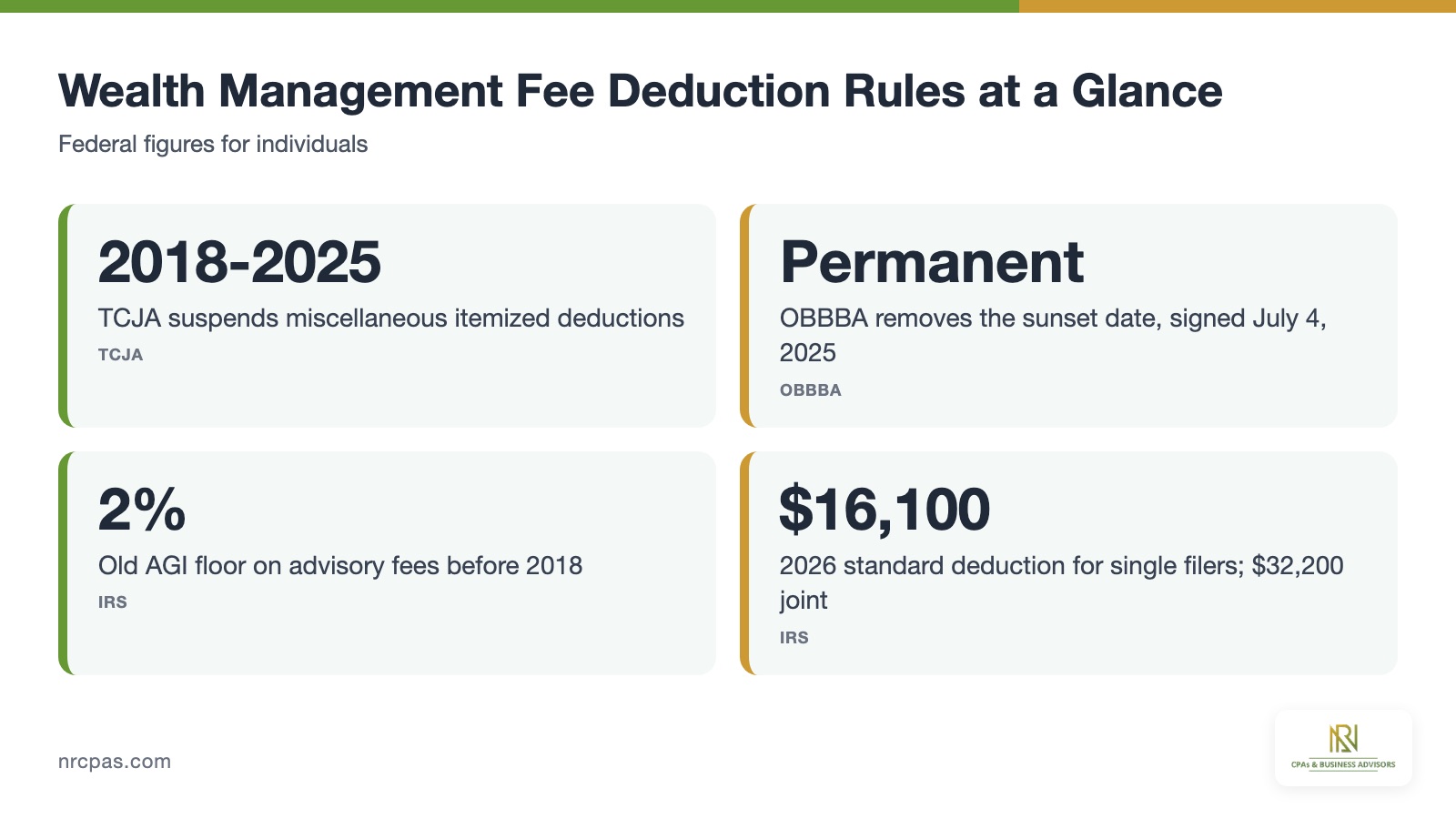
Permanent suspension makes the account that pays the fee more important than the deduction. A traditional IRA changes the math, which leads to the next section.
Can You Deduct Investment Fees Paid From an IRA or Retirement Plan?
You cannot deduct investment fees paid from an IRA or retirement plan, but paying them from the account gives a similar benefit. An advisory fee withdrawn from a traditional IRA is paid with pre-tax money. The fee reduces the balance before income tax is ever charged on it.
Compare a $5,000 fee at a 24% bracket. A traditional IRA that loses $5,000 would have owed $1,200 of tax on that money at withdrawal. The after-tax loss is therefore $3,800, while the same fee from a taxable account costs the full $5,000.
The table below shows the same $5,000 fee paid three ways.
| Paid From | Tax Treatment | After-Tax Cost | Note |
|---|---|---|---|
| Traditional IRA | Pre-tax dollars | $3,800 | Assumes a 24% bracket at withdrawal |
| Taxable account | After-tax dollars | $5,000 | No federal deduction |
| Roth IRA | Tax-free balance | $5,000 | Also removes tax-free growth |
| 401(k) | Pre-tax dollars | $3,800 | Plan rules decide whether fees may be charged |
The comparison graphic below lines up the traditional IRA and the taxable account for the same fee.
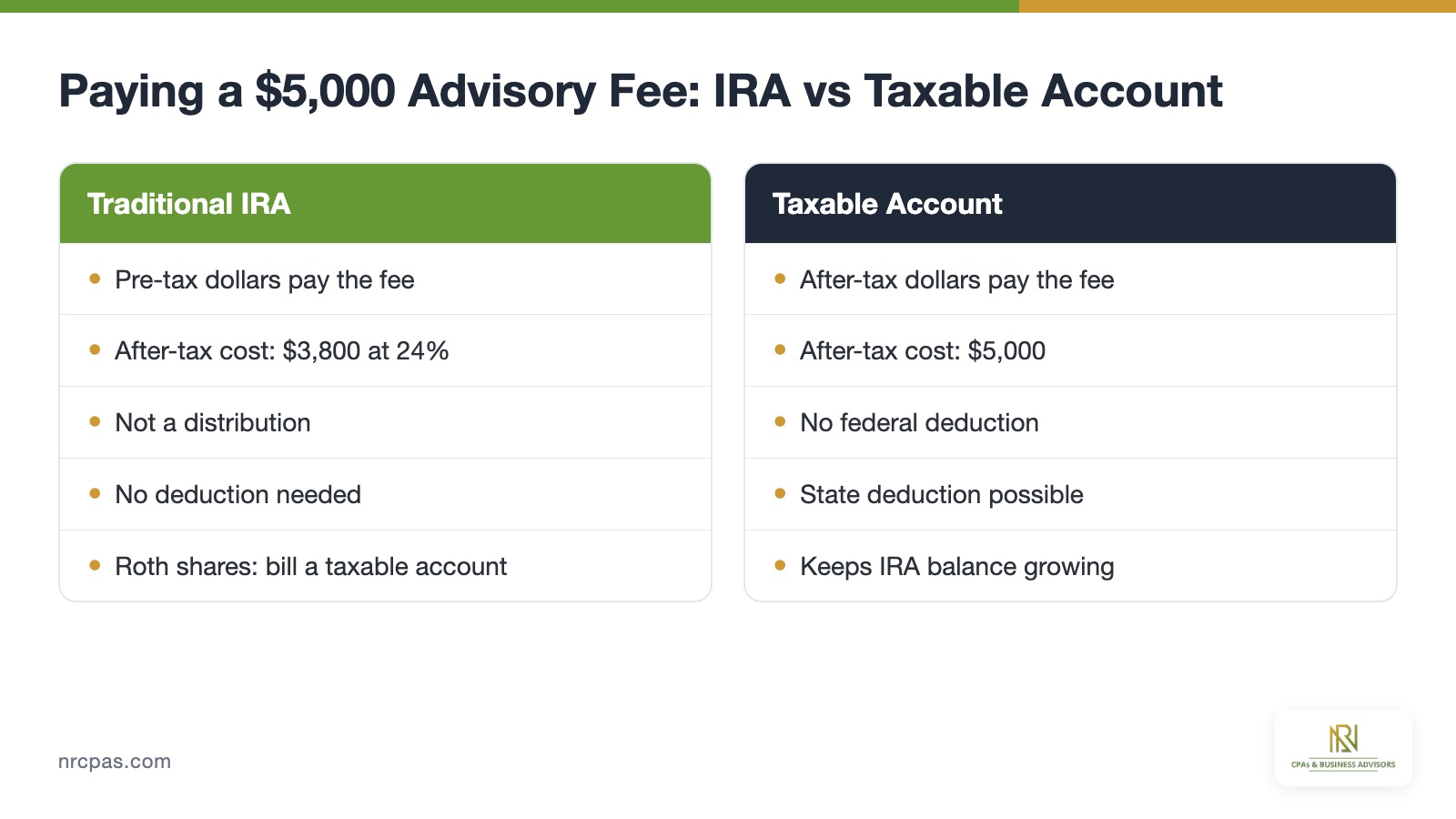
A fee billed to the IRA is not a distribution, so it does not trigger tax or the 10% early withdrawal penalty. The IRS caps annual IRA contributions at $7,500 for 2026, and the 401(k) deferral limit is $24,500. Fees paid from inside the account do not count toward either limit. Investment management fees therefore leave the contribution room untouched.
Roth accounts are the exception to the pre-tax rule. Advisors usually bill Roth shares to a taxable account, so the Roth keeps compounding tax free. An investor who splits the bill across accounts needs a clear record of which dollars paid which fee. The sub-question below covers outside payment.
Do Fees Paid From Outside an IRA Count as a Contribution?
Fees paid from outside an IRA do not count as a contribution when they cover investment advice for that IRA. Outside payment keeps more money working inside the IRA. The owner still gets no deduction, because the personal payment is a miscellaneous itemized deduction.
Outside payment suits an owner who expects a higher tax bracket in retirement than today. That owner preserves pre-tax assets and pays the fee at a lower rate now. Document the payer on each statement so the IRA custodian and the return agree. Trusts follow a different rule.
Are Wealth Management Fees Tax Deductible for Trusts and Estates?
Wealth management fees are partly deductible for trusts and estates when the cost would not have been incurred outside the trust. Section 67(e) of the Internal Revenue Code sets that test. Costs unique to administration remain deductible, while ordinary investment advice does not.
The Supreme Court decided Knight v. Commissioner in 2008. The Court held that investment advisory fees of a trust face the 2% floor. Only costs an individual could not commonly incur escape it. The Treasury Department issued final Section 67(e) regulations in May 2014 to apply the same test.
The TCJA suspension then removed the 2% floor deduction entirely. In Notice 2018-61, dated July 13, 2018, the IRS confirmed that Section 67(e) deductions are not suspended. Trustee fees, executor fees, court costs and fiduciary tax return fees therefore still reduce trust income. Investment advisory fees fall on the suspended side.
Bundled fees need splitting. A single trustee fee that covers administration and investment management must be allocated between the two parts. Only the administration share is deductible, so the trust should request an itemized fee statement from the trustee.
Trust income taxes also stack quickly. According to the IRS, the 37% bracket for trusts and estates starts at $16,000 of taxable income in 2026. A qualifying fiduciary fee therefore saves tax at a high rate. The same is true of estate legal fees that qualify. Business owners face a different set of rules.
Are Wealth Management Fees Tax Deductible and How Does It Work for Business Owners?
Wealth management fees are tax deductible for business owners when the advice serves the business and not the owner's personal portfolio. The business purpose, and not the title of the advisor, decides the deduction. Section 162 allows ordinary and necessary business expenses, according to IRS Publication 535.
Advice on pricing, budgeting, cash flow and entity structure supports business income. A sole proprietor reports that fee on Schedule C, line 17, for legal and professional services. Owners who buy operations consulting for the company claim the cost the same way.
Entity choice changes where the deduction appears. A partnership deducts the fee on Form 1065, and an S corporation uses Form 1120-S. A one-owner entity taxed as a sole proprietor, such as a sole proprietor LLC, files the fee on Schedule C.
The fee follows the entity. A partnership, an S corporation and a sole proprietorship each report the same advice on a different return. The entity type choice therefore decides which return carries the deduction.
Lowering Schedule C profit also lowers the base for self-employment tax, which the IRS charges at 15.3% on net earnings. Net profit feeds the QBI limits as well. A fee that is deductible lowers both numbers at once.
Employer retirement plans add another category. Fees to set up and administer a company 401(k) plan are business costs when the company pays them. Fees for the owner's personal portfolio are not business costs, even when the same advisor manages both.
The IRS looks at the invoice. A fee covering both purposes needs a written split, such as 70% for business advice and 30% for personal investing. Tax preparation fees raise the same allocation issue.
Can Tax Preparation Fees Be Split Across Schedule C, E and F?
Tax preparation fees can be split across Schedule C, E and F. Each business schedule carries its own share of the work. The portion of the fee tied to a business or rental schedule is deductible on that schedule. The personal portion on Form 1040 is a suspended miscellaneous itemized deduction.
Take a $3,000 preparation bill. A preparer who spends 40% of the time on a Schedule C business assigns $1,200 to that schedule. Rental properties use Schedule E, where the fee falls under line 10 for legal and other professional fees. Farm income uses Schedule F, where the fee goes under other expenses.
Ask the preparer for a time-based or schedule-based invoice. A one-line total gives the owner nothing to allocate. The same discipline helps with fees tied to investment interest.
Is Investment Interest Expense Still Deductible?
Investment interest expense is still deductible for taxpayers who itemize, up to net investment income. Margin loan interest is a common example. Form 4952 calculates the allowed amount, and the final figure lands on Schedule A.
The deduction covers interest only, and advisory fees do not qualify. Net investment income includes taxable interest, non-qualified dividends and short-term gains. Excess interest carries forward to later years without an end date. The deduction still depends on beating the standard deduction, so planning for it takes strategy.
Which Strategies Lower the After-Tax Cost of Wealth Management Fees?
Four strategies lower the after-tax cost of wealth management fees. They are choosing the paying account, separating business advice, unbundling trust fees, and negotiating the fee structure. Each strategy works inside current law and needs only records. The numbered steps below put those strategies in order.
- List every fee for the year, with the payer, the account and the service it covers.
- Separate business advice, rental management and tax preparation shares from personal investment advice.
- Bill traditional IRA assets to the traditional IRA and Roth assets to a taxable account.
- Ask each trustee for an itemized statement that splits administration from investing.
- Give the state return a copy of the investment expense total when the state allows the deduction.
The graphic below shows the same sequence as a workflow.

Families who pair fee choices with investment tax planning keep the savings visible each year.
Fee structure matters too, and negotiation is a legitimate tool on large accounts. A flat fee or hourly fee can cost less than a percentage of assets at higher balances. Any fee coordination review can track each payer across every account, every trust and every business entity. The same fee can look different once taxes enter the picture, as the grouper question below shows.
What Else Should Investors Know About Wealth Management Fees?
Are Wealth Management Fees Tax Deductible and How Does It Work in California and New York?
Wealth management fees are still deductible on the California and New York state returns, even though the federal deduction is gone. California does not conform to the federal suspension. The California Franchise Tax Board still allows miscellaneous itemized deductions that exceed 2% of federal AGI.
New York decoupled from the federal change as well. A New York taxpayer can itemize on Form IT-196 even after taking the federal standard deduction. Investment expenses stay subject to the 2% of federal AGI floor there. Other states vary, so each state return needs its own check. Residents of states without an income tax gain nothing from this rule.
Are Commissions and Fund Expense Ratios Deductible?
Commissions and fund expense ratios are not separate deductions. Brokerage commissions on a purchase add to cost basis. The higher basis cuts the gain or raises the loss when the investment is sold.
Fund expense ratios work differently, because the fund pays them before reporting returns. The investor never sees a line item to deduct. Advisory fees billed outside the fund are the only ones that appear on a statement.
Does Tax-Loss Harvesting Offset the Cost of Fees?
Tax-loss harvesting offsets part of the cost of fees by lowering the tax bill on gains. Net capital losses can reduce ordinary income by $3,000 per year, according to the IRS. The same net loss carries forward without an end date.
A harvested loss does not deduct the fee itself. The loss lowers tax on other income, which is the indirect offset. Investors can harvest investment losses while avoiding the wash-sale rule, which bars repurchase within 30 days.
Can Traders Deduct Investment Expenses?
Traders can deduct investment expenses as business costs, but investors cannot. Trader status requires substantial, continuous and regular trading to profit from short-term price moves. The IRS describes those tests in Topic 429.
A qualifying trader reports expenses on Schedule C. The trader may also elect mark-to-market treatment under Section 475(f), which makes gains and losses ordinary. The election has its own deadline and trade-offs, so it needs a review before filing. A person who trades often can still count as an investor.
Who Can Help Coordinate Advisory Fees and Tax Reporting?
A CPA firm can coordinate advisory fees and tax reporting by sorting each fee into the right return. We work with families, business owners and trusts that pay advisors from several accounts. Founder Nischay Rawal, CPA, EA, leads the team, reachable at (305) 872-3096.
The NR CPA specialists review fee statements, split business and personal shares, and prepare the federal and state returns.
Households with several advisors, trusts and an operating business can organize that work through a household wealth team that tracks every fee.