How to Find Sales Revenue on an Income Statement


Sales appear on the first line of the income statement, labeled Net Sales, Net Revenue or Total Revenue. For how to find sales in income statement reports, read from the top down and take the first dollar amount. Net sales equal gross sales minus returns, allowances and discounts. Gross sales of $250,000 less $15,500 of deductions leave $234,500.
Key Takeaways
- The sales line is the first dollar amount on an income statement.
- Net sales equal gross sales minus returns, allowances and discounts.
- Gross profit equals net sales minus cost of goods sold.
- Sales belong on the income statement, never on the balance sheet.
- Interest and equipment gains are nonoperating income, not sales.
- Schedule C reports sales on line 1, and Form 1120 reports sales on line 1a.
How to Find Sales in an Income Statement?
Finding sales in an income statement takes four moves, and the sales line sits at the top of the page. The first revenue caption under the statement heading is the sales line. Companies label that caption Sales, Net Sales, Revenue or Total Revenue.
The numbered list below shows the four moves in order.
- Confirm the reporting period in the statement heading, such as the year ended December 31.
- Read the first dollar amount under the heading, which is the top line.
- Check whether the statement shows gross sales, deductions and a Net Sales subtotal.
- Match the net figure to the line that feeds gross profit.
These steps for how to find sales on income statement pages work for any size of business. The graphic below turns them into one checklist.

Accountants build that top line from the sales ledger every month. Owners who want a reviewed top line can request income statement support before the statements reach a lender. The top line sits in a fixed spot, so the layout is the next thing to learn.
Where Is Net Sales in an Income Statement?
Net sales sit at the top of the income statement, above cost of goods sold and gross profit. Where to find net sales on income statement layouts depends on the format. Net sales are either the single first line or the subtotal of a short revenue block. Single-step statements show one revenue total, while multi-step statements break the block into parts. For how to find net sales on income statement subtotals, look for the line directly above cost of goods sold.
A multi-step statement for a product business follows a fixed order, and the table below lists the top five lines.
| Line | What it shows | Example |
|---|---|---|
| Gross Sales | All sales before deductions | $250,000 |
| Less: Returns and Allowances | Refunds and price cuts | $11,000 |
| Less: Sales Discounts | Early-payment and volume discounts | $4,500 |
| Net Sales | The top-line subtotal | $234,500 |
| Cost of Goods Sold | Direct product cost | $140,700 |
The example column ties to the worked calculation later in this post, so every figure matches. Many small companies print only the Net Sales row and hide the deductions in the ledger. That choice makes the label itself worth a closer look.
What Is Another Name for Net Sales?
Another name for net sales is net revenue, and some statements print Total Revenue or Revenues instead. All of these captions name the same top-line subtotal. How to find revenue on income statement pages therefore means scanning for any of those captions. Product sellers lean toward Net Sales, while service firms print Fees Earned or Service Revenue.
A service revenue line works the same way, with no inventory beneath it. Each caption points to one definition, which is the next heading.
What Are Net Sales on an Income Statement?
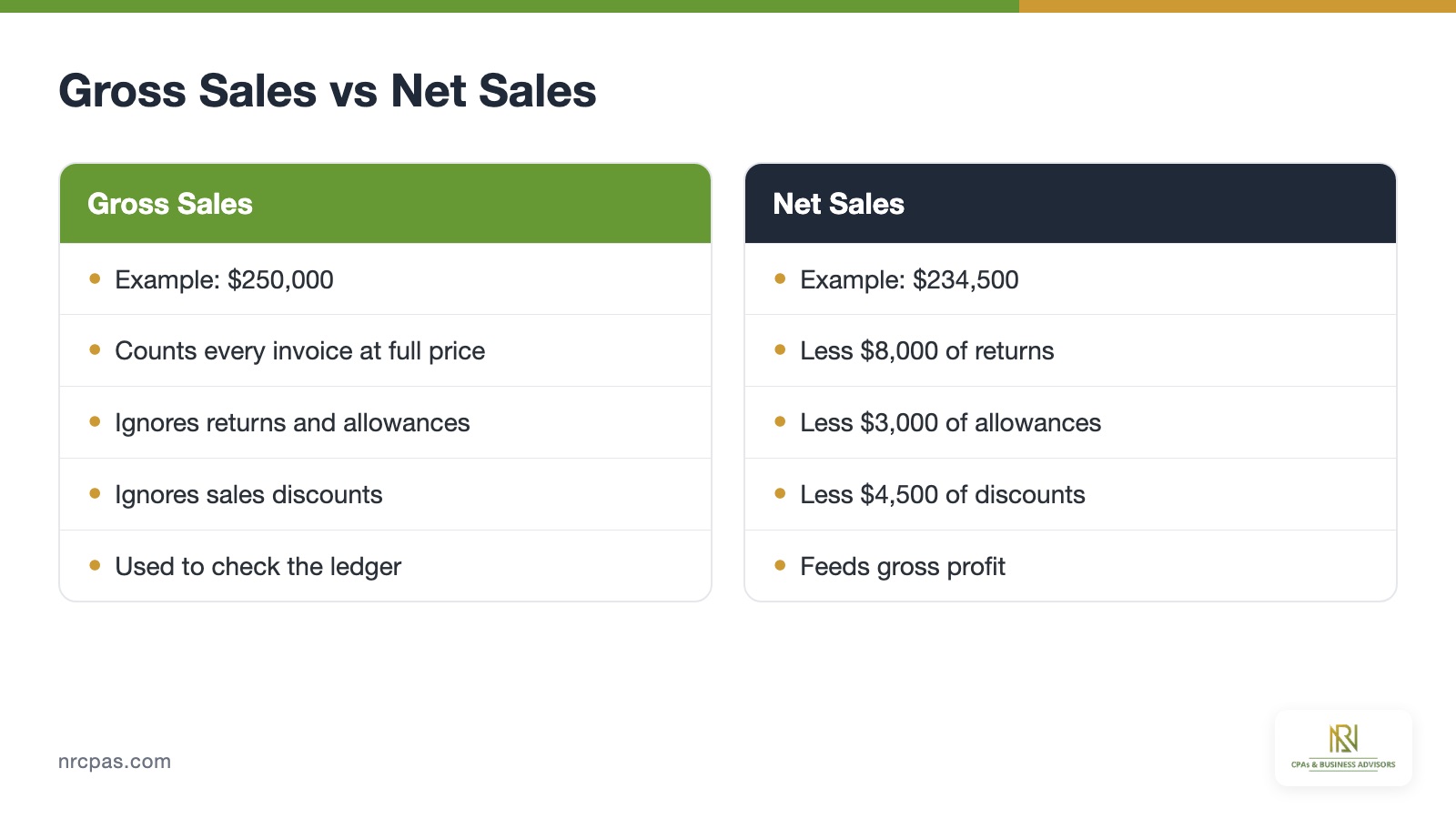
Net sales are the revenue a business keeps after customer returns, allowances and sales discounts. Net sales measure the sales a customer actually paid for. Gross sales count every invoice at full price, which overstates real demand.
Three deductions separate gross sales from net sales, and the bulleted list below defines each one.
- Sales returns are refunds paid for goods a customer sends back.
- Sales allowances are price reductions given for damaged or late goods.
- Sales discounts are cuts for early payment or large orders.
According to the Internal Revenue Service (IRS), a sales allowance cuts the selling price and is not a refund. Net sales therefore carry all three deductions in one subtotal. The deductions drive the formula, and the formula is the next step.
How Do You Calculate Net Sales From Gross Sales?
Calculate net sales from gross sales by subtracting returns, allowances and discounts. The formula is net sales = gross sales - returns - allowances - discounts. Gross sales equal units sold times the price per unit. How to calculate sales in an income statement therefore starts with that product.
A shop that sells 5,000 units at $50 records $250,000 of gross sales. Customers return $8,000 of goods, and the shop grants $3,000 in allowances. Early-payment discounts add $4,500, so total deductions reach $15,500.
Net sales for the shop equal $250,000 minus $15,500, which is $234,500. The comparison graphic below sets the gross and net figures side by side.
Bookkeepers post each deduction to its own contra-revenue account, which keeps the gross figure visible. A clean ledger also supports Schedule C planning at year end. Net sales then feed the next subtotal, which raises a common mix-up.
Is Net Sales the Same as Sales Minus COGS?
No, net sales are not sales minus cost of goods sold, because that subtraction produces gross profit. Gross profit equals net sales minus cost of goods sold. Cost of goods sold (COGS) is the direct cost of the products a business sold.
The shop above spent $140,700 on product cost. Gross profit therefore equals $234,500 minus $140,700, which is $93,800. Gross margin is gross profit divided by net sales, so the shop earns 40%.
How Do You Find Cost of Sales on an Income Statement?
Cost of sales appears directly below net sales, labeled Cost of Goods Sold, Cost of Sales or Cost of Revenue. The cost line sits between net sales and gross profit. Service firms often print Cost of Services on that line.
The IRS Form 1120 mirrors the same order. Line 1a is gross receipts or sales, line 1b is returns and allowances, and line 2 is cost of goods sold. Owners who track margin by product can add business advisory reviews to the monthly close. The cost line makes the final question easier, which is where sales do not belong.
Does Sales Go on a Balance Sheet or Income Statement?
Sales go on the income statement, not the balance sheet, because sales are revenue earned over a period. The balance sheet reports balances on one date, and the income statement reports activity over a period. Sales create balance sheet items such as cash and accounts receivable.
A credit sale of $10,000 raises accounts receivable on the balance sheet and raises sales on the income statement. Net income then flows into retained earnings, the equity account on the balance sheet. That flow links the two statements, though the sales line itself never moves.
Sales are also not an asset, since revenue is an income account with a normal credit balance. Revenue measurement raises one last question, which is why anyone cares about the top line.
Why Does the Sales Line Matter More Than Other Lines?
The sales line matters because every other income statement figure starts from net sales. Gross profit, operating income and net income all inherit the top line. An error of $5,000 in net sales moves each lower subtotal by the same $5,000.
Lenders also read the top line first, so how to find sales in income statement packages is a skill borrowers need. Growth in net sales shows demand, and a wide gap between gross and net sales signals heavy returns or discounting. Reviewed top-line figures keep cash flow reporting believable for outside readers. Several side topics shape how sales appear, and the grouper below covers them.
What Else Changes How Sales Appear on Financial Statements?
Sales appear differently by business type, tax form, filer size and recordkeeping habit. The short answers below cover the side topics most often asked about sales on financial statements.
What Does Not Count as Sales on an Income Statement?
Interest income, investment gains and gains on equipment sales do not count as sales on an income statement. Those items are nonoperating income, and they sit below operating income. According to AccountingCoach, operating revenues come from the main business. Examples are net sales for a retailer and service fees for a service firm.
Owners asking where to find revenue on an income statement should read only the operating revenue block. Sales tax and customer deposits also stay out of that block until earned.
How Are Returns and Discounts Recorded Behind the Sales Line?
Returns and discounts are recorded in contra-revenue accounts that reduce sales without erasing the original invoice. A return debits Sales Returns and Allowances and credits cash or accounts receivable. A discount debits Sales Discounts in the same way.
Terms of 1/10 net 30 give a 1% discount when the customer pays within 10 days. On a $10,000 invoice, early payment cuts net sales by $100. According to Investopedia, sellers book the discount only after the customer pays early.
Should You Use Gross Sales or Net Sales?
Use net sales for analysis and gross sales for checking the ledger. Net sales give the fair view of revenue, while gross sales show the full invoiced volume. Growth rates, gross margin and price comparisons all work from net sales. A fractional team can set that rule in CFO reporting packages.
What Is Another Name for an Income Statement?
Another name for an income statement is a profit and loss (P&L) statement. Some companies print statement of operations or statement of earnings instead. Every version has three parts, with sales on top, costs in the middle and profit at the bottom. Sales act as the base for comparing each cost line.
A cost of goods sold line equal to 60% of sales shows how much of each sales dollar leaves as product cost. That percent-of-sales view works only when the top line is accurate. Service firms apply the same view with a different formula, covered next.
How Do Service Companies Calculate Sales?
Service companies calculate sales by multiplying customers served by the average service price. A firm with 120 clients at $450 each records $54,000 of sales for the month. Sales for a service firm are recognized when the service is delivered, even if payment came earlier.
Where to find sales on an income statement for a service firm differs only in the caption, such as Fees Earned. Sales tax stays out of that figure when the firm records it as money owed to the state. The tax return handles the same line differently, as the next topic shows.
Where Do Sales Appear on a Tax Return?
Sales appear on line 1 of Schedule C for sole proprietors and on line 1a of Form 1120 for C corporations. According to the IRS, the 2025 Schedule C instructions also place returns and allowances on line 2. The tax return starts from gross receipts, then subtracts returns and allowances.
Sole proprietors also owe 15.3% self-employment tax on net earnings. According to the IRS, the Social Security part applies to the first $184,500 of 2026 earnings. Single-member owners can compare self-employment tax rules before choosing an entity.
Does Sales Tax Collected Count as Sales?
Sales tax collected counts as gross receipts on Schedule C, according to the IRS, and belongs on line 1. Books that post collected sales tax to a liability account keep it out of net sales. The books and the return then need one reconciliation each month.
How Do Retail and E-Commerce Sales Show Up?
Retail and e-commerce sales both land on the same top line, though platform fees and refunds need their own accounts. According to the Census Bureau, e-commerce sales reached $340.2 billion in the second quarter of 2026. That amount was 17.1% of $1,986.5 billion in total retail sales.
The Bureau of Labor Statistics (BLS) counted about 15.48 million retail trade jobs in September 2026. The BLS also counted 6.17 million wholesale trade jobs in 2025. Restaurant sales add tips, delivery apps and gift cards to the same top line.
The callout graphic below lists the four retail and labor figures from this section.

What Forms Report Sales to the IRS?
Payment platforms report card and app sales on Form 1099-K, according to the IRS. The 1099-K threshold is $20,000 and more than 200 transactions. Clients file Form 1099-NEC for service payments of $2,000 or more made on or after January 1, 2026.
Every dollar of sales is taxable, with or without a 1099 form. Reconcile each form to the sales ledger each January.
Which Accounting Method Changes the Sales Line?
Accrual accounting records sales when the sale is made, while cash accounting records sales when payment arrives. According to the IRS, small businesses with average gross receipts under $31 million for 2025 may use the cash method. The limit is $32 million for 2026.
Financial Accounting Standards Board (FASB) ASC 606 sets the timing for accrual sales. According to FASB, public companies applied ASC 606 for annual periods beginning after December 15, 2017. All other entities followed after December 15, 2018.
How Do Public Companies Report Sales?
Public companies report sales in Form 10-K, which they file with the Securities and Exchange Commission (SEC). According to the SEC, large accelerated filers file within 60 days of year end. Accelerated filers file within 75 days, and other filers within 90 days. The 10-K income statement opens with net sales or revenues.
Founders preparing for outside capital should know how early-stage companies present that top line to investors.
How Long Should Sales Records Be Kept?
Sales records should be kept for at least 3 years from the filing date, according to the IRS. The period grows to 6 years when unreported income exceeds 25% of the gross income shown. Bad debt claims need 7 years of records.
Invoices, receipts, deposit slips and return slips all belong in the sales file. S corporation owners also keep payroll files beside them, as covered in the S corporation returns comparison.
Who Can Review the Sales Line Before It Goes to a Lender?
A CPA can review the sales line before the statements reach a lender, buyer or tax preparer. Owners who know how to find sales in income statement reports can then spot errors faster. We tie sales to bank deposits, returns and the ledger so the top line holds up. The firm is led by founder Nischay Rawal, CPA, EA, and the NR CPAs team can be reached at (305) 872-3096.
Monthly statements list sales, cost of goods sold and profit in a fixed order. Lenders and buyers trust a top line built that way. Owners who want that routine in place can order year-end financial statements work with the same CPA team.