Example of an Income Statement for a Small Business


An example of income statement lines for a small business lists revenue first, subtracts expenses, and ends on net income. A design studio with $241,200 of income and $168,000 of expenses reports $73,200 of net income for the year. The two full examples below show every line, one for a service firm and one for a restaurant.
Key Takeaways
- An income statement shows revenue, expenses and net income for a period, such as a month, quarter or year.
- A service business uses a simple single-step layout with no cost of goods sold.
- A restaurant uses a multi-step layout with gross profit, operating income and pre-tax income.
- Net income from the statement closes into owner's equity on the balance sheet.
- Sole proprietors carry the net profit to Schedule C, line 31 of Form 1040.
What Is an Example of an Income Statement for a Small Business?
An example of an income statement for a small business is a one-page report of income, expenses and profit for one period. A small business income statement example ends on net income, the profit left after every expense. The same report is called a profit and loss statement, or P&L.
Small businesses are the main users of this report. According to the U.S. Small Business Administration (SBA) Office of Advocacy, the country has 36.2 million small businesses. Those businesses employ almost 46% of private-sector workers, and Florida alone has 3.49 million of them.
The U.S. Securities and Exchange Commission (SEC) describes the income statement as a report of revenue, expenses and net income. Monthly P&L reports pull those numbers straight from the general ledger, so clean books come first.
Every income statement, large or small, is built from 4 groups of lines, listed below.
- Revenue: money earned from customers for goods or services.
- Cost of goods sold: the direct cost of the products sold, which service firms skip.
- Operating expenses: rent, payroll, marketing, insurance and depreciation.
- Net income: revenue and gains minus every expense, interest and tax.
The full formula also counts gains and losses, such as the sale of an old van. Net income equals revenue plus gains, minus expenses and losses.
Those 4 groups appear with real numbers in the service business example next.
What Does a Service Business Income Statement Example Look Like?
A service business income statement example looks like the table below, which shows Harbor Design Studio for 2025. The studio is a sole proprietor on the accrual basis with no inventory. The studio therefore uses the single-step format, which groups all income, then all expenses.
| Line Item | Amount | Share of Income |
|---|---|---|
| Design service fees | $240,000 | 99.5% |
| Interest income | $1,200 | 0.5% |
| Total income | $241,200 | 100.0% |
| Salaries and wages | $96,000 | 39.8% |
| Contractor fees | $24,000 | 10.0% |
| Rent | $18,000 | 7.5% |
| Software and subscriptions | $6,000 | 2.5% |
| Marketing | $7,200 | 3.0% |
| Insurance | $3,600 | 1.5% |
| Depreciation | $4,800 | 2.0% |
| Office and other | $6,000 | 2.5% |
| Interest expense | $2,400 | 1.0% |
| Total expenses | $168,000 | 69.7% |
| Net income | $73,200 | 30.3% |
Total income of $241,200 minus total expenses of $168,000 leaves net income of $73,200. Net income equals 30.3% of total income for the studio. Salaries and wages form the largest expense at $96,000.
Depreciation of $4,800 is a non-cash expense, because no money leaves the bank account that month. Interest income of $1,200 is non-operating income, since the studio earns it outside design work. Both lines still belong on the statement.
The studio has no income tax line, because a sole proprietor reports profit on a personal return. According to the IRS, net profit goes on Schedule C, line 31 of Form 1040. Net earnings of $400 or more also trigger self-employment tax at 15.3%.
Single-member owners can compare SE tax rules before they set aside cash. According to the Social Security Administration (SSA), the Social Security part of that tax stops at a $184,500 wage base in 2026.
The studio has no inventory, so no cost of goods sold line appears. A restaurant buys food and drink, and that purchase cost changes the layout.
What Does a Restaurant Income Statement Example Look Like?
A restaurant income statement example adds a cost of goods sold section and subtotals, as the table below shows. The restaurant is a C corporation with $800,000 of sales. The multi-step format reveals gross profit, operating income and pre-tax income before net income.
| Line Item | Amount | Share of Sales |
|---|---|---|
| Food sales | $620,000 | 77.5% |
| Beverage sales | $180,000 | 22.5% |
| Total sales | $800,000 | 100.0% |
| Food cost | $195,000 | 24.4% |
| Beverage cost | $36,000 | 4.5% |
| Total cost of goods sold | $231,000 | 28.9% |
| Gross profit | $569,000 | 71.1% |
| Wages and payroll taxes | $232,000 | 29.0% |
| Rent | $72,000 | 9.0% |
| Utilities | $24,000 | 3.0% |
| Marketing | $16,000 | 2.0% |
| Insurance | $14,000 | 1.8% |
| Depreciation | $18,000 | 2.3% |
| Supplies and other | $40,000 | 5.0% |
| Total operating expenses | $416,000 | 52.0% |
| Operating income | $153,000 | 19.1% |
| Interest expense | $12,000 | 1.5% |
| Income before taxes | $141,000 | 17.6% |
| Income tax at 21% | $29,610 | 3.7% |
| Net income | $111,390 | 13.9% |
Sales of $800,000 minus cost of goods sold of $231,000 leaves gross profit of $569,000. Gross profit equals 71.1% of sales at Cedar Street Kitchen. Food cost runs 31.5% of food sales and beverage cost runs 20.0% of beverage sales.
Operating expenses of $416,000 reduce gross profit to operating income of $153,000. Interest of $12,000 then reduces operating income to $141,000 of income before taxes. According to the IRS, a C corporation pays a flat 21% federal rate, which gives $29,610 of tax.
Restaurant owners work in a large industry. According to the National Restaurant Association, restaurant and foodservice sales are projected to reach $1.55 trillion in 2026. The same forecast counts 15.8 million restaurant jobs, which makes payroll the heaviest line for restaurant bookkeeping.
Both examples reach net income, but they reach it by different routes. Those routes are called the single-step and multi-step formats.
What Is the Difference Between a Single-Step and Multi-Step Income Statement?
The difference between a single-step and multi-step income statement is the number of subtotals before net income. A single-step statement has one subtotal for income and one for expenses, while a multi-step statement adds gross profit and operating income. Both formats end on the same net income, so any example of income statement lines fits one of them.
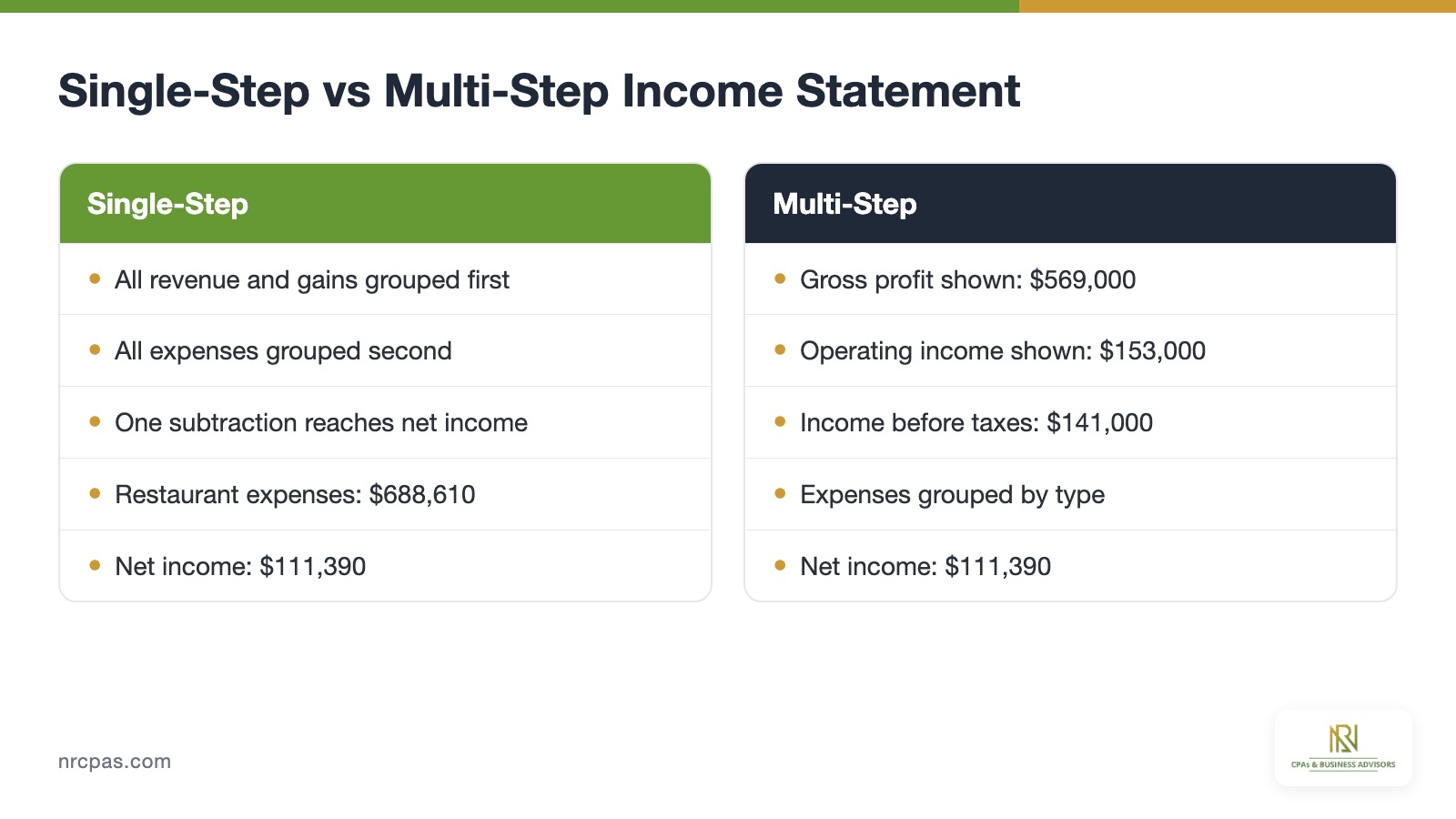
The table below puts Cedar Street Kitchen into both formats. Net income stays at $111,390 in each column.
| Feature | Single-Step | Multi-Step |
|---|---|---|
| Total revenue | $800,000 | $800,000 |
| Gross profit shown | No | Yes, $569,000 |
| Operating income shown | No | Yes, $153,000 |
| Total expenses | $688,610 | Grouped by type |
| Net income | $111,390 | $111,390 |
The single-step expense total of $688,610 adds cost of goods sold, operating expenses, interest and tax. The graphic below compares the two layouts side by side.
The Financial Accounting Standards Board (FASB) issued ASU 2015-01 in January 2015. That update removed extraordinary items as a separate line from both formats. The multi-step layout gives lenders more detail, because gross profit and operating income show where profit is made.
Format choice matters less than the numbers behind it. Those numbers come from a repeatable process, which starts with a period and a list of accounts.
How Do You Make Your Own Income Statement From Scratch?
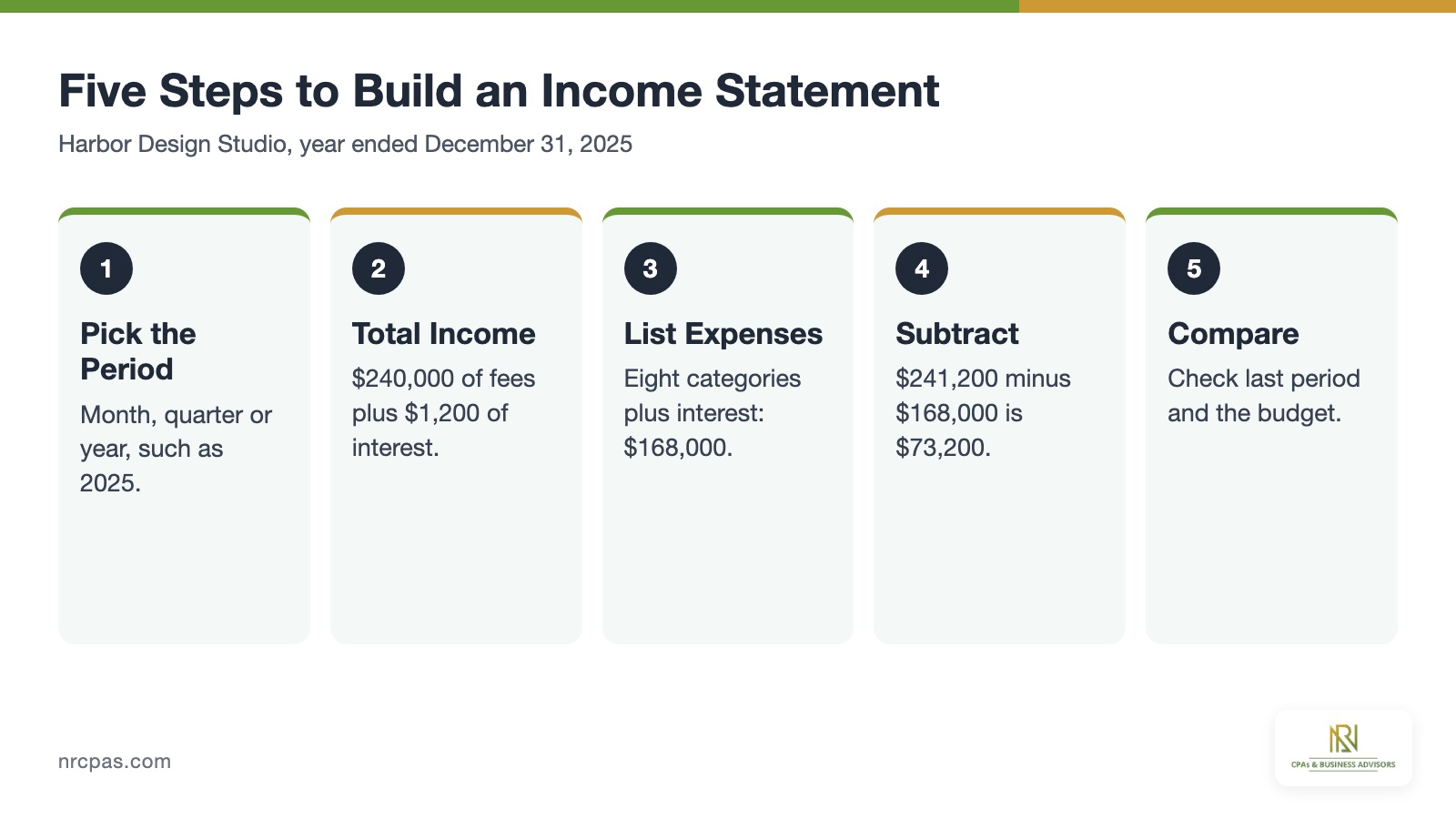
You make your own income statement from scratch by choosing a period, totaling income, listing expenses and subtracting. Five steps turn a bookkeeping file into a finished statement. The numbered list below follows the order used for Harbor Design Studio.
- Pick the reporting period, such as January 1 to December 31, 2025.
- Total all income earned in that period, which gave $240,000 of fees plus $1,200 of interest.
- List each expense by category and total them, which gave $168,000.
- Subtract total expenses from total income to reach net income of $73,200.
- Compare net income with last period and with the budget.
The steps above work in a spreadsheet or in bookkeeping software, because both read the same ledger. Owners who hand off the ledger can use P&L preparation for the final report. A trial balance at period end confirms that debits equal credits before the report is built.
Each expense needs one category, such as payroll, rent or supplies. Consistent categories let one month compare cleanly with the next. Those comparisons show which expense lines are growing faster than income.
A CFO review then checks that each expense sits in the right category. That review catches errors before a lender or the IRS does. The finished statement also feeds a second report, the balance sheet.
How Does an Income Statement Connect to the Balance Sheet?
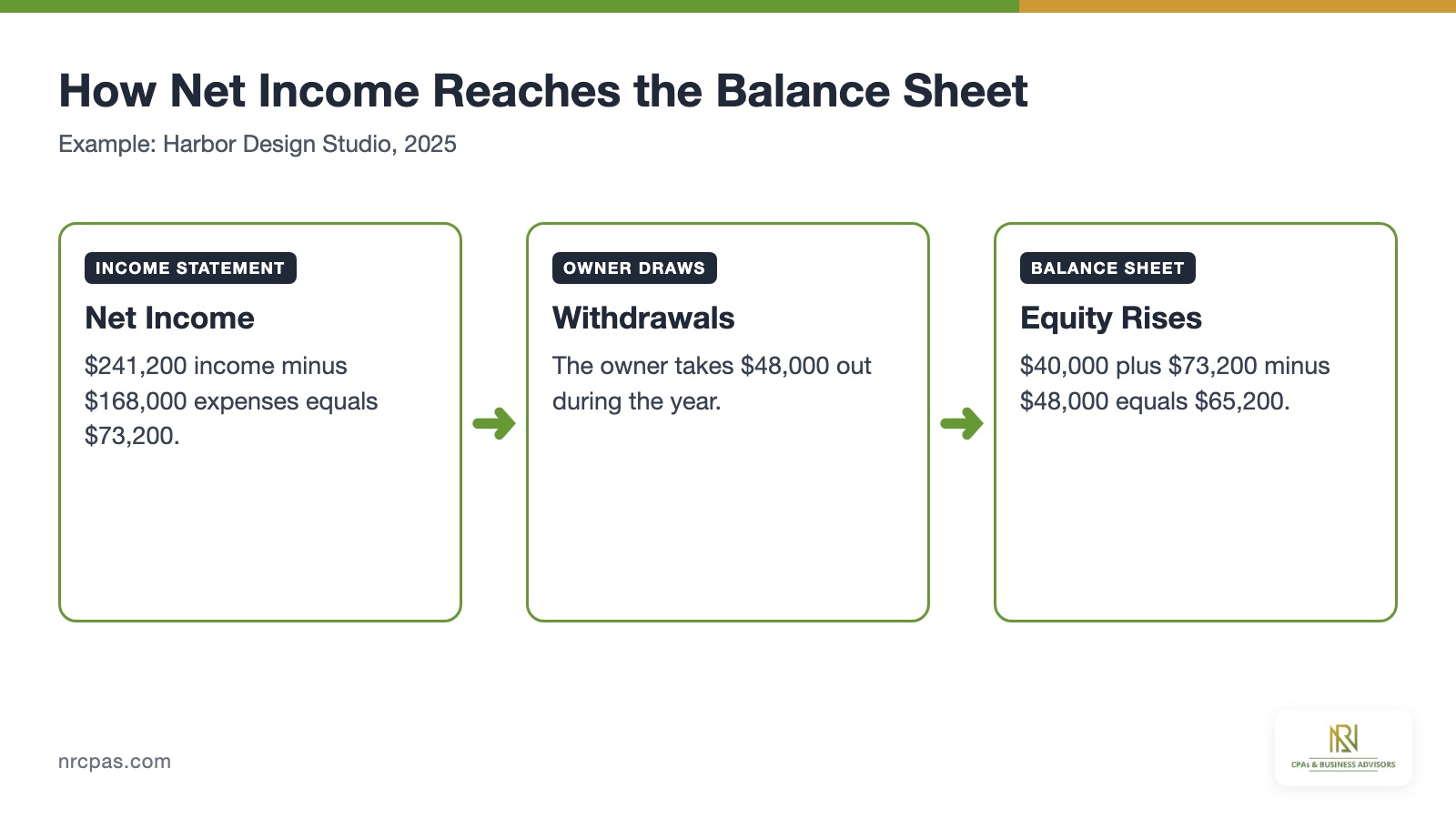
An income statement connects to the balance sheet through net income, which closes into owner's equity at period end. Net income of $73,200 raises Harbor Design Studio's equity by $73,200 before owner draws. The balance sheet then reports the new equity balance.
In this balance sheet and income statement example, the owner started 2025 with equity of $40,000 and withdrew $48,000 during the year. The year-end equity is then $40,000 plus $73,200 minus $48,000, or $65,200. Cedar Street Kitchen sends $111,390 of net income to retained earnings in the same way.
The income statement covers a period, while the balance sheet covers a single date. The flow graphic below shows how the statements link.
Net income is not the same as cash in the bank, because accrual books record sales before payment arrives. A cash position report fills that gap, and the 3 statements together show the full picture.
Together, the statements answer who needs the income statement and how often. Lenders, owners and tax authorities each set a schedule.
How Often Does a Small Business Need an Income Statement?
A small business needs an income statement at least once a year, and monthly statements give owners faster control. Public companies file an annual Form 10-K and quarterly Form 10-Q reports with the SEC, and private firms follow a similar rhythm.
Lenders also ask for the statement. According to the Federal Reserve Banks, 38% of small employer firms applied for financing in the prior 12 months. A recent profit and loss statement gives the lender a view of repayment ability.
Survival depends on profit. According to the Bureau of Labor Statistics (BLS), 34.7% of business establishments born in 2013 were still operating in 2023. A monthly statement flags a falling margin early.
Owners who pass profit through to a personal return can also check the 20% QBI deduction. The QBI deduction applies to net income from qualifying pass-through businesses, so an accurate statement sets the deduction base.
Those schedules cover the core question. Owners then raise related examples, from cash basis reports to nonprofits.
What Other Income Statement Examples Do Business Owners Ask About?
Does a Cash Basis Income Statement Differ From an Accrual One?
Yes, a cash basis income statement differs from an accrual one in timing, because cash basis records sales when payment arrives. A cash basis income statement example books the December invoice in January. An accrual income statement example books the same sale in December, when the work is done.
According to the IRS, the cash method stays open to a C corporation with gross receipts under $31 million for 2025. Cedar Street Kitchen, at $800,000 of sales, qualifies. Method changes go through cash method planning before a return is filed.
What Does a Nonprofit Income Statement Example Include?
A nonprofit income statement example is called a statement of activities, and it reports contributions, grants and program expenses. The bottom line is the change in net assets, not net income. A $500,000 nonprofit might show $420,000 of grants, $80,000 of donations and $455,000 of program and admin costs.
That nonprofit ends with a $45,000 increase in net assets. Specialists in nonprofit accounting also split costs into program, management and fundraising categories.
What Does a Rental Property Income Statement Example Show?
A rental property income statement example shows rent collected, then mortgage interest, taxes, insurance, repairs and depreciation. A duplex with $36,000 of rent and $24,000 of expenses reports $12,000 of net income. Depreciation is the key non-cash line.
Owners who buy equipment for the building should review rental depreciation rules. Section 179 rules limit rental property, so the depreciation line usually follows standard schedules.
What Is an Income Statement Example With EBITDA?
An EBITDA income statement example adds back interest, taxes, depreciation and amortization to net income. Cedar Street Kitchen shows operating income of $153,000 before interest and tax. Adding $18,000 of depreciation gives EBITDA of $171,000.
Who Uses an Income Statement?
Internal and external users read an income statement for different reasons. Owners and managers use the statement to decide whether to open a branch, close a department or raise output. Investors read the statement for profit and growth, while creditors focus on cash flow and repayment ability.
What Counts as Non-Operating Income and Gains?
Non-operating income is revenue earned outside the main business, such as bank interest, royalties or rent from business property. Gains come from one-time events, such as selling an old delivery van. Harbor Design Studio reports $1,200 of interest income in this way.
What Is the Difference Between Gross Profit and Gross Margin?
Gross profit is the dollar amount left after cost of goods sold. Gross margin is that profit as a percent of revenue. Cedar Street Kitchen has gross profit of $569,000 and a gross margin of 71.1%. Service firms may label direct costs as cost of sales.
Interim statements also help management between year-end reports, because a monthly statement shows trends sooner than an annual one.
Does an LLC Need an Income Statement and a Balance Sheet?
Yes, an LLC needs both statements for lenders, owners and tax preparation, even when the IRS does not demand them. The income statement shows profit for a period, while the balance sheet shows assets, liabilities and equity on one date.
Can a Spreadsheet Template Build an Income Statement?
Yes, a spreadsheet template can build an income statement when the rows match the chart of accounts. Each row sums a ledger account, and formulas compute gross profit and net income. Templates fail when categories change from month to month.
How Long Should Income Statements Be Kept?
Income statements and their records should be kept for at least 3 years, according to the IRS. The period grows to 6 years when omitted income exceeds 25% of the gross income shown. Bad debt claims need 7 years.
Who Can Prepare an Income Statement for Your Business?
A CPA can prepare an income statement from your books and check it against tax returns. We prepare monthly and annual statements for service firms, restaurants and other small businesses.
The team at NR CPAs accountants is led by founder Nischay Rawal, CPA, EA, and the office number is (305) 872-3096.
Lenders and owners read the same lines, so a clean example of income statement lines pays off. Monthly statement support keeps those lines current.