Is a Gift Tax Deductible and Do You Pay Tax on a Gift


No, a gift tax is not deductible, and gifts to individuals are not deductible either. Charitable gifts are the exception, and business gifts carry a $25 limit per person each year. According to the Internal Revenue Service (IRS), the 2026 annual exclusion is $19,000 per recipient. A gift tax return only reports a gift and never creates a deduction.
Key Takeaways
- Gift tax paid is not an income tax deduction, and gift tax is owed only after the $15,000,000 exemption for 2026.
- Gifts to family members and friends are not deductible in any amount, cash or property.
- Cash gifts to qualified charities are deductible for itemizers up to 60% of adjusted gross income.
- Business gifts are deductible up to $25 per recipient each year.
- The recipient of a gift reports no income on the gift itself.
Is a Gift Tax Deductible on Your Income Tax Return?
A gift tax is not deductible on an income tax return. The IRS treats gift tax as a tax on the transfer, not as an expense of earning income. Gift tax paid is never an income tax deduction. According to the IRS, a donor cannot deduct the value of gifts made, other than deductible charitable contributions.
The gift tax itself is rare. According to the IRS, the 2026 basic exclusion amount is $15,000,000 per person under Public Law 119-21. The top gift tax rate is 40%, according to the Instructions for Form 709. A donor owes gift tax only after taxable gifts pass the $15,000,000 exclusion.
The exclusion was $13,990,000 in 2025, so the exclusion grew by $1,010,000 for 2026. Donors who track that exclusion each year often rely on gift tax planning from a family office. A gift tax rule also decides whether the gift itself is deductible, which matters most for family gifts.
Is a Gift to a Family Member Tax Deductible?
A gift to a family member is not tax deductible. Internal Revenue Code Section 102 treats a personal gift as a transfer of after-tax money. A gift to a family member never reduces the giver's income tax. The amount, the occasion and the relationship change nothing.
A $10,000 birthday gift to a daughter and a $200 holiday gift to a nephew both produce a $0 deduction. The same Section 102 keeps the gift out of the receiver's income. Cash is the most common family gift, so the cash question comes next.
Is a Cash Gift Tax Deductible?
A cash gift is not tax deductible when the cash goes to a child, a parent or a friend. Cash handed to an individual is not a deduction in any amount. According to the IRS, gifts to individuals are not deductible.
A check to a crowdfunding page for one person follows the same rule. The campaign benefits an individual and not a charity. The gift also stays non-deductible for the person who receives the cash. Tuition and medical gifts raise a related question.
Are Tuition and Medical Payments Deductible Gifts?
Tuition and medical payments are not deductible gifts, but they are exempt from gift tax when paid directly. According to the IRS, the payment must go straight to the school or the medical provider. A parent who pays a $30,000 tuition bill directly files no Form 709 and takes no deduction.
Money handed to the student first counts as a regular gift under the annual exclusion. Room and board do not qualify for the tuition exclusion. The annual exclusion also decides when a gift needs a return.
Do I Have to File a Gift Tax Return for a Large Gift?
A gift tax return is required when gifts to one person exceed the annual exclusion. According to the IRS, that exclusion is $19,000 per recipient for 2026. The return reports the gift and never creates a deduction. Married couples who split gifts report $38,000 per recipient.
Form 709 is due April 15 of the year after the gift, according to the Instructions for Form 709. Filing costs no tax for most donors. Mark gives his son $50,000 in 2026, which is $31,000 over the exclusion. Mark reports the $31,000, owes $0 and keeps $14,969,000 of lifetime exemption.
The graphic below shows the four 2026 limits that decide whether a gift is reported.

The table below lists six common gifts and shows the deduction and the filing result for each one.
| Gift | Income tax deduction | Form 709 | Limit or note |
|---|---|---|---|
| $15,000 cash to an adult child | No | No | Under the $19,000 exclusion |
| $50,000 cash to an adult child | No | Yes | $31,000 reported, $0 tax |
| Gift to a U.S. citizen spouse | No | No | Unlimited marital deduction |
| Tuition paid to the school | No | No | Direct payment only |
| Cash to a qualified charity | Yes | No | Up to 60% of AGI |
| Business gift to a client | Yes | No | $25 per recipient |
Each row keeps the income tax deduction apart from the gift tax return, because the two systems are separate. Form 709 has its own deductions, since the IRS allows a marital deduction and a charitable deduction on the return.
According to the Instructions for Form 709, late filing costs 5% of the unpaid tax per month, capped at 25%. Donors who missed a required return can seek late filing relief before penalties grow. The charitable deduction is the one place where a deduction does appear.
Can a Gift Be Tax Deductible When It Goes to Charity?
A gift can be tax deductible when it goes to a qualified charity and the giver itemizes deductions. Gifts to qualified charities are the main deductible gifts. According to the IRS, cash gifts to public charities are limited to 60% of adjusted gross income (AGI). Excess gifts carry forward for 5 years under Internal Revenue Code Section 170(d).
The charity must be a qualified organization, so donors check its status in the IRS Tax Exempt Organization Search. Nonprofit teams that issue receipts rely on strong charitable organizations bookkeeping to support each gift. Receipts and records then decide the deduction.
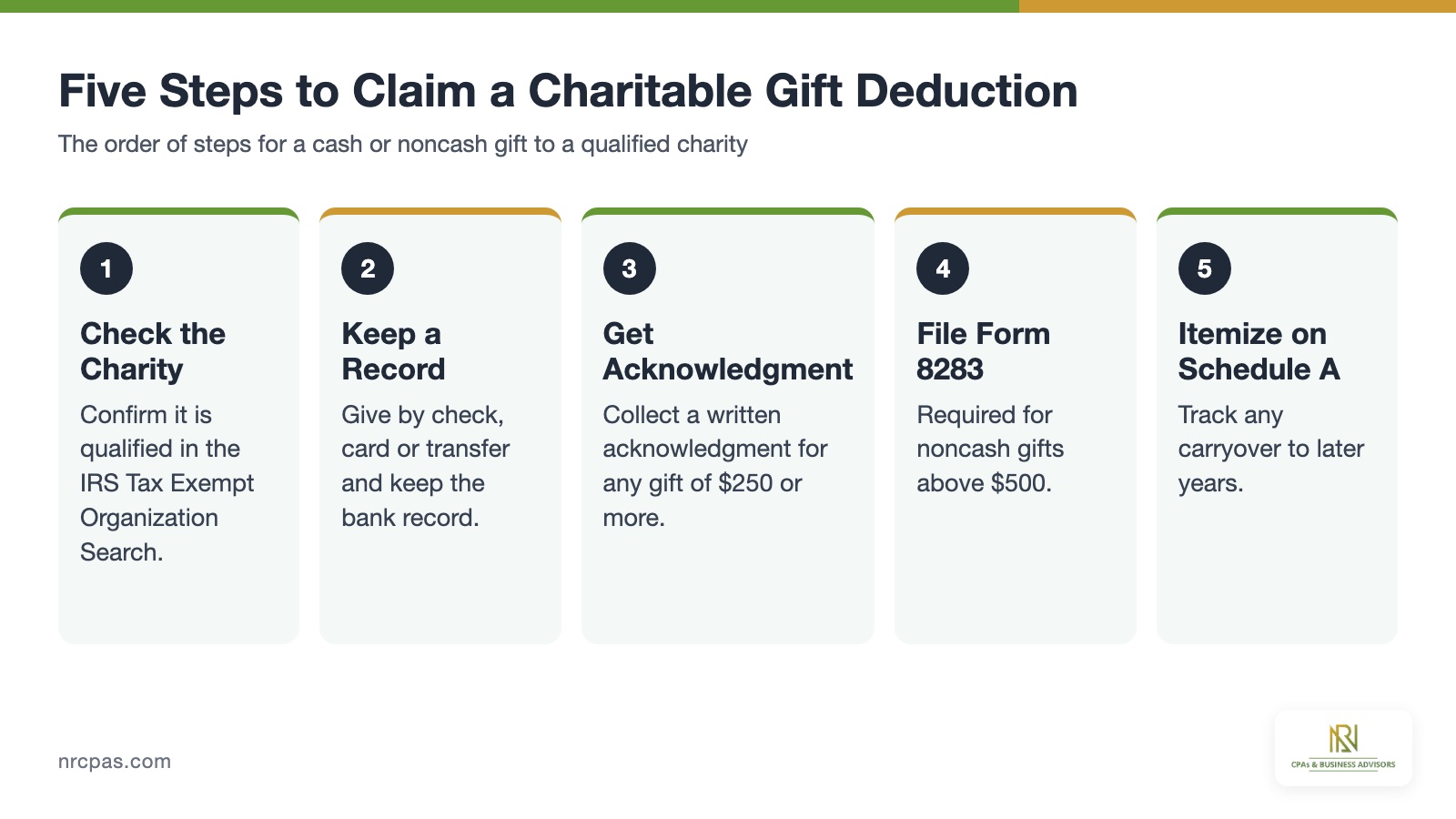
According to the IRS, a gift of $250 or more needs a written acknowledgment from the charity. Noncash gifts above $500 need Form 8283. The numbered list below gives the order of steps for a gift.
- Confirm that the organization is a qualified charity in the IRS Tax Exempt Organization Search.
- Give by check, card or bank transfer, and keep the bank record.
- Collect a written acknowledgment for any gift of $250 or more.
- File Form 8283 for noncash gifts above $500.
- Itemize on Schedule A and track any carryover to later years.
The graphic below shows the same five steps in order.
The limit changes with the gift type and the recipient, as the table below shows.
| Gift type | Recipient | AGI limit |
|---|---|---|
| Cash | Public charity | 60% |
| Appreciated property held over 1 year | Public charity | 30% |
| Cash | Private foundation | 30% |
| Appreciated property held over 1 year | Private foundation | 20% |
Appreciated stock held over 1 year is deducted at fair market value, and the donor skips capital gains tax on the growth. Donors who also sell losing stock can pair a gift with capital gains offset planning. The 2026 law changed how much of this deduction a donor keeps.
How Did the 2026 Rules Change the Charitable Gift Deduction?
The 2026 rules changed the charitable gift deduction in two ways under the One Big Beautiful Bill Act (Public Law 119-21). Taxpayers who take the standard deduction can now deduct up to $1,000 of cash gifts, or $2,000 on a joint return. The gift must go to a public charity, and donor-advised funds do not qualify.
According to the IRS, the 2026 standard deduction is $16,100 for single filers and $32,200 for joint filers. Tom and Maria file jointly, take the standard deduction and give $2,500 to a food bank. They deduct $2,000 of that gift.
Itemizers face a floor in 2026. Charitable gifts count only above 0.5% of AGI. A donor with $100,000 of AGI has a $500 floor, so a $5,000 gift produces a $4,500 deduction. Taxpayers in the 37% bracket also see a 35% cap on the value of itemized deductions.
The charity deduction is large, while the deduction for business gifts is far smaller.
Is a Gift a Tax Write Off for a Business?
A gift is a tax write off for a business when the gift goes to a client or contact. The deduction is limited to $25 per recipient each year. The $25 limit applies per person and not to total gift spending. Internal Revenue Code Section 274(b) sets the cap, as IRS Publication 463 explains.
A $60 gift basket sent to 10 clients produces a $250 deduction for the gift value. Shipping at $10 per basket adds $100, so the total deduction is $350. The bulleted list below covers the exceptions to the $25 limit.
- Incidental costs such as shipping, wrapping and engraving stay outside the $25 limit.
- Items costing $4 or less with the business name stamped on them are not treated as gifts.
- A gift to a client's spouse counts toward the client's $25 limit.
- Employee gifts fall outside the $25 limit, and cash or gift cards are taxable wages on Form W-2.
Good records separate a deductible client gift from a personal gift. Business deduction planning keeps receipts, recipient names and business purpose in one file. The graphic below compares deductible and non-deductible gifts.

Every deduction question has a second side, which is the recipient's tax result.
Do You Have to Pay Tax on a Gift You Receive?
You do not have to pay tax on a gift you receive, because a gift is not income to the recipient. The donor files Form 709 and pays any gift tax. According to the IRS, the donor is generally responsible for paying the gift tax.
The IRS adds that a donee may agree to pay the tax under a special arrangement. That arrangement is a net gift, and the donor still reports it. The recipient lists the gift nowhere on Form 1040. Property gifts add one more rule.
Do You Pay Income Tax on a Gift of Property?
You do not pay income tax when you receive a gift of property, but income tax arrives when you sell the property. A recipient keeps the donor's basis in the property. According to the IRS, stock bought at $10 per share and sold at $100 per share creates a $90 gain per share.
Income earned after the gift, such as dividends and interest, is taxable to the recipient. Several side topics sit around these rules.
What Else Should You Know About Gift Tax Deductions?
Gift tax deductions raise eight side topics, and the short answers below cover each one.
Is a Gift Tax Deductible When the Donor Pays It for the Recipient?
A gift tax is not deductible even when the donor pays the tax on top of a net gift. The only tax benefit of gift tax paid is a basis increase for the recipient. Internal Revenue Code Section 1015(d) limits that increase to the tax tied to appreciation.
Gift tax paid on gifts made within 3 years of death is added back to the estate under Section 2035(b). A family wealth planning review can model a net gift before the gift is made.
Can You Amend a Gift Tax Return?
Yes, you can amend a gift tax return by filing a supplemental Form 709. Write "Supplemental Information" across the top of page 1. The IRS also asks for a statement of the change and a copy of the original return.
Is Gift Tax Federal or State?
Gift tax is federal in nearly every state. According to the Key Wealth Institute 2026 state summary, Connecticut is the only state with a gift tax. Five states charge inheritance tax to recipients. State rules never turn a gift tax into a deduction.
Are Crypto and Stock Gifts Deductible?
A gift of crypto or stock to a person is not deductible. The same asset given to a qualified charity is deductible. A donor who held the asset over 1 year deducts fair market value. Reports on crypto donations follow the same Form 8283 rules.
Is a Gift Tax Deductible for a Gift to a Noncitizen Spouse?
A gift tax is not deductible for a gift to a noncitizen spouse, and the unlimited marital deduction does not apply. According to the IRS, the 2026 annual exclusion for a noncitizen spouse is $194,000. Gifts from foreign persons over $100,000 are reported on Form 3520.
Donors and heirs abroad should review nonresident gift rules before a transfer.
Are Life Insurance Premiums for Someone Else Deductible?
Life insurance premiums paid for someone else are not deductible, because the payment is a gift to the policy owner. Premium gifts count against the $19,000 annual exclusion. Owners of life insurance policies in trusts follow the same gift reporting rules.
Are Estate Planning Fees Deductible?
Estate planning fees are a different expense from gift tax, and the deduction rules for them differ. Fees paid to a lawyer or advisor are not gift tax deductions. Readers can review estate planning expenses separately.
How Can a Family Office Team Help With Gift Deductions?
A family office team helps donors sort deductible gifts from reportable gifts and track the exclusion each year. We prepare Form 709 and keep charity receipts with each return.
The NR CPA team is led by founder Nischay Rawal, CPA, EA. Call (305) 872-3096 to reach the office. The office answers questions on Form 709, charity receipts and gift records.
Donors with large yearly gifts can build a gift calendar with family office support from the same team.