How to Do Market Research for a Business Plan


Market research for a business plan means defining the customer, sizing the market, studying competitors and testing demand with real buyers. This guide shows how to perform market research for a business plan in five steps. Free data from the Census Bureau, the Bureau of Labor Statistics and the Small Business Administration covers most of the work.
Key Takeaways
- The market analysis has 3 parts: industry, target market and competition.
- Five steps cover the work: questions, secondary data, segments and size, competitors, and primary research.
- Market size is measured in 3 layers: total, serviceable and obtainable revenue.
- Census Bureau, BLS and SBA data are free and cover most industries.
- The IRS lets owners elect to deduct up to $5,000 of start-up costs, which include surveys.
Why Learn How to Perform Market Research for a Business Plan?
Market research for a business plan matters because market research replaces guesses about demand with measured numbers. A plan built on measured demand also gives lenders and partners something to check.
According to the Bureau of Labor Statistics (BLS), 79.6% of private-sector establishments born in 2013 survived their first year. The BLS reports that 50.6% were still open after 5 years and 34.7% after 10 years. The graphic below shows those 3 survival rates.

Competition is dense, too. According to the U.S. Small Business Administration (SBA) Office of Advocacy, the country has 36.2 million small businesses. Those firms employ almost 46% of private-sector workers.
Every one of those firms competes for the same buyers a new plan targets, so proof of demand carries weight. Owners who turn research into a written forecast get faster answers from business plan help and from lenders. That written result starts with a clear definition of the analysis itself.
What Is a Market Analysis in a Business Plan?
A market analysis in a business plan is the section that proves enough customers will pay a price that covers costs. The market analysis has 3 parts: industry, target market and competition. The industry part covers size, growth and trends. The target market part names and counts the buyers. The competition part compares rivals on price, features and reach.
The SBA lists 7 topics that research should answer for a new business. The list below shows each topic.
- Demand: whether buyers want the product or service.
- Market size: how many buyers would be interested.
- Economic indicators: income ranges and employment rates.
- Location: where buyers live and where the business can reach them.
- Market saturation: how many similar options already exist.
- Pricing: what buyers pay for alternatives.
- Trends: the shifts in share and demand that will affect profit.
Those 7 answers form the market analysis, while the research is the work that produces them. The research follows a short sequence of steps.
How Do I Do Market Research for a Business Plan?
Doing market research for a business plan takes 5 steps. The numbered list below shows how to do market research for a business plan in working order.
- Define the research questions the plan must answer.
- Gather secondary data on the industry and the buyers.
- Segment the target market and size it.
- Profile direct and indirect competitors.
- Test demand with primary research, such as surveys and interviews.
The graphic below lays out the 5 steps in the same order.
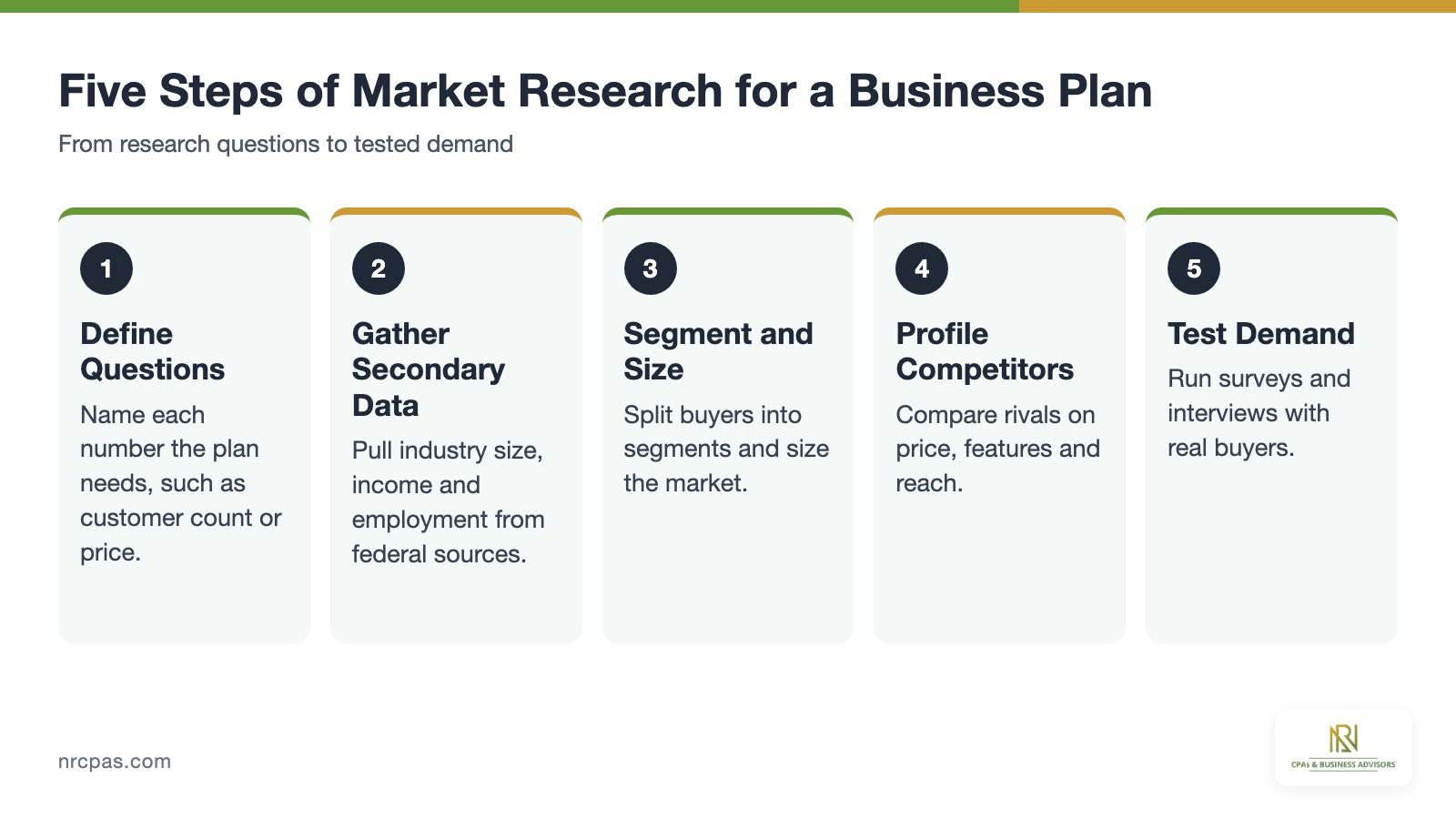
Step 1 sets the scope. Each research question should name one number the plan needs, such as customer count or average price. Questions written first keep the research short. The answers to those questions will describe a group of buyers, and a group of buyers needs a clear definition.
What Is Market Segmentation in a Business Plan?
Market segmentation in a business plan is the practice of dividing buyers into groups that share needs, traits or buying habits. A segment is a group large enough to target and alike enough to serve with one offer. Four bases are used: demographic, geographic, psychographic and behavioral.
Demographic segments use age, income and household size. Geographic segments use a ZIP code or metro area. Psychographic segments use values and lifestyle, while behavioral segments use purchase frequency and brand loyalty.
Two federal benchmarks help test whether a segment can afford a price. According to the Census Bureau, median household income was $83,730 in 2024. According to the BLS, average annual spending was $78,535 per consumer unit in 2024. Founders of software startups often segment by company size instead of household income.
A segment with a known income can be counted. Counting segments leads to the size of the opportunity.
What Is Market Opportunity in a Business Plan?
Market opportunity in a business plan is the revenue a business can win from the customers it can reach. Three layers measure the opportunity: total addressable market (TAM), serviceable available market (SAM) and serviceable obtainable market (SOM). The table below sizes a hypothetical mobile pet grooming business in a metro area with 120,000 households.
| Layer | Definition | Households | Annual revenue |
|---|---|---|---|
| TAM | All households in the metro area | 120,000 | $28,800,000 |
| SAM | Households that own a pet and fit the service area (30%) | 36,000 | $8,640,000 |
| SOM | Share the business can win in year one (5% of SAM) | 1,800 | $432,000 |
Each household spends $240 a year in this example, which equals 4 visits at $60 each. The SOM of $432,000 becomes the first revenue line in the forecast.
The flow graphic below shows the 3 layers narrowing from the full metro area to the obtainable share.
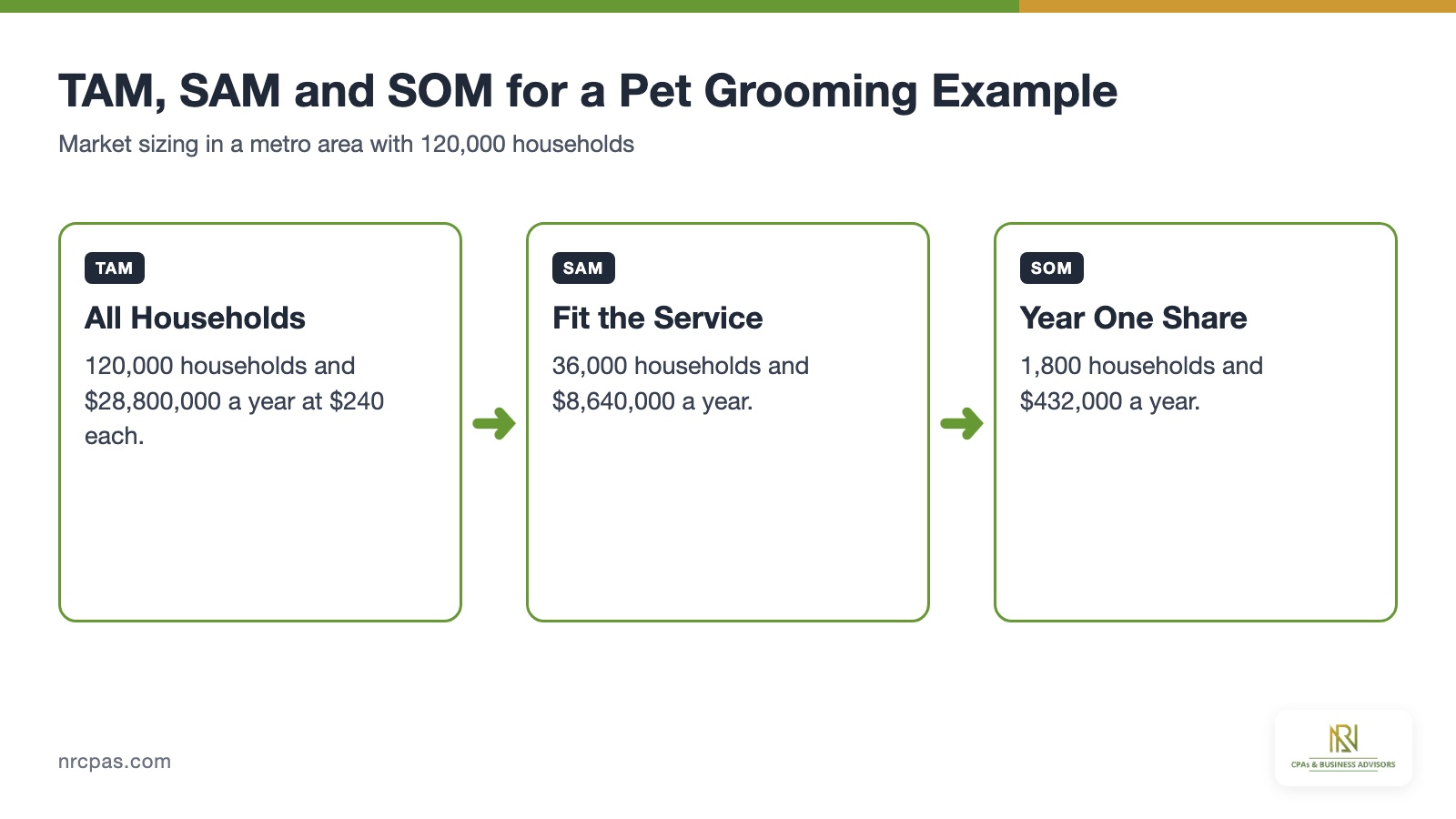
This three-layer sizing shows how to do a market analysis for a business plan with numbers a lender can check. Owners who want those numbers tied to a full forecast can use plan development as the next stage. A revenue target also needs rivals measured, which is the competitor step.
How Do You Research Competitors for a Business Plan?
Researching competitors for a business plan means profiling each rival on price, features, reach and customer reviews. Direct competitors sell the same offer to the same buyers, while indirect competitors solve the same problem another way.
The SBA tells owners to assess each competitor's market share, strengths, weaknesses and entry barriers. Public sources fill the profile: websites, review pages, job postings, social channels and state business filings. Public companies also file reports with the Securities and Exchange Commission.
A comparison matrix keeps the profiles side by side, with one row per competitor and columns for price, features and reach. The gaps in that matrix become the plan's positioning. A competitor benchmarking review adds margin and pricing comparisons to the same matrix. Desk research only goes so far, so primary and secondary research must be compared next.
Should You Use Primary or Secondary Market Research?
A business plan needs both primary and secondary market research, because each answers a different question. Secondary research reads existing data, while primary research collects new answers from real buyers. The table below compares the two types.
| Type | Examples | Cost level | Best use |
|---|---|---|---|
| Secondary | Census tables, BLS data, trade reports | Low | Industry size and trends |
| Primary | Surveys, interviews, focus groups | Moderate | Price and demand tests |
Survey questions should ask about the problem, the purchase frequency and the price buyers accept. Interviews uncover why buyers pick a rival, and that reason shapes the offer. Secondary research comes first, and its main source is free federal data.
Where Do You Find Free Market Research Data?
Free market research data comes from federal agencies that publish industry, income and employment numbers. The Census Bureau, the BLS and the SBA publish most of the free data a plan needs. The list below names the main sources.
- Census Business Builder and data.census.gov for customer counts and business counts by area.
- County Business Patterns for establishments, employment and payroll by industry, with 2023 as the latest data year.
- The Economic Census, run every 5 years in years ending in 2 and 7.
- BLS tables for employment, earnings and the Consumer Price Index.
- The Federal Reserve Small Business Credit Survey for financing demand.
According to the Census Bureau, the 2022 Economic Census counted 8.0 million employer establishments. Those establishments reported $50.5 trillion in sales and 136.6 million employees. Each figure can be filtered by industry, so a plan can quote its own sector instead of the national total.
These sources answer most secondary questions, and the same sources answer the side questions below.
What Else Should You Know Before Writing the Market Section?
The market section also raises cost, lender, tax and timing questions. The sections below answer each one in short form.
Can You Research the Market for a Business Plan for Free?
Yes, a market can be researched for free, because federal data covers industry size, income and employment at no charge. Free federal tables plus 20 customer interviews cover most of a small plan. That mix shows how to research the market for a business plan when cash is tight. It also shows how to conduct market research for a business plan without paid reports.
How Does Market Research Feed Financial Projections?
Market research feeds financial projections through three inputs: customer count, price and purchase frequency. Revenue equals the obtainable customers multiplied by price and frequency. The SOM becomes the revenue line, and expenses build down from it.
Those revenue lines then flow into forecast statements for the first 3 years. The statements show profit, assets and debt in one package.
Monthly timing matters as much as annual totals for a new business with little cash on hand. A cash flow projection shows when survey costs, inventory and payroll hit the bank account.
Do Lenders Ask for Market Research?
Lenders set their own document lists, so a market analysis is worth having ready. According to the SBA, each lender decides which documents an application needs. The SBA states the maximum 7(a) loan amount at $5 million. A CFO for founders can package the market analysis with the forecast before an application goes in.
According to the Federal Reserve Banks, 60% of small employer firms applied for financing in the 12 months before the 2025 survey. Of those firms, 38% applied for a loan, line of credit or merchant cash advance. Measured demand sets a plan apart from the other applications.
Are Market Research Costs Tax Deductible?
Market research costs paid before a business opens are start-up costs, and the IRS lets owners elect a deduction. According to the IRS, owners can elect to deduct up to $5,000 of start-up costs and $5,000 of organizational costs. The $5,000 deduction shrinks once total start-up costs pass $50,000.
IRS Publication 583 lists surveys among start-up costs, and remaining costs are amortized. Owners who track survey and data costs in a separate account gain cleaner startup cost deductions in the first return.
How Often Should You Update Market Research?
Market research should be updated before each financing request and at least once a year. The Economic Census refreshes every 5 years, while County Business Patterns refreshes annually. A growing company also needs fresh numbers for each new segment. A scaling plan shows which segments to refresh first.
How Can a CPA Firm Help With the Market Section of a Business Plan?
A CPA firm helps by checking the revenue math, the cost assumptions and the tax effect of each research cost. We build market-based forecasts for new and growing businesses. We also review the numbers lenders test first.
Early-stage owners can set the research scope with pre-launch advisory before the first survey goes out. A clear scope is how to perform market research for a business plan without wasted effort or duplicate surveys. Scope comes first, and budget follows.
The team at NR CPAs main is led by founder Nischay Rawal, CPA, EA. Reach the office at (305) 872-3096.
The findings from all five steps then become revenue, cost and cash lines in the forecast through market-based planning.