How Long Is a DBA Good For and When to Renew It

A DBA is good for 5 years in Florida and California, up to 10 years in Texas and indefinitely in New York. Each state sets its own term. The term starts on the filing date, and the owner must renew before it ends. The filing office keeps the renewal date, so that office decides the deadline. The exact expiration date appears on the original filing confirmation.
Key Takeaways
- A Florida fictitious name is valid for 5 years and expires on December 31 of the fifth year.
- A Florida renewal costs $50 and must be filed during the year the registration expires.
- A California statement expires 5 years after filing.
- A Texas certificate expires at the end of its stated term of up to 10 years.
- A New York assumed name certificate has no expiration, and an expired Florida name must be registered again.
How Long Is a DBA Good For Under State Law?
A DBA is good for the term written in state law. The answer to how long is a DBA good for changes at every state line. Five years is the term in Florida, California and Arizona. Texas allows up to 10 years, and New York sets no end date.
The term belongs to the filing, not to the business. A DBA, also called a fictitious name or assumed name, is a registered trade name. It lets an owner operate under a name other than the legal one. The table below lists the terms in 5 states.
| State | Term | Renewal rule | Filing office |
|---|---|---|---|
| Florida | 5 years, to December 31 | Renew during the expiration year | Division of Corporations |
| California | 5 years from filing | File a new statement | County clerk |
| Texas | Up to 10 years | File a new certificate | Secretary of State for entities |
| Arizona | 5 years from registration | Renew within 6 months before expiry | Secretary of State |
| New York | No expiration | None, but amend or discontinue | County clerk or Department of State |
Every row in the table depends on the office that holds the filing. Owners who need name registration support can start with the filing office and the original filing date. Florida shows the pattern most clearly.
How Long Does a DBA Last in Florida?
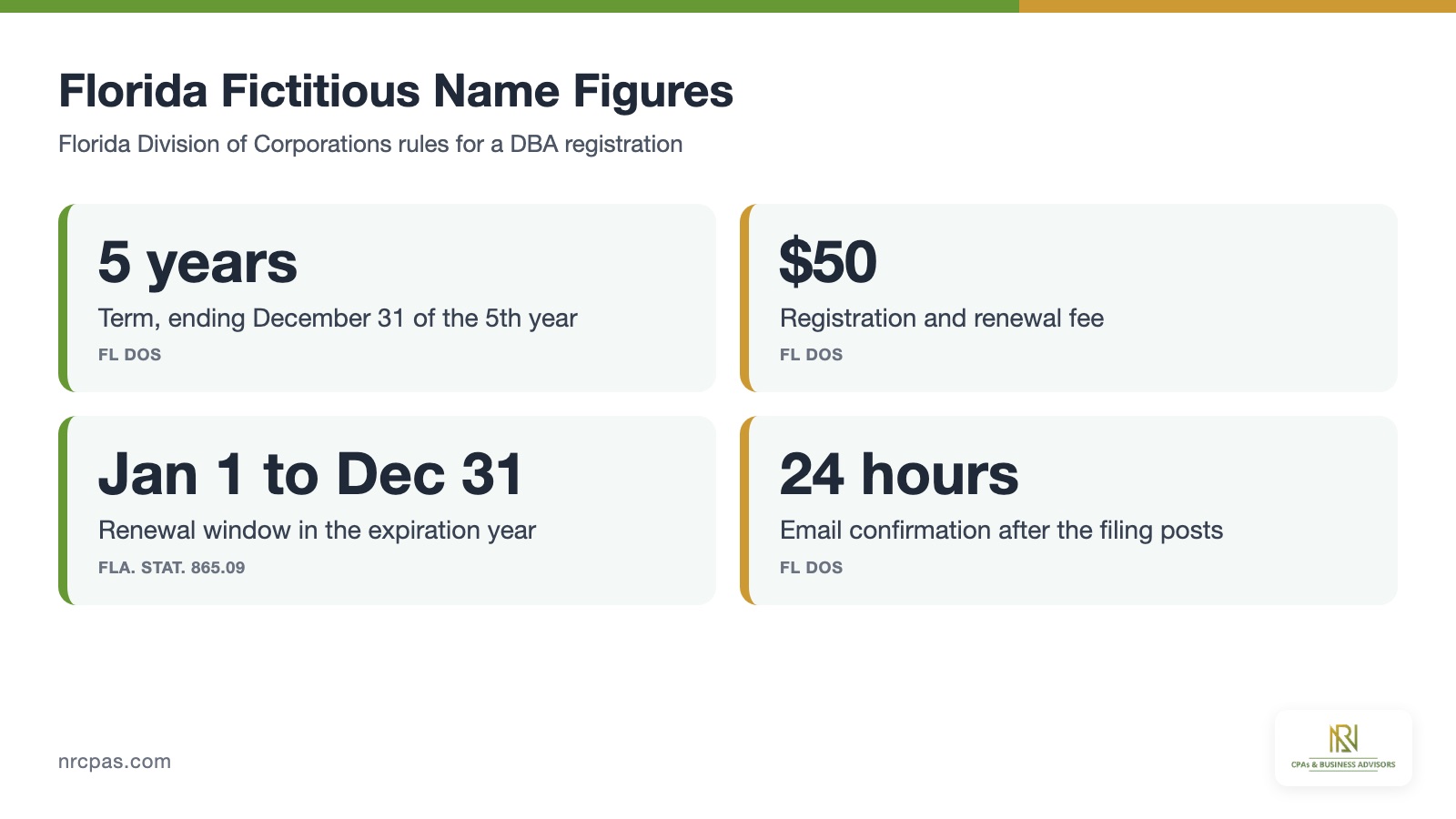
A DBA lasts 5 years in Florida, and the registration expires on December 31 of the fifth year. According to the Florida Division of Corporations, both new registrations and renewals are valid for 5 years. A name filed in 2026 expires on December 31, 2030.
The filing date inside the year does not matter. A name filed on January 5 and a name filed on December 20 end on the same December 31. Florida Statutes section 865.09 sets that calendar rule.
A Florida registration costs $50, according to the Florida Division of Corporations. The Division emails the filing confirmation within 24 hours of the registration posting on Sunbiz. The graphic below shows the main Florida figures.
The expiration date sets the renewal window, and the window decides when an owner must act.
When Should You Renew a DBA?
A DBA should be renewed before its expiration date, and the renewal window depends on the state. Florida renewals open on January 1 and close on December 31 of the expiration year, according to Florida Statutes section 865.09.
The Florida Division of Corporations must notify the registrant of the upcoming expiration no later than September 1 of that year. The same statute says a missing notice does not extend the deadline. A Florida renewal then runs 5 more years, from January 1 of the next year.
Arizona uses a different window. According to Arizona Revised Statutes section 44-1460.02, a trade name registration lasts 5 years. The renewal application is filed within 6 months before expiration. The Arizona Secretary of State writes to the registrant during the 60 days before expiration.
The Texas and California rules set no early renewal window. A Texas owner files a new certificate for the next term. A California owner files a new statement with the county clerk. The steps below fit all five states.
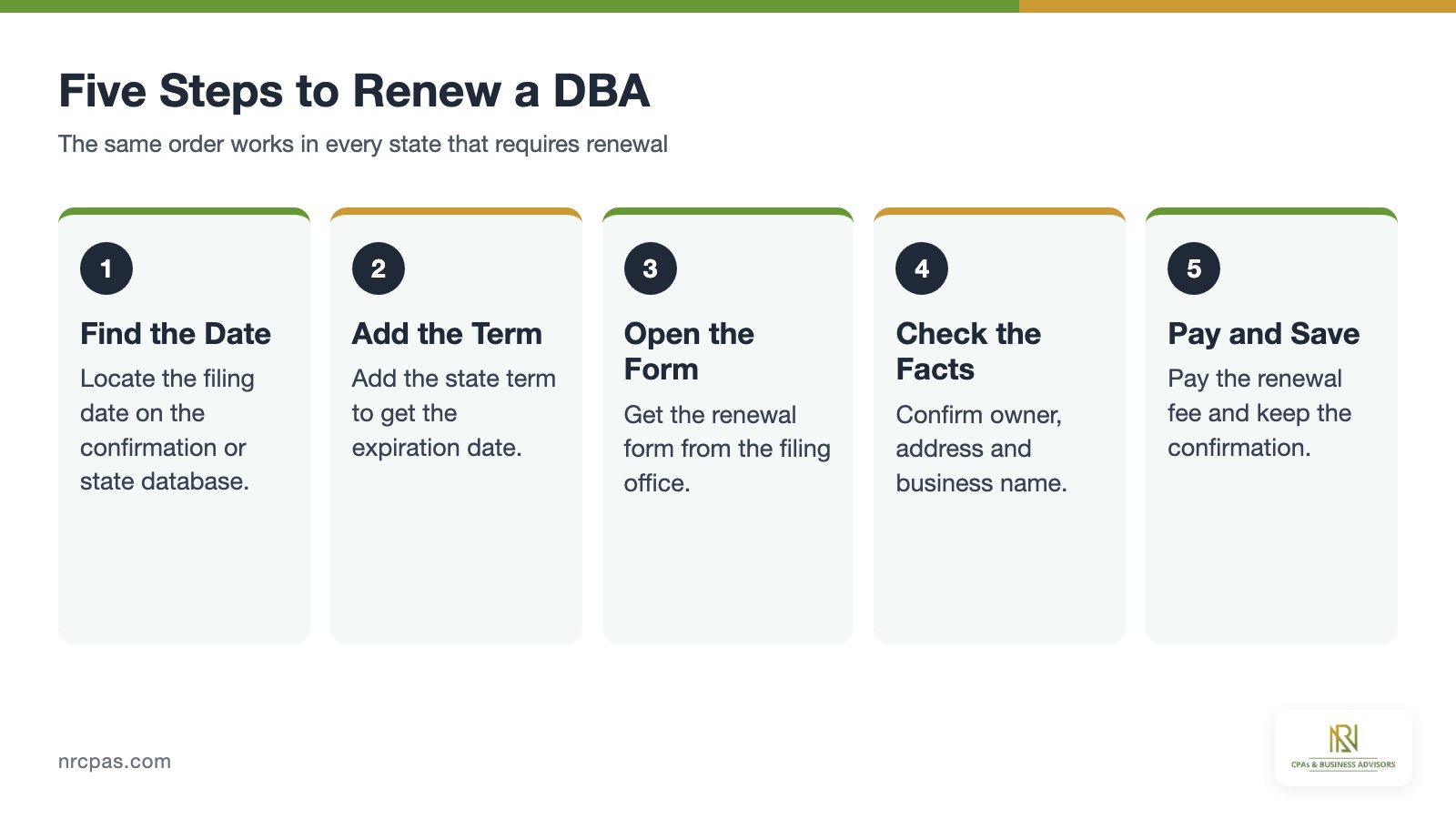
- Find the filing date on the original confirmation or in the state business database.
- Add the state term to that date to get the expiration date.
- Open the renewal form from the filing office, such as Form 503 in Texas.
- Check the owner name, address and business name against the current facts.
- Pay the renewal fee and keep the new confirmation.
The same 5 steps appear in the graphic below.
Skipping the last step in that list lets a registration expire, so the next section covers what an expired DBA costs.
What Happens If a DBA Expires?
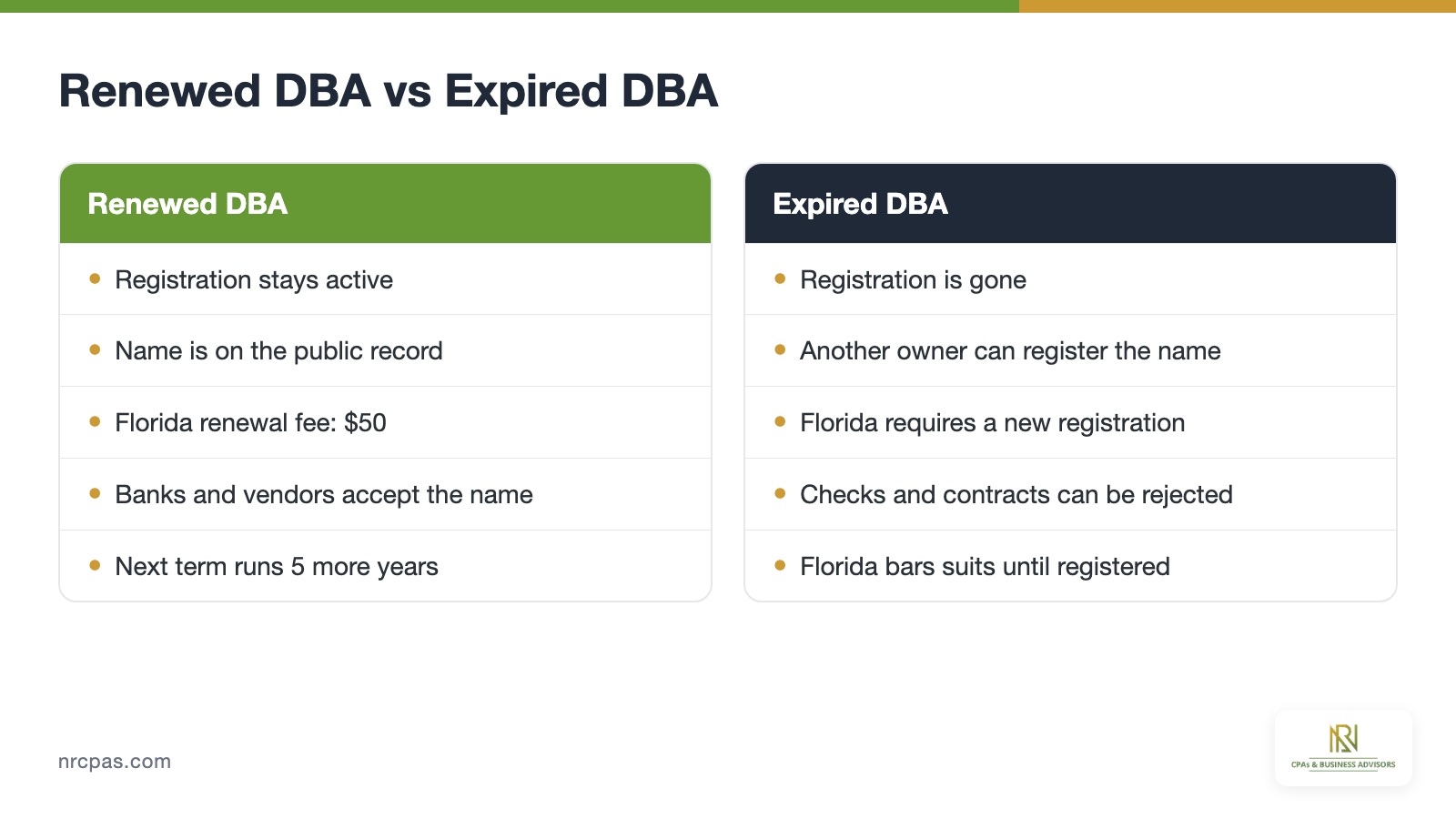
An expired DBA loses its registration, and the owner loses the filing that makes the trade name legal. Florida does not renew an expired fictitious name, according to the Florida Division of Corporations, so the owner files a new registration.
A new registration is not a renewal, and it carries 3 risks.
- Another owner can register the same name while the registration is lapsed.
- Banks and vendors can reject checks and contracts made out to the trade name.
- Florida bars an unregistered business from filing suit until the owner registers, according to Florida Statutes section 865.09.
The name risk is real because a filing never reserved the name. Florida Statutes section 865.09 states that a registration does not stop another party from filing the same name. A lapse simply removes the only record of use.
California adds a second way to lose a filing. According to California Business and Professions Code section 17920, a statement expires 40 days after any change in the facts it lists. An owner who moves or adds a partner must file a new statement within 40 days.
Owners who protect a brand name need a federal filing, because a state DBA never covers the whole country. The graphic below compares a renewed DBA with an expired one.
The expired path starts with a new filing, and the new filing starts with a processing clock.
How Long Does It Take for a DBA to Be Approved?
A DBA is approved when the filing office posts the registration, and the time depends on that office. Florida emails a confirmation within 24 hours after the registration posts on Sunbiz, according to the Florida Division of Corporations.
The Division processes online filings in the order received, so the posting date trails the submission date by a short queue. Owners who file by mail wait longer than owners who file online. Mail filings add postal time, so how long does a DBA take to process by mail includes the same queue.
County clerks run their own queues. A clerk can stamp a filing the same day at the counter. A mailed filing can take weeks, so a call to the clerk gives the current time. The total of how long to get a DBA also grows when the state requires a newspaper notice.
Florida requires the owner to certify that the name was advertised once in a county newspaper, according to Florida Statutes section 865.09. California counties also require newspaper publication of a new statement. The notice adds days or weeks to the finish line.
The filing date starts the term, and the term depends on the filing office. These variations lead to the side topics below.
What Else Should Owners Know About DBA Terms?
How Long Does It Take to Get a DBA in NY?
The time to get a DBA in NY depends on who files. A sole proprietor files a business certificate with the county clerk. A corporation or LLC files a certificate of assumed name with the New York Department of State.
The wait behind how long does it take to file a DBA in New York comes from the clerk's queue. A New York assumed name never expires once filed, under General Business Law section 130. Changes still need an amended certificate.
Does an LLC Need to Renew Its DBA?
An LLC needs to renew its DBA, because the DBA is a separate registration from the LLC. In Florida the LLC must be in active status before the Division accepts the registration. The LLC annual report costs $138.75 from January 1 to May 1, according to the Florida Division of Corporations. A late report adds $400.
The annual report and the DBA renewal run on different clocks. Owners who plan a move to LLC keep both dates on one calendar.
Each added trade name carries its own filing date, its own fee and its own expiration date. Florida adds a $50 fee for every registration, so a second name doubles the fee. Owners who register extra DBA names under one LLC track one renewal per name.
Can a DBA Be Cancelled Before It Expires?
A DBA can be cancelled before it expires. Florida requires the cancellation within 30 days after the owner stops using the name. A Florida cancellation filing costs $50, according to Florida Statutes section 865.09.
New York uses a certificate of discontinuance for the same purpose. A cancelled name ends the term and removes the renewal duty. The cancellation date then closes the name on the owner's records.
Does a DBA Protect a Name After the Term Ends?
A DBA does not protect a name after the term ends, and it does not protect the name during the term either. Registration is public notice only. A federal trademark costs $350 per class to file, according to the U.S. Patent and Trademark Office (USPTO), since January 18, 2025.
A DBA is also not a legal shield. A DBA is not a separate entity, so the DBA liability limits stay with the owner.
A sole proprietor under a DBA remains personally responsible for every business debt, and the renewal never changes that. A sole proprietor who wants separation from business debts needs an LLC instead. The filing duties for owners without an LLC are covered under sole proprietor filing rules.
Does Renewing a DBA Change Taxes or the EIN?
Renewing a DBA changes neither taxes nor the employer identification number (EIN). The Internal Revenue Service (IRS) taxes a sole proprietor on net earnings through Schedule C. Self-employment tax applies at 15.3% once net earnings reach $400, according to the IRS.
A DBA does not create a new EIN, and an LLC keeps the EIN it already has. Owners with several trade names can review the EIN reuse rules before filing again.
A new LLC receives its number after the state accepts the articles of organization. That order matters when the DBA is filed after the LLC and the bank asks for both documents. The timing of an EIN after formation sets which paperwork comes first.
Why Do Small Owners Need a DBA Term Calendar?
Small owners need a DBA term calendar to track every trade name. The Census Bureau counted 30.4 million nonemployer businesses in 2023, with $1.8 trillion in receipts. Many of those owners work under trade names that sit on separate expiration dates.
The Small Business Administration (SBA) says registering a business usually costs less than $300 in total. A Florida renewal costs $50, far less than that, and a lapse costs more. New founders start the calendar with new business advisory support. The calendar keeps each date visible, and it lists four items.
- Registration filing date and expiration date for each name.
- Renewal window open and close dates.
- Annual report due date for the LLC.
- Estimated tax payment dates from the business tax calendar.
Who Can Track DBA Renewal Dates for a Growing Business?
A formation and tax firm can track DBA renewal dates for a growing business alongside the annual report and the tax filings. We keep a compliance calendar for owners who add trade names, new states or new entities.
The team at NR tax pros is led by founder Nischay Rawal, CPA, EA, and the office line is (305) 872-3096. The office also reviews each trade name against the owner's tax filings and entity structure.
The answer to how long is a DBA good for ends with one date per name. The team files each renewal through state filing help for owners across the country.