What Is Off Balance Sheet Financing and How Does It Work

Off balance sheet activities are transactions, assets or debts that a company leaves off its balance sheet but still carries as exposure. Common examples include short-term leases, unconsolidated joint ventures, sold receivables and bank loan commitments. Companies must disclose material arrangements in the notes to their financial statements.
Key Takeaways
- Off balance sheet means an item is missing from the balance sheet but may be described in the notes.
- ASC 842 moved leases longer than 12 months onto the balance sheet.
- A special purpose entity stays off the books only when the sponsor is not its primary beneficiary.
- Sold receivables leave the balance sheet only when all three ASC 860 sale conditions are met.
- Off balance sheet financing is legal when disclosed, and it becomes a problem when it hides risk.
What Is Off Balance Sheet Activities in Accounting?
Off balance sheet activities in accounting are arrangements whose assets or obligations stay off the company's own balance sheet. A balance sheet lists assets, liabilities and equity on one date. The Financial Accounting Standards Board (FASB) sets the rules that decide which items get listed.
The phrase what is off balance sheet activities describes a reporting result, not a hidden account. Clean financial statement packages show both the recorded balances and the notes behind them. Each package should explain the arrangements that the balance sheet leaves out.
According to the U.S. Small Business Administration (SBA) Office of Advocacy, the country has 36.2 million small businesses. Each of those businesses signs leases, loans and supplier contracts. The meaning of the label itself comes next.
What Does Off Balance Sheet Mean?
Off balance sheet means a financial item is not listed as an asset or a liability on the balance sheet. The label describes how an item is presented, not whether the item is legal. The notes to the financial statements may still describe the item.
Banks use the same label for loan commitments, standby letters of credit and derivatives. Those bank items are contingent, because money moves only when a borrower draws funds or a customer defaults. Every contingent commitment is one type of off balance sheet item.
What Is an Off Balance Sheet Item?
An off balance sheet item is an asset, debt or commitment that accounting rules let a company leave unrecorded. Every off balance sheet item still rests on a signed contract. The list below names five categories.
- Short-term leases of 12 months or less.
- Joint ventures and stakes of 20% to 50% reported as one investment line.
- Receivables sold to a factor or an investor under sale accounting.
- Loan commitments, standby letters of credit and derivatives held by banks.
- Contingent liabilities, such as a lawsuit or a co-signed loan, that are only possible losses.
Each of those five categories works through a different contract. Each contract can finance a business without adding reported debt.
What Is Off Balance Sheet Financing and How Does It Work?
Off balance sheet financing lets a company use an asset or raise cash without recording new debt. The company shifts ownership, control or risk to another party through a contract. The numbered list shows the usual sequence.
- The company needs an asset or cash and wants to avoid new reported debt.
- The company signs a contract with a lessor, a factor, a venture partner or a separate entity.
- The contract moves ownership, control or credit risk to that other party.
- The accounting rules test whether the asset and the debt may stay off the books.
- The company discloses material arrangements in the notes to its financial statements.
The five steps appear in order in the graphic below.
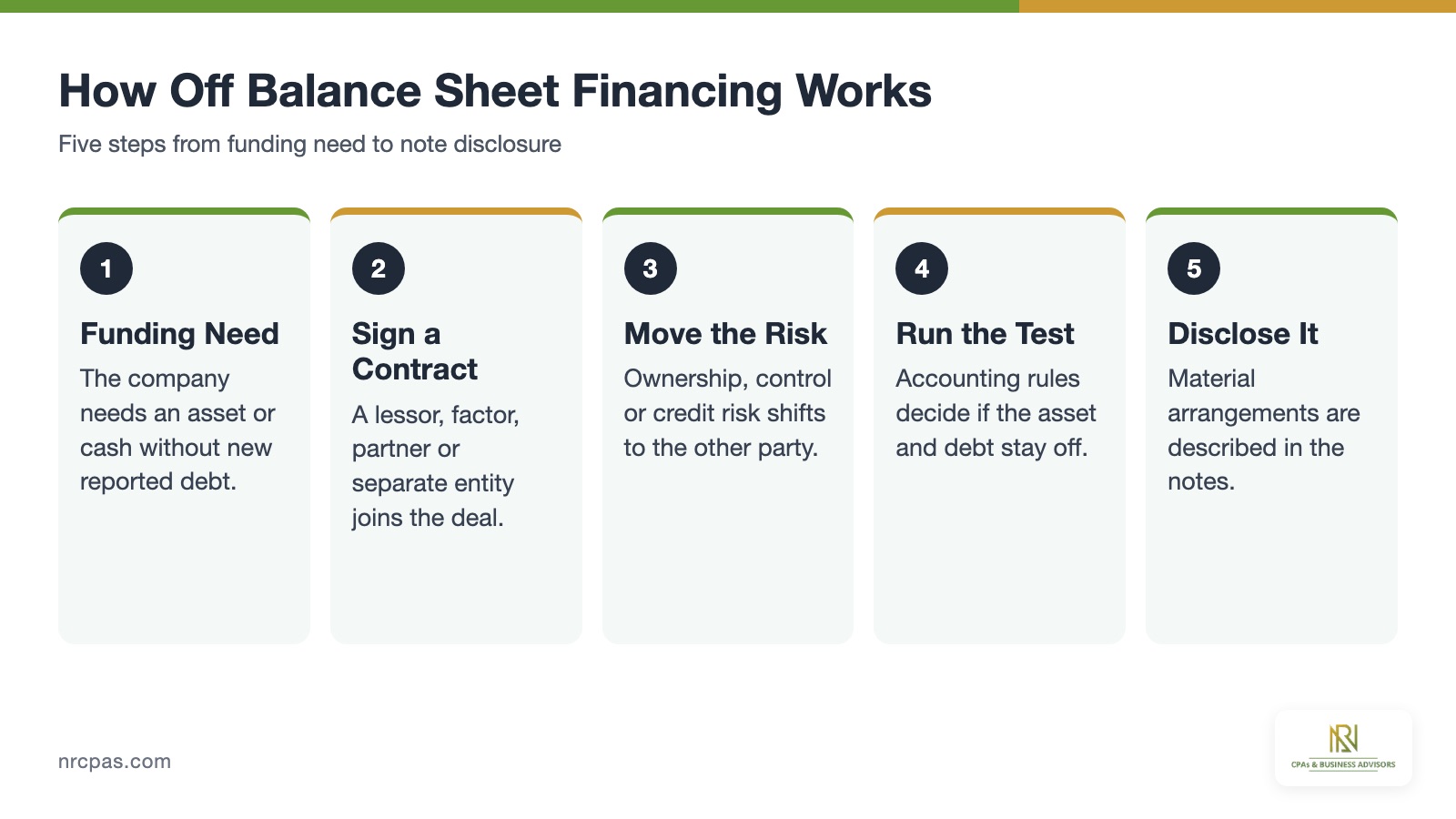
Step 4 decides the outcome, because the accounting rules, not the contract title, set the result. A contract called a lease or a sale can still land on the balance sheet. The next section shows how that plays out for real off balance sheet items.
What Are Off Balance Sheet Items in Real Companies?
Off balance sheet items in real companies include leases, special purpose entities, sold receivables, joint ventures and bank commitments. Each item has its own governing rule and its own current status. The table below compares six items by rule and status.
| Item | Why it can stay off | Governing rule | Status today |
|---|---|---|---|
| Short-term lease | Term of 12 months or less | ASC 842 | Off, by election |
| Operating lease over 12 months | Old rule recorded rent expense only | ASC 842 | On the balance sheet |
| Special purpose entity | Sponsor lacks control or main risk | ASC 810 | Off unless the sponsor is the primary beneficiary |
| Sold receivables | Control passes to the buyer | ASC 860 | Off when all three conditions are met |
| Joint venture or 20% to 50% stake | Reported as one investment line | ASC 323 | Venture debt stays off |
| Loan commitment | Contingent until funds are drawn | Disclosure rules | Off, described in the notes |
Leases changed under ASC 842, so leases get the first closer look.
Are Operating Leases Still Off the Balance Sheet?
No, operating leases longer than 12 months now sit on the balance sheet under ASC 842. The lessee records a right-of-use asset and a lease liability. FASB issued Accounting Standards Update (ASU) 2016-02, the source of ASC 842, in February 2016.
According to FASB, public business entities adopted ASC 842 for fiscal years beginning after December 15, 2018. FASB set fiscal years beginning after December 15, 2021 for private companies through ASU 2020-05. The International Accounting Standards Board made IFRS 16 effective for annual periods beginning January 1, 2019.
The timeline below places those dates next to the SEC study that pushed leases into view.

The Securities and Exchange Commission (SEC) staff released that study on June 15, 2005. The staff estimated that off balance sheet operating leases among active U.S. issuers may approach $1.25 trillion in undiscounted cash flows. The staff criticized the old all-or-nothing lease approach, because lease terms clustered just below the line that required recording.
A lessee can still elect the 12-month exemption, so short leases remain off the balance sheet. Lease expense also stays on the income statement. Leases are one structure, and special purpose entities are another.
Do Special Purpose Entities Keep Debt Off the Books?
Special purpose entities keep debt off the books only when the sponsoring company is not the primary beneficiary of the entity. A special purpose entity (SPE) is a separate legal entity formed for one narrow purpose. Examples include holding assets or financing a project.
FASB ASC 810 defines the primary beneficiary of a variable interest entity by two traits. The party has the power to direct the activities that most affect the entity's results. The party also absorbs losses or receives benefits that could be significant.
A sponsor that meets both traits must consolidate the entity and record its debt. The Enron collapse in 2001 drew attention to SPEs that kept losses out of view. Sold receivables raise a similar question about control.
Does Factoring Receivables Stay Off the Balance Sheet?
Factoring receivables stays off the balance sheet only when the sale meets the three conditions in ASC 860. Factoring means selling unpaid customer invoices to a third party, called a factor, at a discount.
The three conditions are listed below.
- The receivables are legally isolated from the seller and the seller's creditors.
- The buyer may pledge or exchange the receivables it received.
- The seller does not keep effective control over the receivables.
A transfer that fails any one condition is recorded as a secured borrowing. The receivables and the matching debt then stay on the books. Recourse terms need extra review, because recourse can show that the seller keeps risk. Faster collection also supports cash flow control during slow months. Companies chase these structures for a reason.
Why Do Companies Use Off Balance Sheet Financing?
Companies use off balance sheet financing to keep debt ratios low, meet loan covenants and preserve borrowing room. A loan covenant is a loan term that limits a ratio, such as debt to equity. Lenders read the balance sheet closely, so lower reported debt can support better loan terms.
A simple ratio shows the effect. A company with $2,000,000 of debt and $1,000,000 of equity reports a debt-to-equity ratio of 2.0. Removing $1,000,000 of debt from the balance sheet lowers that ratio to 1.0, though the obligation remains.
Some arrangements also move real risk, such as a joint venture partner who shares losses. Owners who weigh these choices often seek capital structure advice before signing. The same low reported debt carries a cost, and that cost is called off balance sheet risk.
What Is Off Balance Sheet Risk?
Off balance sheet risk is the chance that an unrecorded obligation turns into a real loss that the balance sheet never showed. The loss arrives when a contingent commitment is called, drawn or consolidated. Three sources of that loss are listed below.
- A co-signed loan or letter of credit is called after the other party defaults.
- A sponsored entity loses money and its losses return to the sponsor.
- A lease or purchase commitment must be paid while revenue falls.
Readers who see low debt on a balance sheet may underestimate those exposures. Strong audit-ready statements list each exposure in the notes with its amount and trigger. Disclosure rules exist because the balance sheet alone cannot carry that detail.
How Are Off Balance Sheet Activities Reported and Regulated?
Off balance sheet activities are reported in the notes to the financial statements, and public companies add disclosure in SEC filings. The notes explain the nature, purpose and size of each material arrangement. The Sarbanes-Oxley Act became law on July 30, 2002.
Section 401(a) of that law required the SEC to write rules on off balance sheet arrangements. The SEC adopted those rules on January 22, 2003, and they took effect on April 7, 2003. The rules required a separately captioned section in management's discussion and analysis (MD&A).
On November 19, 2020, the SEC amended the MD&A rules and replaced that separate section with a principles-based instruction. The instruction tells companies to discuss material arrangements inside the rest of MD&A. The notes, the balance sheet and the other statement flow work as one set. The legal status of these arrangements is the next question.
Is Off Balance Sheet Financing Legal?
Yes, off balance sheet financing is legal, unless the arrangement hides obligations or breaks the accounting rules. Companies must still disclose material arrangements in their notes. The problem cases involve concealment, not the structure itself.
That legal baseline leads to several side topics for business owners.
What Else Should Business Owners Know About Off Balance Sheet Activities?
Off balance sheet activities raise side questions about financing terms, lender views, taxes and books that do not balance. The sections below answer each one in short form.
What Is Balance Sheet Financing?
Balance sheet financing is funding recorded on the balance sheet as a liability or as equity. A bank loan is a liability, and owner capital is equity.
The cash raised also appears under balance sheet assets until it is spent. Off balance sheet financing works the opposite way, because the funding source never appears as a recorded liability.
What Is the Difference Between On Balance Sheet and Off Balance Sheet?
The difference between on balance sheet and off balance sheet is recording. On balance sheet items are recorded as assets or liabilities, while off balance sheet items appear only in the notes. The graphic below compares the two treatments side by side.
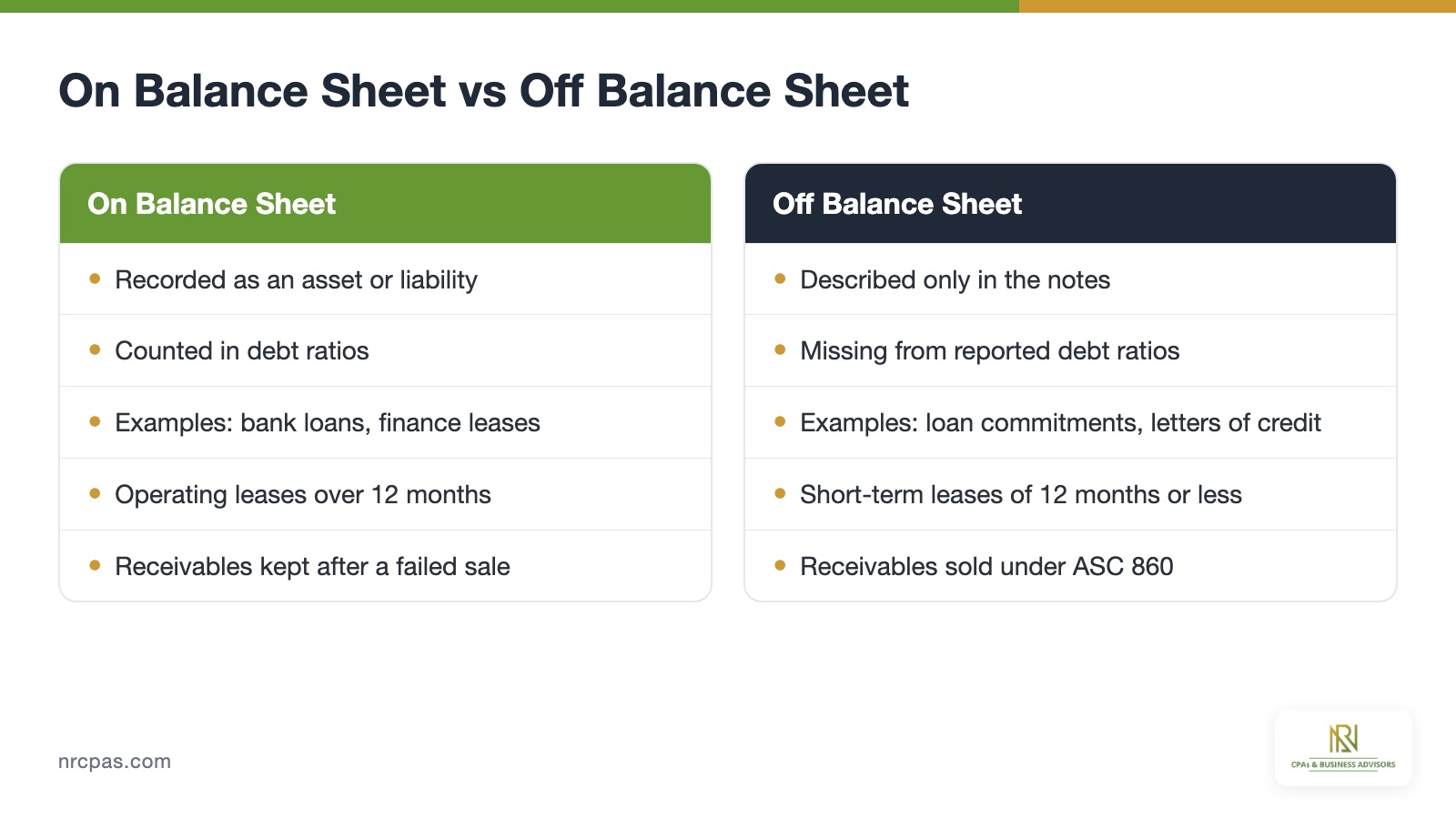
Recorded items also flow into the income statement and the cash flow statement. The statement differences explain where each recorded balance lands. Lenders care about that recorded debt.
How Do Lenders Treat Off Balance Sheet Obligations?
Lenders read the notes to the financial statements for obligations that the balance sheet leaves out. A lender may add lease payments, co-signed debts and receivable recourse back into its own debt calculations.
Covenant ratios may be defined with or without lease liabilities, so the loan agreement wording matters. CFO covenant support tests each ratio against that wording before a loan closes. Tax results follow separate rules.
Does Off Balance Sheet Treatment Change Taxes?
No, off balance sheet treatment does not decide tax treatment, because tax law has its own tests for leases, sales and ownership. A true lease lets the lessee deduct rent, while a purchase may qualify for first-year expensing.
According to the IRS, the 2026 Section 179 limit is $2,560,000. Careful lease-or-buy planning compares both paths before equipment is ordered.
The same IRS guidance sets the 2026 phase-out start at $4,090,000. Those limits apply to qualifying equipment placed in service during 2026. Owners can read how first-year expensing works for purchased equipment. A different meaning of the word off also shows up in bookkeeping.
What to Do When Your Balance Sheet Is Off?
A balance sheet that is off means assets do not equal liabilities plus equity. The first step is finding the exact difference. That error is an entry mistake, not an off balance sheet item.
A difference that divides evenly by 9 can signal two swapped digits in one entry. A difference equal to one entry signals a missing or one-sided posting. A difference equal to half an entry signals an amount posted to the wrong side.
How Can NR CPAs Support Off Balance Sheet Reporting?
Owners asking what is off balance sheet activities for their own company can start with a lease and contract review. We prepare financial statements with lease schedules, consolidation checks and complete note disclosures for small and mid-size businesses.
The firm is led by founder Nischay Rawal, CPA, EA, and the office number is (305) 872-3096. Readers can find more accounting basics through NR CPA learning. Lease schedules, consolidation checks and note disclosures all start from the same signed contracts. Collecting those contracts early shortens the year-end close for every owner.
Owners who want clean notes and balanced statements can request financial statement compilation from the team.