How to File FBAR for Previous Years After a Missed Deadline


Yes, you can file an FBAR for previous years, and each missed year needs its own report in the BSA E-Filing System. How to file FBAR for previous years starts with the $10,000 test. Then each year gets one late report with a reason for the delay. The IRS asks late filers to file as soon as possible. Filers the IRS has not contacted should act before any notice arrives.
Key Takeaways
- A late FBAR is filed online on FinCEN Form 114, one report for each missed calendar year.
- The $10,000 test applies to all foreign accounts combined, at any point in the year.
- The BSA E-Filing System lets you choose the past year and give a reason for filing late.
- The non-willful penalty reaches $16,536 per unfiled report, and willful penalties are far higher.
- Streamlined procedures cover six years of FBARs when returns also need fixing.
Can You File an FBAR for Previous Years After the Deadline Passes?
You can file an FBAR for previous years after the deadline passes, because the BSA E-Filing System accepts past calendar years. The Financial Crimes Enforcement Network (FinCEN) runs the filing system, and the IRS enforces the rule. The report itself is FinCEN Form 114.
According to FinCEN, a U.S. person files an FBAR when foreign accounts together exceed $10,000 at any time in a calendar year. According to the IRS, the FBAR is due April 15, with an automatic extension to October 15. A report still missing after October 15 is late.
The IRS tells filers not to attach the FBAR to a federal tax return. A late return review often uncovers a missed report, and expat tax advisors can check each year against the account records. The number of years to check is the next question.
How Many Years Back Can I File an FBAR?
You can file an FBAR for any past calendar year, because the BSA E-Filing System lets you enter the reporting year. Six years is the penalty window and the streamlined filing period. Federal law at 31 U.S.C. 5321 lets the Treasury assess a penalty within 6 years of the violation.
The IRS streamlined procedures also ask for FBARs from the six most recent years with a passed due date. Each missed year gets a separate report, so a missing 2021 report and a missing 2022 report are two filings. A year in which the combined balance stayed at or under $10,000 needs no report.
The year list sets the workload, and the account records set the content of every report.
What Do You Need Before You File a Late FBAR?
Before you file a late FBAR, you need five records for each account and each year. The IRS lists the same record set for FBAR recordkeeping.
- The name on the account and the account number.
- The name and address of the foreign bank or other institution.
- The type of account, such as bank, brokerage or mutual fund.
- The greatest value of the account during the calendar year.
- The Treasury exchange rate for the last day of that year.
According to the IRS, filers figure the greatest value in the currency of the account. They then convert it to U.S. dollars at the Treasury Bureau of the Fiscal Service rate for December 31. Filers may rely on periodic statements issued at least quarterly when the statements show the greatest value.
Old statements are the usual gap, so request year-end statements from each bank before you open the filing screen. Complete records make the filing steps short.
How Do You File a Late FBAR Step by Step?
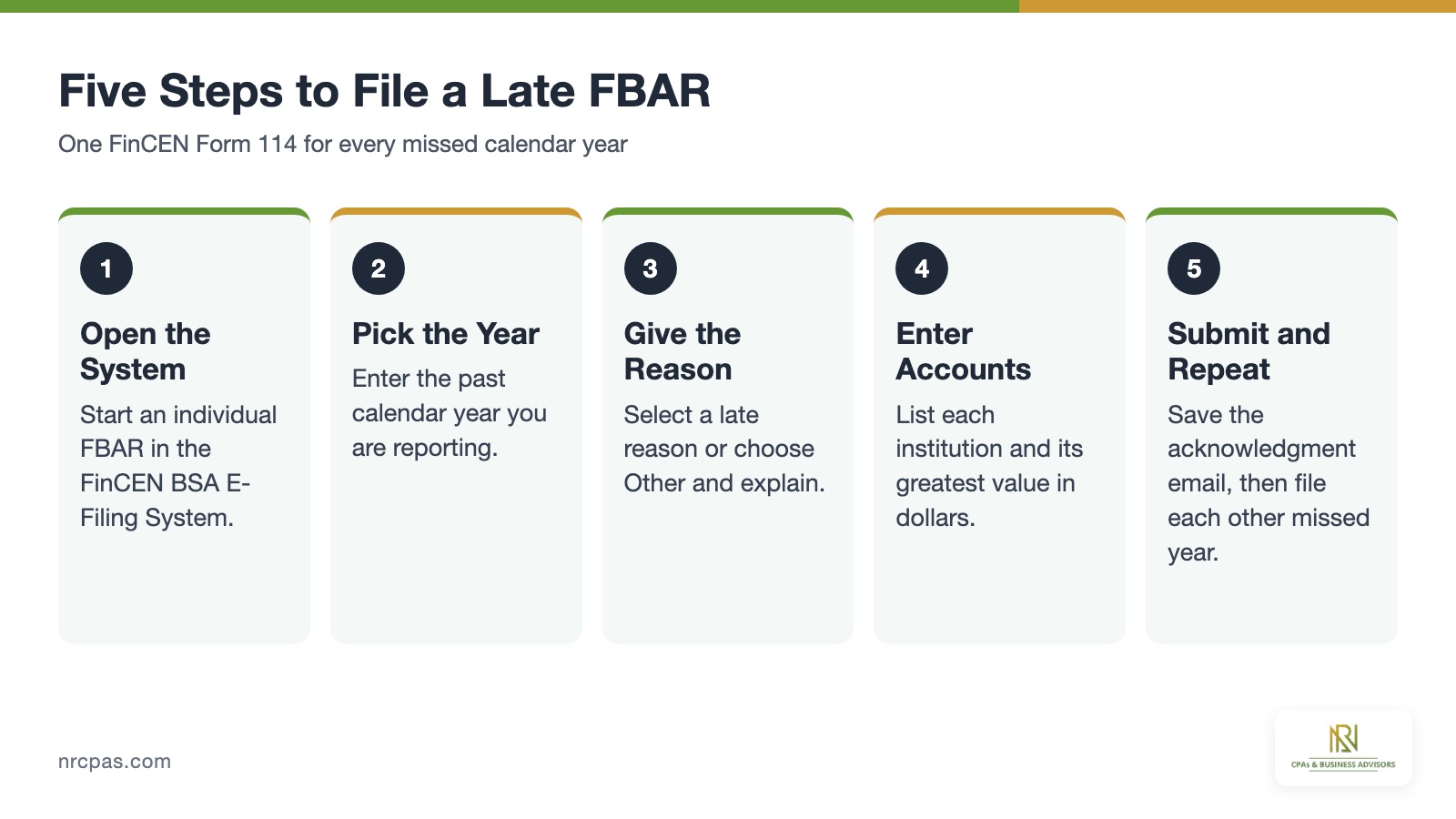
You file a late FBAR step by step with one FinCEN Form 114 for every missed year in the BSA E-Filing System. Each missed year needs a separate report. The numbered list below follows the order of the screens.
- Open the BSA E-Filing System and start an individual FBAR.
- Enter the calendar year you are reporting, including a past year.
- Select the reason for filing late, or choose Other and explain.
- Enter each account with its institution details and greatest value in dollars.
- Submit the report, save the FinCEN acknowledgment email and repeat for every other missed year.
The graphic below shows the same five steps in a single row.
Individuals who cannot e-file must ask the FinCEN Resource Center for an alternative filing method. Paper filing is not the default, so ask before you mail anything. Filers with several missed years can use FBAR compliance help to keep every report consistent. The reason field is the part of the report that needs the most care.
What Reason Should You Give for Filing a Late FBAR?
The reason for filing a late FBAR is the explanation you select or write in the BSA E-Filing System. According to the IRS, the system offers an option to explain the reason for late filing. It also lets you mark a report that is part of an IRS compliance option.
According to 31 U.S.C. 5321, a non-willful violation carries no penalty when it was due to reasonable cause and the account was properly reported. Reasonable cause is the legal basis for a no-penalty result on a late FBAR. The statute gives willful violations no such defense.
A good explanation states facts only. It says when you learned of the rule, which years are affected and what you did next. Tax professionals who draft penalty relief requests keep that statement short and truthful. Plain facts also support the reasonable cause rule described above.
The statement works best when it matches the IRS guidance on late filers, and that guidance changed in 2026.
What Happened to the Delinquent FBAR Submission Procedures?
The Delinquent FBAR Submission Procedures page was removed from IRS.gov on July 1, 2026, according to EY. The old page said the IRS would not impose a penalty solely for a late FBAR when certain conditions were met. Those delinquent FBAR submission procedures covered filers who had already reported their foreign account income.
According to EY, the underlying FBAR rules did not change, and the IRS will not automatically penalize every late FBAR. The Internal Revenue Manual (IRM) section 4.26.16.3.11 still covers late reports. It says no penalty is asserted for an account when the failure was non-willful and due to reasonable cause. The account must also appear properly on the delinquent report.
The written assurance is gone from the IRS website, but reasonable cause remains in the statute and in the IRM. The IRS FBAR page, updated July 30, 2026, tells uncontacted filers to file late FBARs as soon as possible. The same page says the filer must not be under civil or criminal investigation.
Those conditions fit filers with complete returns, and filers with incomplete returns need a different route.
Which Catch-Up Option Fits Your Situation?
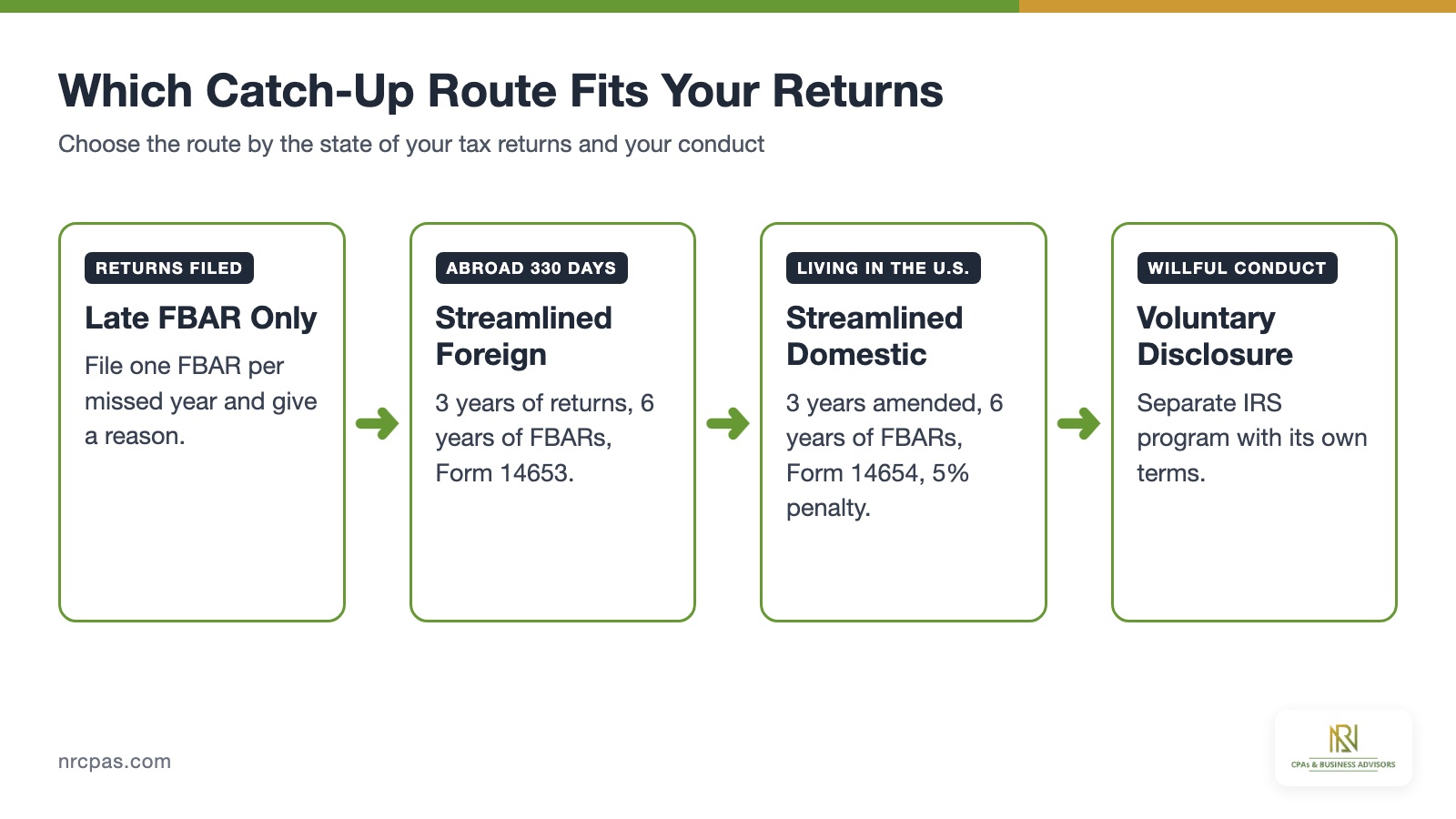
The catch-up option that fits depends on whether your tax returns reported the foreign account income. The table below compares four routes by who qualifies, what you file and how penalties work.
| Route | Who it fits | What you file | Penalty terms |
|---|---|---|---|
| Late FBAR only | Returns filed, foreign income reported | One FBAR per missed year | Reasonable cause can remove the penalty |
| Streamlined, abroad | 330 full days outside the U.S., non-willful | 3 years of returns, 6 years of FBARs, Form 14653 | No failure-to-file or FBAR penalties |
| Streamlined, in the U.S. | Resident of the U.S., non-willful | 3 years of amended returns, 6 years of FBARs, Form 14654 | 5% of the highest aggregate balance |
| Voluntary disclosure | Willful conduct | Case-specific filings | Separate IRS program with its own terms |
The IRS streamlined filing compliance procedures require a certification that the conduct was non-willful. Both streamlined routes still send the FBARs through the BSA E-Filing System. According to the IRS, the filer selects Other as the late reason and enters Streamlined Filing Compliance Procedures in the explanation box.
The decision graphic below traces each route from the state of your returns.
The domestic route adds a cost. According to the IRS, the 5% penalty applies to the highest year-end aggregate balance of the foreign assets in the covered years. Returns that need repair also benefit from foreign income planning for the years ahead.
The penalty terms in that table come from specific federal figures, and those figures come next.
What Are the Penalties for Missing an FBAR?
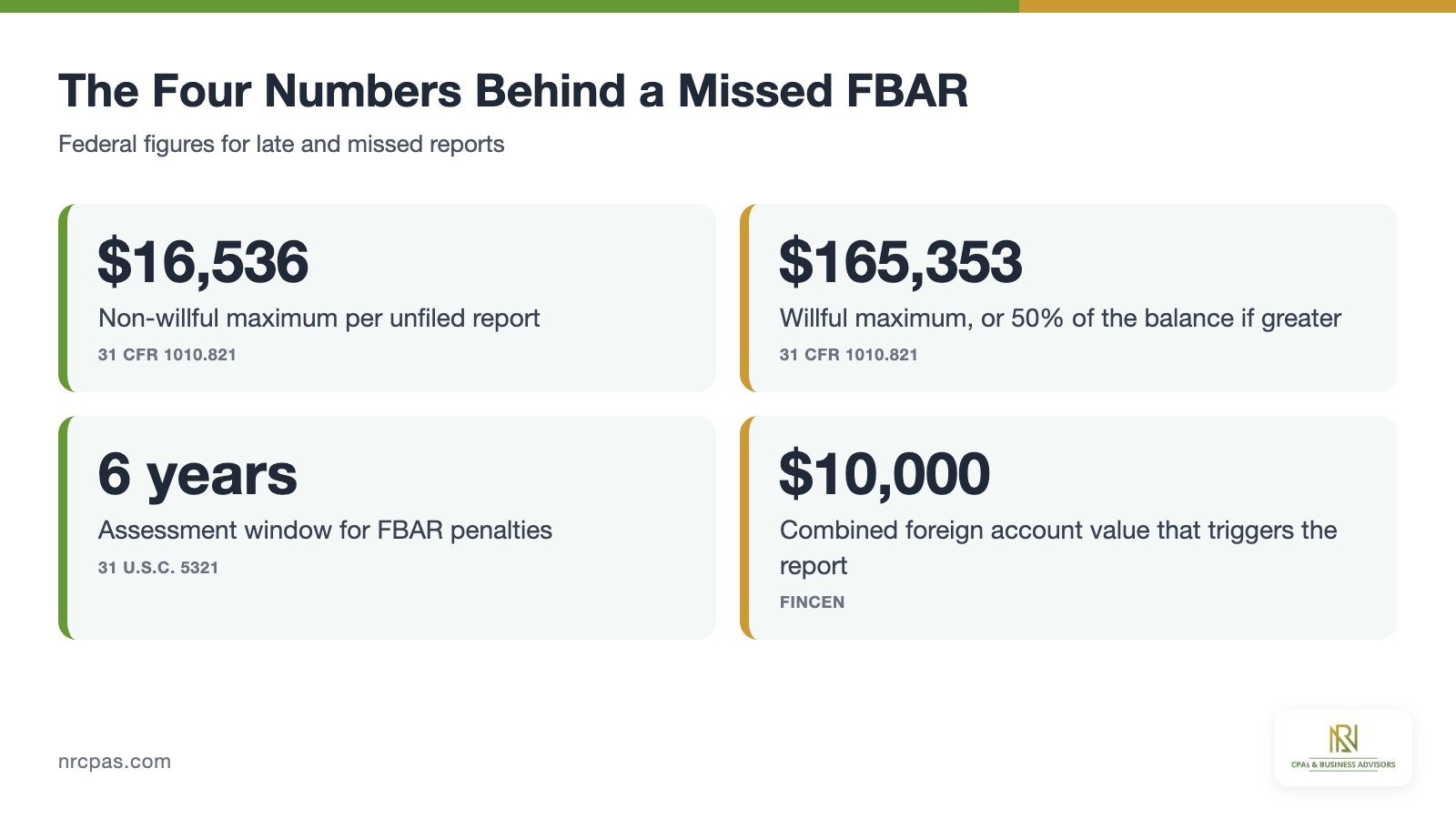
The penalties for missing an FBAR depend on whether the failure was willful, and the amounts are adjusted for inflation. According to 31 CFR 1010.821, the non-willful maximum is $16,536 for penalties assessed on or after January 17, 2025. The maximum willful penalty in that table is $165,353.
- The non-willful penalty is up to $16,536 per unfiled report.
- The willful penalty is the greater of the inflation-adjusted $100,000 or 50% of the account balance at the time of the violation.
- Criminal violations can bring a fine, up to five years in prison, or both, according to the IRS.
The Supreme Court decided Bittner v. United States on February 28, 2023. The Court held that the non-willful penalty accrues per report, not per account. A filer with four missed reports faces at most 4 x $16,536, or $66,144, in non-willful exposure. The account count does not change that math.
The graphic below shows the four numbers that frame the risk.
Those figures explain why timing matters, and timing is the next question.
Should You File a Delinquent FBAR or Wait for the IRS?
You should file a delinquent FBAR now instead of waiting, because the IRS asks late filers to file as soon as possible. The IRS ties that advice to filers it has not contacted. EY adds that delay could raise enforcement risk if the IRS later views the failure as willful.
Filing before any IRS contact is the lowest-risk timing. That timing is the core of how to file FBAR for previous years. Contact from the IRS changes the route, and the penalty relief described above then depends on the facts of the case. Records collected early make every route faster.
Several side topics shape a late filing, and the section below answers each one.
What Else Should You Know Before Filing Late FBARs?
Late FBAR filings raise five side topics: joint accounts, which accounts count, gifts, record retention and quiet disclosure. Each topic below gets a short answer.
How Do Joint Accounts and Spouses Work on a Late FBAR?
Joint accounts require each owner to report the entire value of the account, according to the IRS. Spouses can skip separate reports by signing Form 114a, when all of the non-filing spouse's accounts are jointly owned. Otherwise both spouses file separate FBARs.
Households with accounts in several countries often track balances through family office reporting each month. Monthly tracking makes the greatest value for each year easy to find later, and it speeds up every future FBAR.
Spouses who signed joint returns with unreported foreign income should also review innocent spouse claims before filing. The FBAR itself carries no spousal relief.
Which Foreign Accounts Count Toward the $10,000 Test?
Foreign accounts count toward the $10,000 test when you have a financial interest in them or signature authority over them. Bank accounts, brokerage accounts and mutual funds all count, according to the IRS. Signature authority counts even when the money belongs to someone else.
The IRS excludes individual retirement accounts and tax-qualified plans under IRC Sections 401(a), 403(a), 403(b), 408 and 408A. Employees and owners of founder-led companies with accounts abroad should check signature authority each year.
Do Gifts Sent to a Foreign Account Change the Balance?
Gifts sent to a foreign account raise the greatest account value for that year. That gift can push the total over $10,000. The FBAR counts the balance, whatever its source. Gift tax is a separate question, and the gift tax rules cover who owes it. The FBAR needs only the balance and the year, not the reason the money arrived. Deposit records still help the account statements match the report.
A sender under the annual gift exclusion amount still leaves the recipient with a reportable balance.
How Long Should You Keep FBAR Records?
FBAR records should be kept for five years from the FBAR due date, according to the IRS. Copies of filed reports belong in the same file. Keeping records for six years covers the full penalty window.
What Is Quiet Disclosure and Why Does It Matter?
Quiet disclosure is filing late FBARs with no explanation and no IRS program. The BSA E-Filing System asks for a reason, so an empty explanation gives up the chance to document reasonable cause. Filers with unreported income should choose a stated route instead.
Who Can Help With Late FBARs?
We prepare late FBARs, check each year against the tax returns and pick the right catch-up route. Founder Nischay Rawal, CPA, EA, leads the work, and the office line is (305) 872-3096. The team at NR CPA advisory handles each missed year as its own report. The work runs from the first statement request to the last saved email.
That plan covers how to file FBAR for previous years from the first record to the last acknowledgment. Each filing rests on expat tax services from start to finish.