Can I Add a DBA to My Personal Bank Account


No, most banks will not add a DBA to a personal bank account, since the title must match the owner's legal name. Banks open a separate business account that displays the DBA name. The bank asks for the DBA certificate, a government photo ID and a Social Security number (SSN) or Employer Identification Number (EIN).
Key Takeaways
- Banks rarely rename a personal checking account, so the DBA name goes on a new business account.
- A sole proprietor can bank under a legal name without a DBA, but a trade name needs the filing.
- A DBA bank account needs a DBA certificate, a photo ID and an SSN or EIN.
- Mixing business and personal money muddies Schedule C income and the 15.3% self-employment tax.
- The FDIC insures a DBA account at $250,000 per bank, combined with the owner's personal accounts.
Can I Add a DBA to My Personal Bank Account?
No, you cannot usually add a DBA to your personal bank account, because a personal account is titled in your legal name. A DBA, short for doing business as, is a trade name that a state registers for you. The trade name never becomes a second account holder.
A sole proprietorship has no separate legal existence from its owner, according to the Federal Deposit Insurance Corporation (FDIC). The bank therefore ties every DBA account back to your SSN or EIN. Owners who ask can I add a DBA to my personal bank account hit this identity rule first.
The need is common, because small firms are everywhere. According to the Census Bureau, the country had 29.8 million nonemployer businesses in 2022. Those firms have no paid staff, and each owner decides which account receives the income.
Most owners solve the problem with a second account, and business registration sets the paperwork that account needs. The reasons banks refuse a DBA on a personal account come next.
Why Do Banks Refuse a DBA on a Personal Account?
Banks refuse a DBA on a personal account for three reasons: the account title, the check rules and the identity checks. The account title must match the name on every deposited check. A check payable to a trade name cannot enter an account titled only in a personal name.
Check handling is the daily problem. Some tellers accept a check when the owner signs the back with the DBA and then the legal name. Other banks reject the item, and the customer must reissue the payment.
Identity checks are the second reason. The federal customer identification rule makes a bank collect 4 items before opening an account, says the Financial Crimes Enforcement Network (FinCEN). Those items are a name, a date of birth, an address and an identification number.
The third reason is anti-money laundering review. Banks watch for business-style deposits in personal accounts, and they ask owners to move that activity to a business account. The graphic below sets the two account types side by side.

Refusals look different once the business account exists, so the next question is whether a DBA is needed at all.
Do You Need a DBA to Open a Business Bank Account?
No, you do not need a DBA to open a business bank account when the business uses its owner's full legal name. A DBA becomes necessary only when the account must carry a trade name. Jane Smith can bank as Jane Smith, while Jane's Bakery needs the filing.
The same rule applies to entities. An LLC that banks under its exact registered name needs its Articles of Organization and an EIN, not a DBA. An LLC that trades under another name needs the DBA as well.
According to the U.S. Small Business Administration (SBA), a DBA and an EIN together let an owner open a business bank account. The SBA also lists formation documents, ownership agreements and a business license as common bank requests. Sole proprietors can review the trade name rules in full.
Florida shows what the filing costs. According to the Florida Division of Corporations, a fictitious name registration costs $50 and runs through December 31 of the fifth year. Owners who wonder can you open a business bank account with a DBA get a yes once that certificate exists. The certificate is only one item on a longer document list.
What Do I Need to Open a DBA Bank Account?
To open a DBA bank account you need a DBA certificate, a government photo ID and a tax identification number. Banks match the name on the certificate to the name on the new account. Most banks also ask for a business address, which may be a home office.
The bank may add more papers, depending on the owner. The list below shows the usual set for a sole proprietor.
- The DBA certificate or the filing receipt from the state or county.
- A driver's license, state ID or passport.
- An SSN, or an EIN if you have one.
- A business license, when the trade requires one.
- A starting deposit, which varies by bank.
Entity owners bring formation papers on top of that list. The table below shows how the paper set changes by owner type.
| Owner type | Tax ID | Formation paper | DBA paper |
|---|---|---|---|
| Sole proprietor | SSN or EIN | None | DBA certificate |
| Single-member LLC | EIN | Articles of Organization | DBA filed under the LLC |
| Partnership | EIN | Partnership agreement | DBA certificate |
| Corporation | EIN | Articles of Incorporation | DBA filed under the corporation |
Every row ends with a DBA paper, which proves the trade name belongs to the owner. Banks differ on small details, so a short call before the visit saves a second trip. The tax ID column leads to the next question.
Can I Open a Bank Account With My EIN Number?
Yes, you can open a bank account with your EIN number, and a sole proprietor may use it instead of an SSN. An EIN does not replace the DBA certificate. The bank still needs proof of the trade name.
The IRS issues the EIN at no charge. According to the IRS, a sole proprietor with no employees, and no excise or pension plan returns, does not need an EIN. Many owners apply anyway to keep an SSN off invoices and bank forms.
That choice shapes how to open a bank account with an EIN number. The EIN goes on the application, the DBA certificate proves the name, and the owner signs the signature card. Owners with several trade names can read about EIN sharing before they apply.
Entities cannot skip the EIN. A corporation, a partnership and a multi-member LLC all file with an EIN. The steps that follow work the same for each owner type.
How Do You Open a Business Bank Account Under a DBA?
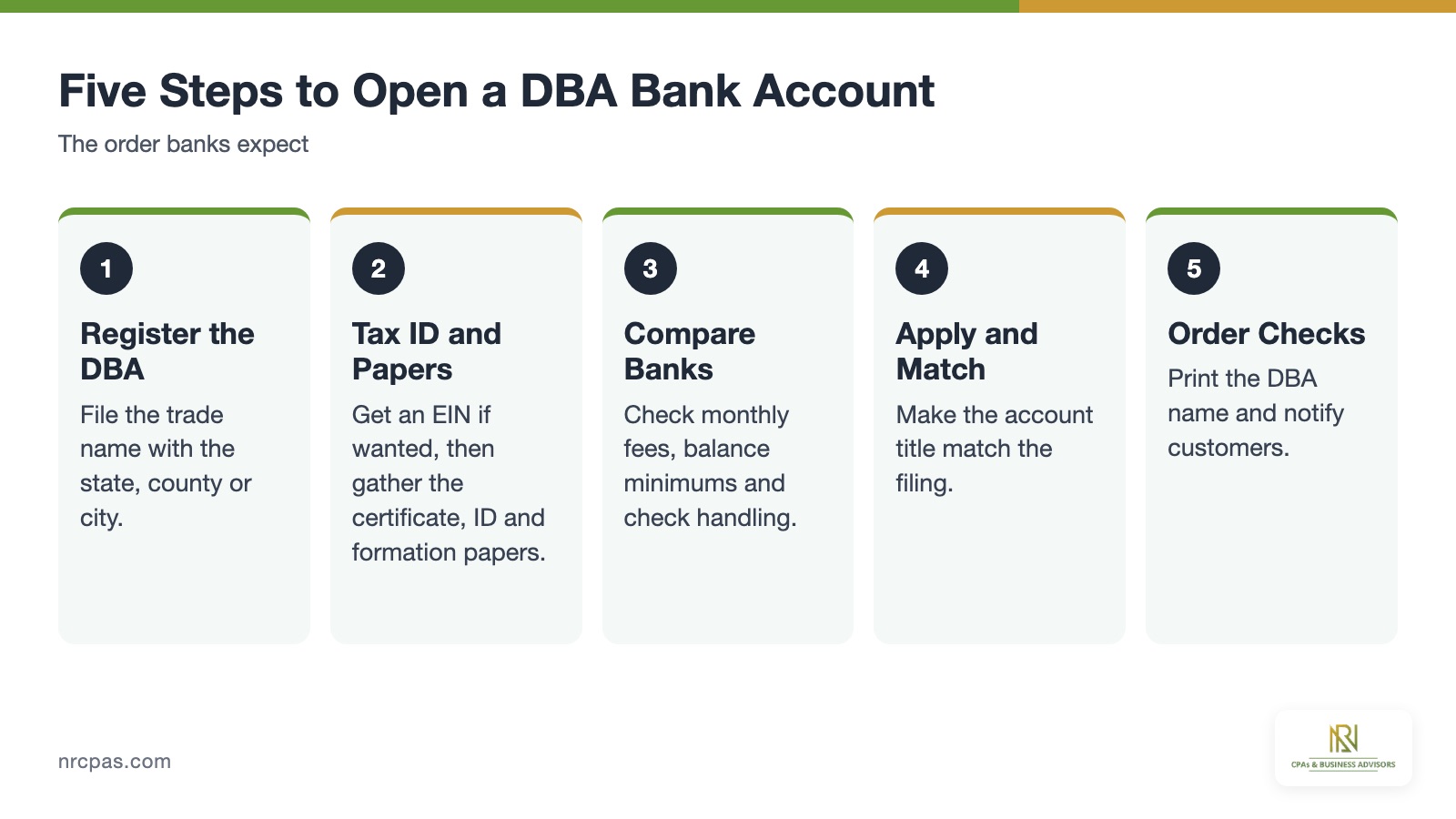
You open a business bank account under a DBA in 5 steps, from the state filing to the first deposit. The filing comes first, because the bank cannot open the account without the certificate. The numbered list below follows that order.
- Register the DBA with the state, county or city office that handles trade names.
- Apply for an EIN if you want one, and gather the certificate, the photo ID and any formation papers.
- Compare banks on monthly fees, balance minimums and check handling.
- Apply online or at a branch, and make sure the account title matches the filing.
- Order checks with the DBA name and tell customers where to send payments.
The five steps are charted in the graphic below, in the order a bank expects them.
New owners can use a launch checklist to line up the filing, the EIN and the bank in one week. After the account opens, endorsement matters. Endorse each customer check with the DBA name exactly as it appears on the account.
The opened account answers the opening question, yet owners still ask whether the account is optional.
Does a DBA Need a Separate Bank Account?
A DBA does not need a separate bank account under federal law, but a separate account is the standard practice. IRS Publication 583 tells owners to keep the business account separate from the personal checking account. The rule is simple, and the benefits are practical.
Owners who ask do I need a separate bank account for a DBA should weigh three benefits. The first is clean records for Schedule C. The second is a clear paper trail for lenders and customers. The third is a firm line between personal and business spending.
Entities have a stronger reason. An LLC that mixes its money with the owner's money weakens the liability shield. Courts look at separate accounts as one sign that the company is a real, distinct business.
A monthly bookkeeping system keeps the DBA account and the personal account apart in the ledger. That separation matters most when the two accounts start to blur.
What Happens When Personal and Business Money Mix?
When personal and business money mix, the result is called commingling, and it hides your true profit. Commingling makes every deposit a question the owner must answer in an audit. A single account holding paychecks, refunds and customer payments cannot show business income alone.
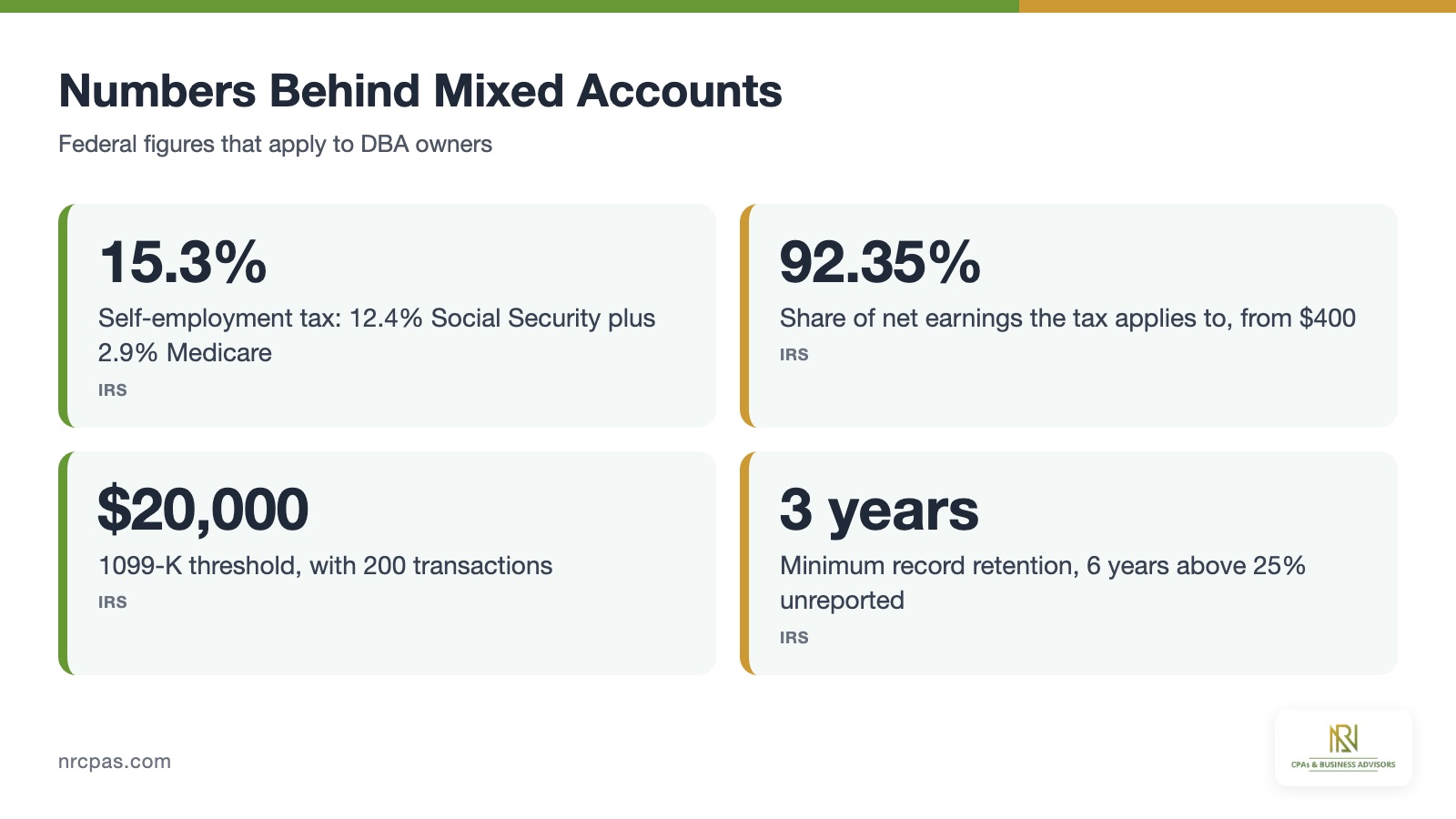
The tax cost is real. A sole proprietor reports profit on Schedule C and pays self-employment tax on it. According to the IRS, the tax rate is 15.3%, made of 12.4% for Social Security and 2.9% for Medicare.
The IRS applies that rate to 92.35% of net earnings once earnings reach $400. According to the Social Security Administration (SSA), the Social Security part stops at $184,500 of 2026 earnings. A profit of $60,000 therefore produces about $8,478 of tax.
Mixed accounts also invite payment-platform reports. The 1099-K threshold is $20,000 and 200 transactions, and gaps between those forms and the return draw notices. Owners can plan around those numbers with sole proprietor taxes advice before the year ends.
Record keeping closes the loop. According to the IRS, records should be kept for 3 years from the filing date. The period grows to 6 years when unreported income exceeds 25% of gross income. The graphic below lists the figures.
Separate accounts cure the record problem, and they also shape how much of the deposit the FDIC protects.
Is a DBA Bank Account Covered by FDIC Insurance?
Yes, a DBA bank account is covered by FDIC insurance, up to $250,000 per depositor, per insured bank. The FDIC counts a DBA account as the owner's single account. The balance adds to the owner's personal single accounts at the same bank.
An owner with $180,000 in personal checking and $120,000 in a DBA account holds $300,000 of single deposits. According to the FDIC, only $250,000 of that is insured. Credit unions follow a parallel $250,000 limit through the National Credit Union Administration (NCUA).
Several DBAs under one owner do not add coverage, because each shares the same owner category. A DBA owned jointly by two people falls under the joint account category instead. Owners with large balances can spread cash across insured banks. Side rules about adding names and cards follow.
What Else Should Owners Know About DBA Bank Accounts?
Owners should know five side rules that change how a DBA account works in practice. Each rule below gives a short answer.
Can I Add a DBA to My Business Bank Account?
Yes, you can add a DBA to your business bank account at many banks, because the account already has a legal owner. The bank updates the title with the new trade name after it sees the certificate. A sole proprietor or an LLC owner can request this at a branch.
The answer differs from the personal account rule, since a business account expects trade names. Banks may still open a new account for a second brand. The old account then stays for the first name.
Can One Bank Account Serve Multiple DBAs?
One bank account can serve multiple DBAs at some banks, but separate accounts keep the books clearer. Each trade name should have its own income and expense records. Owners who run several brands can study the rules for multi-brand DBAs before they open accounts.
Should a DBA Become an LLC?
A DBA should become an LLC when the owner wants liability protection, because a DBA creates no separate entity. According to the Florida Division of Corporations, a Florida LLC filing costs $125, against $50 for a fictitious name. The owner then moves the bank account, contracts and licenses to the LLC. Owners can read about becoming an LLC before filing.
Does a DBA Make an Owner Personally Liable?
Yes, a DBA leaves the owner personally liable, because the owner and the business stay legally identical. A bank account in the DBA name does not change that fact. The details sit in a guide to DBA liability and legal status.
Can a DBA Get a Business Credit Card?
A DBA can get a business credit card, and the issuer usually asks for the owner's SSN or an EIN. A clean DBA bank account helps the application. Applicants can compare business cards that accept an EIN.
How Can a CPA Help With a DBA Bank Account?
A CPA can help with a DBA bank account by lining up the filing, the EIN, the bank and the books. We help owners at each of those steps, so the account opens cleanly and the tax return matches. Owners who ask can I add a DBA to my personal bank account get a firm answer before they open anything.
The team at NR accounting firm is led by founder Nischay Rawal, CPA, EA. Call (305) 872-3096 to talk through a DBA setup.
Owners who want the account and the legal structure set together can use entity filings support.