How to Avoid Self Employment Tax and Reduce It Legally


No, you cannot avoid self-employment tax completely, but you can cut it legally with lower net profit and S corporation distributions. The tax runs 15.3% on 92.35% of net profit, so a 2026 owner with $120,000 of profit pays $16,955. The legal methods below show how to avoid self employment tax on part of that income.
Key Takeaways
- Self-employment tax is 15.3% of 92.35% of net profit once net earnings reach $400.
- Business deductions and an S corporation salary split are the two methods that cut the tax itself.
- A solo 401k, a SEP IRA, an HSA and the QBI deduction lower income tax only.
- An S corp owner must pay a reasonable salary before taking distributions.
- Hiding income or skipping salary is illegal and carries penalties of 20% to 75%.
How Can You Avoid Self Employment Tax Legally?
You can avoid self employment tax legally only on the share of income that stays out of net earnings from self-employment. No lawful method removes the tax entirely, and each method has a limit. According to the Internal Revenue Service (IRS), the tax is 15.3%, made of 12.4% Social Security and 2.9% Medicare.
Knowing how to avoid self employment tax starts with sorting the moves by what they touch. Some moves shrink the tax base, while others only shrink the income tax bill. The table below sorts eight common moves by those two effects.
| Move | Cuts SE tax | Cuts income tax | Key limit |
|---|---|---|---|
| Business deductions | Yes | Yes | Ordinary and necessary costs only |
| S corp salary and distributions | Yes | Yes | Reasonable salary required |
| Hiring a child under 18 | Yes | Yes | Sole proprietor or parent-only partnership |
| Solo 401k or SEP IRA | No | Yes | $72,000 total cap in 2026 |
| HSA contribution | No | Yes | $4,400 self-only, $8,750 family |
| Half of SE tax deduction | No | Yes | Claimed on Schedule 1 |
| Self-employed health insurance | No | Yes | Capped at net profit |
| QBI deduction | No | Yes | 20% of qualified business income |
The rows marked No still save money, so each one earns a place in a complete plan. The graphic below splits the same moves into the two groups.

A written tax reduction strategy keeps the moves in the right order, and the order starts with a baseline.
How Much Self Employment Tax Do You Owe Before Any Planning?
The self-employment tax owed before any planning is 15.3% of 92.35% of net profit. A sole proprietor with $120,000 of 2026 net profit owes $16,955. The numbered steps below show the math from Schedule SE.
- Multiply $120,000 of net profit by 92.35% to reach $110,820 of net earnings.
- Multiply $110,820 by 15.3% to reach $16,955 of self-employment tax.
- Divide $16,955 by 2 to reach an $8,478 deduction on Schedule 1.
The same three steps appear in the graphic below, in the order Schedule SE uses.

The Social Security Administration (SSA) caps the 12.4% Social Security part at $184,500 of earnings for 2026, up from $176,100 for 2025. That cap makes the highest Social Security tax $22,878, while the 2.9% Medicare part has no cap. Every dollar removed from net profit lowers the $16,955 bill, so deductions come first.
How Do Business Deductions Lower Self Employment Tax?
Business deductions lower self employment tax because the tax applies to net profit after expenses. The steps for how to reduce self employment tax begin with the profit line. Each $10,000 of added deductions saves $1,413 of self-employment tax below the Social Security wage base. That saving comes from $10,000 times 92.35% times 15.3%.
The IRS allows costs that are ordinary and necessary for the trade. Common deductions for a sole proprietor include the items listed below.
- Advertising, software subscriptions and website costs.
- Professional fees for bookkeeping, legal and tax services.
- Business insurance, licenses and bank fees.
- A home office, at $5 per square foot up to 300 square feet, which equals $1,500 under the IRS simplified method.
- Equipment, which can be expensed up to $2,560,000 in 2026 under Section 179.
Equipment buyers can read how the Section 179 savings work on net earnings. Owners should never buy an asset only to create a deduction, because the cost still uses real cash.
Health insurance premiums need a separate note. The self-employed health insurance deduction lowers income tax on Schedule 1, but it does not lower net earnings for Schedule SE. Deductions only shrink profit, so owners with larger profit next compare entity choices.
Can an S Corp Reduce Self Employment Tax?
An S corp can reduce self employment tax because only the owner's salary carries payroll tax, while distributions do not. S corporation distributions are not subject to self-employment tax, but the salary must be reasonable. According to the IRS, an S corporation shareholder who works in the business must receive reasonable compensation before any distribution.
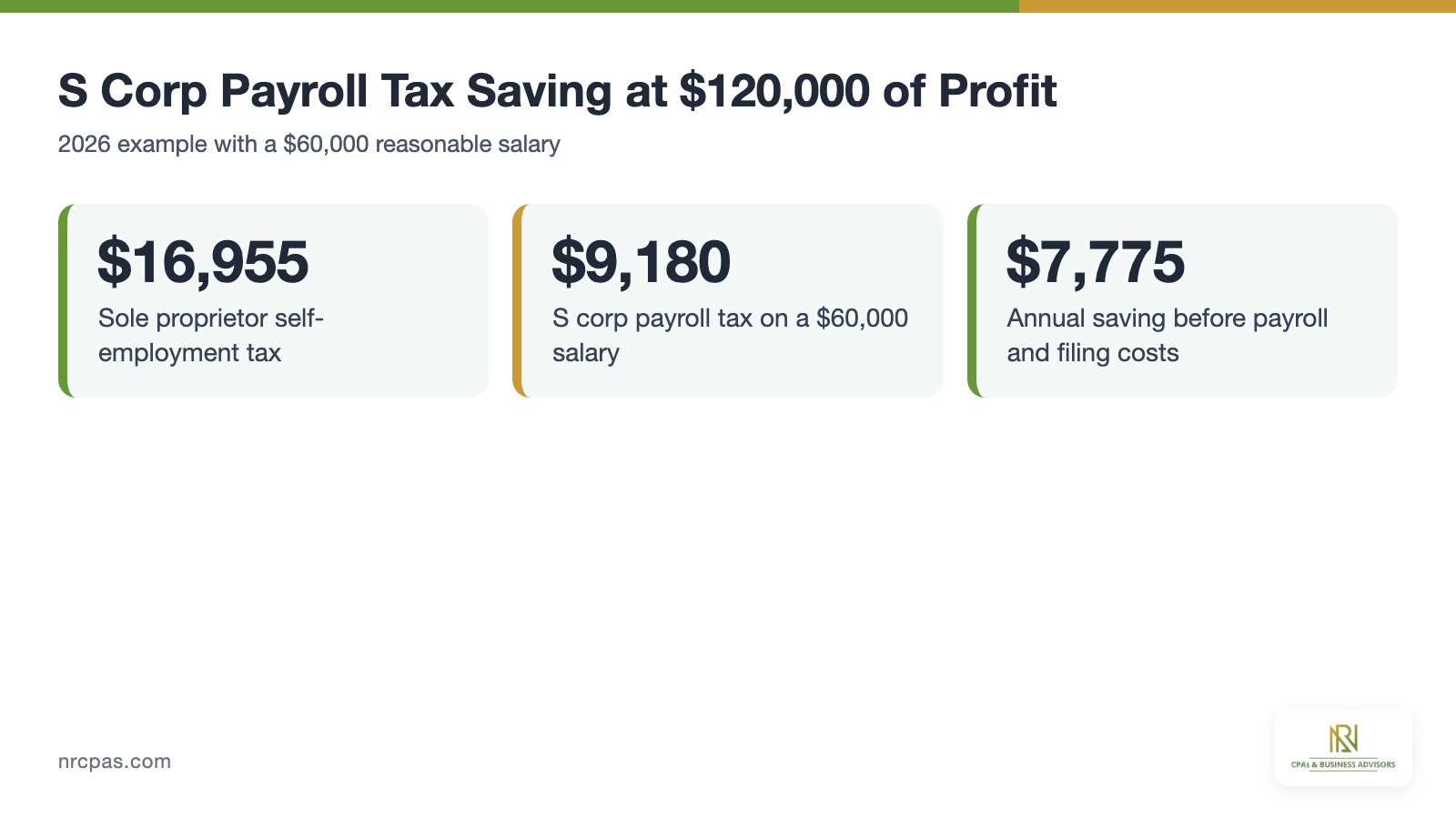
The saving depends on the salary chosen. The table below compares a sole proprietor with an S corp owner who earns $120,000 of profit and pays a $60,000 salary.
| Item | Sole proprietor | S corp owner |
|---|---|---|
| Income taxed at 15.3% | $110,820 | $60,000 |
| Social Security and Medicare tax | $16,955 | $9,180 |
| Annual payroll tax saving | None | $7,775 |
The $7,775 saving comes before payroll service fees, the extra tax return and state costs. The graphic below shows the same three figures.
Owners who want the full rules can read how S corp payroll is taxed. Eligibility is narrow, since an S corporation allows 100 shareholders and one class of stock. The election uses Form 2553, filed within 2 months and 15 days of the start of the tax year.
A limited liability company (LLC) can make the election without forming a new company. The LLC election options show how the tax treatment changes. The saving only holds when the salary passes an IRS review, which brings up the salary itself.
What Is a Reasonable Salary for an S Corp Owner?
A reasonable salary for an S corp owner is the pay a business would give an outside employee for the same work. The IRS weighs duties, hours, training, experience and what similar businesses pay. A salary set too low invites reclassification of distributions as wages.
The Watson case shows the risk. According to the IRS, an accountant in that 2012 Eighth Circuit case took a $24,000 salary and $203,651 in distributions. The court accepted $91,044 as the reasonable salary and taxed the gap as wages.
A defensible salary rests on written support. Owners can keep pay surveys, job descriptions and hours logs in the payroll file. Owners comparing how to minimize self employment tax must weigh the saving against payroll costs. Payroll also adds costs for the payroll provider, quarterly filings and Form 1120-S, so a smaller profit may not justify the change. An S corp setup belongs in the plan only after those costs are modeled.
Salary is only one lever, because retirement plans offer a different kind of saving. Those plans start with the solo 401k.
Does Solo 401K Reduce Self Employment Tax?
No, a solo 401k does not reduce self-employment tax, because the tax is set on net profit before any plan contribution. A solo 401k lowers income tax through a deduction on Schedule 1. According to the IRS, the 2026 limits are $24,500 for employee deferrals and $72,000 for total contributions.
Employee deferrals still carry Social Security and Medicare tax for an S corp owner paid wages. Employer contributions do not. The solo 401k limits and the full worked example sit in a dedicated post.
The SEP IRA is the other common plan for owners without employees. That plan needs its own answer.
Does SEP IRA Reduce Self Employment Tax?
No, a SEP IRA does not reduce self-employment tax, because the deduction comes after net profit is set. A SEP IRA contribution is limited to 25% of compensation, up to $72,000 in 2026. The owner funds the account by the tax return due date, including extensions.
A SIMPLE IRA offers a lower cap, with a 2026 employee deferral limit of $17,000. Each of these plans reduces qualified business income, so the QBI deduction shrinks slightly. The income tax saving can outweigh that loss, but it never touches Schedule SE.
Retirement plans lower income tax, and the deduction for half of the self-employment tax does the same. That deduction raises a taxable income question.
Does Self Employment Tax Reduce Taxable Income?
Yes, self employment tax reduces taxable income, because the IRS lets owners deduct half of it from income. The deduction equals $8,478 on $120,000 of 2026 net profit. The deduction lowers income tax only, and the self-employment tax stays at $16,955.
The deduction is claimed on Schedule 1, so no itemizing is needed. Owners can confirm each line in the guide to the half deduction before filing. Family payroll offers one more of the ways to reduce self employment tax.
Can Hiring Your Child Lower Self Employment Tax?
Hiring your child can lower self employment tax when you are a sole proprietor and the child is under 18. Wages paid by a parent to a child under 18 are exempt from Social Security and Medicare tax. The business deducts the wages, and the child owes no payroll tax on them.
A $10,000 wage cuts net profit by $10,000, which saves $1,413 of self-employment tax. The same wage would carry $1,530 of payroll tax for an adult employee. The exemption covers sole proprietorships and partnerships owned only by the parents. S corporations and C corporations do not qualify.
The child must do real work at a fair wage, and the business keeps timesheets. State unemployment rules can still apply. Some owners push too far in the search for savings, which leads to the methods that break the law.
Which Ways to Avoid Paying Self Employment Tax Break the Law?
Ways to avoid paying self employment tax break the law when they hide income or disguise wages. Four methods draw IRS penalties: unreported cash income, zero S corp salary, invented deductions and wages relabeled as loans. The list below explains each one.
- Unreported cash income that appears on no return.
- An S corp owner who takes only distributions and no salary.
- Personal costs written off as business expenses.
- Wages relabeled as shareholder loans to avoid payroll tax.
According to the IRS, the accuracy-related penalty is 20% of the underpayment, and the civil fraud penalty is 75%. Interest runs on top of both. Owners who receive a notice can ask for audit representation before replying. A lawful plan avoids those penalties and still leaves room to plan further.
What Else Should Self-Employed Owners Check Before Cutting Their Tax?
Owners should check the wage cap, benefit trade-off, QBI deduction, HSA rules, exemptions and estimated payments before cutting tax. The sections below answer each of those checks in short form.
Does the Social Security Wage Base Change the Plan?
Yes, the Social Security wage base changes the plan, because the 12.4% part stops at $184,500 of 2026 earnings. A sole proprietor reaches that cap at roughly $199,800 of profit. Above the cap, each extra dollar carries only 2.9% Medicare tax. Knowing how to lower self employment tax above the cap means planning around that smaller rate.
The IRS adds a 0.9% Additional Medicare Tax above $200,000 for single filers. Owners above that line save less self-employment tax from each added deduction.
Does Lowering Self Employment Tax Reduce Social Security Benefits?
Yes, lowering self-employment tax can reduce Social Security benefits, because benefits follow reported earnings. According to the SSA, the benefit formula uses the highest 35 years of indexed earnings. Lower reported profit or salary can lower the future monthly benefit.
Does the QBI Deduction Reduce Self Employment Tax?
No, the qualified business income (QBI) deduction does not reduce self-employment tax, because it lowers taxable income after Schedule SE. According to the IRS, the deduction is up to 20% of qualified business income. The 2026 thresholds are $201,750 for single filers and $403,500 for joint filers.
The QBI effect on a $100,000 profit is worked out in a separate post.
Does an HSA Reduce Self Employment Tax?
No, a health savings account (HSA) does not reduce self-employment tax, because the deduction applies to income tax. According to the IRS, the 2026 contribution limit is $4,400 for self-only coverage and $8,750 for family coverage. HSA withdrawals for qualified medical costs are tax-free.
Who Is Exempt From Self Employment Tax?
Owners with net earnings below $400 are exempt from self-employment tax. Certain ministers can file Form 4361, and members of recognized religious groups can file Form 4029. Passive income and corporate dividends are not net earnings from self-employment.
Do Estimated Payments Reduce Self Employment Tax?
No, estimated payments do not reduce self-employment tax, because they only spread the payment across the year. According to the IRS, owners who expect to owe $1,000 or more should pay quarterly with Form 1040-ES. Planning the payments avoids underpayment penalties.
How Can a CPA Help You Lower Self Employment Tax?
A CPA can model salary, deductions and retirement contributions together before any filing is made. We run that comparison through owner compensation planning, so the S corp saving is measured against payroll costs. The comparison also lists which moves touch Schedule SE and which touch only income tax.
Founder Nischay Rawal, CPA, EA, leads the team at NR CPAs people, and the office line is (305) 872-3096.
Each written plan starts with the owner's profit, entity type and retirement goals, and it lists the filing dates for every move. Owners who want that schedule for how to avoid self employment tax can request tax minimization support.