Annual Gift Tax Exclusion for 2026 and How It Works


The annual gift tax exclusion is $19,000 per recipient for 2026. You can give that amount to any number of people without filing a return. Married couples who split gifts can give $38,000 per recipient. Gifts above the limit trigger no immediate tax, because the excess only reduces the $15,000,000 lifetime exemption.
Key Takeaways
- The 2026 exclusion is $19,000 per recipient, the same as 2025, and $20,000 for 2027.
- The exclusion applies to each recipient separately, with no cap on the number of recipients.
- Only present interest gifts qualify, meaning the recipient can use the gift right away.
- Gift splitting lets a married couple give $38,000 per recipient in 2026.
- Gifts above $19,000 need Form 709 and reduce the $15,000,000 lifetime exemption.
- Tuition and medical bills paid directly to the school or provider sit outside the exclusion.
What Is the Annual Gift Tax Exclusion for 2026 Gifts?
The annual gift tax exclusion for 2026 is $19,000 per recipient, according to the Internal Revenue Service (IRS). The IRS annual gift tax exclusion applies to every person who receives a gift from you. Cash, stock, real estate and other property all count toward the $19,000.
According to the IRS, the exclusion is adjusted for inflation in $1,000 steps. A donor with four grandchildren can give each grandchild $19,000, which totals $76,000, and file nothing. Donors who repeat that pattern every year keep a gift tracking record for each recipient.
The same donor could also give $19,000 to a friend and $19,000 to a neighbor under the same rule. The exclusion works through a few simple mechanics, and those mechanics decide how far $19,000 stretches.
How Does the Annual Gift Tax Exclusion Work?
The annual gift tax exclusion works per recipient and per calendar year, and the donor owns it. Every gift to the same person adds together before the $19,000 limit applies. A donor who gives a niece $10,000 in March and $9,000 in July reaches exactly $19,000.
The steps below show how a donor applies the exclusion to one recipient.
- Add every gift made to that recipient during the calendar year.
- Subtract the $19,000 exclusion for 2026.
- Treat a result of zero or less as fully excluded, with no return needed.
- Report any remaining amount on Form 709 as a taxable gift.
- Repeat the same math for each other recipient.
The exclusion resets on January 1, and unused room does not carry into the next year. A donor who gives nothing in 2026 still faces the 2027 limit. The dollar amount itself has moved up in $1,000 steps over the years.
How Has the Annual Gift Tax Exclusion Amount Changed Over Time?
The annual gift tax exclusion amount has risen from $14,000 to $19,000 since 2013, according to the IRS. The table below lists each period, the per-recipient amount and the amount for a couple that splits gifts.
| Year of gift | Per recipient | Couple splitting | Change from prior period |
|---|---|---|---|
| 2013 through 2017 | $14,000 | $28,000 | Base period |
| 2018 through 2021 | $15,000 | $30,000 | +$1,000 |
| 2022 | $16,000 | $32,000 | +$1,000 |
| 2023 | $17,000 | $34,000 | +$1,000 |
| 2024 | $18,000 | $36,000 | +$1,000 |
| 2025 | $19,000 | $38,000 | +$1,000 |
| 2026 | $19,000 | $38,000 | $0 |
| 2027 | $20,000 | $40,000 | +$1,000 |
The gift tax annual exclusion amount for 2026 matches 2025, so the limit held steady for one year. The IRS set the 2027 figure at $20,000 in Rev. Proc. 2026-35, released on November 5, 2026. Donors who plan around each January reset can get gift timing advice from a CPA.
A higher limit only helps when the gift actually qualifies, so the next question is which gifts qualify.
Which Gifts Qualify for the Federal Annual Gift Tax Exclusion?
Gifts qualify for the federal annual gift tax exclusion when the recipient receives a present interest. A present interest is an immediate right to use, possess or enjoy the property or its income, according to the IRS. Outright transfers meet that test, while gifts of future interests do not.
The list below shows how common gifts are treated under the present interest test.
- Cash, checks and wire transfers to an individual qualify as present interest gifts.
- Stock, bonds and cryptocurrency qualify at fair market value on the date of the gift.
- Real estate qualifies at fair market value, and an appraisal supports that value.
- Forgiven debts and below-market sales count as gifts for the difference in value.
- Gifts in trust qualify only for beneficiaries who hold a present interest.
Fair market value is the price a willing buyer and a willing seller would agree on, with neither under pressure. According to the IRS, a gift of a future interest must be reported on Form 709 at any dollar amount. The graphic below compares gifts that qualify with gifts that need extra review.

Married couples can stretch the qualifying amount further, and the election that does it is called gift splitting.
How Does Gift Splitting Change the Gift Tax Annual Exclusion?
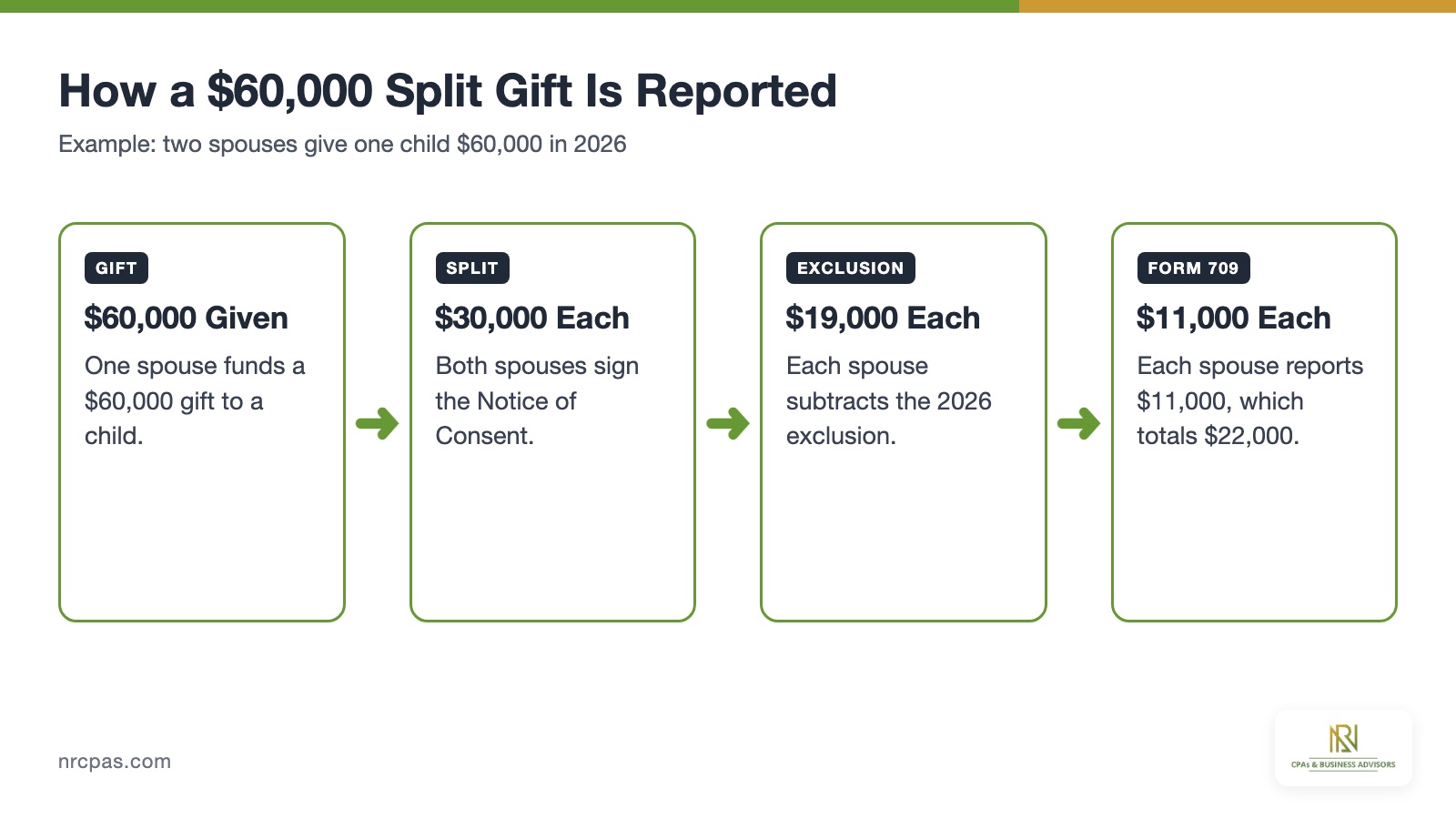
Gift splitting lets a married couple treat a gift from one spouse as made half by each spouse. Gift splitting doubles the exclusion to $38,000 per recipient in 2026. One spouse can fund the whole gift, even from an account in that spouse's name alone.
According to the IRS, both spouses must be married to each other on the gift date. Neither spouse can be a nonresident who is not a citizen. Both spouses sign a Notice of Consent, and the consent covers every gift made that calendar year.
There is no joint gift tax return, so each spouse files a separate Form 709. A couple who gives a child $60,000 treats $30,000 as coming from each spouse. Each spouse then reports $11,000 over the exclusion, which totals $22,000. The graphic below walks through that $60,000 example.
Splitting is optional, since each spouse can also give $19,000 from separate funds with no return. Any amount above the exclusion raises a different question about what the gift costs.
What Happens When a Gift Goes Over the Annual Exclusion?
A gift that goes over the annual exclusion requires Form 709 but produces no immediate tax bill. The amount above $19,000 reduces the $15,000,000 lifetime exemption. The One Big Beautiful Bill Act, Public Law 119-21, set the 2026 exemption at $15,000,000 per person.
According to the IRS, the 2025 exemption was $13,990,000. A married couple shelters $30,000,000 in 2026 when both spouses use the full amount. A donor who gives a nephew $50,000 reports $31,000 and keeps $14,969,000 of exemption. Families that track the balance can use wealth transfer planning to stay ahead of it.
The graphic below sets the main 2026 gift tax numbers side by side.
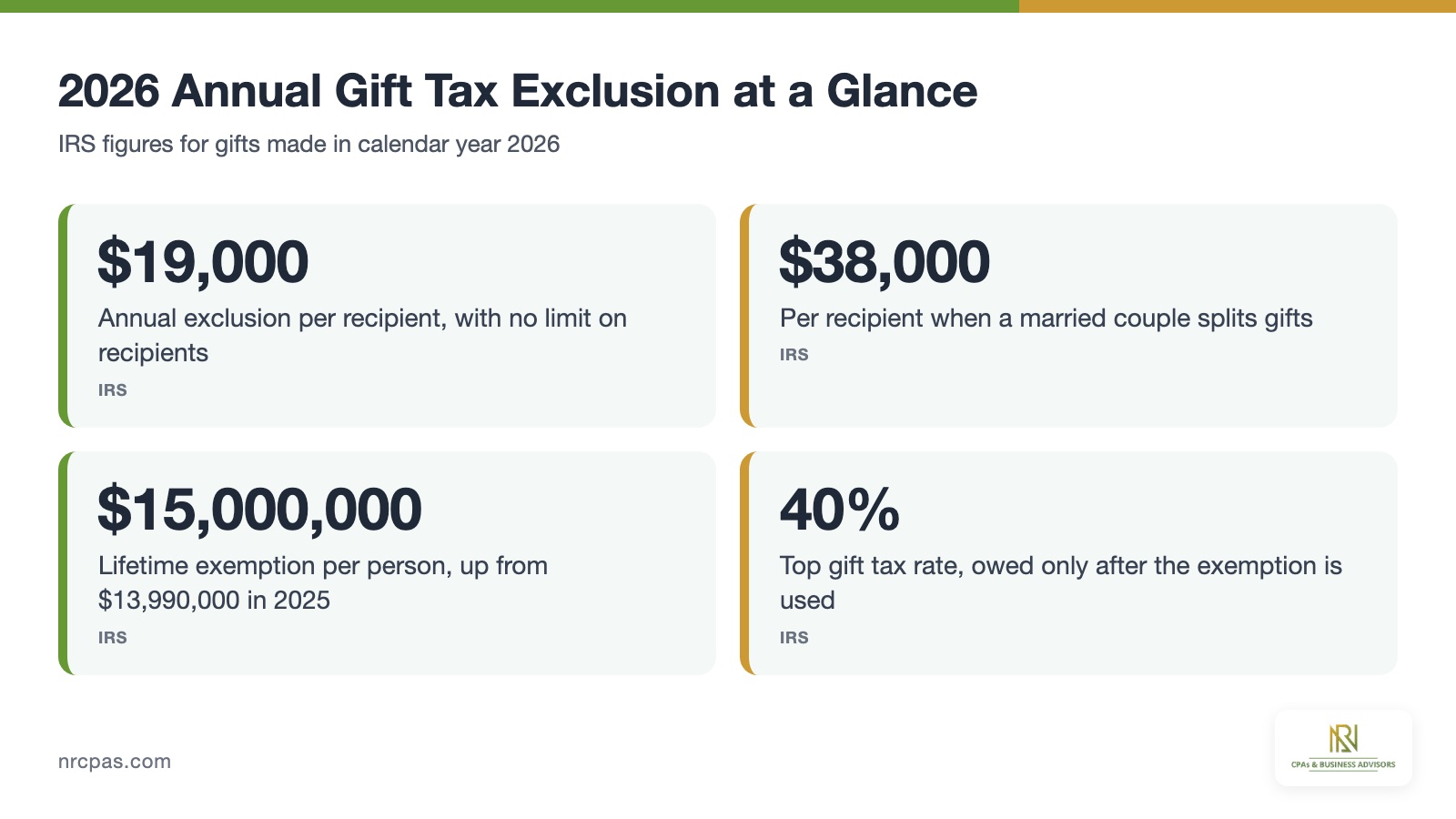
Gift tax itself starts only after taxable gifts pass the exemption. According to the Instructions for Form 709, the rate schedule starts at 18% and tops out at 40%. Form 709 is due April 15 of the year after the gift, and Form 8892 adds an automatic 6-month filing extension.
The extension does not delay payment, and interest runs from April 15. A separate gift limits summary lists every dollar threshold together. Some gifts never count against the exclusion, and those gifts come next.
Which Gifts Do Not Count Against the Annual Exclusion for Gift Tax?
Several gifts do not count against the annual exclusion for gift tax, and none of them reduce the lifetime exemption. The IRS excludes tuition, medical bills, spousal gifts, political gifts and qualifying charity gifts. The list below shows each category.
- Tuition paid directly to a qualifying school, with no dollar limit.
- Medical expenses paid directly to the provider, including health insurance premiums.
- Gifts to a U.S.-citizen spouse, covered by the unlimited marital deduction.
- Gifts to a political organization for its own use.
- Gifts to a qualifying charity, which are deductible from the gifts reported, as charity accounting records show.
The direct payment rule covers tuition only, so books, supplies and room and board do not qualify. The payment must go straight to the school or provider. A grandparent can pay $45,000 of tuition to a university and still give the same student $19,000 in cash that year.
Those categories cover the main exclusions, and the side topics below cover timing, 529 plans and other edge cases.
What Else Should You Know About the Annual Exclusion Gift Tax Rules?
The annual exclusion gift tax rules raise side questions about timing, education accounts, spouses and filing. The short answers below cover each one in turn.
Can You Give $19,000 on December 31 and Again on January 1?
You can give $19,000 on December 31, 2026 and $20,000 on January 1, 2027, and both gifts stay excluded. Each calendar year has its own exclusion. A recipient can therefore receive $39,000 across two days with no Form 709.
How Does the 529 Plan Five-Year Election Use the Annual Exclusion?
The 529 plan five-year election lets a donor treat one large contribution as spread over five years of annual exclusions. For 2026, that means up to $95,000 per beneficiary, or $190,000 for a couple who split gifts. The donor reports one-fifth of the total on Form 709 for each of the five years.
Extra gifts to the same beneficiary during those five years can push the donor over the yearly exclusion.
Does a Spouse Who Is Not a U.S. Citizen Get a Different Limit?
A spouse who is not a U.S. citizen gets a different limit, because the unlimited marital deduction does not apply. According to the IRS, the exclusion for such gifts is $194,000 in 2026 and $201,000 in 2027. Anything above that amount reduces the lifetime exemption. Families with cross-border gift planning needs should confirm each spouse's status before giving.
What Is the Annual Gift Tax Exclusion for 2027 Gifts?
The annual gift tax exclusion for 2027 is $20,000 per recipient, according to the IRS. A married couple who split gifts can give $40,000 per recipient. The 2027 lifetime exemption is $15,480,000 per person. The IRS announced both figures on November 5, 2026.
Does the Recipient Pay Tax on an Annual Exclusion Gift?
The recipient does not pay tax on an annual exclusion gift, because the donor is generally responsible for any gift tax. A gift is also not income to the recipient. The gift recipient rules add one later effect.
According to the IRS, a recipient who sells gifted property takes the donor's cost basis. Stock bought at $10 per share and sold at $100 per share creates a $90-per-share gain. The recipient owes income tax on that gain, not gift tax.
Can You Deduct Annual Exclusion Gifts on Your Tax Return?
You cannot deduct annual exclusion gifts on your income tax return, according to the IRS. Only gifts to qualifying charities are deductible. A donor who wants the details can read about gift deductibility in a separate post.
What Happens When a Gift Goes Unreported or Filed Late?
A gift that goes unreported or filed late can bring late filing and late payment penalties, unless the donor shows reasonable cause. According to the IRS, adequate disclosure on Form 709 starts the statute of limitations on the gift. A complete return, a property description and the names of donor and recipient make a disclosure adequate. A donor who files after the deadline can ask for penalty abatement help.
Can a Family LLC Help With Annual Exclusion Gifts?
A family LLC can hold assets that an owner gifts in small ownership slices each year. Each slice needs an appraisal for fair market value. Transfer limits can turn an interest into a future interest, so the LLC operating agreements need careful drafting.
How Can a Family Office Team Help Track Annual Exclusion Gifts?
A family office team tracks each gift by recipient, by year and by Form 709. We coordinate gifts of cash, stock and business interests with the rest of a family's tax picture. We also keep the running lifetime exemption balance for each spouse.
Readers can find more gift and estate topics on the NR CPAs blog. The firm is led by founder Nischay Rawal, CPA, EA, and the office answers at (305) 872-3096.
Families that want one place to log gifts, filings and exemption balances can lean on family office gifting support.