Family Business Succession Plan and How to Build One


A family business succession plan is a written roadmap that names the next leader, sets the new owners and funds the handover. The plan works best when the owner starts 5 to 10 years before stepping back. It covers successor choice, a buy-sell agreement, gift and estate tools, governance rules and a dated timeline.
Key Takeaways
- Leadership succession and ownership succession are two separate decisions in a family business.
- A buy-sell agreement sets the price and the buyer before a death, disability or divorce forces the question.
- The 2026 federal estate and gift exclusion is $15,000,000 per person, and the annual gift exclusion is $19,000 per recipient.
- Gifted shares keep the donor's tax basis, while inherited shares take the fair market value at death.
- Written governance rules and a dated timeline keep the transfer fair and on schedule.
What Is a Family Business Succession Plan and Why Does It Matter?
A family business succession plan is a written document that sets who leads, who owns and when each transfer happens. The plan separates leadership succession from ownership succession. One daughter can run daily operations while all siblings share the equity.
Age makes the question urgent. Over half of U.S. business owners were age 55 or older, according to the Census Bureau's 2019 Annual Business Survey. Those owners will hand over their companies within a generation.
Planning gaps are real. According to PwC's 2025 US Family Business Survey, succession planning affected 44% of U.S. family firms in the past year. The graphic below shows 4 figures that frame the plan.
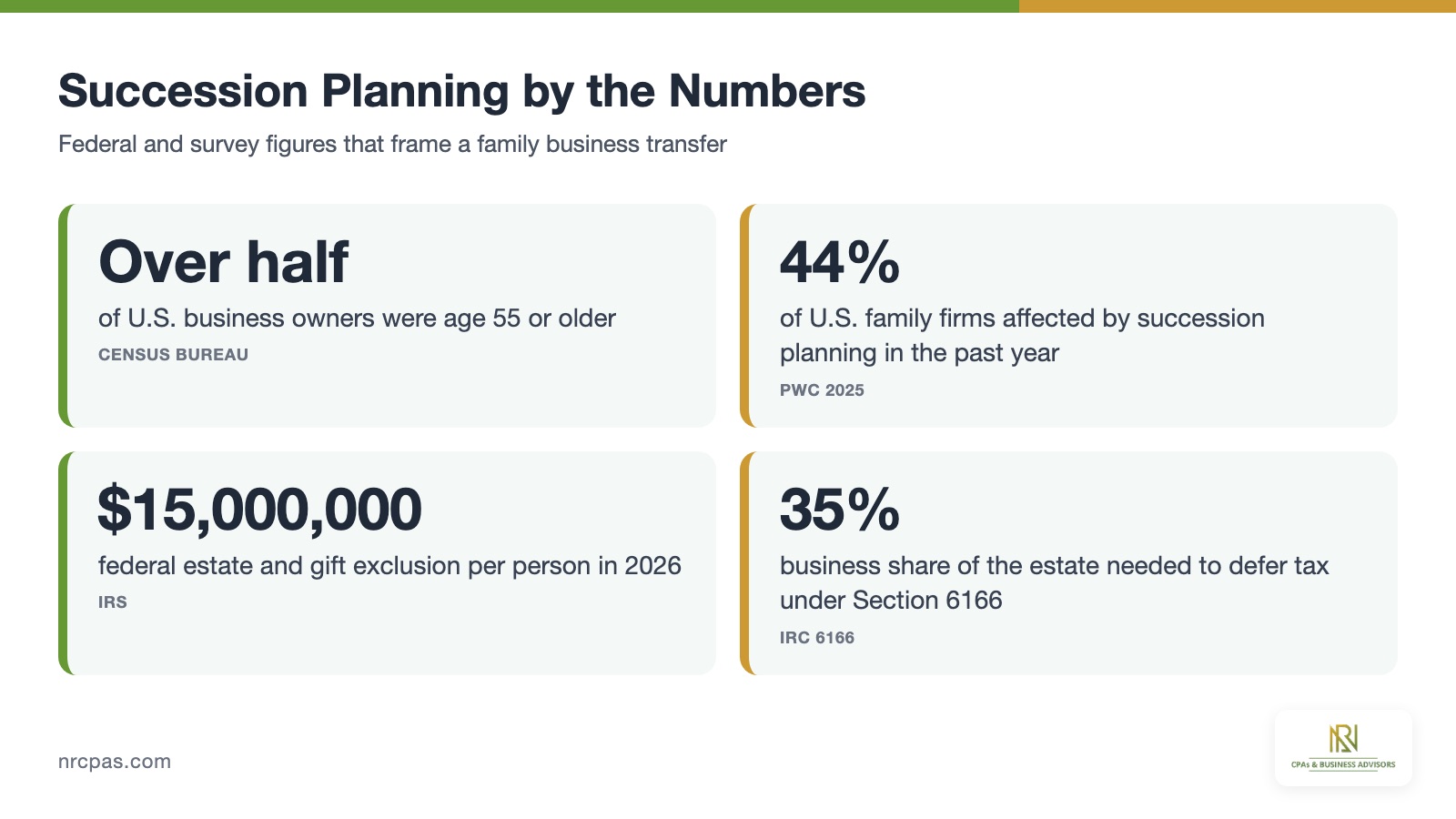
A formal business succession plan turns open questions into dated steps with named owners.
Dated steps need a start date, and the start date is the next question.
When Should a Family Business Start Succession Planning?
A family business should start succession planning 5 to 10 years before the owner plans to step back. A long runway gives the successor time to earn credibility with employees and customers. A shorter runway forces rushed choices on price, control and taxes.
Emergencies do not wait for a runway. According to the Exit Planning Institute, roughly half of business exits are driven by unplanned events. Advisors group those events into the Five Ds, listed below.
- Death of an owner or key leader.
- Disability that ends an owner's ability to work.
- Divorce that puts shares in dispute.
- Distress from cash shortages or lost customers.
- Disagreement among family members or shareholders.
An emergency clause in the plan names an interim leader for each of the five events. Once the emergency leader is named, the owner can turn to the long-term question of choosing a successor.
How Do You Choose a Successor for a Family Business?
Choose a successor for a family business by scoring each candidate on skills, interest and respect from staff, not on birth order. An objective scorecard protects both the company and the family relationships. Outside work experience and written milestones make the scorecard fair.
A succession plan for family business owners works best when every candidate sees the same criteria. A successor who passes the scorecard still needs a development plan with real responsibility, such as running one division for a year.
Does the Next Leader Also Have to Be the Next Owner?
No, the next leader does not have to be the next owner, because leadership and ownership can pass to different people. A child who runs the company may hold a larger stake, while siblings outside the business hold smaller stakes.
Splitting the two roles can call for a new ownership structure. A holding entity or an updated operating agreement can set each heir's share and voting rights.
What Happens When No Family Member Wants the Job?
When no family member wants the job, the owner can hire a non-family manager or sell to a partner or employees. A professional manager can run the company while the family keeps the equity. Each choice still needs a price and a contract, which is where the buy-sell agreement comes in.
What Is a Buy-Sell Agreement in a Family Business Succession Plan?
A buy-sell agreement in a family business succession plan is a contract that sets the buyer and price for an owner's shares. The contract turns a family argument into a pre-agreed formula. Triggers usually include death, disability, divorce, retirement and a sale offer from an outsider.
The price comes from a formula or a yearly appraisal by a Certified Public Accountant (CPA). A signed price removes a valuation fight during the hardest month for the family.
Funding comes next. A life insurance policy on each owner pays the buyout without draining company cash. Two designs exist, and each fits a different owner count.
- Cross-purchase: each owner buys a policy on every other owner, which suits a small group.
- Entity-purchase: the company buys one policy per owner, which suits a larger group.
A succession plan for a business with two owners of different ages often favors the entity-purchase design. The younger owner would otherwise pay far less than the older owner for matching coverage. With the price and funding set, the next question is how shares move to the heirs.
How Can Ownership Pass to the Next Generation?
Ownership can pass to the next generation by lifetime gift, by sale, by installment note or by bequest at death. Each route trades owner control, income and tax cost in a different way. The table below compares the 4 routes in 4 columns.
| Route | Tax result | Heir's basis | Best fit |
|---|---|---|---|
| Lifetime gift | Uses annual exclusion, then lifetime exemption | Donor's basis carries over | Gradual transfer over several years |
| Sale to an heir | Seller reports capital gain | Purchase price | Heir can pay and owner needs cash |
| Installment note | Seller reports gain as payments arrive | Purchase price | Owner wants steady retirement income |
| Bequest at death | Counts in the taxable estate | Fair market value at death | Owner keeps control for life |
The basis column carries the biggest long-term cost difference between gifts and bequests. Planners who coordinate yearly gifts to several heirs call that work wealth transfer. The tax rules behind the table decide which route wins.
How Do Gift and Estate Taxes Affect a Family Business Transfer?
Gift and estate taxes affect a family business transfer only above the federal exclusions. The 2026 exclusions are $19,000 per recipient each year and $15,000,000 per person. Transfers below those amounts owe no federal gift or estate tax. According to the Internal Revenue Service (IRS), the basic exclusion amount was $13,990,000 in 2025.
Married couples can split gifts, which doubles the annual exclusion to $38,000 per recipient. According to the IRS, the top estate tax rate is 40%. The estate return, Form 706, is due 9 months after the date of death.
Basis shapes the real bill. According to IRS Publication 551, a gift keeps the donor's adjusted basis. Inherited property takes its fair market value at the date of death. The graphic below shows one example.

A stake worth $2,000,000 with a $200,000 basis leaves an heir a $1,800,000 gain after a gift and a sale. The same stake inherited at death takes a $2,000,000 basis. Capital gains tax applies to the first case only.
According to the IRS, a long-term gain needs a holding period over one year. For 2025, the 15% rate applies up to $533,400 of taxable income for single filers, and the 20% rate applies above it. Careful estate tax planning weighs the basis cost of a gift against the estate tax saved.
Can the Estate Pay Business Estate Tax Over Time?
Yes, an estate can pay business estate tax over time under Section 6166, but only above a 35% threshold. The business interest must exceed 35% of the adjusted gross estate. The tax can be paid in up to 10 equal installments. The first installment can wait up to 5 years after the normal due date.
Interest runs during the deferral. According to the statute, the unpaid tax comes due early when 50% or more of the business interest is sold or withdrawn. The estate must elect the deferral on a timely return.
Does a Gift of Business Shares Need a Gift Tax Return?
Yes, a gift of business shares above the annual exclusion needs a Form 709 gift tax return. The return is due even when the lifetime exemption means no tax is owed. The return records the gift against the $15,000,000 lifetime exemption. A yearly gift allowance of $19,000 per recipient does not need a return when gifts stay under it.
A correct return also needs a supported value for the shares. Money rules set the cost, and governance rules set the peace, so governance is next.
How Should Governance Work During the Handover?
Governance during the handover works best when a written charter separates family decisions from company decisions. A charter gives every family member a clear role, a clear voice and a clear limit. Governance is the part of a succession plan in family business that keeps a holiday dinner from becoming a board meeting.
Four governance tools do the core work, as listed below.
- A family council that meets on a set schedule to discuss ownership and values.
- A board with at least one independent director who has no family tie.
- Written job descriptions with pay set at market rates.
- A dispute process that names a mediator before conflict starts.
Authority should move in phases. In phase one the successor shares leadership with the founder. In phase two the successor holds final authority, and in phase three the founder takes a board or advisory role or retires.
Neutral numbers calm those phases. An independent CFO can report the same financials to the founder, the successor and the board. A dated timeline then ties the roles together.
What Are the Steps to Build a Family Business Succession Plan?
The steps to build a family business succession plan run from goal setting to a yearly review. This family business succession planning checklist has 5 steps, listed in order below.
- Set goals for the retirement date, income needs and the family's wishes.
- Value the business and review recent financial statements.
- Pick the successor and write a development plan with milestones.
- Sign and fund the buy-sell agreement, then draft the governance charter.
- Choose the gift, sale or estate tools, file the returns and review the plan each year.
A yearly review keeps the plan current as people, values and tax laws change. The timeline graphic below places the 5 steps on one page.

Owners who want a partner for these steps can map them into a succession roadmap with dates and owners. Steps are only the core of the plan, and a few side topics still need answers.
What Else Should Family Owners Settle Before Handing Over the Business?
Family owners should settle entity rules, fairness for outside heirs, valuation and the review schedule before handing over the business. Every succession plan in business needs an emergency clause for the Five Ds. The topics below finish the plan.
Can an S Corporation Hold a Family Business Through the Handover?
Yes, an S corporation can hold a family business through the handover, but only eligible shareholders and one class of stock qualify. According to the IRS, an S corporation allows a maximum of 100 shareholders.
Individuals, estates and certain trusts qualify, while partnerships and corporations do not. Owners should confirm S corp eligibility before gifting shares to a trust.
Do Family Members Outside the Business Need Equal Shares?
No, family members outside the business do not need equal shares, but each heir should receive a fair result. Equal value does not require equal stock. Heirs outside the company can receive life insurance proceeds, other assets or a buyout note, while the active heir keeps the shares.
Does a Small Business Succession Plan Need a Valuation?
Yes, a small business succession plan needs a valuation, because every gift, sale and buy-sell price starts from fair market value. According to the IRS, fair market value is the price a willing buyer and willing seller agree on, both reasonably informed.
Valuers lean on several years of clean financials, so tidy books raise the credibility of the price.
Are Estate Planning Advisor Fees Deductible?
Estate planning advisor fees follow separate deduction rules for business advice and personal planning. Rules for estate advice fees differ by purpose, so each invoice should say which work it covers.
How Can NR CPAs Help With a Family Business Succession Plan?
We help owners put a family business succession plan on paper, price it, and tie it to the tax return. The team at NR CPA resources is led by founder Nischay Rawal, CPA, EA, and the office takes calls at (305) 872-3096.
We also review the buy-sell price, the gift schedule and the estate numbers with the family. Each owner then sees the same figures. Families that want dated steps can start with transition planning for the next generation.