What Is the Interest Rate on an IRS Payment Plan

The interest rate for an IRS payment plan is 7% per year, compounded daily, for the fourth quarter of 2026. The Internal Revenue Service (IRS) sets that rate at the federal short-term rate of 4% plus 3 percentage points. A payment plan does not stop interest, so the 7% rate keeps running on the unpaid balance until the last payment clears.
Key Takeaways
- The IRS underpayment rate is 7% from October 1 to December 31, 2026, and it resets every quarter.
- Interest compounds daily, so a $10,000 balance adds about $1.92 on the first day.
- An approved plan cuts the failure-to-pay penalty from 0.5% to 0.25% per month, but the interest rate stays the same.
- Setup fees run from $0 for a short-term plan to $178 for a long-term plan arranged by phone without direct debit.
- A $10,000 balance paid over 36 months adds about $1,119 in interest.
What Is the Interest Rate for IRS Payment Plan Debt Right Now?
The interest rate for IRS payment plan debt right now is 7% per year, compounded daily. According to the IRS, that rate applies to underpayments from October 1 to December 31, 2026. The rate is unchanged from the third quarter.
The IRS builds the rate from the federal short-term rate, which was 4% in July 2026. Revenue Ruling 2026-15 adds 3 percentage points to reach 7%. Professional payment plan help starts with that number, because every later cost is measured against it.
The same 7% applies to every plan length and every plan type. Quarterly resets then decide whether the balance grows faster or slower than expected.
Does the IRS Charge Interest on a Payment Plan?
Yes, the IRS charges interest on a payment plan until the balance is paid in full. According to the IRS, interest continues to accrue daily on any amount not paid, including penalties and earlier interest.
Interest also starts well before the plan does. The IRS counts interest from the original due date, which is usually April 15 for individual returns. An extension to file does not move that date, so a plan signed in October still carries six months of interest.
The plan changes the penalty and the paperwork, not the interest rate. That difference makes the daily math worth learning next.
How Does the IRS Calculate Payment Plan Interest?
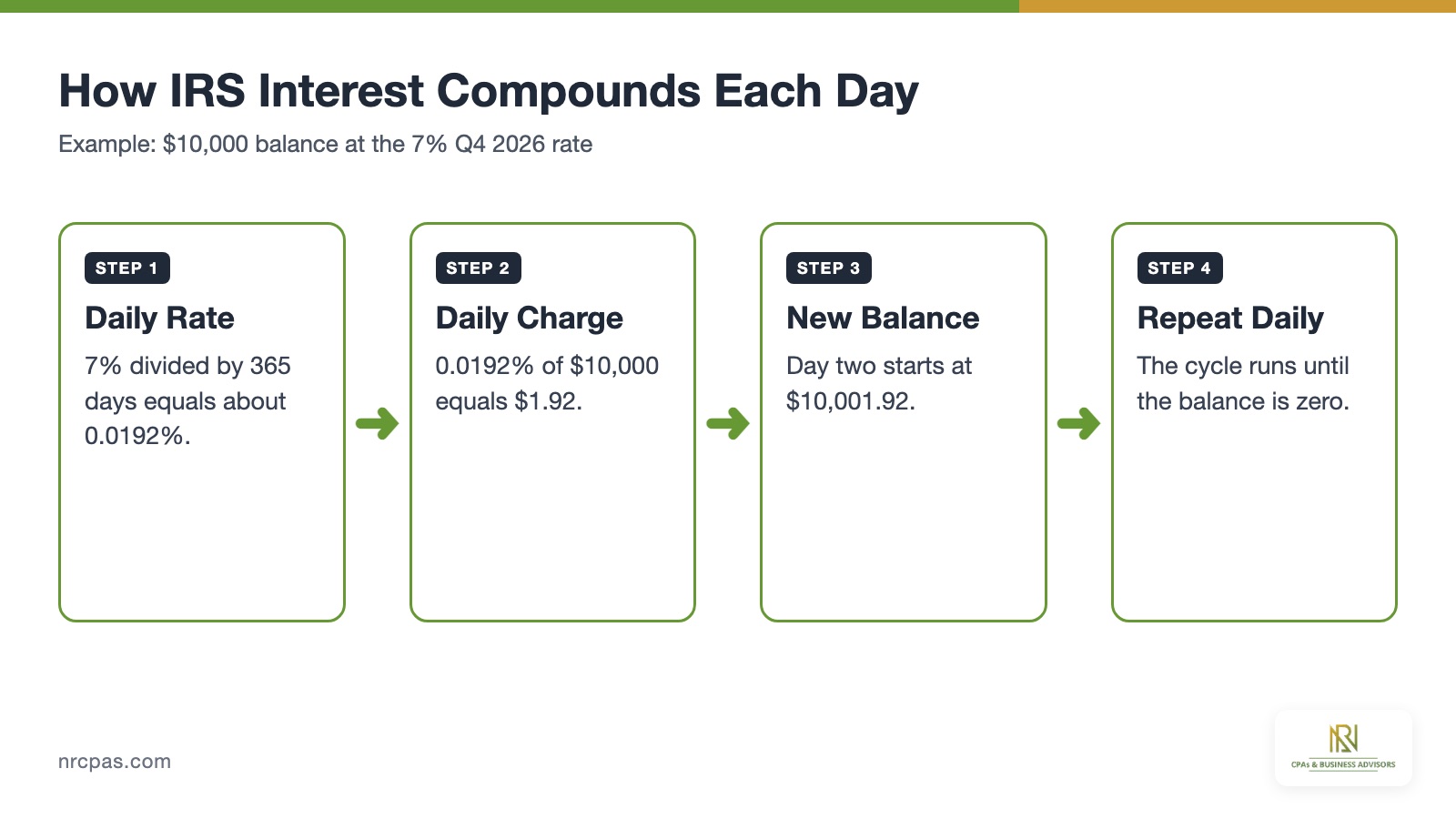
The IRS calculates payment plan interest by applying the annual rate to the unpaid balance daily. The steps below show the cycle for a $10,000 balance at 7%.
- Divide the 7% annual rate by 365 days to get a daily rate of about 0.0192%.
- Multiply the daily rate by the unpaid balance, which gives $1.92 on $10,000.
- Add that $1.92 to the balance, so day two starts at $10,001.92.
- Repeat the same steps every day until the balance reaches zero.
The cycle above is summarized in the graphic below.
Daily compounding makes the effective annual rate about 7.25% instead of a flat 7%. Each monthly payment lowers the balance, so each later day's interest shrinks. The monthly view of that same cycle comes next.
What Is the Interest Rate on an IRS Payment Plan Each Month?
The interest rate on an IRS payment plan each month is about 0.58%, which is 7% divided by 12. On a $10,000 balance, the first month adds roughly $58 in interest.
The IRS does not publish a monthly rate, because the annual rate compounds daily. Interest in month two is smaller than in month one once a payment has reduced the balance. A longer plan therefore keeps the monthly charge alive for more months.
Plan length drives the total, and the table below puts numbers on that for one balance.
How Much Is IRS Payment Plan Interest on a $10,000 Balance?
How much IRS payment plan interest builds on $10,000 depends on how many months the plan runs. The table compares four plan lengths at a constant 7% rate with level monthly payments.
| Plan Length | Monthly Payment | Total Interest | Total Paid |
|---|---|---|---|
| 12 months | $865 | $384 | $10,384 |
| 24 months | $448 | $748 | $10,748 |
| 36 months | $309 | $1,119 | $11,119 |
| 60 months | $198 | $1,886 | $11,886 |
Doubling the plan from 12 to 24 months raises interest by $364. Interest at 60 months is nearly five times the 12-month figure. Interest is only one of two running charges, and penalties come next.
How Much Are Penalties and Interest on IRS Payment Plan Balances?
Penalties and interest on IRS payment plan balances are two separate charges that run together. According to the IRS, the failure-to-pay penalty has three rates. Each rate stops at a cap of 25% of the unpaid tax.
- The standard failure-to-pay penalty is 0.5% of unpaid tax per month or partial month.
- The failure-to-pay penalty drops to 0.25% per month for individuals with an approved plan and a timely filed return.
- The failure-to-pay penalty rises to 1% per month when the balance stays unpaid 10 days after a notice of intent to levy.
The graphic below shows the failure-to-pay rates side by side.

The failure-to-file penalty is 5% per month, also capped at 25%, and it is the most expensive charge on the list. Filing on time protects the 0.25% plan rate. Tax professionals handling tax debt resolution check the return history before any plan request for that reason.
The IRS also charges interest on the penalties themselves. A $10,000 balance on a plan therefore carries $25 of monthly penalty plus interest on both amounts. Fees add one more layer, shown next.
How Much Does the IRS Charge to Set Up a Payment Plan?
The IRS charges $0 to set up a short-term payment plan. A long-term payment plan costs between $29 and $178. According to the IRS, the fee depends on how the plan is arranged and paid.
| Plan Type | Online | Phone, Mail or In Person |
|---|---|---|
| Short-term (180 days or less) | $0 | $0 |
| Long-term with direct debit | $29 | $107 |
| Long-term without direct debit | $69 | $178 |
| Long-term, low-income | $0 with direct debit, otherwise $43 | $0 with direct debit, otherwise $43 |
Low-income status applies to individuals with adjusted gross income at or below 250% of the federal poverty level. Changing an existing plan costs $6 online or $89 by phone, mail or in person.
The IRS also limits who can apply online. Individuals owing less than $100,000 can request a short-term plan online, and long-term online plans need a balance of $50,000 or less. Fees and interest together set the real price, as the next section shows.
What Is the Total Cost of an IRS Payment Plan?
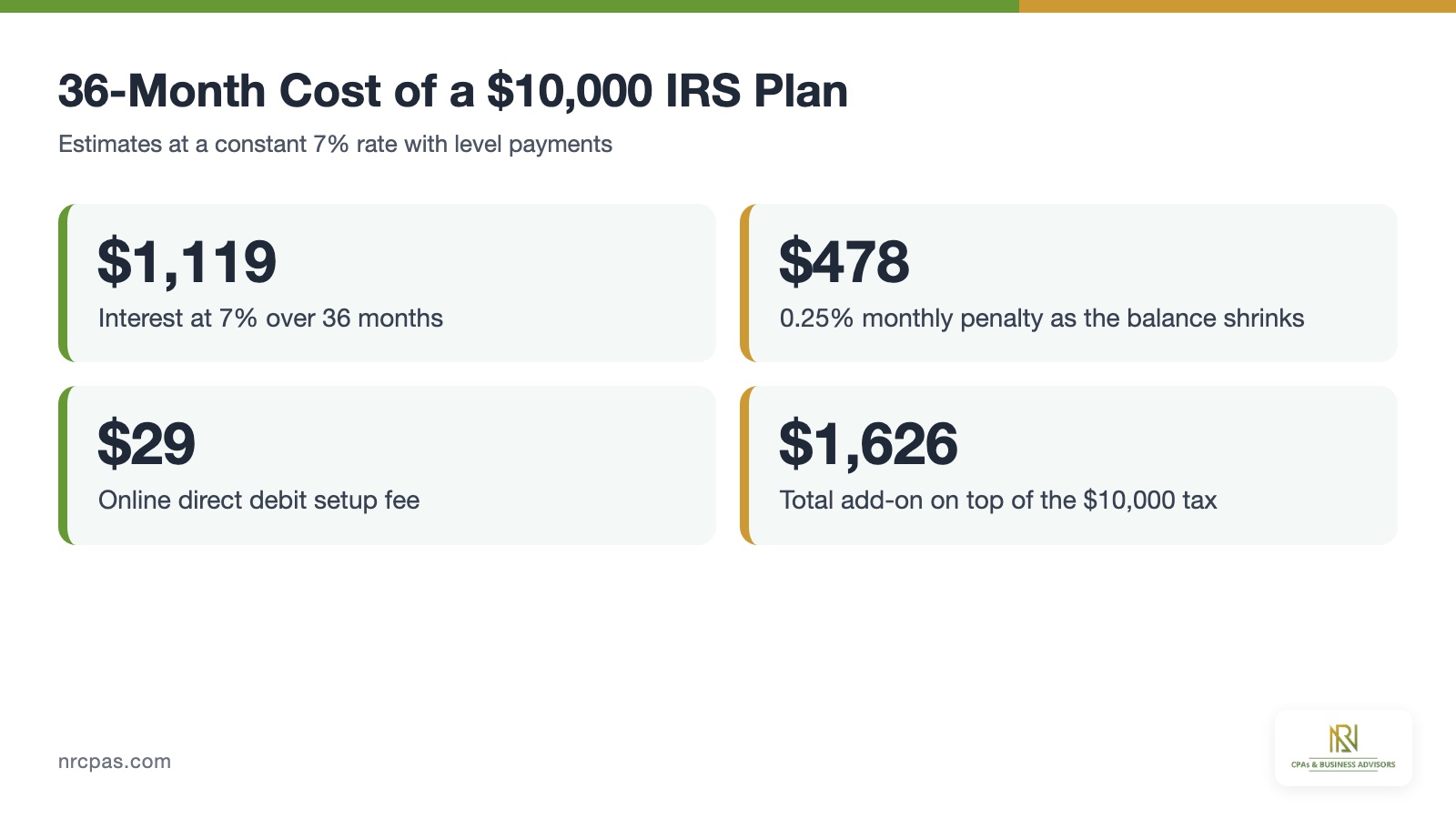
The total cost of an IRS payment plan is the interest plus the reduced penalty plus the setup fee. A $10,000 balance paid over 36 months at 7% costs about $1,626 on top of the tax.
- Interest at 7% adds about $1,119 over 36 months.
- The 0.25% monthly penalty adds about $478 as the balance shrinks.
- An online direct debit setup fee adds $29.
The IRS applies each payment to tax first, then penalties, then interest. A balance can stay flat when the payment barely covers the penalty and interest. The graphic below shows how those three charges stack on the $10,000 example.
Those add-ons are not fixed, and several levers shrink them. Those levers are the next topic.
How Can You Lower the Interest and Penalties on an IRS Payment Plan?
You can lower the interest and penalties on an IRS payment plan by shrinking the balance faster and removing penalties. Extra principal payments cut interest every day afterward, because the IRS charges no prepayment penalty.
- Pay more than the scheduled amount whenever cash allows.
- Choose direct debit to cut the setup fee from $69 to $29 online.
- Request First Time Abatement or reasonable-cause relief to remove penalties.
- File every return on time so the 0.25% penalty rate applies.
Removing a penalty also removes the interest that was charged on it. Owners who need money for those extra payments can build a cash flow worksheet to find it. The wider cost picture includes several side topics.
What Else Affects the Cost of an IRS Payment Plan?
Several side factors also change the cost of an IRS payment plan, and the sections below answer each one in short form.
What Is the Interest Rate for IRS Payment Plan Debt Next Quarter?
The interest rate for IRS payment plan debt next quarter is not set until the IRS announces it. The IRS resets the rate on January 1, April 1, July 1 and October 1.
According to the IRS, the rate was 7% in the first quarter of 2026. The second quarter ran 6%, and the third and fourth ran 7%. A new rate applies only to future days, never to interest already charged. Owners who time extra payments around each reset can plan with cash forecasting in place.
Can the IRS Waive Interest on a Payment Plan?
The IRS can waive interest on a payment plan only in narrow cases. Internal Revenue Code Section 6404(e) allows abatement of interest caused by unreasonable IRS error or delay in a ministerial or managerial act.
Financial hardship does not qualify. Only interest from the period of the IRS error is removed. Penalties are easier to remove, so penalty relief is the usual first request.
What Is the IRS Payment Plan Interest Rate for Corporations?
The IRS payment plan interest rate for corporations is 9% on large underpayments, but 7% on smaller balances. According to the IRS, large corporate underpayments carry 9% in the fourth quarter of 2026, compared with 7% for other taxpayers.
Sole proprietors pay the same 7% on personal balances. The self-employment tax deduction lowers taxable income on the next return, which keeps later balances smaller.
Does Innocent Spouse Relief Remove Interest?
Innocent spouse relief can remove a joint tax liability, including related interest and penalties, when the IRS grants the request. A spouse who did not know about an understatement can ask for relief on Form 8857.
The IRS decides each claim on its facts. Spouses in that position can read about innocent spouse relief before filing.
How Much Is the Interest on IRS Payment Plan Debt After a Default?
The interest on IRS payment plan debt after a default is still 7%, and the IRS can end the agreement. According to the IRS, reinstating a plan by phone, mail or in person costs $89.
A default also ends the 0.25% penalty rate and opens the door to collection. The IRS can file a lien or levy a bank account after a terminated plan. Taxpayers dealing with a recorded lien can review tax lien removal steps.
How Long Can an IRS Payment Plan Run?
An IRS payment plan can run until the Collection Statute Expiration Date, which is generally 10 years from assessment. According to the IRS Taxpayer Advocate Service, Internal Revenue Code Section 6502 sets that 10-year period.
A longer plan means more months of interest, as the table above showed. Owners who expect a large balance can add estimated tax strategy to the cash plan so the next balance stays small.
Who Can Help With IRS Payment Plan Costs?
A tax firm can compare plan lengths, request penalty relief and keep new balances small. We review the return history, the notices and the cash position before any plan request.
The team at NR CPAs Nischay is led by founder Nischay Rawal, CPA, EA. Reach the office at (305) 872-3096. Knowing what is the interest rate for IRS payment plan debt each quarter helps owners schedule extra payments that lower the total.
Clients with a larger balance or active notices can work with installment agreement support from start to finish.