When Are Gift Tax Returns Due and Who Must File Form 709

Gift tax returns are due on April 15 of the year after the gift. Gifts made in 2026 are therefore reported by April 15, 2027. According to the Internal Revenue Service (IRS), Form 8892 or an income tax extension moves the filing date to October 15. Any gift tax owed is still due April 15, and gifts under the lifetime exemption owe none.
Key Takeaways
- Form 709 is due April 15 following the calendar year of the gift.
- Gifts made in 2026 are due April 15, 2027, and an extension moves filing to October 15, 2027.
- A return is required when one recipient gets more than $19,000 in a year, or when gifts are split with a spouse.
- An extension to file is not an extension to pay, so tax owed is due April 15.
- Late filing costs 5% of the unpaid tax per month, capped at 25%.
- A donor who dies during the gift year triggers an earlier due date for the executor.
When Are Gift Tax Returns Due Each Year?
Gift tax returns are due on April 15 following the year in which the gift was made, according to the IRS. A gift made at any point in 2026 goes on a Form 709 due April 15, 2027. The answer to when are gift tax returns due does not change with the month of the gift.
The IRS adds a weekend rule to the gift tax return due date. A due date that lands on a weekend or legal holiday moves to the next business day. April 15, 2027 falls on a Thursday, so that date stands.
The table below lists the gift tax return due date 2026 donors face. It also shows two earlier gift years.
| Gift Year | Regular Due Date | Extended Due Date | Status in November 2026 |
|---|---|---|---|
| 2024 | Tuesday, April 15, 2025 | Wednesday, October 15, 2025 | Both dates passed |
| 2025 | Wednesday, April 15, 2026 | Thursday, October 15, 2026 | Both dates passed |
| 2026 | Thursday, April 15, 2027 | Friday, October 15, 2027 | Still open |
The 2026 row is the live gift tax return deadline. An unfiled 2025 return is already late, because both 2025 dates have passed.
Donors who track these dates often hand the calendar to gift filing support so that no year slips. A date matters only to donors who must file, so the filing test comes next.
Who Must File Form 709 for a Gift?
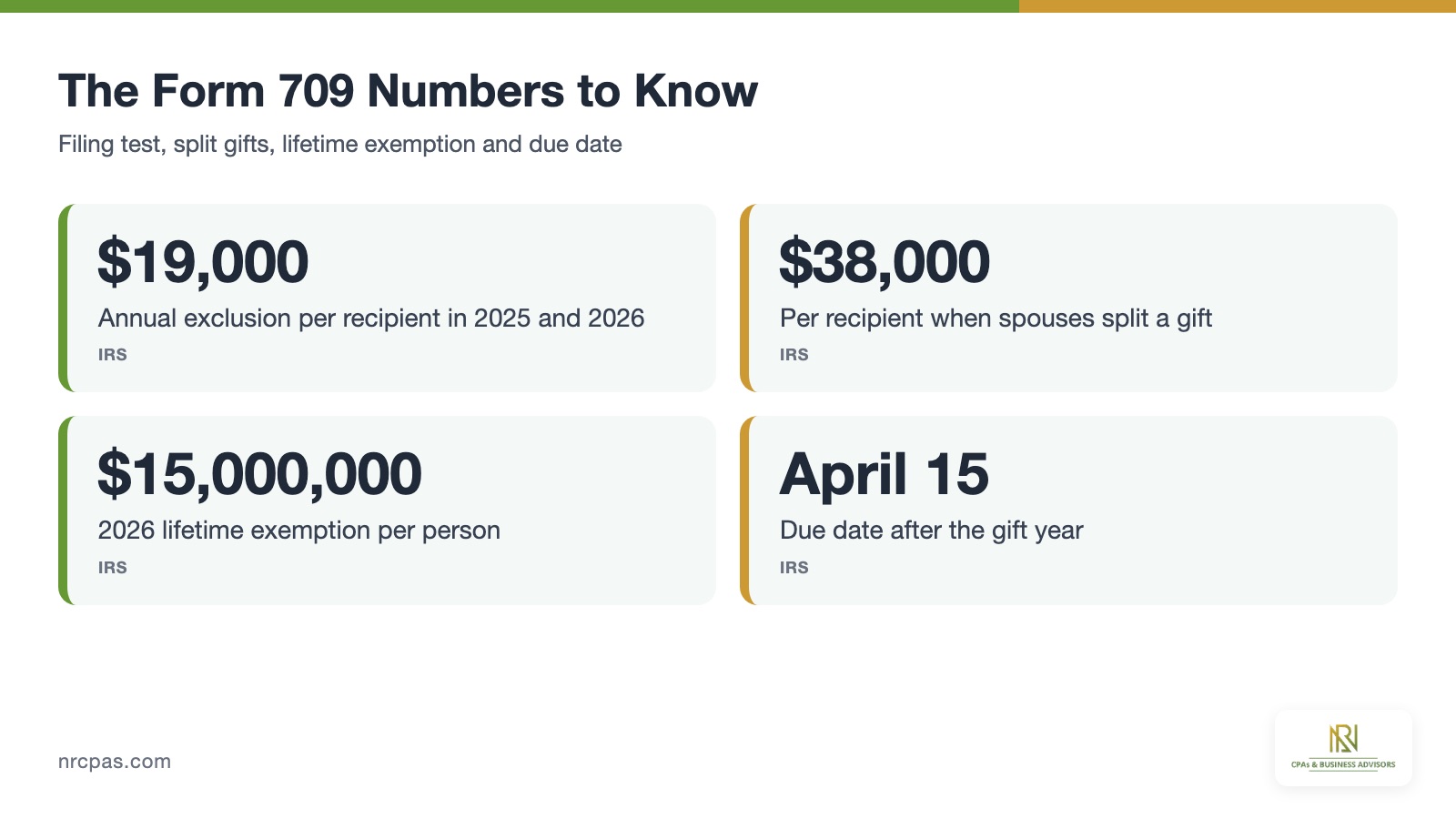
A donor must file Form 709 when gifts to one person other than a spouse exceed $19,000 in a year. The filing trigger is a gift above $19,000 to one recipient, for both 2025 and 2026. That test answers when do you have to file a gift tax return in the first place.
According to the IRS, five situations require a return, and the bullets below list them.
- Gifts above $19,000 to any one person other than a spouse.
- Gifts of a future interest, at any dollar amount.
- Gift splitting with a spouse, at any dollar amount.
- Gifts to a spouse who is not a U.S. citizen above the annual limit, $190,000 for 2025 and $194,000 for 2026.
- Contributions to a 529 plan that use the five-year election.
The graphic below sets the main Form 709 numbers side by side.
Spouses cannot file a joint gift tax return, according to the IRS. Each spouse files a separate Form 709, even when the couple splits every gift.
The spouse who agrees to split signs a Notice of Consent. According to the IRS, that consent generally cannot be signed after April 15 following the gift year. The donor carries every deadline, because donor liability rules place the duty on the giver.
A donor who needs more than the regular date next asks about extensions.
Can You Get a Gift Tax Return Due Date Extension?
Yes, you can get a gift tax return due date extension of 6 months, which moves Form 709 to October 15. The extension needs either Form 4868 for your income tax return or Form 8892 for the gift tax return. The IRS grants both automatically.
A Form 4868 or Form 2350 extension carries the gift tax return along without any separate form. That route works only when the income tax extension is actually filed. A donor who skips the income tax extension needs Form 8892 instead.
The comparison below sets the two routes next to each other.

The numbered steps below show how a donor secures the extra time.
- Decide before April 15 whether Form 709 will be complete on time.
- File Form 4868 for the income tax return, or file Form 8892 for the gift tax return alone.
- Mail Form 8892 to the IRS in Kansas City, MO 64999.
- Estimate the gift tax owed and pay it by April 15.
- File Form 709 by October 15.
A Form 8892 filed after April 15 grants no extension. A donor living in the United States gets one 6-month extension. A second form does not push the date past October 15.
Neither route moves the payment date, according to the IRS. Interest and the 0.5% per month late-payment penalty start on April 15 for any unpaid tax. Form 8892 includes a voucher, called Part III, for sending that payment.
The timeline below traces the dates for gifts made in 2026.

The payment date is its own deadline, and it follows a different test than the filing date.
When Do You Have to Pay Gift Tax?
You have to pay gift tax by April 15 following the gift year, and only when taxable gifts exceed the lifetime exemption. The payment date matches the regular filing date, even when the return is extended. The answer to when do you have to pay gift tax therefore starts with the exemption.
The lifetime exemption is the amount a donor can give away over a lifetime before tax starts. According to the IRS, the 2026 basic exclusion amount is $15,000,000. The 2025 amount was $13,990,000. The top gift tax rate is 40%.
Those limits show when does the gift tax apply. Tax applies only after cumulative taxable gifts pass the exemption, and every smaller gift just reduces the remaining balance.
A short example shows the math. A donor gives a child $119,000 in 2026. The first $19,000 is excluded, and the remaining $100,000 is a taxable gift reported on Form 709. That gift leaves $14,900,000 of exemption, so the tax owed is $0.
The return is still due April 15, 2027 in that example. The annual exclusion limits explain why the first $19,000 never reaches the return.
Gift tax paid is not an income tax deduction either, and neither is the cost of the gift itself. Gifts to individuals earn no deduction at any amount, and the rules on gift tax deductibility show which transfers do.
Each reported gift also uses up exemption, and the remaining balance shrinks with every return. A donor who plans several large gifts can schedule them through gift deadline planning before December 31. A return with $0 due still has a deadline, and missing it carries its own cost.
What Happens When You Miss the Gift Tax Return Deadline?
A missed gift tax return deadline triggers a failure-to-file penalty of 5% of the unpaid tax for each month, capped at 25%. The IRS adds a failure-to-pay penalty of 0.5% per month on tax left unpaid after April 15. When both apply, the IRS reduces the filing penalty by the payment penalty.
Both penalties can be waived for reasonable cause, according to the IRS. Penalties are measured on unpaid tax, so a return with $0 due builds no penalty. The late return still needs filing. The answer to when are gift tax returns due for a missed year is as soon as possible.
The larger cost of silence is the statute of limitations. According to the IRS, a gift must be adequately disclosed on a complete Form 709 before the limitation period starts. Without that disclosure, the IRS can revalue the gift years later.
A donor who skipped the 2025 return should file Form 709 now instead of waiting for April 15, 2027. Penalty notices from late returns can be answered through IRS penalty abatement requests. Death of the donor adds a different kind of deadline.
When Is a Gift Tax Return Due After the Donor Dies?
A gift tax return is due earlier than April 15 when the donor dies during the gift year. The executor files Form 709 by the earlier of the estate tax return due date or April 15. The estate tax return due date includes any extensions, according to the IRS.
The IRS sets the estate tax return due date at nine months after death. A 6-month extension is available. A donor who gives gifts and dies on March 1, 2026 leaves an estate return due December 1, 2026. The gift return is then due December 1, 2026, not April 15, 2027.
The same executor usually handles other estate filings, including estate return deductions such as funeral costs. Several side topics also change how and when a gift return is filed.
What Else Affects Gift Tax Filing Dates?
Can You File Form 709 Electronically?
Yes, you can file Form 709 electronically, because the IRS runs Modernized e-File for Form 709 and Form 709-NA. E-filing does not change the gift tax return filing deadline. Electronic and paper returns share the same April 15 date.
Do 529 Plan Contributions Change the Due Date?
No, 529 plan contributions do not change the due date, and the return is still due April 15. A contribution above $19,000 can be treated as made evenly over 5 years, up to $95,000, according to the IRS. The five-year election is made on the Form 709 for the contribution year.
Do Gifts of Crypto Need a Return?
Yes, crypto gifts follow the same $19,000 test as cash and stock. The 2025 Form 709 also adds a yes or no question about digital asset transfers. A donor answers that question on line 21. Owners can review digital asset gifts before transferring coins.
Is a Return Due for Gifts From Foreign Persons?
No, a recipient does not file Form 709. A U.S. person who receives over $100,000 from a nonresident alien or foreign estate files Form 3520 instead. According to the IRS, that report is separate from the gift tax return. Donors abroad can review foreign donor rules before sending money to the United States.
Does a State Gift Tax Return Have a Different Date?
Only Connecticut taxes gifts at the state level in 2026, according to the Key Wealth Institute. Donors in other states file no state gift tax return. A Connecticut donor checks the state date separately from the federal April 15 date.
Who Can Help File Form 709 on Time?
A CPA can calendar both dates, value the gift, track the running exemption total and prepare Form 709. We handle that work for families who give to children, trusts and other relatives. We also keep each donor file current each year.
The team at NR CPAs resources is led by founder Nischay Rawal, CPA, EA. Reach the office at (305) 872-3096 to review a missed or upcoming gift year.
Donors who need a deadline plan for 2026 gifts can use gift return preparation from the same team.