Does Chevy Tahoe Qualify for Section 179 and Who Qualifies for It


Yes, a Chevy Tahoe qualifies for Section 179 when the business that owns it drives it more than 50% of total miles. Published weight ratings of 7,400 to 7,600 pounds clear the 6,000-pound line, so the 2026 heavy SUV cap of $32,000 applies. According to the IRS, 100% bonus depreciation can then cover the rest of the cost.
Key Takeaways
- The Tahoe GVWR is 7,400 pounds for 2WD and 7,600 pounds for 4WD, so every trim clears 6,000 pounds.
- The 2026 Section 179 cap for a heavy SUV is $32,000, up from $31,300 for 2025.
- Bonus depreciation covers the cost above the cap, so a $75,000 Tahoe used 100% for business yields $75,000.
- Business use must exceed 50%, and the Tahoe must be placed in service by December 31.
- Owners of sole proprietorships, LLCs, partnerships and corporations qualify, while employees and lessees do not.
Does Chevy Tahoe Qualify for Section 179 and Who Qualifies for It?
A Chevy Tahoe qualifies for Section 179 as business property. Any business that owns the Tahoe and drives it more than 50% for work qualifies for it. Qualification rests on three tests: ownership, business use above 50%, and a placed-in-service date inside the tax year. The weight rating then decides the dollar cap.
According to the Internal Revenue Service (IRS), the 2026 Section 179 limit is $2,560,000, and the phase-out starts at $4,090,000 of purchases. The 2025 figures were $2,500,000 and $4,000,000. One Tahoe sits far below those totals, so the vehicle cap matters more than the annual limit.
The Section 179 requirements apply to every asset type, and vehicles add a weight test. The Tahoe passes that test easily, as the next section shows.
Is the Chevy Tahoe Over 6,000 Pounds?
The Chevy Tahoe is over 6,000 pounds on every configuration, because the Chevy Tahoe GVWR runs from 7,400 to 7,600 pounds. GVWR means gross vehicle weight rating, the maximum loaded weight the manufacturer allows. According to the Washington State Department of Enterprise Services, the 2026 Tahoe rates 7,400 pounds in 2WD and 7,600 pounds in 4WD.
Some 2026 dealer listings show 7,600 pounds for a 2WD Tahoe with the 5.3L engine. The door-jamb label settles any gap between sources. Every published Tahoe rating sits at least 1,400 pounds above the 6,000-pound line.
The table below sets the Tahoe beside the Suburban, the longer sibling, and the margin over 6,000 pounds.
| Model and drive | Published GVWR | Margin over 6,000 pounds |
|---|---|---|
| Tahoe 2WD | 7,400 pounds | 1,400 pounds |
| Tahoe 4WD | 7,600 pounds | 1,600 pounds |
| Suburban 2WD | 7,600 pounds | 1,600 pounds |
| Suburban 4WD | Read the door-jamb label | Label decides |
The graphic below plots the same ratings against the 6,000-pound line.

Trim names such as LS, LT, RST, Z71, Premier and High Country change equipment, not the weight class. Chevrolet does not publish a separate rating for every trim, so the label on the actual unit controls. Curb weight causes the most confusion, and the next question covers it.
Does Section 179 Go by GVWR or Curb Weight?
Section 179 goes by GVWR, not curb weight. According to the IRS, a heavy SUV has a GVWR above 6,000 pounds and not above 14,000 pounds. A Tahoe curb weight of 5,509 pounds does not decide the tier.
According to Edmunds, the 2026 Tahoe LS weighs 5,509 pounds empty, and the Z71 4WD weighs 5,705 pounds. Both figures sit below 6,000 pounds. The 7,400-pound GVWR adds fuel, passengers and cargo, which explains why lists show different Tahoe weights.
Where to Find GVWR on a Chevy Tahoe?
The GVWR on a Chevy Tahoe is printed on the certification label inside the driver's door jamb. According to the National Highway Traffic Safety Administration (NHTSA), federal rules require that label on every vehicle. Photograph the label on delivery day and file it with the purchase contract.
The same label shows the build date and the vehicle identification number. An auditor reads that label, not a brochure. Once the label shows more than 6,000 pounds, the next question is the size of the cap.
What Is the 2026 Chevy Tahoe Section 179 Deduction Limit?
The 2026 Chevy Tahoe Section 179 deduction limit is $32,000, the Section 179 heavy SUV cap. According to the IRS, the cap was $31,300 for 2025. The cap applies per vehicle, and it applies on top of the annual limit of $2,560,000.
Congress capped SUVs because they carry personal appeal. The cap limits Section 179 only, and bonus depreciation can deduct the balance. Vehicles at or below 6,000 pounds face much tighter passenger-auto caps instead.
According to IRS Revenue Procedure 2026-15, the passenger-auto cap is $20,300 in year 1 with bonus depreciation and $12,300 without it. Years 2 and 3 allow $19,800 and $11,900, and later years allow $7,160. The table below compares a $75,000 vehicle in both tiers.
| Vehicle type | Weight test | Year 1 deduction |
|---|---|---|
| Chevy Tahoe or other heavy SUV | Above 6,000 pounds | $75,000 |
| Passenger SUV or sedan | 6,000 pounds or less | $20,300 |
| Pickup with a 6-foot bed | Above 6,000 pounds | $75,000 |
The Tahoe lands in the top row only because bonus depreciation fills the gap above the cap. Tax advisors build Tahoe deduction planning around that split before the purchase. The split is the answer to a common question about writing off the whole price.
Can You Write Off 100% of a Chevy Tahoe?
You can write off 100% of a Chevy Tahoe in year 1 with 100% business use. Bonus depreciation covers the cost above the cap. According to the One Big Beautiful Bill Act, 100% bonus depreciation applies to property acquired after January 19, 2025. Section 179 takes the first $32,000, and bonus depreciation takes the rest.
A $75,000 Tahoe used 100% for business shows the pattern. The numbered list below walks through the math in order.
- Start with the $75,000 purchase price and 100% business use.
- Deduct $32,000 under Section 179, the 2026 heavy SUV cap.
- Subtract the cap from the price, which leaves $43,000.
- Deduct $43,000 as 100% bonus depreciation.
- Add both amounts for a $75,000 first-year deduction.
The graphic below shows the same split of the $75,000 price.
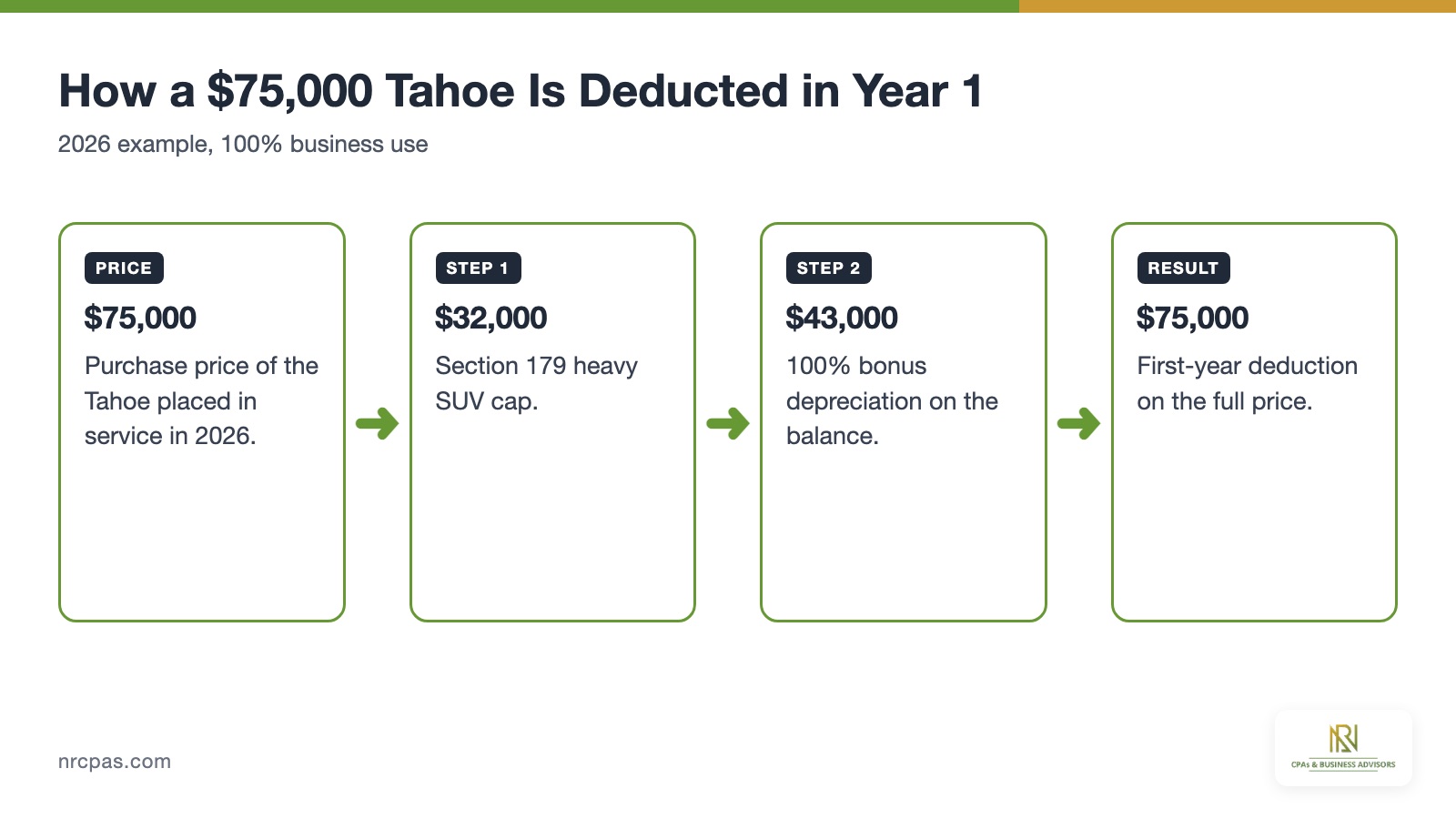
At a 24% federal bracket, a $75,000 deduction cuts federal income tax by $18,000. Business use below 100% shrinks every figure by the same share. A Tahoe used 70% for business has a $52,500 basis, a $22,400 Section 179 deduction and $30,100 of bonus depreciation.
Owners can compare outcomes with SUV bonus stacking rules. Bonus depreciation also raises a related question about which vehicles share this treatment.
What Vehicles Qualify for 100% Bonus Depreciation?
Vehicles that qualify for 100% bonus depreciation were acquired after January 19, 2025. They also have a recovery period of 20 years or less. Automobiles use a 5-year recovery period under the Modified Accelerated Cost Recovery System (MACRS). Bonus depreciation applies automatically unless the owner elects out on Form 4562.
Passenger autos at or below 6,000 pounds still face the yearly caps. The Tahoe, the Suburban, the Escalade and the Yukon all use the heavy SUV path. Business use above 50% remains the gate for all of them.
Who Qualifies for the Chevy Tahoe Section 179 Deduction?
Businesses that buy and use the Tahoe qualify for the Chevy Tahoe Section 179 deduction, whatever their legal form. The owner must hold title or a financing contract, and the business must earn taxable income. The list below shows who qualifies and who does not.
- Sole proprietors report the deduction on Form 4562 with Schedule C.
- Single-member and multi-member LLCs claim it through their tax classification.
- Partnerships and S corporations pass the deduction to owners on Schedule K-1.
- C corporations claim it on Form 1120.
- Employees do not qualify, because the business must own the vehicle.
- Lessees do not qualify, because the lessor owns the vehicle.
A financed Tahoe still qualifies, since the deduction rests on the purchase price and not on cash paid. The answer to does chevy tahoe qualify for section 179 and who qualifies for it is yes for owners. Employees and lessees do not qualify. Reviews by Section 179 advisors confirm that the business must also earn profit for Section 179 to apply. Section 179 cannot exceed taxable business income, and the excess carries forward.
Bonus depreciation has no income limit, so it can create a net operating loss. S corporation owners also need the vehicle on the company's books, so a vehicle titled personally needs a clean transfer first. Ownership alone is not enough, because business use comes next.
What Business Use Does a Chevy Tahoe Need for Section 179?
A Chevy Tahoe needs business use above 50% of total miles to qualify for Section 179. Exactly 50% fails, while 50.1% passes. The deduction is then limited to the business-use percentage of the cost.
Commuting from home to a fixed office counts as personal use. Trips to client sites, job sites and temporary work locations count as business use. According to IRS Publication 463, adequate records show the date, destination, business purpose and miles of each trip.
Four steps set the percentage each year, and the list below puts them in order.
- Record the odometer reading on January 1 and December 31.
- Log each business trip with date, miles and purpose.
- Divide business miles by total miles for the year.
- Apply that percentage to the cost and to the cap.
According to the IRS, records stay on file for 3 years, or 6 years when more than 25% of income is omitted. Claiming Section 179 or bonus depreciation also ends the standard mileage rate for that Tahoe. Timing is the next rule to check.
When Does the Section 179 Deduction Apply to a Chevy Tahoe?
The Section 179 deduction applies to a Chevy Tahoe in the tax year the Tahoe is placed in service. Placed in service means the Tahoe is ready and available for business use, not the day of the contract. A Tahoe delivered and driven for business by December 31, 2026 counts for the 2026 return.
A late-December order that arrives in January moves the deduction to the next year. The steps below run from the label to the return, as the graphic shows.
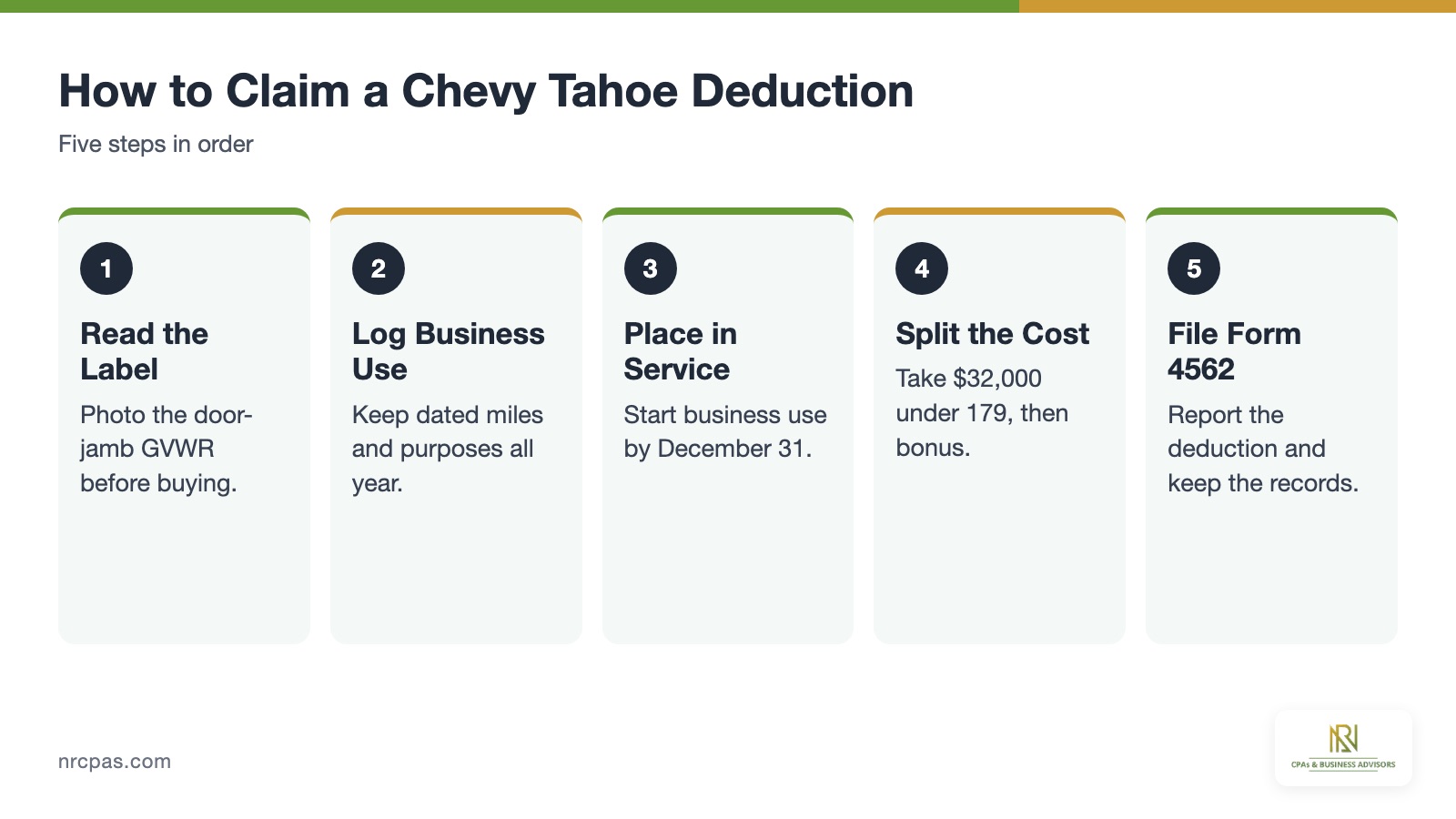
The final amounts go on Form 4562, and the Form 4562 lines show where each number sits. The mileage log backs every figure on that form. The Suburban follows the same timing, which leads to the next comparison.
Does Chevy Suburban Qualify for Section 179?
The Chevy Suburban qualifies for Section 179 on the same terms as the Tahoe, because its published GVWR is 7,600 pounds. Kelley Blue Book lists that rating on the 2026 Suburban LS, LT and RST pages. The Suburban is a heavy SUV, so the $32,000 cap and bonus depreciation apply.
Chevrolet sells the Suburban with seating for up to nine. The seating exception requires more than nine passenger seats behind the driver, so neither SUV escapes the cap. A Suburban 4WD rating was not published in the sources checked, so the door-jamb label rules there too.
The Suburban costs more than the Tahoe, so bonus depreciation carries a larger share of the deduction. A $90,000 Suburban used 100% for business takes $32,000 under Section 179 and $58,000 as bonus depreciation. Owners who prefer a pickup can read the F-150 bed exception to see how a 6-foot bed removes the cap.
What Else Should Chevy Tahoe Buyers Know About Section 179?
Chevy Tahoe buyers also weigh used purchases, leases, recapture, mileage rates and law changes. The sections below answer each topic briefly.
Which Vehicles Qualify for the 2026 Section 179 Vehicle Deduction?
The list of what vehicles qualify for the 179 vehicle deduction in 2026 covers heavy SUVs, pickups, vans and passenger autos. Each needs business use above 50%. Heavy SUVs above 6,000 pounds take the $32,000 cap, and passenger autos take the $20,300 first-year cap. Luxury models face the same test, and the BMW X5 limits show a comparable result.
Does a Used Chevy Tahoe Qualify for Section 179?
A used Chevy Tahoe qualifies when the buyer acquires it from an unrelated seller and has not used it before. The business use and GVWR tests stay the same. The used Tahoe rules add the unrelated-seller condition.
Does a Leased Chevy Tahoe Qualify for Section 179?
A leased Chevy Tahoe does not qualify for Section 179, because the lessee does not own the vehicle. The lessee deducts the business share of lease payments instead. Buying a Tahoe is the only route to the $32,000 cap.
What Happens When Tahoe Business Use Drops to 50% or Less?
Business use that drops to 50% or less triggers recapture, which returns part of the deduction to income as ordinary income. According to the IRS, the five-year MACRS recovery period sets the window. Owners reading the five-year rule learn how the recaptured amount is figured.
Is a Chevy Tahoe Tax Write Off Better Than the Mileage Rate?
A Chevy Tahoe tax write off through Section 179 replaces the standard mileage rate for that vehicle. Owners who claim depreciation track actual costs such as fuel, insurance and repairs. Heavy SUVs with a high price and high business use usually favor the depreciation route.
Is Section 179 Going Away In 2026?
Section 179 is not going away in 2026, because the One Big Beautiful Bill Act raised the limits. The 2026 limit is $2,560,000, and the heavy SUV cap is $32,000. The 2026 deduction outlook explains the yearly indexing.
What Records Do You Need for a Chevy Tahoe Deduction?
A Tahoe claim needs records that prove the weight rating, the purchase and the business use. The list below shows the core file.
- A photo of the door-jamb GVWR label.
- The bill of sale and any financing contract.
- The date the Tahoe was placed in service.
- A mileage log with dates, miles and business purpose.
- Fuel, insurance and maintenance receipts for the business share.
How Can a CPA Help With a Chevy Tahoe Purchase?
A CPA can read the GVWR label, model the cap and bonus split, and set the in-service date before year end. We run that comparison for business owners before they sign a purchase contract. Founder Nischay Rawal, CPA, EA, leads the team at NR CPAs advisory, and the office line is (305) 872-3096.
The answer to does chevy tahoe qualify for section 179 and who qualifies for it is yes. The label, the log and the date settle it. Owners comparing both deduction paths can start with SUV tax planning before year end.