Do I Have an EIN Number and How to Find It if You Lost It

Yes, you have an EIN number if the IRS ever assigned your business a nine-digit employer identification number (EIN). That number never expires and is never reissued. Sole proprietors and revocable trusts may never have needed one. A lost EIN is free to recover from old records, a bank, or one call to the IRS.
Key Takeaways
- An EIN is a nine-digit federal tax ID written XX-XXXXXXX.
- Past returns, the CP 575 notice and bank files usually show a lost EIN.
- The IRS Business and Specialty Tax Line, 800-829-4933, reads an EIN back to an authorized caller.
- Letter 147C is the written proof of an EIN that banks accept.
- A lost EIN is never a reason to apply for a second number.
Do I Have an EIN Number?
You have an EIN number when the IRS issued one to your business, estate, trust or nonprofit. An EIN is a nine-digit federal tax ID written XX-XXXXXXX. The IRS uses the EIN to identify a taxpayer, much as a Social Security number identifies a person.
Owners who type "do i have an ein number" into a search box usually hold one already. According to the SBA Office of Advocacy, the United States has 36.2 million small businesses. Each small business that hires staff or files as a partnership or corporation needs an EIN, according to the IRS.
A business that never applied can start with formation specialists, who handle the EIN request alongside the state filing. A business that did apply has an EIN on file, and the records below show where the number sits.
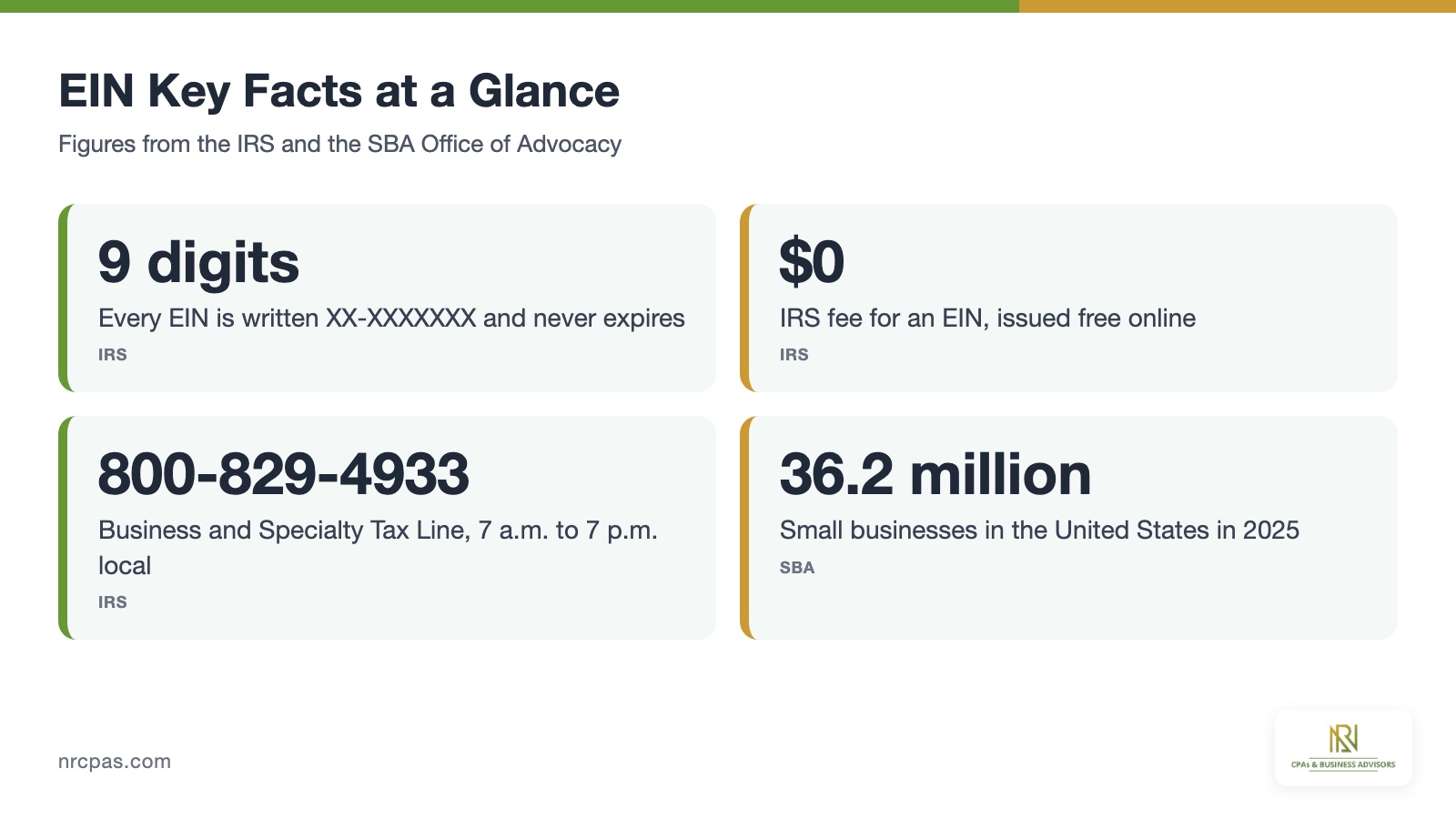
The graphic below shows the key numbers behind an EIN, each one from the IRS or the SBA Office of Advocacy.
Where Can You Find Your EIN Number Yourself?
You can find your EIN number yourself in six places, listed below from the most direct source to the least direct source.
- The IRS confirmation notice, called CP 575, mailed when the EIN was assigned.
- Past federal returns, where the EIN prints near the top of Form 1120, Form 1065 and Schedule C.
- Bank account opening papers and loan files.
- State and local license or permit applications.
- Payroll records, because the employer EIN sits in Box b of Form W-2.
- Notices the IRS mailed about the business account.
The IRS tells online applicants to print the confirmation letter at the end of the session. That printed letter is the first file to search. The table below shows what each record looks like and where the EIN prints.
| Record | Where the EIN prints | Who holds the record |
|---|---|---|
| CP 575 notice | Top right of the notice | The owner |
| Form 1120, 1065 or Schedule C | Employer identification number box near the top | The owner and the tax preparer |
| Form W-2 | Box b, employer identification number | Payroll provider |
| Bank account file | Business account application | The bank |
| License application | Tax ID field | State or city agency |
Banks keep the EIN in the account file, and the same number sits on past card applications. Every record in the table comes from the business itself. A missing record sends the search to the IRS.
How Do You Find Your EIN Number With the IRS?
You find your EIN number with the IRS by calling the Business and Specialty Tax Line at 800-829-4933. The line is open Monday through Friday, 7 a.m. to 7 p.m. local time, according to the IRS. The call takes five steps, shown in the graphic below.
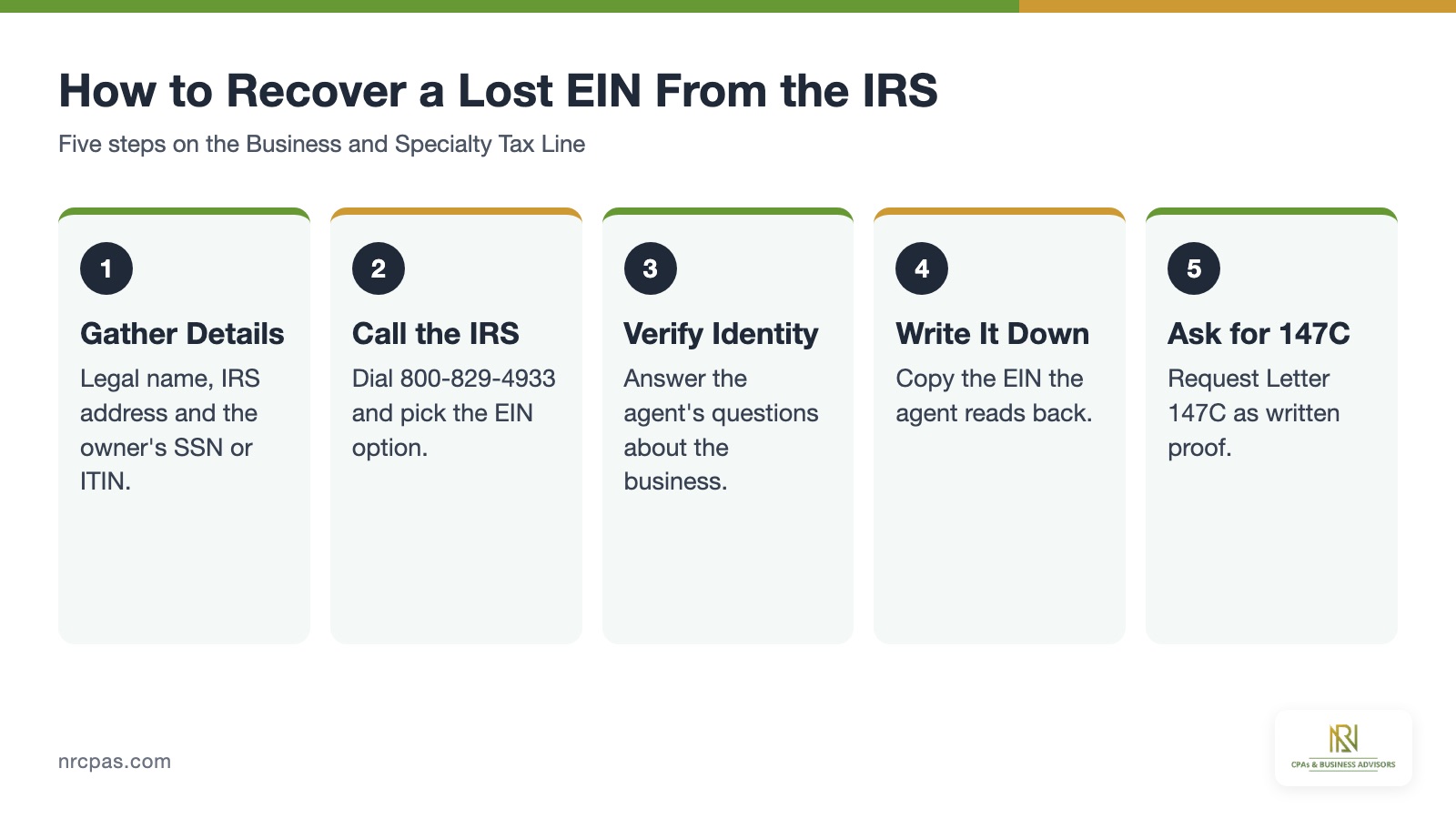
- Gather the exact legal name, the mailing address on file with the IRS and the responsible party's Social Security number or ITIN.
- Call 800-829-4933 and choose the option for employer identification numbers.
- Answer the identity questions the IRS agent asks about the business.
- Write down the EIN the agent reads back, digit by digit.
- Ask for Letter 147C, EIN Previously Assigned, to get written proof.
Letter 147C is the IRS letter that confirms an EIN in writing. Banks and state agencies accept the letter as proof of the number. The IRS does not mail Letter 147C when the EIN was assigned in the last 30 days.
Callers outside the United States use 267-941-1099, which is not toll-free. That line runs Monday through Friday, 6 a.m. to 11 p.m. Eastern time. Owners who also hold an IRS letter about unpaid tax can get IRS notice help while the EIN is being confirmed.
Who Can Ask the IRS for an EIN Number?
Only the owner, an officer or another authorized person can ask the IRS for an EIN number. The IRS releases an EIN only to a person tied to the entity. The list below shows who qualifies for each entity type.
- Sole proprietorship: the owner.
- Corporation: a principal officer, such as the president.
- Partnership: a general partner or another authorized member.
- Trust or estate: the trustee, executor or administrator.
A CPA or enrolled agent (EA) can ask for the number with a signed Form 2848, Power of Attorney. The IRS must process Form 2848 before the representative calls. Callers also need current details on file, and old details cause the next problem.
What If Your Business Details Changed Since the EIN Was Issued?
Changed business details can stop the IRS from finding your EIN, so update the file before you call. According to the IRS, a new mailing address or a new responsible party is reported on Form 8822-B. A responsible party change is due within 60 days.
A new business name does not create a new EIN, according to the IRS. A corporation reports the name change on its return, and a sole proprietor writes a signed letter to the IRS. The IRS then matches the name on the account to the name you give on the phone.
A name change keeps the number, while a change in structure may not. That difference leads to the question of a new EIN number.
Can You Get a New EIN Number?
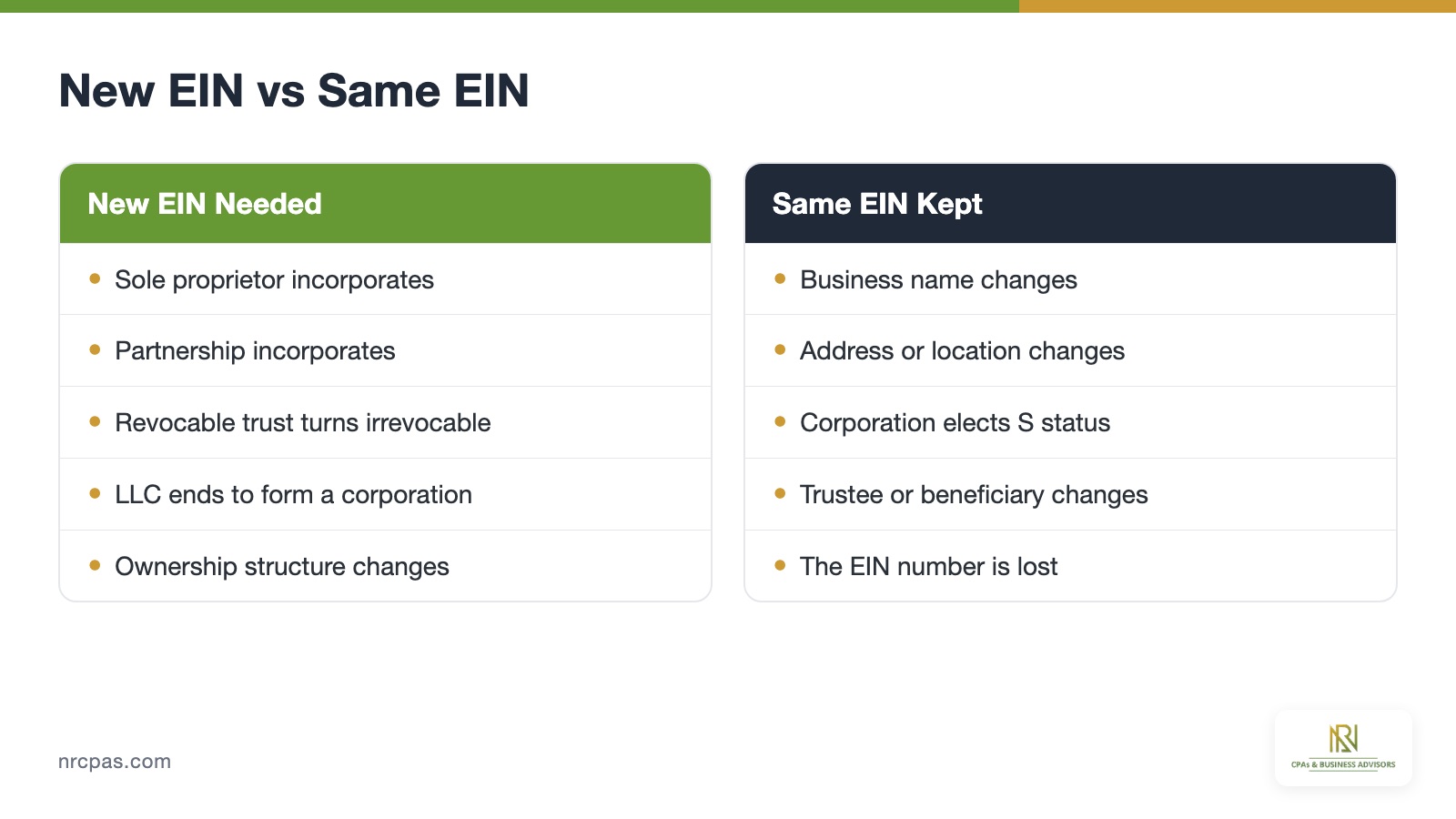
You can get a new EIN number only when the business changes ownership or structure. A lost EIN is never a reason for a second EIN, because the IRS advises one EIN for each entity. A name or address change keeps the same number.
The table below lists when each entity needs a new number, based on the IRS rules for each entity type.
| Entity | New EIN needed | Same EIN kept |
|---|---|---|
| Sole proprietor | Incorporates, forms a partnership or files bankruptcy | Name change or new location |
| Corporation | New state charter or becomes a subsidiary | Name change or S corporation election |
| Partnership | Incorporates or ends to start a new partnership | Name change or new location |
| LLC | Ends to form a new corporation or partnership | Name change or tax election change |
| Trust | Revocable trust becomes irrevocable | New trustee or beneficiary address |
The table shows that structure drives each new number. Owners who form a company can read how EIN for LLCs works at formation. The graphic below compares both outcomes side by side.
Owners with more than one company often ask about a shared number, and the answer follows the entity lines in the table. The rules for multiple businesses depend on whether each company is a separate entity. Other EIN questions about entity types follow.
What Other EIN Questions Do Owners Ask?
Owners ask about need, cost, trusts, nonprofits, entity numbers and tax filing once the EIN is found. The short answers below cover each topic.
Do I Need an EIN Number for My Business?
You need an EIN number for your business when it hires employees, operates as a corporation or partnership, or pays excise taxes. A sole proprietor with no employees may use a Social Security number instead. According to the IRS, an EIN is also needed to change business structure or administer a trust or estate.
Many sole proprietors still apply, because an EIN keeps a Social Security number off client forms. Founders who plan to hire can work with new founder support to time the application. Entity choice then decides how the business gets taxed.
Do You Have to Pay for an EIN Number?
No, you do not have to pay for an EIN number. The IRS issues an EIN for free, and its own website says you never have to pay a fee. Third-party sites that charge a fee file the same form.
The IRS online tool runs Monday through Friday from 6 a.m. to 1 a.m. Eastern time. Each responsible party can apply for 1 EIN per day, and the session expires after 15 minutes of inactivity. According to the IRS, a fax request returns the EIN in about 4 business days. A mailed Form SS-4 takes about 4 weeks.
Does a Trust Need an EIN Number?
A trust needs an EIN number unless it is a revocable trust owned by its grantor. A revocable trust uses the grantor's Social Security number while the grantor is alive. The trust needs its own EIN once it becomes irrevocable.
A trust with an EIN files Form 1041 when it has $600 or more of gross income, according to the IRS. Families that manage trusts and estates can use trust support to track each number. Nonprofits face a separate rule.
Does a Nonprofit Have an EIN Number?
Yes, a nonprofit has an EIN number, because every tax-exempt organization needs one, according to the IRS. The IRS says to apply only after the organization is legally formed. The EIN is requested first, and the exemption application comes later.
An EIN does not make a nonprofit tax exempt, because exemption comes from IRS recognition. A nonprofit can use nonprofit bookkeeping to keep the EIN tied to every grant and payroll record. The state issues a different number for the entity itself.
Is My Entity Number My EIN?
No, your entity number is not your EIN, because the state assigns the entity number and the IRS assigns the EIN. The entity number identifies the company on the state registry. A Florida articles of organization filing, for example, carries a state document number.
The EIN has nine digits in the XX-XXXXXXX format, so the two numbers are easy to tell apart on a document. Banks ask for both numbers, and the IRS treats only the EIN as a tax number.
Is EIN a Tax Number?
Yes, an EIN is a tax number, because the IRS uses the EIN as the federal taxpayer identification number (TIN) for entities. The broader TIN term also covers the Social Security number and the ITIN. An EIN identifies the taxpayer but does not make the taxpayer exempt. That tax role explains why the EIN sits on every business return.
Can I File Taxes With My EIN Number?
Yes, you can file taxes with your EIN number when the return belongs to a business entity. Corporations file Form 1120, and partnerships file Form 1065. The EIN goes on every federal business return and every payroll form.
A sole proprietor with an EIN reports it on Schedule C. Owners who want the EIN matched to the right deductions and filing dates can use annual tax planning each year. Tax filings are one reason to keep the EIN in a safe file.
Can a CPA Help With a Lost EIN Number?
Yes, a CPA can help with a lost EIN number by asking the IRS for the number under a signed Form 2848. A CPA can also answer "do i have an ein number" from the IRS account record. We also store each client's Letter 147C with the formation records.
The firm is led by founder Nischay Rawal, CPA, EA, and the office line is (305) 872-3096. More about the team is on the NR CPAs page. That page lists every service, and each service page explains the filings, deadlines and records that the firm handles for owners nationwide.
Owners who still need an EIN can start with business launch paperwork from the same team.