Does a Honda Pilot Qualify for Section 179 and What Can You Claim


Yes, a Honda Pilot qualifies for Section 179 when business use tops 50% of miles, but GVWR sets the deduction size. GVWR, the gross vehicle weight rating, sits on the door-jamb label, because Honda's owner's manual omits it. Above 6,000 pounds, the 2026 heavy SUV cap is $32,000. At or below 6,000 pounds, passenger-auto caps apply.
Key Takeaways
- Honda's owner's manual lists no Pilot GVWR, so the door-jamb label decides the weight tier.
- Honda's published curb weights plus payloads add up to about 5,900 to 6,100 pounds, so the Pilot sits near the line.
- Above 6,000 pounds, the 2026 heavy SUV cap is $32,000, and 100% bonus depreciation covers the rest.
- At or below 6,000 pounds, the 2026 first-year cap is $20,300 with bonus depreciation and $12,300 without it.
- Business use must exceed 50%, and the Pilot must be placed in service by December 31.
Does Honda Pilot Qualify for Section 179 and What Can You Claim?
A Honda Pilot qualifies for Section 179 as business property, and what you can claim depends on its weight tier. Honda Pilot Section 179 eligibility rests on two tests, business use above 50% and the GVWR on the label. The weight test sets the dollar cap, and the Section 179 definition covers the business-use percentage.
According to the Internal Revenue Service (IRS), the 2026 Section 179 limit is $2,560,000, and the phase-out starts at $4,090,000 of purchases. The 2025 figures were $2,500,000 and $4,000,000. Those totals sit far above one Pilot, so the vehicle caps matter more than the totals.
The vehicle caps depend on the weight rating, so early Pilot purchase planning starts with the label. The Pilot is a three-row SUV, and Honda's manual lists seating for seven or eight. The weight rating is the first number to settle.
Is the Honda Pilot Over 6,000 Pounds?
Whether the Honda Pilot is over 6,000 pounds changes by trim and drivetrain, because Honda publishes no single GVWR for the model. According to Honda's 2026 Pilot owner's manual, the GVWR appears only on the certification label in the driver's door jamb. The manual does list a gross combined weight rating of 8,444 pounds for 2WD and 10,141 pounds for AWD.
Honda's trim specifications fill part of that gap. They list Pilot curb weights from 4,313 pounds for the Sport 2WD to 4,685 pounds for the TrailSport. Published payload ratings run from 1,420 to 1,625 pounds. GVWR equals curb weight plus payload, so the sum estimates the label.
The table below adds curb weight and payload for four common trims. These sums are estimates from published ratings, not label readings.
| Trim and drivetrain | Curb weight | Payload | Estimated GVWR |
|---|---|---|---|
| Sport 2WD | 4,313 pounds | 1,625 pounds | 5,938 pounds |
| Sport AWD | 4,488 pounds | 1,580 pounds | 6,068 pounds |
| EX-L AWD | 4,497 pounds | 1,545 pounds | 6,042 pounds |
| Touring AWD | 4,625 pounds | 1,490 pounds | 6,115 pounds |
The graphic below plots the same four estimates against the 6,000-pound line.
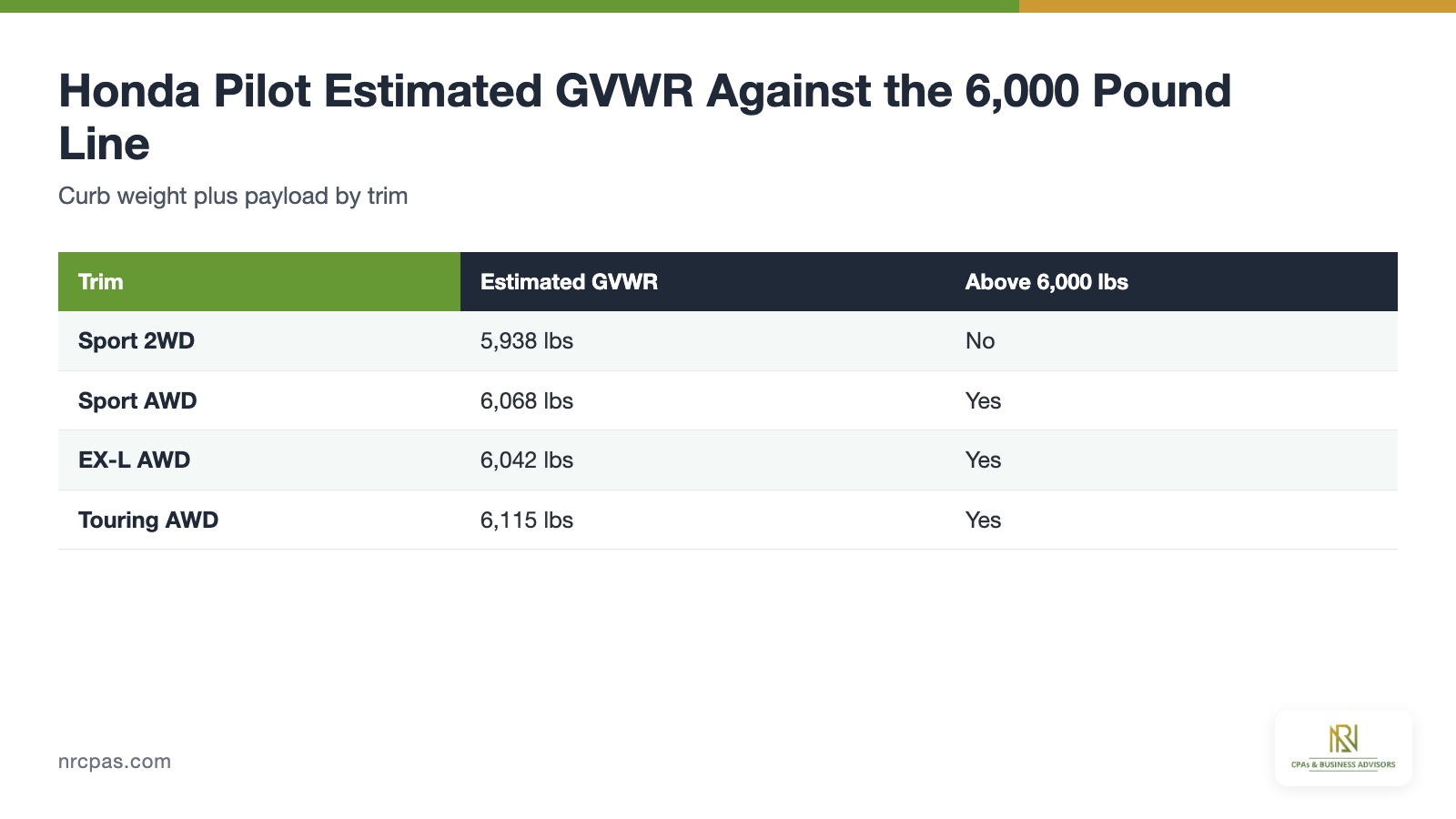
The site iSeeCars shows a 6,195 pound weight rating for the 2025 Pilot Elite AWD. Other third-party listings show lower figures, and those listings disagree with each other. The two-wheel-drive Sport lands just under the line, while the all-wheel-drive trims land just over it.
A gap of 60 to 120 pounds decides the tier, so the label outranks every estimate. The IRS also reads one specific rating, which raises a fair question about curb weight.
Does Section 179 Go by GVWR or Curb Weight?
Section 179 goes by GVWR, not curb weight and not the combined weight rating. According to the IRS, a heavy SUV has a GVWR above 6,000 pounds and not above 14,000 pounds. The Pilot's 10,141 pound combined rating is not its GVWR.
The combined rating, GCWR, caps the Pilot plus a loaded trailer. Honda rates towing at 3,500 pounds for 2WD and 5,000 pounds for AWD. Curb weight is the empty vehicle weight, and neither figure changes the tier.
Where to Find GVWR on a Honda Pilot?
The GVWR on a Honda Pilot is printed on the certification label inside the driver's door jamb. Photograph that label on delivery day and file the photo with the purchase contract. The label also shows the manufacture date and the vehicle identification number.
An auditor reads the label, not a brochure or a listing. The label number then sets which deduction table applies. The lighter tier comes first.
How Big Is the Honda Pilot Section 179 Deduction at 6,000 Pounds or Less?
The Honda Pilot Section 179 deduction at 6,000 pounds or less is limited to the Section 280F passenger-auto caps. According to Revenue Procedure 2026-15, the first-year cap is $20,300 with bonus depreciation and $12,300 without it. The cap for year 2 is $19,800, and year 3 is $11,900.
Each later year is capped at $7,160. The caps limit Section 179 and bonus depreciation combined, so a higher price does not raise year one. A vehicle rated at exactly 6,000 pounds also stays in this tier, because the rule says above 6,000.
A $52,000 Pilot used 100% for business in 2026 shows the pattern. The table below compares that purchase under both weight tiers.
| Year | At or below 6,000 pounds | Above 6,000 pounds |
|---|---|---|
| Year 1 | $20,300 | $52,000 |
| Year 2 | $19,800 | $0 |
| Year 3 | $11,900 | $0 |
| Total | $52,000 | $52,000 |
The capped path recovers the full cost over three years instead of one. The graphic below sets the two tiers side by side.

A three-year spread changes taxable income in each year, so first-year deduction planning compares both paths before the purchase. The heavier tier changes year one sharply.
How Big Is the Honda Pilot Tax Deduction Above 6,000 Pounds?
The Honda Pilot tax deduction above 6,000 pounds is a $32,000 Section 179 cap plus bonus depreciation on the remaining cost. According to the IRS, the 2026 heavy SUV cap is $32,000, up from $31,300 for 2025. Bonus depreciation can cover the full balance above the cap.
According to the One Big Beautiful Bill Act, 100% bonus depreciation applies to property acquired after January 19, 2025. A $52,000 Pilot takes $32,000 of Section 179 and $20,000 of bonus depreciation in year one. That $52,000 result sits in the right column of the table above.
The Pilot seats seven or eight, so the exemption for vehicles with more than nine passengers behind the driver does not apply. Heavy SUV caps also apply to the Toyota Sienna at about 6,170 pounds, and the Sienna comparison shows that result.
Bonus depreciation follows the same business-use percentage on any Pilot. That holds in the passenger-auto tier and in the heavy SUV tier alike. Owners comparing both tiers can read the bonus on SUVs rules for the details. Business use is the second test.
What Business Use Does a Honda Pilot Need for Section 179?
A Honda Pilot needs business use above 50% of total miles to qualify for Section 179. Exactly 50% fails, while 50.1% passes. The deduction is then limited to the business-use percentage of the cost.
An 80% business-use Pilot has a depreciable basis of 80% of its price. The passenger-auto cap shrinks by the same share, so $20,300 becomes $16,240. Four steps set the percentage each year.
- Record the odometer reading on January 1 and December 31.
- Log each business trip with the date, miles and purpose.
- Divide business miles by total miles for the year.
- Apply that percentage to the cost and to the yearly cap.
Commuting miles count as personal miles, so a daily drive to a fixed office lowers the percentage. Claiming Section 179 or bonus depreciation also ends the standard mileage rate for that Pilot. Actual expenses must be tracked from then on, and the in-service date matters just as much.
When Does the Section 179 Deduction Apply to a Honda Pilot?
The Section 179 deduction applies to a Honda Pilot in the tax year it is placed in service. Placed in service means the Pilot is ready and available for business use, not the day of the contract. A Pilot delivered and driven for business by December 31 counts for that year.
Section 179 cannot exceed the business's taxable income for the year. Bonus depreciation has no income limit, so the two work together. Any disallowed Section 179 amount carries forward to the next year.
The steps for claiming the Pilot deduction run in order, as the graphic below shows.
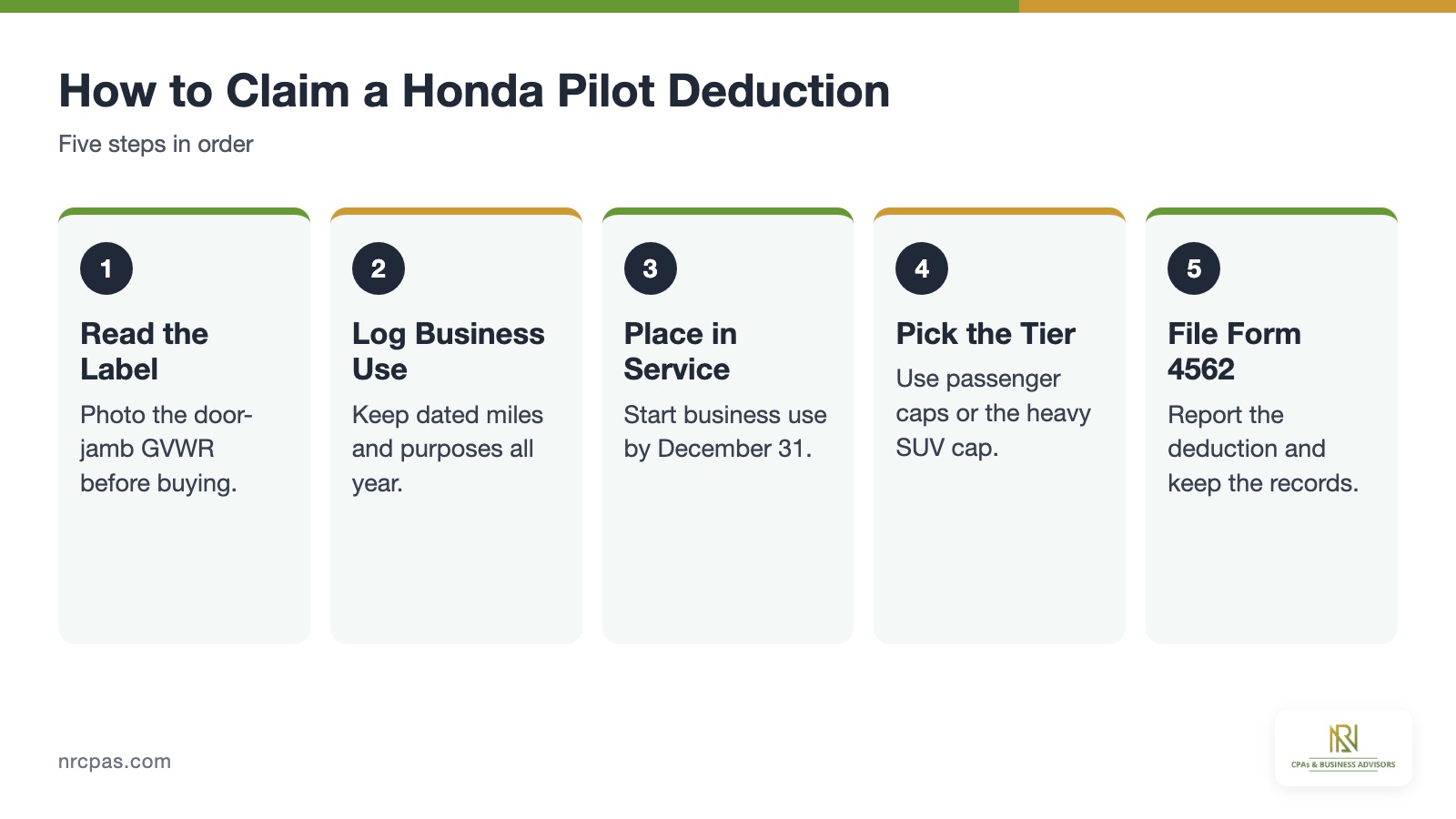
The final numbers go on Form 4562, and a Form 4562 guide shows where each line sits. The business-use log backs every figure on that form. Other Honda models raise the same weight question.
What Other Section 179 Questions Do Honda Buyers Ask?
Does Honda Odyssey Qualify for Section 179?
The Honda Odyssey qualifies for Section 179 when business use is above 50%, and its weight rating sets the cap. The site iSeeCars lists a 6,019 pound weight rating for the 2025 EX-L and Elite. That figure is just above the 6,000-pound line, so the heavy cap would apply if the label matches.
Does Honda Ridgeline Qualify for Section 179?
The Honda Ridgeline qualifies for Section 179 with business use above 50%, and the cap again follows GVWR. A Hendrick Honda 2025 specification sheet shows 2,730 kilograms, which is 6,019 pounds. According to Honda, the Ridgeline bed is 64.0 inches long, under six feet.
A pickup with a bed of at least six feet escapes the SUV cap, and the F-150 comparison shows that exception. The Ridgeline bed misses it, so the $32,000 cap applies.
Which SUVs Qualify for Section 179?
SUVs with a GVWR above 6,000 pounds qualify for the $32,000 heavy SUV cap. SUVs at or below that weight follow the passenger-auto caps. The BMW X5 is another model owners test against the line, and the X5 result lists its ratings.
What Is Not Eligible for Section 179?
Vehicles used 50% or less for business are not eligible for Section 179. Property held for investment also fails. A Pilot used mostly for commuting does not qualify.
Does Honda Pilot Qualify for Section 179 When Leased?
A leased Honda Pilot does not qualify for Section 179, because the lessee does not own the vehicle. The lessee deducts the business share of lease payments instead. Lease deductions also carry an income inclusion amount for higher-value vehicles.
How Long Do You Have to Keep a Vehicle Under Section 179?
You must keep a vehicle under Section 179 for the five-year recovery period, with business use above 50% each year. The period comes from the Modified Accelerated Cost Recovery System (MACRS). Business use that falls to 50% or less triggers recapture. The recapture risk returns part of the deduction to income as ordinary income.
Does Honda Pilot Qualify for Section 179 When Bought Used?
A used Honda Pilot qualifies when the buyer acquires it from an unrelated seller and has not used it before. According to the Bureau of Labor Statistics (BLS), used car and truck prices fell 2% in the 12 months ending January 2026. The used SUV rules add the unrelated-seller condition.
What Records Do You Need to Claim a Honda Pilot?
A Pilot claim needs records that prove the weight rating, the purchase and the business use. The list below shows the core file.
- A photo of the door-jamb GVWR label.
- The purchase contract and the bill of sale.
- The date the vehicle was placed in service.
- A mileage log with dates, miles and business purpose.
- Fuel, insurance and maintenance receipts for the business share.
Is Section 179 Going Away In 2026?
Section 179 is not going away in 2026. The One Big Beautiful Bill Act set the 2025 limit at $2,500,000, and the 2026 limit is $2,560,000. The 2026 cap changes follow inflation indexing.
How Can a CPA Help With a Honda Pilot Purchase?
A CPA can read the GVWR label, model both caps and set the in-service date before year end. We run that comparison for business owners before they sign a purchase contract. Founder Nischay Rawal, CPA, EA, leads the NR CPA practice, and the office line is (305) 872-3096. The conversation starts with the label, the business-use log and the planned in-service date.
Owners ready to compare the capped and heavy SUV paths can start with Section 179 timing.